As many of you know, it is all the rage, it is à la mode – it is the very apex of enlightened criticism! – to point out the many and myriad ways in which beloved authors of the past were so profoundly morally inferior to our scholars today. C.S. Lewis has hardly escaped this trend unscathed, and has been plagued with accusations of sexism for quite some time. In Lewis the Sexist? over at Radix Magazine, Monika Hilder of Trinity Western University sets the record straight in what I found to be a very enjoyable and edifying interview.
Over at Agape Review, a new online literary journal that publishes Christian-themed creative work, I stumbled across this lovely little poem by Jeffrey Essmann that connects the Exodus to my typical morning experience:
I have been enjoying reading some of the writings of Paul Kingsnorth recently. He is a British author of some repute and has a very interesting background. Now a Christian in the Orthodox church, he was not so long ago a radical environmentalist and practicing Wiccan. I first encountered him in an interview he did with Jonathan Pageau, who is another interesting character. Kingsnorth has written for First Things here, where he details his conversion and gives the reader a taste of his style and substance. He is a gifted writer.
Paul Kingsnorth
I have a weakness for good writing, even when I find myself disagreeing with some or much of what is written. Thus I find myself reading and returning to a broad range of writers – but this I think ends up being a good thing. I am not so rootless in my own tradition that I end up being tossed to and fro, but I love to get inside the minds of those who think differently than me, or who see the world from another vantage point. Good writers are those who can express these thoughts, ideas, and insights with the most clarity and beauty. I am the better for this exposure, and the best of those insights can always be incorporated into my own thinking.
On his Substack, The Abbey of Misrule, Kingsnorth has been exploring the role of technology in modern society in a series of reflections titled Divining the Machine. It is worth reading. I’d like to draw a link between something he explores in Part Five of the series and a theme one finds throughout the writings of C.S. Lewis and J.R.R. Tolkien: the relationship between magic and science.
First, Lewis, from his (increasingly?) prescient and relevant The Abolition of Man:
There is something which unites magic and applied science while separating both from the ‘wisdom’ of earlier ages. For the wise men of old the cardinal problem had been how to conform the soul to reality, and the solution had been knowledge, self-discipline, and virtue. For magic and applied science alike the problem is how to subdue reality to the wishes of men: the solution is a technique; and both, in the practice of this technique, are ready to do things hitherto regarded as disgusting and impious—such as digging up and mutilating the dead. If we compare the chief trumpeter of the new era (Bacon) with Marlowe’s Faustus, the similarity is striking.
First Edition of The Abolition of Man
We see a fictional representation of this dynamic in Tolkiens’ The Two Towers, where the wizard Saruman constructs an industrial hellhole – or should we say a dark Satanic Mill – in and around Isengard. The key line is placed in the mouth of Treebeard, who says of Saruman:
“He is plotting to become a Power. He has a mind of metal and wheels; and he does not care for growing things, except as far as they serve him for the moment.”
That a corrupted wizard would be the one to lead in mechanization is telling. By itself it may mean nothing, but in context of Tolkien’s other writings on the subject, and those of his friend Lewis, we see that he is making a profound point. Tolkien explains this in a letter to a friend in 1951, where he describes the almost-finished Lord of the Rings as having to do, amongst other things, with The Machine:
By the [Machine] I intend all use of external plans or devices (apparatus) instead of development of the inherent inner powers or talents — or even the use of these talents with the corrupted motive of dominating: bulldozing the real world, or coercing other wills. The Machine is our more obvious modern form though more closely related to Magic than is usually recognised. . . . The Enemy in successive forms is always ‘naturally’ concerned with sheer Domination, and so the Lord of magic and machines.
Fascinating. We do Lewis and Tolkien a great injustice when we make it seem that they were simply good writers of compelling fiction. The more one digs into their thought, the more one finds a depth of learning and reflection that informs a stunningly broad range of topics. I will now quote a somewhat lengthy section of Paul Kingsnorth’s piece (but if Rod Dreher is allowed to do it, then so am I).
The scientific worldview is leading us rapidly towards the total remaking of both humanity and non-human nature in the image of the (post) modern self. Science built the Machine. Now the Machine will rebuild the world, and us with it. As Sherrard has it:
“There is a price to be paid for fabricating around us a society which is as artificial and mechanised as our own, and this is that we can exist in it only on condition that we adapt ourselves to it. This is our punishment.“
Sherrard presents science as a modern enterprise built on a Christian rootstock that grew out of shape. He is not the only one to make this case, but as I was reading his book, another thought occurred to me; a thought that took me back to the time, not so long ago, when I used to practice magic.
When I say ‘magic’ I don’t mean fairground tricks; I mean the workings of what is sometimes called the Western Mystery Tradition, or, if we want to be spookier about it, the occult. The meaning of the word ‘occult’ is actually less sinister than it has been made to sound: occulted simply means hidden. A few years back, before I became, to my own surprise, an Orthodox Christian, I was a practicioner of Wicca, a nature religion founded by the eccentric Englishman Gerald Gardner back in the 1950s. Wicca is a form of modern ‘witchcraft’, though everyone involved will have a different explanation of what that word means. Being a modern path, Wicca is mostly undefined and eclectic. At its (usually American) extreme, you can basically make it up as you go along, which is why it has proved so appealing to millennial teenagers.
The Wicca I practiced was the more traditional variety: I was a member of a coven, whose workings and details were secret and into which you had to be initiated. The people in the coven were not dastardly devil-worshippers; they were basically good-hearted, interesting people looking for meaning in a society which offered none outside the marketplace. Wiccan covens do all sorts of things, but at the heart of the enterprise is the practice of magic: which, if you’re feeling mysterious or pretentious, you can spell magick.
There are all kinds of magick available to the practicing mage. There’s sympathetic magic, Hermetic magic, herbal magic, elemental magic, High (or ceremonial) magic, folk magic (or ‘cunning craft’), natural magic, Enochian magic (fun with secret Angelic languages) and – for the ultimate rush – Goetic magic, which involves the summoning of spirits to do your will. Faust, who did his famous deal with the devil, was practicing Goetia. At the heart of the practice is the notion that the spirits of the otherworld are ours to command. If we are knowledgeable, smart and well-trained enough, we can summon up the very forces of nature itself, and ‘bind’ them to our will.
Perhaps you can see where I’m going here. The history of magic in the West is a long one, but one thing it teaches is that what we call ‘magic’ and what we call ‘science’ are intertwined. Many of the pioneers of science we know today were also magicians of one sort or another. Bacon was said to be a Freemason and an alchemist. Isaac Newton wrote far more about alchemy than he did about physics, and many of the august founders of England’s Royal Society, still one of its foremost scientific institutions, were alchemists or mages. In the early modern period, today’s distinction between ‘science’ (real, good, objective) and ‘magic’ (fantastical, bad, superstitious) did not really exist. Both were branches of the same effort: to understand the mysterious forces of the universe, and ultimately to control them.
Here is Francis Bacon’s definition of science:
“The knowledge of causes and secret motions of things; and the enlarging of human empire, to the effecting of all things possible.”
And here is the occultist Aleister Crowley’s definition of magic:
“The science and art of causing change to occur in conformity with the will.”
These could be swapped around without anybody really noticing. The thread that links them together is control. Both the scientific enterprise, and the magical quest which it was part of, spring from the same desire: to know the world, and to bend it to our will. Will, in both cases, is the key word. When Aleister Crowley, pioneering occultist, rampant self-publicist and self-described ‘Great Beast’, created his own occult religion, Thelema, in the early 20th century, he gave it its own famous commandment: do what thou wilt shall be the whole of the law. Thelema wilted on the vine, but we could say that Crowley’s dictum lived on as the foundational basis of what our culture has become.
At this point, any scientists reading will be protesting. No, no! they might cry; that’s not what we do at all! We’re driven only by curiosity, by wonder, by a desire to understand the world! Maybe. But science, always and everywhere, is handmaiden to technology, and technology is, in this time, never innocent. Einstein bombed Hiroshima just as surely as the pilots of the Enola Gay, and he knew it.
My point is not that all magical workings, or all scientific experiments, are bad, let alone the people who carry them out. A magician might want to perform a working aimed at bringing good luck to a friend. A scientist may be searching for a cure for cancer. But the wider project of both carries hidden within it a telos: a direction of travel. It is the direction of the Machine that now envelops us, and the new world it is building.
Clearly there is a lot of overlap here and, I think, something profound we need to grasp. And given our – all of us – embeddedness in the Machine, something to grapple with personally. Are we giving ourselves over to the human desire for control? Is such control always bad? I wish that Kingsnorth dealt with the tension and distinction between the desire for control and the calling we have to exercise dominion over the natural world. I haven’t finished his series yet, so maybe I will find it addressed elsewhere.
One thing is for sure, the signals are coming increasingly loudly and clearly from every conceivable source that our relationship to technology is deeply unhealthy. We need thinkers and resources to help us navigate this with wisdom we do not yet possess. I commend to you the artful writing of Paul Kingsnorth, a voice in the wilderness, to stimulate your thinking in this important endeavor.
It was the worst heat wave of the summer and our new house had no air conditioning. The air was dense and humid. We had been wilting at home for days, trying to find excuses to head out to air conditioned stores. The slightest pretext was sufficient. “Oh it looks like someone ate our banana. Better head to the store and buy another one.” Or: “I think I’d like to go look at the bandsaws again, see if they have any new models since last Wednesday.” We’d all pile into the van, all six of us, and relish the cool air conditioned drive and the cool air conditioned store for whatever amount of time we could. Having done a number of these short-distance, brief-duration trips, we needed something more.
That is how we came upon the idea of going to that megalithic monument of the modern world, the pride of Sweden, that den of suspiciously inexpensive meatballs: IKEA.
Going to IKEA used to be a blast for families with a bunch of kids. But now their free kid daycare, Småland, is shut down indefinitely because of the pandemic. Our little Emma, now 5 years old, waited for years to be tall enough to be allowed in with her older brother and sister. She got to go just one time before the gates were shut. But has anyone thought about the serious repercussions of this policy? Where are our kids going to get their immune systems boosted by being exposed to every pathogen known to man? How now will they get to watch Kung Fu Panda 7 (by far the best of the series) standing slack-jawed and silent? When will they ever get to play in that giant pit filled with plastic balls and feel the excitement of being buried alive in them? By the time they reopen this magical land of germs and mediocre supervision, Emma will probably have children of her own! Maladjusted and melancholic children to be sure, what with a mother whose childhood was so bleak and miserable as to have only gone to Småland one time.
Yes, IKEA is a store that, more than any other, thinks intentionally about appealing to families with kids. I suspect that they may even have sat down a couple of such families and had them answer questions on a clipboard. How do I know this? Well for one thing they put complimentary diapers in the family washrooms in case you forget one or run out. Brilliant. By going there every day on my way home from work, I didn’t have to buy diapers for two years! (Just kidding – I only stopped once a week.)
Aside from the diapers, they always have little stools for the kids to use in the bathrooms so they can wash their hands for a change. Not only that, there are also specially-furnished, dimly-lit rooms for nursing mothers. Whether the mothers nurse their babies in there or just lay down for naps or play scrabble, who can know? But at least they have a room to do it in. The food is pretty affordable too. Eating out when you’re a crew of six can be a financially traumatic experience requiring months of free online therapy and DIY acupuncture. So an affordable family meal is always nice. Sure, it is more like eating at a strange cafeteria, and you often get that regret-filled indigestion first pioneered by McDonalds, but in the moment it is always a nice option to have.
Well all of that is gone, my friends. Chalk it up as another casualty of this pandemic we’ve all been stumbling through. IKEA – it’s just not the same.
To return to our ill-fated plan that very hot day, we parked the van in the closest available parking spot and stepped out into the angry blaze of the summer sun in all its fury. You know what it’s like when the humidity is 100% and the temperature is approaching the melting point of human flesh, it feels like as soon as you step out of the air conditioning someone drops a heavy wet towel on your head and points three hair dryers at you. If you have glasses, as I do, you get treated to instant fog on your lenses, adding temporary blindness to the experience. After an approximately 14-kilometer walk, we reach the front door, where we realize one of our children has forgotten their mask. That is a tough moment, when you realize you have no choice but to abandon your child to its cruel fate. Just kidding – I went back with the child and got the mask. After making that walk three times, that first blast of air conditioning on my skin was a rapturous experience, let me tell you.
But far from the joyous raucous scene that usually greets us when entering IKEA, with the little screams and squeals of children playing and chasing each other and sharing communicable diseases, we came upon a scene more reminiscent of your favorite post-apocalyptic zombie movie. This grim aura was maintained throughout our wandering, for that is what you do when you go to IKEA.
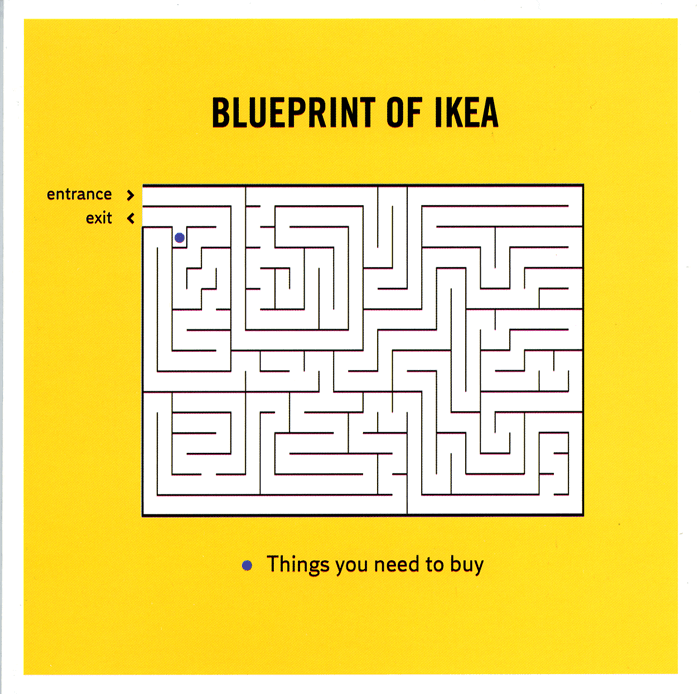
Aside from the few insiders and veterans who have memorized or learned to decipher the maps in that labyrinthian place, every poor soul who enters the front door will not be able to find the exit until they have walked a total of 17 kilometers. It is not unusual to see the older folks laying down for a nap in the bedding section or to see people with the soles of their shoes completely worn away desperately strapping pillows to their feet with hair elastics just to have a chance at reaching the exit. One time, a wide-eyed customer, weak with dehydration and leg cramps, offered me $500 and a Billy bookcase if I’d let him clamber into my cart and push him to the exit.
This is a real map.
And so we wander through the endless kitchens, living rooms, bedrooms and offices – hour upon hour, mile after mile. While the air conditioning is lovely, the fact that we have three masked children and a fussy baby catches up with us approximately 10% of the way through the maze. By the time we reach the checkout, everyone is on edge. If we don’t figure something out, this shopping trip might turn out as badly as that time we went to Target.
It seems like a good idea to get ice cream cones as we prepare to return to the inferno. My wife has the cart – yes that special IKEA cart with the four wheels that spin and is therefore about as easy to steer as an ocean liner – and I have two ice cream cones: mine and hers. Each child has one ice cream cone, with a thin napkin wrapped around the cone. You’ll see in a minute why I’m setting the scene so carefully here.
As we are about to head out the door, my daughter Emma announces that she needed to go potty. We quickly devise a plan: I will take her to the washroom while my wife and the two older kids set off for the van. This will give her a head start on starting the van and loading up our goods. What could go wrong? In fact, it does not escape my calculating mind that this will mean I have to eat a bit of my wife’s ice cream in order to keep it from dripping. Oh but if only I had known.
After Emma is done in the washroom, we step through the exterior doors, are hit by a furnace blast, and set out at a good clip towards the van. Approximately ten seconds after leaving the cool air, I feel what seems like a raindrop on my hand. I glance up but the sky is clear and blue and the sun is blazing. I glance down and see to my shock and dismay that rivulets of ice cream are pouring down over the cone and onto my hands. Even considering the heat, this is not normal ice cream behavior. It dawns on me in that instant that this is not actually ice cream — it is ice cream’s ugly step-brother frozen yogurt, which apparently can’t keep itself together nearly as well when the heat is on. With a cone in each hand, I start frantically licking the drips to try and avert a complete meltdown. I glance over at Emma and notice that her hand is covered in white rivers of frozen yogurt as drops freely fall to the pavement.
“Emma! Lick your ice cream!”
But she’s useless. I mean, I love her, but she’s useless. She makes every rookie mistake in the book: she licks one side while the other drips, or she licks the very top but the part below that, just above the cone, is collapsing and flowing right down over her hand. By this point the drips are coming so fast from her cone that an uninterrupted stream of frozen yogurt threatens to connect her cone to the pavement like a tornado about to touch down. Unable to watch this train wreck any longer, I hand her one of my cones and grab hers to give it a proper cleanup.
With all of this drama, I’ve lost track of my position in the parking lot, which is roughly the size of Rhode Island. I look around, trying to find my bearings. Suddenly I see in the distance a silver colored van like ours with the back open. It might be ours, or it might not be – how can I tell? If Emma and I walk all the way there and we end up being wrong, we could be lost for days. That is when – like the captain of a lost ship sighting the beacon of a lighthouse or the pilot of a stalled airplane spotting the bright runway lights below – I notice on the pavement two clear lines of wet liquid going from our very position to that silver van: the frozen yogurt road of hope. I feel a wave of relief wash over me: we’re going to make it.
A few minutes later, with everyone safely in the van and the air conditioning turned to ultra maximum, we pass out baby wipes for everyone to start wiping down their hands and forearms and elbows and legs. We all solemnly agree on three things:
1. We’ll wait for the pandemic to be over before making another family trip to IKEA.
In the first post on the topic of chronological snobbery we looked at what C.S. Lewis meant by the phrase and we considered two reasons for its particular prevalence in our own day. In this post I would like to explore related ideas from a thinker that has been helpful to me: René Girard.
Girard was a profound and original thinker whose work ranges over many disciplines. I am familiar with only a few small slices of that work, but some of those slices have been eye-opening. Consider his reflections on the words of Jesus in Matthew 23:29-30.
“Woe to you, scribes and Pharisees, hypocrites! For you build the tombs of the prophets and decorate the monuments of the righteous,saying, ‘If we had lived in the days of our fathers, we would not have taken part with them in shedding the blood of the prophets.’
Girard focuses in on the attitude of the scribes and Pharisees as they built tombs and monuments for prophets who were harassed, persecuted, and killed by their forefathers: “If we had lived in the days of our fathers, we would not have taken part with them in shedding the blood of the prophets.” He considers this as a kind of spirit, an attitude of the heart that any of us can adopt.
In the context of his broader theory of mimetic desire and the scapegoating mechanism, he describes this impulse as a mob of the living scapegoating the dead. For our purposes, we can simply say it is the attitude whereby one generation or group condemns those who came before them, exonerating themselves.
Girard points out one historical example of this in the phenomenon of Christian anti-Semitism, the kind that blames the Jews for killing Jesus. It says “if we, who are the spiritual children of Abraham, had been there when Jesus was crucified, we would not have joined the actual children of Abraham in condemning and killing Jesus. We are better than them. We alone would have resisted the mob. We would have stood by him when all had deserted him. We would have been willing to be killed with him rather than deny him.”
When one lays out what such an attitude really claims, as I did above, it starts to be seen for what it is. But usually the claim to superiority is not parsed and exposed for what it is. A claim like that is really more about the person making it than about the people he or she is supposedly superior to. At bottom, such statements are saying something like: “If everyone was as innocent as I am the world would be better. Therefore they must not be innocent like me, because someone has to be responsible for all this mess.”
Ask any high school class if they think they would have stood up against the Nazis if they had lived in Germany leading up to and during WW2. Most will say they would have resisted, which is to claim that if Germany had been populated with 21st-century North American teenagers instead of Weimar-era Germans, Hitler would not have done what he did. More pointedly, it is to claim that each of those students raising their hands, students who allow their wardrobes, attitudes, mannerisms, and vocabulary to be dictated by the passing fads and peer pressures of their social peers, yes these paragons of strict moral virtue, would have had the backbone to stand against what was an immense amount of social pressure and very real threats to their reputations, social standing, finances, and very lives.
In Romans 2:1, the apostle Paul writes “Therefore you have no excuse, O man, every one of you who judges. For in passing judgment on another you condemn yourself, because you, the judge, practice the very same things.” We live in a time when forces all around us seem to be working hard to whip up offense, outrage, and judgment towards the other. But not all judgment is the same. Some judgment is warranted and needed, but a lot of it is spiritually dangerous.
What do I mean by spiritually dangerous? Well, I mean that it is dependent on sin and it fosters sin. To judge others for what I am guilty of is to reinforce my own blindness to that sin, thereby distancing myself further from the truth about myself that might lead me to repentance and freedom. It is much harder to admit to a sin that I have clearly – and perhaps publicly – judged another for. I am less able to see it in myself when I get a kick out of pointing it out in others.
So this leaves the one judging further from the grace of humility, further from the grace of gospel sanity, further from the grace of honesty about my sin. These are graces that flow from Christ and to Christ.
When one takes this principle and applies it, what happens? It becomes very difficult to stand in judgment over our historical predecessors, because we now see that to do so is to fall into a very dangerous spiritual trap. It is the trap of saying that we are better and we would not have done what they did.
But does this rule out any and all criticism of the past? Quite the opposite: It allows for the kind of criticism that is good for us, rather than a danger. When I recognize that in the garden of my own soul grows the same root that in others bore such heinous fruit, it motivates me to weed it out. When I recognize that there is more than a little family resemblance between their sin and my own – if not in the fruit, then in the root – this encourages humility.
Indeed the effect is precisely the opposite of what self-righteous criticism produces, namely a deepening blindness with regard to my own expressions of whatever fault I am pointing out in others married to a swelling pride at being found so much superior.
The best writers of history intuitively (or perhaps intentionally) treat their subjects with this kind of moral sensitivity. They do not fall into moral relativism, which may be an enjoyable intellectual hobby for rich and comfortable Westerners, but is insufferable in the face of actual evil. Neither do they unleash a full one-dimensional moral tirade against historical villains, painting them as uniformly evil characters. Rather they preserve the humanity of both heroes and villains, allowing for nuance and being honest about the shortcomings of the heroes as well as the positive qualities of the villains, all while writing with a sense of moral clarity. This kind of history proves informative and beneficial to the reader. It is humbling, sobering, inspiring.
Moving from history to the contemporary, we can apply this idea to so many current cultural issues. For example, I see a lot of folks these days eager to tear down statues of people who, terribly flawed and implicated in evil as they may have been, are nevertheless in many ways their betters. Leaving aside the specific arguments for or against any particular monument, or even for the taking down of statues in general, I just want to point out that this kind of fury, this kind of one-dimensional judgment of those in the past, is spiritually dangerous for all the reasons described above.
To take an example from the opposite side of the culture wars, we have the phenomenon of so many conservative religious leaders who were so thundering in their denouncing of sexual immorality being revealed to be sexually immoral themselves. Zacharias, Falwell, Hybels, and the list goes on and on. We all know such failures do not happen overnight. So we have someone publicly denouncing a sin in others that they are not just struggling against but positively nurturing in their own hearts.
This can happen on the political left as much as on the right, both inside and outside the church. But from my perspective, which is admittedly conservative, it does seem to be a particularly fashionable attitude among progressives on the left these days. If you think I’m wrong about that, let me know why in the comments.
There is lots to love about this book. A great title, a great first line, and moments of brilliance throughout. The story moves at a fine clip and carries the reader along to an exciting finish. My kids read this book as part of their schooling and they adored it, so I wanted to read it also. I can see why they were taken with it! It certainly leaves the reader wondering what will happen next at each chapters’ end. And while I enjoyed reading this book, I wanted to enjoy it more. There were a few hindrances and shortcomings that impeded that enjoyment. As a debut novel, I say bravo and well done! If I were to write a first novel this good, I’d be a happy man indeed. And so I offer some thoughts – in a spirit of constructive criticism – on what kept this book from being, to my mind, on par with the classics.
First, while the breadth and playfulness of a fertile imagination is on display throughout the book, there is a certain lack of cohesion and gravitational center to that imagination. The worlds, characters, landscapes, buildings, and monsters are all fantastical and creative, but it felt like there was something lacking that would draw them all into a narrative that fit together well. This unpredictability can give the reader a kind of whiplash as she tries to keep pace with the story. A few unexpected twists and turns makes a story interesting; but constant unexpected turns undermines the stability of the narrative and gives it a chaotic feel.
Second, and related to the first point, is the issue of world-building. This is the bread and butter of all fantasy-fiction. The author must build a world that is believable. But believable does not mean it must conform to our world. As Tolkien said, the key is that world must be internally consistent – what happens there must make sense within the framework of that world. This is the secret ingredient that explains why some fantasy worlds feel real, like Middle-Earth, Narnia, and Aerwiar, and others don’t. The author here shows real promise in the world that he creates, and yet fails to fully convince the reader that this place is so real in his own mind that all this could really take place.
Third and last, stories are irreducibly moral. The best stories are deeply moral, for it is the moral instinct in myself as a reader that makes me care deeply about the characters. On this point, once again, the author does a good job with some characters but does not quite pull off a complete victory. We see some development in Peter Nimble, but not a whole lot. His moral character remains quite static, while his self-understanding grows as he discovers his true identity and steps into the role he has been destined for. Sir Tode seems to me to be more promising, for we find out he is largely a fraud and has not truly earned his knighthood. Yet this assumed persona of a brave knight seems to draw out his courage and moral fibre and self-sacrifice. By the end of the book, despite the dubious origins of his knighthood, he has grown into the true picture of knighthood. This seems to exemplify something that C.S. Lewis pointed out: when growing in virtue, we often start by behaving as if we were more virtuous than we really are, which can feel like a kind of pretending or false persona. But if persevered in, this is often the route by which we do really become virtuous.
The best stories have a moral depth that speaks deeply to the reader about right, wrong, goodness and evil. While the book had a pretty clear moral compass (unlike the nihilistic morally-relativistic nonsense that sometimes gets passed off as modern fiction these days), it would have been improved, and would leave a deeper impression on the reader, if the characters’ moral trajectory had been explored more deeply.
All in all, a very fine book. I look forward to reading some more of Auxier’s fiction and seeing how he has grown as an author over the years.
This is part 1 of 2. Click here to skip ahead to part 2, or see the link at the bottom.
It was Owen Barfield who induced a young C.S. Lewis to abandon what he called ‘chronological snobbery.’ I like the term, but its meaning is not immediately clear. Is this what Lewis is referring to when he exhorts us to read old books as a corrective to the errors of the day (most famously argued in his essay “On the Reading of Old Books”)?
But no – it cannot mean simply reading old books since Lewis was already reading old books even at an early age (he loved classical poetry), well before meeting Barfield and having his chronological snobbery apparently cured. So what is it, then?
In this post I’d like to explore these ideas a little bit. Let’s start with what Lewis writes about it:
In Surprised by Joy, he defines chronological snobbery as
“the uncritical acceptance of the intellectual climate common to our own age and the assumption that whatever has gone out of date is on that account discredited. You must find why it went out of date. Was it ever refuted (and if so by whom, where, and how conclusively) or did it merely die away as fashions do? If the latter, this tells us nothing about its truth or falsehood. From seeing this, one passes to the realization that our own age is also “a period,” and certainly has, like all periods, its own characteristic illusions. They are likeliest to lurk in those widespread assumptions which are so ingrained in the age that no one dares to attack or feels it necessary to defend them.”
There is overlap here with his famous quote from the essay mentioned above on reading old books:
“Every age has its own outlook. It is specially good at seeing certain truths and specially liable to make certain mistakes. We all, therefore, need the books that will correct the characteristic mistakes of our own period. And that means the old books. … Not, of course, that there is any magic about the past. People were no cleverer then than they are now; they made as many mistakes as we. But not the same mistakes. Two heads are better than one, not because either is infallible, but because they are unlikely to go wrong in the same direction. To be sure, the books of the future would be just as good a corrective as the books of the past, but unfortunately we cannot get at them.“
Reading old books is part of the solution, but the assumption of “newer is better” goes deeper, and it will likely take something more than mere exposure to old ideas to cure you of it. The fact that today we have many university humanities departments devoted to exposing the ‘hetero-normative patriarchal misogyny’ of Shakespeare and Dante and Milton makes that clear enough. They are reading the material, but with such a distorted lens that it renders no benefit, like eating a hearty stew but straining out everything except the onions.
This snobbery, like all snobberies, is subtle and mostly invisible to the one infected with it. It is something that one detects in others but never in oneself. Think about how often you have heard “what a snob!” said, and how not once was the person saying it talking about themselves. We accuse ourselves of many things, but snobbery doesn’t tend to be one of them.
I’m cultured, not a snob, you silly peasant.
The attitude, to the degree that one is conscious of it, seems entirely justified by the facts of the case. “After all, I have very good reasons for feeling this way!” So we are dealing with something that must be exposed before it can be dealt with.
I take it as a matter of fact that this attitude is widespread today. And my hunch is that the less historically informed our society becomes, the more this default assumption about the superiority of our fashionable ideas – this snobbery – will spread. I can see two other reasons for its prevalence.
First, there is this myth of progress. Generally speaking, the field of engineering is more advanced now than 400 years ago. The same is true for medicine, physics, and chemistry. These are the hard sciences where a wrong theory pretty quickly slams into the solid wall of objective reality, or better, the world as God made it. Since the delay between theory and result is brief, misguided ideas tend to reveal themselves as dead ends before getting too far, and more importantly, before the theorizers get too attached to the ideas.
But it really is another story when we are talking about fields such as sociology, anthropology, morality, or ethics. The myth of progress is the assumption that steady progress has been taking place in these fields similar to the progress that we can all see happening when we look out the window at the high-speed trains, jet-liners, and orbiting satellites. In this mode of thinking, the latest idea is, by virtue of its novelty, the best idea.
The problem is that the delay between theory and result in these other fields is much longer. By the time the fruit of misbegotten ideas becomes undeniable, not only can there be a huge human cost, but sometimes the entire field of study has become institutionally committed to the bad idea and cannot abandon it despite the growing evidence for its failure.
Second, it is basic human nature to desire to feel superior to others. Simply put: chronological snobbery allows me to feel superior to an awful lot of people – and most of them are not around to call me out on it. It is therefore a satisfying attitude to adopt.
To return to a point in the second quote above, every age – our own included – has its characteristic virtues and its prevalent vices. Future ages, or contemporary observers from outside the culture in question, are able to see and denounce what we cannot. And so we rightly reject the cruel tortures of the medieval world, the inexcusable infanticide of the Romans, and the perverted pedophilia of the ancient Greeks. But if we are not careful, we will miss their virtues and miss the chance to see and address some of our own vices.
In the next post, I’d like to reflect on some related insights I’ve gleaned from René Girard.
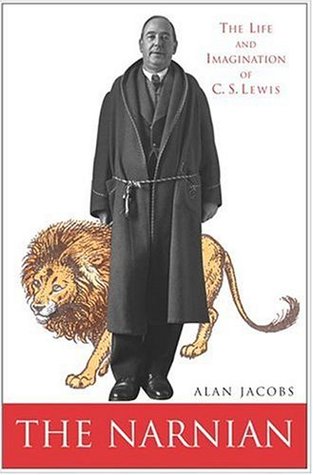
To demonstrate the unique charm of this CS Lewis biography by Alan Jacobs, I’ll have to throw you right into the deep end. Try to follow me here: When Lewis encountered a modern literary scholar who, commenting on an older critic’s assertion that the theme of Milton’s Paradise Lost was simply that ‘Obedience to the will of God makes men happy and disobedience makes men miserable,’ called it ‘vague’, Lewis wrote the following: “Dull if you will. Or platitudinous. Or harsh, or jejune, but how vague? Has it not rather the desolating clarity and concreteness of certain classic utterances we remember from the morning of our own lives? ‘Bend over; go to bed; write out ‘I must do as I am told’ a hundred times. Do not speak with your mouth full.’ How are we to account for the fact that great modern scholars have missed what is so dazzlingly simple? It is after all the commonest of themes. Even Peter Rabbit came to grief because he would go into Mr. MacGregor’s garden.”
While any biographer can dig up that great quote, only a biographer with a strong literary mind and a clever pen can make the following comment: “This is as delightful as it is wise. Any literary critic who can, in the course of a few sentences, take us from the great Milton’s account of the fall of humanity in twelve books of stately and heroic blank verse, to Beatrix Potter’s rather humbler account of Peter Rabbit’s rather humbler troubles, is a critic of – to put it midlly – considerable range.”
And so you see why, of all the commendable biographies of CS Lewis that I could read, I chose to start with Alan Jacobs’. Being familiar with some other books by Alan Jacobs (Original Sin, The Year of our Lord 1943), as well as his essays at First Things (chiefly on W.H. Auden) and elsewhere, I trusted him to do justice to not only the biographical details of Lewis’s life but the contours of his thought and the substance of his writing. I was not disappointed. One reviewer calls Jacobs’ writing ‘thick and circuitous,’ and I think that an apt description of his writing everywhere I’ve encountered it. I find it wonderful. Perhaps it is not to everyone’s liking, but I would rank him as one of the best prose writers of our day.
I have long been fascinated by CS Lewis. And while I am pretty familiar with many of his books and recurring themes, I have never read a full biography until now. I enjoyed learning about the breadth of his life: from the tragedy and loneliness of his childhood, to his adolescent arrogance, atheism and budding brilliance, to the horrors of the Great War trenches and corpses, to the strange and scandalous living arrangement he entered into after the war, to his conversion and the central place that myth and story occupied in it, to his most productive years where he churned out book after book, to his surprising but brief marriage, declining health, and death. Jacobs serves as a more-than-able guide through all these seasons of his life. While Jacobs does not hide his affinity and appreciation for Lewis, neither does he gloss over the unsavory aspects of his life, letters, and character.
Some readers expecting a deep dive into the actual writing of the Narnia Chronicles may be disappointed. For that particular itch perhaps Michael Ward’s Planet Narnia would be more suitable, although it is even more dense and scholarly than this volume.
I gladly recommend it to those looking for a good CS Lewis biography that will acquaint them with not only the arc of his life but also with the singular imagination and intellect of this towering 20th-century figure.
This is a big book tackling some big ideas. The author aims at nothing short of a paradigm shift in the reader, who is assumed to be a modern 21st-century Christian. In this goal, I think Heiser is largely successful. The book, despite some issues, is a serious contribution to any thinking Christian’s worldview.
When I was in Bible College, one of the paradigm shifts I had was as a result of missiology courses. It was in studying different cultures that I gained some perspective on my own; it was in realizing that developing-world cultures had thoroughly supernatural worldviews that I understood how thoroughly secular my own worldview was. This book continued that process and shored it up with serious scholarship and Biblical evidence. The fact is that modern western Christians have absorbed the naturalistic cosmology of the surrounding culture. This book seeks to awaken the believer to the Bible’s thoroughly supernatural worldview.
In order to do that, the author takes the reader on a journey from one end of the Bible’s storyline to the other, developing the concepts of the divine council (see Psalm 82 for a start) and all its entailments. In this regard, I found the first half of the book, focusing on the OT, to contain the bulk of the insights. There were some good chapters in the NT sections but in general they were less compelling and convincing. At times Heiser proposes significant departures from mainstream scholarship in translation and interpretation concerning key verses. I will have to do some further study and reading on such matters before buying into them – Heiser is clearly ‘all-in’ on this paradigm and sees evidence for it everywhere, even when such evidence is a bit of a stretch.
In terms of criticisms I have of the book, there are a couple. First, in chapter 7 Heiser awkwardly inserts his understanding of free will as somehow necessary for the Bible’s storyline to make sense. It felt forced. Full disclosure: I am comfortably Reformed in my soteriology and I take the Bible to present both absolute divine sovereignty and mankind’s moral responsibility in a kind of tension best represented by compatibilism. So I shrugged and moved on.
Second, in my recent reading of Craig Carter’s work, I have become sensitized to the danger of reading and interpreting Scripture from outside an ecclesiastical tradition. This is a modern evangelical temptation, and it leads to the re-emergence of historic distortions and heresies. I saw this at work somewhat in The Unseen Realm, although time does not permit me to go into detail. Suffice it to say that the helpful correctives this book aims to bring need to be made within the structures of the historic orthodox Christian church and its teaching.
Lastly, I don’t think that what Heiser has put forth here merits a central place in the Christian’s life and theology. And yet the book is presented almost as if this should radically re-orient everything in the Christian’s life and mind. No. The fact remains that Heiser is drawing on a small percentage of carefully selected texts; the main sweep of the Bible’s storyline, while informed by this supernatural worldview and this understanding of the role of the divine council, lies elsewhere: the life, death, and resurrection of Jesus Christ the long-promised Messiah. Heiser’s contribution is to fill in some wonderful detail in the backdrop of that central drama. The gospel must remain central. And for that reason, while I would gladly recommend this book to thoughtful mature Christians, I would not hand it to a new believer.
Have you ever thought about the uniqueness of a baby’s stare? Since having our 4th child in November 2020, I have been thinking about this. Of all our children, this one is the stare-iest. She just loves to look; she’s glad to gaze and gape and gawk! Yes our little Lucy is simply obsessed with observing everyone and everything around her.
“I see you.”
I have spent many luxurious minutes returning her stare and wondering what might be going on in that adorable little head of hers. I realized that I could not exchange a stare like this with just anyone in the street. Could you imagine silently staring into the eyes of a stranger on the street for even 15 seconds? 30 seconds? An entire minute? Try it. Folks nowadays hardly make eye contact at all, never mind a sustained stare. “Do I know you? Is there a problem?” … “I’m calling the police.” Heck, even my other kids wouldn’t stand for that: “Dad, stop being weird.” Or my wife: “What are you doing? Do I have something on my face?!”
But with baby Lucy, there is no such reaction. Why is that? For one, she can’t talk. So while she’s staring at me, I can’t engage her with a question. If I try to stare at anyone verbal, they will inevitably engage me with words quite quickly along the lines described above. But if they know I can’t speak, they will intuitively put up with a much longer gaze. In the absence of words, we find other ways to communicate.
She’s especially expressionless soon after waking up, as seen here.
Still, it’s more than that. A non-verbal person of normal intelligence will use hand signals and facial expressions to communicate. But a baby can’t do even that. And this gets to the heart of the vulnerability and magic of babies. They come into the world with no ideas about how the world should be. A baby simply takes in the world as it is. And to do that, a baby stares. (Babies also put every single possible thing within their reach into their mouths like some kind of overzealous Roomba, but that’s not the topic of this particular reflection.)
So we have the situation that we embrace from infants what we would never accept from anyone of an older age – long silent stares. As you may know, babies don’t really make facial expressions in reaction to visual stimulus for the first few months. It’s hard work to get that baby to smile back at you. So the stare I’m talking about is wide-eyed, mouth slightly open, and expressionless. Which goes back to my previous point: a child simply takes in the world around it without making any value judgement on what it finds. It has nothing to compare to, no way to evaluate. The mother it has becomes the idea of Mother; the father it has becomes the idea of Father; the family and home it has likewise. I often imagined Lucy saying to herself, when she was in one of her gazing moods, “so this is what life is like.” This open-hearted receptiveness contributes to the weightiness of parenting; who is equal to this task?
So the next time a baby stares at you, don’t look away, don’t feel awkward, don’t laugh it off. Something momentous is happening. This child is taking in everything it can through the windows of the mind we call eyes. The open-hearted receptiveness you see on display will not survive the next two decades of various pains, disappointments, losses; no – it will give way to some level of guardedness and maybe even cynicism. While that may be inevitable, maybe this beautiful stare can remind you of a time when you were less guarded and cynical. And if you can, use that moment to let down your guard and stow your cynicism: that would make the world just a little better for this baby and for you.
Say what you will about Murray, he is a pretty honest guy. And these days that is a rare quality. He is willing to say what many are not, and willing to ask questions which make people squirm. The on-the-ground feel of the book was one of its strengths. Murray draws on his travels and conversations for first-hand experience of the realities on the ground. Upon this foundation he builds his arguments using carefully researched statistics and citations.
I think there is a counter-argument to be made, and I hope it is made publicly. The problem seems to be that these important conversations and debates are so often being shut down with slurs and slanders before they can even begin. Despite the fact that Murray everywhere rejects far-right nationalism and racism, a quick glance at the reviews in major outlets shows that these accusations are often made.
While the entire book was interesting, the most fascinating part to me, as a Christian, was chapter 16, titled “The feeling that the story has run out.” In this chapter, Murray delves into the big questions: “What am I doing here? What is my life for? Does it have any purpose beyond itself?” and reflects on the inability of modern Western Europeans to come up with satisfying answers: “the answers to these questions that we have held onto for centuries seem to have run out.” With striking clarity, Murray argues that modern Europe, with its culture of human rights and freedoms, is built on “beliefs that we have left behind…” And yet, despite acknowledging that this has prompted some “to become better acquainted with our own traditions,” such as Christianity, he says multiple times that modern people “cannot force themselves into sincere belief.” It is clear that he finds this to be true for himself as well as others.
In another striking part of this chapter, Murray reflects on a quote by Richard Dawkins to the effect that the theory of evolution bequeathed to us by Charles Darwin has solved ‘the greatest of all mysteries’: “Right there is the gulf that now exists between the accepted secular-atheist world view of our culture and the reality of how people live and experience their lives. Because although Dawkins may feel that our mystery has been solved – and although science has indeed solved part of it [notice how Murray is more modest in his claim than the ever-bombastic Dawkins] – most of us still do not feel solved.” Turning to the fact that humans are now shown to be highly evolved apes, he says “we also know that we are more than animals and that to live merely as animals would be to degrade this thing that we are. […] We know we are something else, even if we do now know what that else is.”
Perfectly anticipating my exasperation at his clear-headed insights and half-answers, the next line is: “Of course religious people find talk like this frustrating because for real believers the question will always be, ‘Why do you not just believe?’ Yet this latter question ignores the most likely irreversible damage that science and historical criticism have done to the literal-truth claims of religion and ignores the fact that people cannot be forced into faith.” He is exactly right that I find it frustrating, but he is exactly wrong about the question I would pose. ‘Why do you not just believe’ is a stupid question to ask someone whose intellect and reason have raised objections to the content of Christianity. Real faith does no violence to the intellect, although it may transcend it.
The most crucial part of the quote above is Murray’s listing of his two main intellectual objections to belief: ‘science’ and ‘historical criticism’. So the questions should be: ‘Why do you believe science and historical criticism make belief impossible? Have you taken the time to read the best responses to those objections? Why is it that there are leading thinkers in nearly every advanced field of scientific knowledge who are devout Christians? Do you understand the science better than them?’ It’s almost like he’s read the pamphlets put out by the atheists and thrown up his hands and said “so it’s hopeless – no intelligent person can believe this God stuff!”
But Murray is certainly correct that one cannot simply choose to believe. There is a mystery to true conversion; as Jesus explained to Nicodemus: “The wind blows where it wishes, and you hear its sound, but you do not know where it comes from or where it goes. So it is with everyone who is born of the Spirit.” (John 3:8). Even once the intellectual objections are dealt with, there is a surrender, a yielding, an unveiling, an inner transformation, which only the Spirit’s work can accomplish.









 Phil's Scribblings