
Two Types of Book Reviews

Writing a book review is a little bit like brushing my teeth at this point; I do it without thinking. Ever since I discovered the wonder that is goodreads.com and got a bit more serious about tracking my reading and setting reading goals, I’ve gotten into the habit of writing at least something about every book I read. And so whenever I read something particularly interesting or engaging, I tend to write a lengthier and more detailed review.

My approach to writing reviews is definitely more whimsical than a typical academic book review. I like to focus in on a few salient points that struck me particularly and then to engage the book via reflection, sometimes bringing in another conversation partner as well. The classic “summary plus evaluation” equation for book reviews has always been rather unsatisfying to me because I enjoy a writer who involves himself or herself more directly in the review. Context matters here. For some publications, such as academic journals or professional association publications, it makes sense for the reviewer to fade into the background. But frankly, the kind of depersonalized prose this approach produces is so stripped of human vitality that no one would ever be able to tell if it was written by ChatGPT or not.

In contrast to this, I prefer to read (and write) reviews that emphasize the reviewer’s encounter with the book. One label for this is the review essay: a piece of writing where the reviewer uses his or her encounter with the book as a launching point. This means the resulting piece has a lot more personality in it; more of the writer and slightly less of the book. Sometimes such an essay can actually take two books and put them in conversation with each other. When done well, this approach makes for a compelling piece of writing.

Lately I’ve had a couple of book reviews published. First, at Faith Today, I have a review of Harold Ristau’s book, Spiritual Warfare and Deliverance: How to Minister to the Demonically Oppressed and Possessed. Faith Today has a very limited word count for their reviews, so I wouldn’t say this piece manages to feel like the kind of review essay I prefer. Nevertheless, I’m always grateful for the chance to be published in a print magazine, and the book was very interesting. Second, at TGC Canada, I have a review of Brad Littlejohn’s book Called to Liberty: Retrieving Christian Liberty in an Age of License. My editor at TGC, Wyatt Graham, prefers the review essay, so I appreciate the freedom to do those.

In an earlier piece, I reflected on the contents of the opening chapter of Samuel G. Parkison’s book To Gaze upon God: The Beatific Vision in Doctrine, Tradition, and Practice. I have since finished that book, and I gave it 4.667 stars over at goodreads. Here is the brief review I left there:

This book is a great achievement. It succeeds in its mission, which is to retrieve the doctrine of the beatific vision for evangelicals, and in so doing, reintroducing new generations of Protestants to the riches of their own tradition. The introduction and opening chapters do a great job situating the modern reader in terms of where we are in late modernity and how that relates to the metaphysical foundations that undergirded earlier eras of Christian thought. The book self-consciously situates itself within the ‘Great Tradition’ and calls evangelicals back to classical Trinitarian theism from the barren wilds of modernist biblicism.

Having been thus oriented, Parkison takes the reader through a number of major figures from the early church, the middle ages, and the Reformation, and explores how the church’s view of the beatific vision has evolved over the centuries. The author then attempts to synthesize the best of these views into a coherent whole that is digestible for modern readers. His distinctive contribution seems to be a more thoroughly trinitarian formulation of the beatific vision, drawing on and continuing the work of Protestant giants such as John Owen and Jonathan Edwards.

One of the book’s strengths is the affective tone, the marriage of academic and spiritual concerns. In other words, the book is edifying and, when rightly read, is sure to bring the reader to worship. That being said, it is still quite dense, and some of the middle chapters felt like a bit of a slog at times. Perseverance, however, is richly rewarded. I recommend it most heartily.

Dave Barry—Still a Clown after All these Years

Dave Barry, true to form, made fun of himself and almost everything else in his memoir. I’ve enjoyed Barry’s writing on and off over the years as I’ve come across it. This book, like many of his columns, had me bursting out with laughter. For that reason alone it was worth reading.

The more serious sections were handled with adequate solemnity, but Barry’s brand of irreverence, as funny as it is, seems inadequate to face up to the realities of the world. The ability to make everything into a joke cuts both ways, of course. It helps one get through tough times with humour and wit, but it also encourages a habit of mind and heart that ultimately undermines one’s ability to take seriously what in fact is serious.

C.S. Lewis is helpful here, lest I be accused of simply being a fun-hating curmudgeon. In the Screwtape Letters, he helpfully distinguishes between four types of laughter: joy, fun, the joke proper, and flippancy. The first two are good and harmless. Barry’s humour contains a fair amount of rejoicing in sheer fun, and this is all to the good. The joke proper relies “on [a] sudden perception of incongruity,” and this is Barry’s bread and butter. Much of the time, it is simply clever and a good deal of fun, but Lewis warns that this type of humour is especially apt to be used to destroy the healthy human instinct towards shame (Brené Brown will just have to deal with it; I’m going with Lewis on this one). Barry certainly deploys jokes in this way, though not nearly as much as so many of the most popular comedians.

The last type of laughter, flippancy, is described memorably in the following lines: “Only a clever
human can make a real Joke about virtue, or indeed about anything else; any of them can be trained to talk as if virtue were funny. Among flippant people the Joke is always assumed to have been made. No one actually makes it; but every serious subject is discussed in a manner which implies that they have already found a ridiculous side to it…. It is a thousand miles away from joy it deadens, instead of sharpening, the intellect; and it excites no affection between those who practice it.”

As much as I enjoyed the book, I did feel this kind of flippancy to be at work in Barry’s writing, and it is the part of it I enjoyed least. Perhaps it is an occupational hazard when one is in the business of comedy. The other thought that came to me was that Barry’s type of humour is particularly situated in the baby boomer generation’s experience of the world. This is not a criticism, only an observation. And it seems to me that it’s unlikely to appear again in any subsequent generation.

I grabbed the (audio)book because I wanted something light and enjoyable to listen to on my commutes that wasn’t a current events podcast riling me up about the latest unbelievable political outrage. It certainly met and exceeded my hopes for such a light and enjoyable read. If that’s what you’re looking for, Dave Barry’s memoir may be just the ticket.

The State of the Blog (What I’ve Been Up To)

Things have been quiet here at the blog, you might have noticed. Life has its way of crowding in and getting busy, doesn’t it? Work has been a couple notches busier than normal, and then I also recently was voted in to serve as an elder in my local church (again). By the way, I just signed up for the Amazon affiliates program, so that if you are so convinced by my writing to make a purchase on Amazon through a link on my site, I will become an internet millionaire through Bitcoin. I’m pretty sure that’s how it works. Anyways, moving on.

I’ve been keeping up my reading, though. I read Church Elders by Jeramie Rinne – simple and good on the topic. I finally got around to reading Rod Dreher’s Benedict Option, which I found myself resonating with. It’s a bleak perspective on the state of the West, to be sure, but I largely agree with his assessment. I also found that the loudest critiques of the book I’d heard were pretty obviously mis-readings of Dreher’s actual argument. I’ve got an idea to combine a review of it with a review of Aaron Renn’s Life in the Negative World (which is sitting on my shelf), putting the books in conversation with each other.

I also read a Canadian book called Divorcing Marriage, a collection of essays from social conservatives and lawyers from the era a generation ago in 2004 when homosexual marriage was just being pushed through the courts. It was astonishing just how much things have changed in the last twenty years. At the time, I was not politically or socially conscious. I was easily convinced by simple appeals to fairness and empathy that gay marriage regulated by the secular state was fine – it had no bearing on Christians and I could not imagine any reason why society as a whole might wish to retain a traditional view of marriage. Well, this book really helped crystalize my thinking, which I now realize was about as solid as my 100-year old barn that is half fallen over and whose beams are rotted. I hope to write something more extensive on this, we’ll see.

After finishing that I felt I was due for some classics, so I’ve read Sir Gawain and the Green Knight and the story of Percival, and I’m now reading Roger Lancelyn Green’s classic King Arthur and His Knights of the Round Table, which retells those two stories as well as many others. My son, who just turned 13, read it this year in his schooling so we’ve been able to connect over it. Lastly, I started Charles Dickens’ Great Expectations and am enjoying that as well.

Oh, I forgot, I’m also reading Thomas Watson’s The Lord’s Supper as recommended by Gavin Ortlund during his video on the topic. It’s excellent. It argues for what is known as the ‘Spiritual Presence’ view of the Lord’s supper, as a middle way between the excesses of transubstantiation and memorialism. I’ve become very interested in this topic as I’ve been thinking through re-enchantment and the church (more on which in a moment).

Did you know that both the Westminster Confession and the London Baptist Confession of 1689 took this view? Somewhere along the way the default evangelical view seems to have gotten filtered through enlightenment materialism and the supernatural was stripped out, leaving only the human-level interaction with memory and Scripture. This mere memorialism is the view explicitly laid out in the Southern Baptist document, the Baptist Faith and Message, as well as my own denomination’s Affirmation of Faith. But I haven’t been able to find out why. On the strength of which argument was the more classic reformed view replaced? I am eagerly looking forward to reading Dr. Michael Haykin’s book Amidst Us Our Belovèd Stands: Recovering Sacrament in the Baptist Tradition, which argues this point. Here is the short blurb summarizing the book:

When it comes to baptism and the Lord’s Supper, many Baptists reject the language of sacrament. As a people of the book, the logic goes, Baptists must not let tradition supersede the Bible. So Baptists tend to view baptism and Communion as ordinances and symbols, not sacraments.

But the history of Baptists and the sacraments is complicated. In Amidst Us Our Beloved Stands, Michael A. G. Haykin argues that earlier Baptists, such as Charles Spurgeon, stood closer to Reformed sacramental thought than most Baptists today do. More than mere memorials, baptism and Communion have spiritual implications that were celebrated by Baptists of the past. Haykin calls for a renewal of sacramental life in churches today—Baptists can and should be sacramental.

That’s exactly what I have been leaning towards. It marries my interest in historical retrieval & ressourcement and my desire to exhort evangelical churches to steward well the cultural movement towards re-enchantment.

I translated that desire into an article, my latest over at TGC Canada: Leaning into Evangelical Re-enchantment. If you haven’t, I hope you’ll read it. I was pleased to see Aaron Renn & Rod Dreher both linked to it at their Substacks – it’s a real blessing to a small-beans writer to get amplified and shared to much wider audiences.

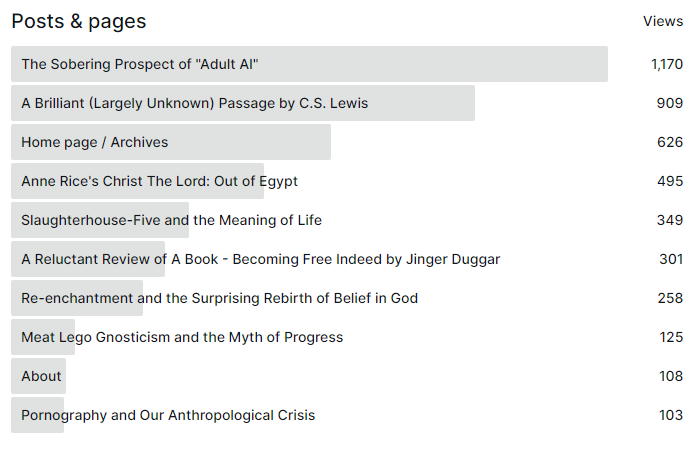
I really don’t know much of anything about internet traffic, but I have to say I have been surprised at the sustained level of reading on this here, my little blog. I have been averaging about 150 visitors and 200 views a week since early this year. This may not interest anyone, but I find it interesting. Here are my most popular posts of 2024. The #1 article, about Adult AI, was boosted by a link from Tim Challies, which also led to an interview with Moody Radio’s Kurt & Kate in the Mornings, which you can listen to if you so wish. Challies is a singular blogging phenomenon.

The #2 post, an extended quote from C.S. Lewis, has been quietly accumulating views week by week as people from all over the world find it, mostly through Google searches and perhaps links on forums. After that it seems that my reviews of popular books are of enduring interest. I would also like to add to my website here a page with links to all my published pieces elsewhere – a kind of central hub where those can be easily found.

Aside from that piece at TGCC, I have one submitted to another outlet (which I haven’t been published at before) and I am waiting to hear back from the editors. It’s another piece about psychedelics. Speaking of psychedelics, I was pleased to be interviewed by none other than Justin Brierley for his excellent documentary podcast series, The Surprising Rebirth of Belief in God. The episode on psychedelics hasn’t been released yet, but I’ll link to it when it comes out. I think I will wind down my writing on psychedelics, however – I’ve said what I had to say, and I think there are others who are better placed to continue writing for the church on this topic.

That about does it for me at this point. I’ve got some articles at various points of completion: on the Pride Rainbow compared to Vaclav Havel’s greengrocer illustration; on cathedral beauty and gospel beauty; and an article on the Haitian Christian community in Montreal which has been commissioned by Faith Today.

As always, thanks for reading.

As an Amazon Affiliate I earn a small commission from qualifying purchases of books purchased through links on my website, while customers do not pay anything extra.

On Facts & Meaning; Nihilism & Salvation

I recently re-read that great collection of essays & talks by C.S. Lewis, The Weight of Glory. Any regular readers here know I cannot go long without referring to Lewis’s thought in some way. I’m afraid that is just the way it’s going to be. I find reading Lewis to be like spreading a large bag of super-fertilizer all over the garden of my mind – it stimulates growth and activity of all kinds.

One of the essays in that book is called ‘Transposition’. It is on the more philosophical end of things, discussing how things on one level of reality look to the level below it, such as how 3-dimensional shapes can be represented on 2-dimensional paper but only in a flattened and reductionist way. You can find it online (usually bundled with other essays) but here is an audio version of it: https://www.youtube.com/watch?v=PXwJk8WtpUY.

He uses this analogy to make sense of how the reality of the spiritual so often looks and feels prosaic and explainable in material terms. He argues that this is exactly what we should expect, but that when one assumes there cannot be a higher realm then he will always find some such explanation:

And the sceptic’s conclusion that the so-called spiritual is really derived from the natural, that it is a mirage or projection or imaginary extension of the natural, is also exactly what we should expect; for, as we have seen, this is the mistake which an observer who knew only the lower medium would be bound to make in every case of Transposition. The brutal man never can by analysis find anything but lust in love; the Flatlander never can find anything but flat shapes in a picture; physiology never can find anything in thought except twitchings of the grey matter. It is no good browbeating the critic who approaches a Transposition from below. On the evidence available to him his conclusion is the only one possible.

This line of reasoning found its apogee in the New Atheists, who never grew tired of pointing out that such and such transcendent experience was really “just” this or that. You can see this little trick being pulled by Dawkins, Bill Nye, Neil DeGrasse Tyson, and so on. Here is a little clip of Jonathan Pageau making the very same point as Lewis:

It’s surely no accident that Pageau looks at the world hierarchically and symbolically, seeing it as laid out across different levels of being or reality. This is the same basic structure as what Lewis lays out in his essay. Near the end of the essay, Lewis makes his point even more explicitly, and I quite enjoyed it. Allow me to quote it at length:

I have tried to stress throughout the inevitableness of the error made about every transposition by one who approaches it from the lower medium only. The strength of such a critic lies in the words “merely” or “nothing but”. He sees all the facts but not the meaning. Quite truly, therefore, he claims to have seen all the facts. There is nothing else there; except the meaning. He is therefore, as regards the matter in hand, in the position of an animal.

You will have noticed that most dogs cannot understand pointing. You point to a bit of food on the floor: the dog, instead of looking at the floor, sniffs at your finger. A finger is a finger to him, and that is all. His world is all fact and no meaning. And in a period when factual realism is dominant we shall find people deliberately inducing upon themselves this doglike mind. A man who has experienced love from within will deliberately go about to inspect it analytically from outside and regard the results of this analysis as truer than his experience.

The extreme limit of this self-blinding is seen in those who, like the rest of us, have consciousness, yet go about to study the human organism as if they did not know it was conscious. As long as this deliberate refusal to understand things from above, even where such understanding is possible, continues, it is idle to talk of any final victory over materialism. The critique of every experience from below, the voluntary ignoring of meaning and concentration on fact, will always have the same plausibility. There will always be evidence, and every month fresh evidence, to show that religion is only psychological, justice only self-protection, politics only economics, love only lust, and thought itself only cerebral biochemistry.

His line about the one who has experienced love from within analyzing it and finding “the results of this analysis as truer than his experience” reminds me of the Preface to J. Budziszewski’s book “The Revenge of Conscience.” I read this fifteen years ago but I have never forgotten those opening pages. In them the Budziszewski tells the story of his conversion from materialistic naturalism (or nihilism as he refers to it) to Christianity. This is how he describes his love for his wife and family during that time:

I resisted the temptation to believe in good with as much energy as some saints resist the temptation to neglect good. For instance, I loved my wife and children, but I was determined to regard this love as merely a subjective preference with no real and objective value. Think what this did to very capacity to love them. After all, love is a commitment of the will to the true good of another person, and how can one’s will be committed to the true good of another person if he denies the reality of good, denies the reality of persons, and denies that his commitments are in his control?

In another place, he writes this memorable quote:

Though it always comes as a surprise to intellectuals, there are some forms of stupidity that one must be highly intelligent and educated to commit. God keeps them in his arsenal to pull down mulish pride, and I discovered them all.

It was ultimately his existential dread at the kind of person he was becoming that convinced him that if there was horror there must be its opposite as well: “I knew that if there existed a horrible, there had to exist a wonderful of which the horrible was the absence. So my walls of self-deception collapsed all at once.”

As the dominance of New Atheism fades and crumbles, there remain a huge number of people whose operative worldview was shaped and cemented by their arguments. Yes, there may be a “Surprising Rebirth of Belief in God” dawning among leading thinkers but these things take time to filter down to the masses. The fact is that there are still countless millions of people walking around with basically the same form of nihilism as Budziszewski describes above.

May their “walls of self-deception” collapse as well, unto light and life and salvation.

On Writing

For as long as I can remember, I have loved writing. But I have always resisted the idea that writing might be a part of my identity and calling in life. I’m not sure why. Recently that has been changing.

I realize now that my childhood home was filled with books in a way that was unusual. My parents were often to be seen reading. My older brother Alex quickly became a devoted reader, blasting through stacks of novels. All of this rubbed off on me, and things which I took to be unremarkable I now see as a foreshadowing of things to come.

I remember having two truly excellent English teachers who both left a mark on me. The first was Mr. Wiggins, who taught me in both grade 5 and grade 6. He was an extremely tall man with large glasses. For some reason I don’t remember what his voice sounded like. He was funny. He would write long sentences across the blackboard and then when he got to the end of the space he would continue writing on the walls of the classroom. To a schoolchild, even a hint of playful rebellion in an authority figure like a teacher is delightful. He got ten and eleven-year-olds to learn words like extemporaneous and calamity and vociferous. I ate it all up, the lessons and the assignments.

Once, when we were told to bring something to read quietly in class, I brought one of our treasured Calvin & Hobbes books along with a dictionary for looking up words I didn’t know. Mr. Wiggins was impressed. I still think Calvin & Hobbes is pretty brilliant and a great way to expand one’s vocabulary:

“Pathetic Peripatetics!”
I probably had to look up “transcendental.”

The other excellent English teacher that left a mark on me was a Mr. Bellamy in high school. He also was a popular teacher. He taught us to write. I don’t remember how he did it, but the end result of it was that I very badly wanted to write the most excellent pieces of creative writing in order to impress him. I worked at it diligently over that year and submitted papers I was proud of. As someone who mostly breezed through school, that level of effort was a new experience. He read those papers carefully and handed them back with copious comments and sometimes a personal conversation too. I couldn’t pinpoint exactly how, but I know for a fact that I’m a better writer today for having had Mr. Bellamy as a teacher.

Some years later, and after my spiritual rebirth at the age of 19, I wrote a short reflection on writing. I recently found it tucked away in an old file in my computer backups. I had forgotten I had ever written it, so it felt like I was reading someone else’s words:

What is writing? It is notation. But there is writing and then there is writing. And the latter sparks revolutions, both quiet and cataclysmic. Writing is communication bordering on impartation. It is a medium so broad that the loftiest ideas imaginable have room aplenty to cross the great divide between these independent entities we call minds.

I wonder, I wonder; am I a writer? Oh I can notate just fine, but can I impart? Can I, with the finesse and restraint of an artist, craft and swirl, lift and push, yes and with finality make a collection of words that imparts the ineffable? Can I sow seeds of the good without the soil’s knowledge, at least until after the fact? Can I teach the eye to see, and yes even to love, the beautiful even as it lusts for the profane? Can I in some small way affect that impenetrable centre of being, the heart, with what I can only pray will be a taste, an appetite, yes a hunger, for that essence which is sourced entirely in the threefold Spirit of the I AM?

Can I be a writer? Probably not. But can I write? Well I hope so. 

I think I wrote that in my early 20’s, about 15 years ago. What I like about that reflection above is that it expresses something I still feel deeply, namely that words have this mysterious but undeniable power to nudge us towards virtue or vice, towards God or away from Him.

Despite writing occasionally on this blog and receiving some affirmation here and there, it has only been in this last year that these lingering questions have been answered for me as doors have opened up for writing and editing in a more public way. One of those open doors has been over at TGC Canada, where I’ve been able to write a serious book review, a piece of cultural criticism, and a piece of spiritual reflection. In each case I’ve been blown away by the positive responses.

In addition, I’ve been given opportunities to do some editing by an extremely accomplished author and editor, Dr. Michael A. G. Haykin. Here is the first look at the fruit of that partnership:

Dr. Haykin is very generous with his time and advice, giving me a chance to work in the world of publishing like this. In addition to this volume on John Gill which will be published this year, we are working on two other projects.

This all has seemed too good to be true. It’s almost like I’m a writer!

Well, I guess I am. I’m just going to have to get used to the idea.

_________________________________________________________________________

As I was waiting for the Rogan piece to be published, I was rather nervous. I had worked on it for months. I had really pushed myself to weave together a narrative that was compelling, intellectually stimulating, and edifying. And as such it felt like more of a risk, and like more of my self was wrapped up in it. When it finally came out, the response was a bit overwhelming for an almost-complete novice to the online writing world. Tim Challies linked to it, and then the main TGC USA site featured it in their Around the Web links for a day. Collin Hansen tweeted it out. I got asked to do a radio interview for a Christian station in Pittsburgh.

And all this happened on the week of the 10th anniversary of my mother’s death, in early March. I tried to write about that at the time, but nothing seemed to come together. It was a strange mix, the marking of a sad milestone along with success in the sphere where my mother had the most influence on me. She was a writer and an editor too. And although I don’t remember sitting down with her to get tips on writing and editing, I know I picked up a lot of things along the way.

I noticed how hard she would work at finding just the right word, as evidenced by the scribbled and scratched-out notes covering her text. I saw how she stressed out over the regular column she had to write for the magazine she edited, yet somehow always found something to submit by the deadline.

Looking back now I guess it makes sense I would end up so involved with words. But all along the way I see how people in my life—my parents, teachers, and others—earned themselves an unpayable debt of gratitude by investing in me and giving me opportunities. Ultimately my writing and editing, like every other aspect of a Christian’s life and calling, is a stewardship of what has been given by God, and faithfulness is the call.

I have tried to write well even when only one person would ever read my words. I have tried to think and write well even when the number of readers of this blog was less than ten. In a sense, the numbers truly don’t matter, and until they don’t matter, the writing itself is tainted. That is something else I learned from Bill Watterson: to do a thing for the love of it and no other reason. (I got this from his only public speech). It is analogous to Eric Liddell’s feeling that God was pleased when he ran, for He had made him to run. My own motives are always mixed, but this is the north star I try to orient them by.

The lines have fallen for me in pleasant places;
    indeed, I have a beautiful inheritance.

Psalm 16:6

On the Writing of Novels

I joked about writing a novel a few days ago, but the truth is that I feel as far from writing a novel as ever before.

Seriously, just thinking about it makes me feel like this:

Image

It’s similar to a one-legged man who has always dreamed of climbing mount Everest. He arrives at base camp and gets a taste for the effects of high altitude and the difficulty of, well, climbing the world’s highest peak with half as many legs as is typically needed. In other words, he gains an appreciation for the immensity of the task, and the romantic glow which accompanied the thought in his mind is replaced by a stagnant dread.

Recently I discovered that my brother is into writing electronic music, and being musically inclined myself, I asked him to show me how he does it. I figured I could take a look at the interface and whip up something decent sounding in a few minutes. Well, not so much. He uses an online interactive in-browser set of tools that is as expansive as it is complicated and intricate, from mixing boards to effects pedals to wave synthesizers and loops, each with dozens of settings and adjustments. I didn’t even know how or where you could even start putting notes down, never mind putting together something with any more complexity than The Itsy Bitsy Spider in C major.

Even if I could manage to produce a sound that I liked, and wrote a little hook, to think of building upon that layers and layers of individually tailored sounds and beats and loops, each requiring a mastery of minutiae, is just overwhelming. The effort required to focus all your faculties on tiny details all while holding in your mind a vision of the entire piece so that each created section fits cohesively within the whole is simply staggering. And writing a novel is just like that. In that sense, even the most basic and formulaic novel is an impressive achievement, never mind creating believable characters that draw you in emotionally, scenes that play out in the readers’ minds with 1080p clarity, story arcs that are suspenseful and thrilling, and a depth of humanity and honesty that moves the work from mere entertainment to literature.

Maybe, I hope, I’ll get there someday. But for now I’m sticking with bite-sized pieces that my mind can wrap itself around. I’ll leave the grand weaving to others who feel so inclined, and heartily cheer when they do it. It is no small task. My humble goal this month is to submit a short story I’ve written to the CBC Canada Writes Creative Non-Fiction Competition. All the previous winners seem to be legit published authors with actual credentials so my expectations are low, but that’s not a reason not to try!

So here’s to you, novelists: well done, well done indeed.

*slow clapping*

Announcing My New Upcoming Debut Novel Pioneering An Entirely New Sub-Sub-Genre

300px-Lancaster_County_Amish_03

Do you love horse-drawn carriages and the sweet smell of manure wafting across the endless prairies? Do you long for the thrill of international espionage and counter-terrorism? Well thanks to me you won’t have to spend one single more candle-lit evening sitting at home and wondering how you’ll ever be able to reconcile these two passions…

Well that’s it, I’ve decided to throw my lot in with all those countless aspiring authors. The problem is: how to get noticed? How can one stand out of the crowd? Or conversely, how can one find a niche so nichey that one becomes a big fish in a very, very small pond? Well, as I was driving to Wal-Mart today to buy more Hot Wheels cars for mysel– I mean my son — I had the idea of a lifetime. Well actually I shouldn’t be quite so modest; it was the idea of a generation, an era, an eon. What if I could take a niche and niche it a little further? And then what if that new niche was actually a hybrid super-genre with massive public appeal? Well shoot if I haven’t gone and done it.

segwaycommandosIn fact it wasn’t terribly complicated – I simply combined the one genre that all Christians who are female and between the ages of 12 and 82 can’t resist: Amish Romance, with one of the hottest selling genres of all time. No, not vampires – someone beat me to the punch – I’m talking about the very first Amish Romance Geopolitical Terrorist Plot Thriller.

The title will be:

A Bomb in Her Bonnet

Synopsis: The incredible based-on-a-true-story story of a young Amish woman who rebels, heads to a massive city of twelve thousand people, and falls in love with a rebellious occasional drinker of alcoholic beverages who turns out to be a CIA spy who actually turns out to be a Middle-Eastern terrorist mastermind who forces this poor damsel to become the world’s first Amish Suicide Bomber by threatening her fourteen younger siblings with iPhones and Netflix accounts and similar forms of torture. She pretends to go along with the plot but secretly informs the police by way of carrier pigeon that she is indeed carrying a bomb in her bonnet. With the help of an extremely handsome, pious, and conservative police officer, she thwarts the threat and returns home on horseback and he proposes to her in the rain and they marry and have lots of children.

Scheduled for release in late March 2014, with sequels every six months afterwards, you may want to pre-order these puppies because they will sell faster than Twilight at a Justin Bieber concert.