This book is a brief survey of the history of Heritage College & Seminary, with a chapter devoted to Central Baptist Seminary, another to London Baptist Bible College & Seminary, and then finally a chapter on the merged entity of Heritage College & Seminary (from 1993 to 2023 when the school celebrated its 30th anniversary and the book was published).
There is lots of very interesting and salient information to be gleaned in this book about the history of these three schools, even though it left me wishing it was longer. Despite being already somewhat familiar with the material, I learned lots from these essays. For example, I had not appreciated before just how central the topic of eschatology had been to the identity of the two schools (perhaps especially London) — which magnifies the accomplishment of finding a way to merge the schools together in 1993 to form Heritage. We too often hear about Christians splintering apart; it is good and right to celebrate when Christians find ways to come together without compromising on truth.
On a personal note, I was also surprised to hear about how truly dire the financial situation was even while I was living on campus and serving in student leadership from 2006-2009. Yet despite those challenges, the school was a buzzing hive of genuine spiritual transformation, regular deep immersion in the Scriptures, and warm Christian fellowship that has left a mark on me for life. As a student I had picked up on the fact that there were financial concerns, but it’s a credit to the leaders at the time that this did not put a damper on the spiritual and academic experience of students. I don’t deny that the school needed course correction and a way to achieve financial stability, but those were also great years of blessing under the leadership of Marvin Brubacher. If I have one minor criticism to make, it’s that this reality (admittedly based on my personal experience and bias) did not seem to come across in the way the story was told.
As a graduate of the college, a former staff member, and a continuing friend to the school and those who work there, I read the book with great personal interest. (And full disclosure: I also know and like the authors!) Despite whatever challenges it has faced and continues to face, Heritage remains a shining light of doctrinal fidelity and spiritual vitality among Bible Colleges and Seminaries in Canada. I pray that it grows and flourishes in the years to come.
I’m so very grateful for the work that went into researching and preparing this written history. I hope it spurs further writing on the history and leadership of what I consider to be the premier Bible College & Seminary option for broadly-reformed complementarian evangelicals in Canada.
“Of making many books there is no end” – Ecclesiastes 12:12
Last week I traveled to Toronto for the annual convention of my denomination, the Fellowship of Evangelical Baptist Churches in Canada – or The Fellowship for short. It was there that every delegate from around the country received a free copy of the book I’ve been working on for over a year, a revised and expanded second edition of A Glorious Fellowship of Churches, which tells the history of our little denomination. This was a collaborative effort with the esteemed historian Dr. Michael Haykin, our second such partnership. In this post I describe a bit of what that process was like and then reflect on what I took away from the experience.
These things are subjective but I think the new cover is quite nice.
As I’ve mentioned before, this was a special project for me to work on because the first edition, published in 2003, was worked on by my mother, Ginette Cotnoir, who served as the editor of the Fellowship’s magazine: then called The Evangelical Baptist and subsequently rebranded to Thrive. She worked with longtime missionary pastor Ernie Keefe on the chapter dealing with Quebec. For the second edition, updating that chapter to cover the time period from its publication in 2003 to current day (2023) was my main writing assignment. This meant interviews with several key leaders and research through annual reports, books, etc. The chapter was already quite long, so there was quite a bit of tightening up to do to make room for the new content. Then the whole thing needed a careful edit so that the narrative voice of the chapter was consistent and enjoyable to read. The main challenge there was to create a bit of distance between the narrator and the narrative. Mr. Keefe – a good and godly man – was a bit wordy and wrote in a style more reminiscent of a missionary update than a history book.
Beyond the writing, the project required a lot of communication, coordination, and editing. Each chapter needed to be expanded to cover the last twenty years, but aside from one chapter, none of the original authors were available to do the work. So this meant finding someone willing to take on the unenviable task of researching and writing a few thousand words of recent history and trying to meld it smoothly into an existing chapter written by someone else completely – with nothing but a “Thank You” and a free copy of the book to show for it. No wonder we had such a hard time finding willing souls for some of the chapters. But in the end we got contributors lined up and I gave them clear instructions as well as a deadline. All of this started well over a year ago, in August of 2022.
Once I received all the chapter updates, I simply blocked off chunks of time in the evenings and went through all the new text with a fine-toothed comb, and then the entire chapter as a whole. There was also one entirely new chapter, written by Steven Jones, the president of the Fellowship since 2011, which dealt with national ministries and how the head office has morphed and changed over the years. It was a needed addition as the first edition did not really deal with the big picture national issues at all.
The last few weeks were a blur of proofreading, sourcing pictures, and putting the finishing touches on the book. Then off to the printers it went, with no small worry in my mind that they might not actually be ready in time for the convention. I could just imagine showing up there and having to tell everyone it would be a week late. But then an email came in on the Friday, just three days before the opening day. The books had arrived! I slept well that night.
My first glimpse of the physical copies happened as I approached the registration tables to get my lanyard and nametag. Then my name wasn’t in their system, and I had to go to another table. After a few minutes, they printed one up for me, and handed me a tote bag with pamphlets and brochures for the conference, but no book. I pointed a bit sheepishly at the pile of books and asked if I could perhaps have a copy. “Sorry, the book is only for those registered as delegates.”
I was not a delegate that year, so I wasn’t sure what to say. I knew I’d be getting a free copy somehow, but I didn’t really want to plead my case at the busy registration table, so I was about to smile and walk away when my friend spoke up and told them that I had worked on it and pointed out my name on the front cover. How nice to have an advocate. So I got a copy of the book and held it in my hands, a very satisfying moment. It looks and feels great. It’s a bit thicker than we expected, but the font is quite large, with generous margins, and lots of colour pictures throughout. So while it feels a bit thick in the hand, it doesn’t feel dense, and therefore not overly intimidating.
So what did I take away from all this? Let me single out four things:
The Importance of Roots
We all love a good tree analogy, do we not? Trees need strong roots. They cannot grow tall or broad without them. Christians and churches and denominations are similar. If there is a consistent weakness in evangelical Baptist groups, it is historical rootlessness. Many of us simply do not know where we came from. This was certainly the case for me growing up. And although this was probably exacerbated by the unusual context of my upbringing, being a part of a church filled with first-generation Christians coming out of a dead French-Canadian Catholicism, it is still a defining feature of evangelicals more broadly. This explains to some part the exodus from evangelicalism to Roman Catholicism, Eastern Orthodoxy, and Anglicanism – three branches of Christianity which emphasize their historical continuity far more than we do.
This was illustrated powerfully by a comment made by Dr. Haykin during a workshop session he gave at the conference. He described how, upon coming to Christ as a young man through the ministry of Stanley Park Baptist Church in Hamilton, he asked his leaders: “Where do Baptists come from?!” But he received no real compelling answer, aside from a suggestion that maybe the folks at Wycliffe College could help him, and that set him on the path to becoming one of the foremost Baptist church historians in the world.
This rootlessness has driven a lot of my own reading and intellectual curiosity over the last two decades. I’ve become convinced that within historic Protestantism, which is in continuity with the best of the ancient and medieval church, we have abundant resources for growing deep, healthy roots. So the problem is not a lack of nutrients but the prevailing alienation from those nutrients and, even worse, an attitude that assumes that the modern church has no need for all that old stuff.
Working on this book reminded me in a fresh way how stabilizing and encouraging it can be to discover one’s roots. The history of the churches that make up the Fellowship in some cases go back to the 18th and 19th centuries. The list of faithful men and women who built and sustained all those churches is long, and we shuffle onto the stage in their wake, holding their props, and seeking to carry on the faithful work they left us. Each new generation receives this legacy from the one before. And that, if it sinks down deep, helps us chart a path that is straight and true.
2. The Nearly-Forgotten Faithful
There are a few names in church history that everybody knows: Augustine, Aquinas, Luther, Whitefield, Spurgeon, Billy Graham. We continue to read and write books about them because of their compelling personalities and the momentous nature of their ministries. But for each of us, there is another, closer set of ancestors – locally, regionally, and nationally – who more directly shaped the church family in which we find ourselves. It is good and right for us to make the effort to remember these men and women. Unlike with Luther and Augustine, if we don’t remember them, no one will. As the spiritual descendants of these saints, it is our responsibility to remember them, to rehearse the works God did through them, and to honour their memory. This seems to me to flow naturally out of the repeated chorus we find throughout the Old Testament to remember the works of God in previous generations.
I’m so glad to have been a part of writing a history of The Fellowship, for I think it helps preserve the health and future of that movement of churches. It helps us remember who we are, and what we’re a part of. The narrower scope means that the book won’t sell thousands of copies, that’s true, but I think it has the potential to have a deeper impact on those who are part of The Fellowship as a result of that narrower focus.
3. The Forgotten Faithful
But here is the reality that we all must embrace: the vast majority of God’s people are, in a human sense, utterly forgotten within a short period of time after their death. This was a curious effect of my research and reading. As I came across name after name I had never heard of before, it impressed upon my mind the reality that there was simply no end to the names or the stories. I could never hear all of them, know all of them, or capture them rightly in words. And yet each of them played their parts through prayer and service and teaching and outreach and building and sowing and reaping, no less than anyone else.
Friends, this is going to be case with you and me, almost certainly. Few will make it into whatever history books are written, and that’s okay. As I heard it put many years ago, there will be only one name lifted high in the new heavens and new earth, and it won’t be yours or mine. The sooner we get on board with that, the better.
4. Don’t Live for the Next Achievement
If you had told me three years ago that I would have gotten multiple articles published and edited a couple of books with real publishers I would hardly have believed it was possible. I had wanted to explore the writing and publishing world for years, but never really saw how that could happen. So I find myself both deeply grateful for these opportunities and also sobered by the fact that the buzz I get from every new venture doesn’t last long.
Thankfully, I am not looking to my writing and editing to give my life meaning; it already has that. I get a joy from using my gifts and all the usual human sensations that come with trying your hand at something new and getting positive feedback. And on the flip side, when that new article is submitted to a new outlet or the new book manuscript sits almost finished but unsent to the publisher, there’s a typical insecurity wondering if it’s any good at all. This is par for the course for writers (and a recurring joke – Anne Lamott’s writing is pretty hilarious on this point). I hate to think how neurotic I would be if I was looking to these kinds of achievements to give my life meaning or secure my identity.
Let me close with an application of this truth. It may not be writing in your life, but maybe there’s some next thing that you’re aiming for and investing just a little too much security and joy into. Maybe it’s a new ministry position, a new relationship, a new church, a work promotion, or even a new car. Well, get ready to be disappointed. None of these things can fill our cup to overflowing.
But there is something which can: a living union with the risen Christ through the Holy Spirit; knowing and being known by God our exceeding joy.
Here we are at the end of another summer. It’s been a busy one for me, which will serve as my excuse for not having written here in some time. Aside from the normal demands and joys of work and family life – with the bulk of the demands coming from the work and the bulk of the joys coming from my family – I’ve been working against some deadlines for a pretty major project.
The project is a second edition of a little-known book about the history of the Fellowship of Evangelical Baptist Churches in Canada (FEBCC), or just The Fellowship for short. The book has had little readership due to its narrow focus on the subject of this denomination, a rather small one in the grand scheme of things. But when I was asked to consider taking on the project, there was a personal reason why I was drawn to say yes. When the first edition was published in 2003, it was for the 50th anniversary of this family of churches, and my mother was one of the people who worked on it. She co-wrote the chapter on Quebec and was involved with editing the whole to some degree. At the time, I was a high schooler with zero interest in church history or the projects my mom was working on, but thankfully I’ve grown up a little since then.
My mother passed away from cancer in 2012. Writing and editing is what she loved to do, and it is also what I love. This is a really meaningful connection for me, but it isn’t one we got much opportunity to share while she was alive. So when Dr. Haykin asked me in 2022 if I’d be willing to work with him on a second edition for the 70th anniversary of the Fellowship, I said yes. That was the easy part.
This summer saw the deadline for this project arrive, so naturally it meant I had to get done all the work I had procrastinated on in previous months. This meant dozens of emails back and forth with various contributors and lots of research and writing, culminating in a frenzy of productivity in the last weeks. But it’s quite amazing what you can get done when the need arises and when unbroken hours can be set aside for a focused purpose. So this project is coming to its fruition and the finished product will be presented in early November at the denominational convention, where I am expected to speak for five minutes or less about the book, or the experience of writing it, or what I learned, or something like that.
Another project came about unexpectedly in the summer: the chance to edit the text to Jonathan Pageau’s forthcoming adaptation of Snow White and the Widow Queen. I worked hard on it and am pleased that it was well received by the team at Symbolic World Press, who then asked me to continue editing the texts of the subsequent fairy tale books they are planning to publish. We’ll see where that goes, but I’m really enjoying the challenge of crafting English prose that feels ancient, mythological, and yet fully accessible to modern readers.
These projects have delayed the writing of a couple articles that I’ve had in the works for a while. But I recently finished a pretty major piece on psychedelics that I submitted to a new online outlet to see if they are interested in running it. If that goes anywhere, I’ll make sure to link to it. And then there is the second article I have been planning to write on the subject of pornography, as a follow-up to my earlier piece arguing that Pornography Poisons Everything. This second piece is meant to be a practical guide to fighting the scourge of pornography and lust in one’s personal life, and I am hoping to finish that this week or next.
Beyond that, I do need to write a book review for Glen Scrivener’s The Air We Breathe, which I am currently reading and enjoying very much. I think I will incorporate Andrew Wilson’s Remaking the World and Carl Trueman’s Strange New World into the review because together these three books cover a lot of the same ground, drawing on history to make sense of the present and give Christians tools for understanding and responding to the challenges of our age. I also would like to write a review & reflection on Christian Poetry in America Since 1940, of which I received a complimentary digital copy. I’ve been slowly reading it and trying to think of how I can say something useful about it despite not understanding much of the poetry within it.
So that’s what I’ve been up to instead of writing on this blog, but I hope to get back to more regular reflections in this space now that the big project is pretty much done. As always, thanks for reading!
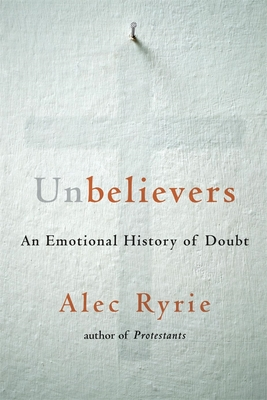
Unbelievers: An Emotional History of Doubt by Alec Ryrie (audiobook)
“The heart has its reasons which reason knows not.” (You’ll see variations on this memorable quote by Blaise Pascal because it was originally written in French: “Le coeur a ses raisons que la raison ne connaît point.”)
This book is in some ways an in-depth historical exploration of that statement and the truth it contains. The author, historian Alec Ryrie, states explicitly that he seeks to counter the prevalent narrative that atheism and secular humanism arose from changes in philosophical reasoning and intellectual beliefs. Rather, he argues that two powerful emotional currents – anger and fear – animated unbelief for centuries before it ever emerged as a coherent set of beliefs. In order to make his point, Ryrie garners evidence from across multiple centuries and the whole of Europe (with a special emphasis on England).
The historical work seems sound to this layman. Ryrie has unearthed dozens of fascinating first-hand accounts. Whatever issues one might take with how Ryrie summarizes the meaning of all the material, I think it’s undeniable that he’s onto something really worthwhile here. There really does seem to be a powerful emotional current at work in so much unbelief both in the past and today.
I found myself wishing he would apply these insights more thoroughly to our own day. But this was not his stated goal so I cannot fault him for anything except failing to write precisely the book I would have preferred. He does however make some interesting comments in the concluding chapter which are worth repeating and reflecting on.
Ryrie argues that, since WW2, Adolf Hitler now functions as the universally agreed fixed moral point. It is now unthinkable to praise Hitler just like it used to be unthinkable to criticize Jesus in centuries past. This manifests itself in another interesting way also. In the 17th Century, the argument-ending slander was to call someone an “atheist,” and Ryrie made clear in previous chapters just how endlessly that insult was hurled from one group to another. Today the argument-ending tactic is to call someone a “Nazi.” Lastly, in terms of imagery, the most potent moral symbol in past centuries was the cross. Today it is the swastika.
I might wish it was different, but this argument strikes me as correct. Modernity and subjective moral reasoning have chipped away at all the shared moral points of reference and really there are not very many left, of which Hitler and Nazism seems to be the one that has the most purchase across the breadth of our society.
These reflections are especially timely for us Canadians as the Freedom Trucker Convoy in the first couple months of 2022 led to some significant political and cultural turmoil, including endless talk about swastikas and accusations of Nazi-sympathy. It is interesting to step back and see that, in a time of massive moral transformation (one might even say revolution), this is indeed the one fixed moral point. Whatever else we believe is right or wrong, everyone agrees that THAT is wrong. And all ends of the political spectrum seem unable to resist the temptation to weaponize that moral certainty to score political points in our troubled age.
In the first post on the topic of chronological snobbery we looked at what C.S. Lewis meant by the phrase and we considered two reasons for its particular prevalence in our own day. In this post I would like to explore related ideas from a thinker that has been helpful to me: René Girard.
Girard was a profound and original thinker whose work ranges over many disciplines. I am familiar with only a few small slices of that work, but some of those slices have been eye-opening. Consider his reflections on the words of Jesus in Matthew 23:29-30.
“Woe to you, scribes and Pharisees, hypocrites! For you build the tombs of the prophets and decorate the monuments of the righteous,saying, ‘If we had lived in the days of our fathers, we would not have taken part with them in shedding the blood of the prophets.’
Girard focuses in on the attitude of the scribes and Pharisees as they built tombs and monuments for prophets who were harassed, persecuted, and killed by their forefathers: “If we had lived in the days of our fathers, we would not have taken part with them in shedding the blood of the prophets.” He considers this as a kind of spirit, an attitude of the heart that any of us can adopt.
In the context of his broader theory of mimetic desire and the scapegoating mechanism, he describes this impulse as a mob of the living scapegoating the dead. For our purposes, we can simply say it is the attitude whereby one generation or group condemns those who came before them, exonerating themselves.
Girard points out one historical example of this in the phenomenon of Christian anti-Semitism, the kind that blames the Jews for killing Jesus. It says “if we, who are the spiritual children of Abraham, had been there when Jesus was crucified, we would not have joined the actual children of Abraham in condemning and killing Jesus. We are better than them. We alone would have resisted the mob. We would have stood by him when all had deserted him. We would have been willing to be killed with him rather than deny him.”
When one lays out what such an attitude really claims, as I did above, it starts to be seen for what it is. But usually the claim to superiority is not parsed and exposed for what it is. A claim like that is really more about the person making it than about the people he or she is supposedly superior to. At bottom, such statements are saying something like: “If everyone was as innocent as I am the world would be better. Therefore they must not be innocent like me, because someone has to be responsible for all this mess.”
Ask any high school class if they think they would have stood up against the Nazis if they had lived in Germany leading up to and during WW2. Most will say they would have resisted, which is to claim that if Germany had been populated with 21st-century North American teenagers instead of Weimar-era Germans, Hitler would not have done what he did. More pointedly, it is to claim that each of those students raising their hands, students who allow their wardrobes, attitudes, mannerisms, and vocabulary to be dictated by the passing fads and peer pressures of their social peers, yes these paragons of strict moral virtue, would have had the backbone to stand against what was an immense amount of social pressure and very real threats to their reputations, social standing, finances, and very lives.
In Romans 2:1, the apostle Paul writes “Therefore you have no excuse, O man, every one of you who judges. For in passing judgment on another you condemn yourself, because you, the judge, practice the very same things.” We live in a time when forces all around us seem to be working hard to whip up offense, outrage, and judgment towards the other. But not all judgment is the same. Some judgment is warranted and needed, but a lot of it is spiritually dangerous.
What do I mean by spiritually dangerous? Well, I mean that it is dependent on sin and it fosters sin. To judge others for what I am guilty of is to reinforce my own blindness to that sin, thereby distancing myself further from the truth about myself that might lead me to repentance and freedom. It is much harder to admit to a sin that I have clearly – and perhaps publicly – judged another for. I am less able to see it in myself when I get a kick out of pointing it out in others.
So this leaves the one judging further from the grace of humility, further from the grace of gospel sanity, further from the grace of honesty about my sin. These are graces that flow from Christ and to Christ.
When one takes this principle and applies it, what happens? It becomes very difficult to stand in judgment over our historical predecessors, because we now see that to do so is to fall into a very dangerous spiritual trap. It is the trap of saying that we are better and we would not have done what they did.
But does this rule out any and all criticism of the past? Quite the opposite: It allows for the kind of criticism that is good for us, rather than a danger. When I recognize that in the garden of my own soul grows the same root that in others bore such heinous fruit, it motivates me to weed it out. When I recognize that there is more than a little family resemblance between their sin and my own – if not in the fruit, then in the root – this encourages humility.
Indeed the effect is precisely the opposite of what self-righteous criticism produces, namely a deepening blindness with regard to my own expressions of whatever fault I am pointing out in others married to a swelling pride at being found so much superior.
The best writers of history intuitively (or perhaps intentionally) treat their subjects with this kind of moral sensitivity. They do not fall into moral relativism, which may be an enjoyable intellectual hobby for rich and comfortable Westerners, but is insufferable in the face of actual evil. Neither do they unleash a full one-dimensional moral tirade against historical villains, painting them as uniformly evil characters. Rather they preserve the humanity of both heroes and villains, allowing for nuance and being honest about the shortcomings of the heroes as well as the positive qualities of the villains, all while writing with a sense of moral clarity. This kind of history proves informative and beneficial to the reader. It is humbling, sobering, inspiring.
Moving from history to the contemporary, we can apply this idea to so many current cultural issues. For example, I see a lot of folks these days eager to tear down statues of people who, terribly flawed and implicated in evil as they may have been, are nevertheless in many ways their betters. Leaving aside the specific arguments for or against any particular monument, or even for the taking down of statues in general, I just want to point out that this kind of fury, this kind of one-dimensional judgment of those in the past, is spiritually dangerous for all the reasons described above.
To take an example from the opposite side of the culture wars, we have the phenomenon of so many conservative religious leaders who were so thundering in their denouncing of sexual immorality being revealed to be sexually immoral themselves. Zacharias, Falwell, Hybels, and the list goes on and on. We all know such failures do not happen overnight. So we have someone publicly denouncing a sin in others that they are not just struggling against but positively nurturing in their own hearts.
This can happen on the political left as much as on the right, both inside and outside the church. But from my perspective, which is admittedly conservative, it does seem to be a particularly fashionable attitude among progressives on the left these days. If you think I’m wrong about that, let me know why in the comments.
This is part 1 of 2. Click here to skip ahead to part 2, or see the link at the bottom.
It was Owen Barfield who induced a young C.S. Lewis to abandon what he called ‘chronological snobbery.’ I like the term, but its meaning is not immediately clear. Is this what Lewis is referring to when he exhorts us to read old books as a corrective to the errors of the day (most famously argued in his essay “On the Reading of Old Books”)?
But no – it cannot mean simply reading old books since Lewis was already reading old books even at an early age (he loved classical poetry), well before meeting Barfield and having his chronological snobbery apparently cured. So what is it, then?
In this post I’d like to explore these ideas a little bit. Let’s start with what Lewis writes about it:
In Surprised by Joy, he defines chronological snobbery as
“the uncritical acceptance of the intellectual climate common to our own age and the assumption that whatever has gone out of date is on that account discredited. You must find why it went out of date. Was it ever refuted (and if so by whom, where, and how conclusively) or did it merely die away as fashions do? If the latter, this tells us nothing about its truth or falsehood. From seeing this, one passes to the realization that our own age is also “a period,” and certainly has, like all periods, its own characteristic illusions. They are likeliest to lurk in those widespread assumptions which are so ingrained in the age that no one dares to attack or feels it necessary to defend them.”
There is overlap here with his famous quote from the essay mentioned above on reading old books:
“Every age has its own outlook. It is specially good at seeing certain truths and specially liable to make certain mistakes. We all, therefore, need the books that will correct the characteristic mistakes of our own period. And that means the old books. … Not, of course, that there is any magic about the past. People were no cleverer then than they are now; they made as many mistakes as we. But not the same mistakes. Two heads are better than one, not because either is infallible, but because they are unlikely to go wrong in the same direction. To be sure, the books of the future would be just as good a corrective as the books of the past, but unfortunately we cannot get at them.“
Reading old books is part of the solution, but the assumption of “newer is better” goes deeper, and it will likely take something more than mere exposure to old ideas to cure you of it. The fact that today we have many university humanities departments devoted to exposing the ‘hetero-normative patriarchal misogyny’ of Shakespeare and Dante and Milton makes that clear enough. They are reading the material, but with such a distorted lens that it renders no benefit, like eating a hearty stew but straining out everything except the onions.
This snobbery, like all snobberies, is subtle and mostly invisible to the one infected with it. It is something that one detects in others but never in oneself. Think about how often you have heard “what a snob!” said, and how not once was the person saying it talking about themselves. We accuse ourselves of many things, but snobbery doesn’t tend to be one of them.
I’m cultured, not a snob, you silly peasant.
The attitude, to the degree that one is conscious of it, seems entirely justified by the facts of the case. “After all, I have very good reasons for feeling this way!” So we are dealing with something that must be exposed before it can be dealt with.
I take it as a matter of fact that this attitude is widespread today. And my hunch is that the less historically informed our society becomes, the more this default assumption about the superiority of our fashionable ideas – this snobbery – will spread. I can see two other reasons for its prevalence.
First, there is this myth of progress. Generally speaking, the field of engineering is more advanced now than 400 years ago. The same is true for medicine, physics, and chemistry. These are the hard sciences where a wrong theory pretty quickly slams into the solid wall of objective reality, or better, the world as God made it. Since the delay between theory and result is brief, misguided ideas tend to reveal themselves as dead ends before getting too far, and more importantly, before the theorizers get too attached to the ideas.
But it really is another story when we are talking about fields such as sociology, anthropology, morality, or ethics. The myth of progress is the assumption that steady progress has been taking place in these fields similar to the progress that we can all see happening when we look out the window at the high-speed trains, jet-liners, and orbiting satellites. In this mode of thinking, the latest idea is, by virtue of its novelty, the best idea.
The problem is that the delay between theory and result in these other fields is much longer. By the time the fruit of misbegotten ideas becomes undeniable, not only can there be a huge human cost, but sometimes the entire field of study has become institutionally committed to the bad idea and cannot abandon it despite the growing evidence for its failure.
Second, it is basic human nature to desire to feel superior to others. Simply put: chronological snobbery allows me to feel superior to an awful lot of people – and most of them are not around to call me out on it. It is therefore a satisfying attitude to adopt.
To return to a point in the second quote above, every age – our own included – has its characteristic virtues and its prevalent vices. Future ages, or contemporary observers from outside the culture in question, are able to see and denounce what we cannot. And so we rightly reject the cruel tortures of the medieval world, the inexcusable infanticide of the Romans, and the perverted pedophilia of the ancient Greeks. But if we are not careful, we will miss their virtues and miss the chance to see and address some of our own vices.
In the next post, I’d like to reflect on some related insights I’ve gleaned from René Girard.




 Phil's Scribblings