Four Lessons from Writing History

“Of making many books there is no end” – Ecclesiastes 12:12

Last week I traveled to Toronto for the annual convention of my denomination, the Fellowship of Evangelical Baptist Churches in Canada – or The Fellowship for short. It was there that every delegate from around the country received a free copy of the book I’ve been working on for over a year, a revised and expanded second edition of A Glorious Fellowship of Churches, which tells the history of our little denomination. This was a collaborative effort with the esteemed historian Dr. Michael Haykin, our second such partnership. In this post I describe a bit of what that process was like and then reflect on what I took away from the experience.

These things are subjective but I think the new cover is quite nice.

As I’ve mentioned before, this was a special project for me to work on because the first edition, published in 2003, was worked on by my mother, Ginette Cotnoir, who served as the editor of the Fellowship’s magazine: then called The Evangelical Baptist and subsequently rebranded to Thrive. She worked with longtime missionary pastor Ernie Keefe on the chapter dealing with Quebec. For the second edition, updating that chapter to cover the time period from its publication in 2003 to current day (2023) was my main writing assignment. This meant interviews with several key leaders and research through annual reports, books, etc. The chapter was already quite long, so there was quite a bit of tightening up to do to make room for the new content. Then the whole thing needed a careful edit so that the narrative voice of the chapter was consistent and enjoyable to read. The main challenge there was to create a bit of distance between the narrator and the narrative. Mr. Keefe – a good and godly man – was a bit wordy and wrote in a style more reminiscent of a missionary update than a history book.

Beyond the writing, the project required a lot of communication, coordination, and editing. Each chapter needed to be expanded to cover the last twenty years, but aside from one chapter, none of the original authors were available to do the work. So this meant finding someone willing to take on the unenviable task of researching and writing a few thousand words of recent history and trying to meld it smoothly into an existing chapter written by someone else completely – with nothing but a “Thank You” and a free copy of the book to show for it. No wonder we had such a hard time finding willing souls for some of the chapters. But in the end we got contributors lined up and I gave them clear instructions as well as a deadline. All of this started well over a year ago, in August of 2022.

Once I received all the chapter updates, I simply blocked off chunks of time in the evenings and went through all the new text with a fine-toothed comb, and then the entire chapter as a whole. There was also one entirely new chapter, written by Steven Jones, the president of the Fellowship since 2011, which dealt with national ministries and how the head office has morphed and changed over the years. It was a needed addition as the first edition did not really deal with the big picture national issues at all.

The last few weeks were a blur of proofreading, sourcing pictures, and putting the finishing touches on the book. Then off to the printers it went, with no small worry in my mind that they might not actually be ready in time for the convention. I could just imagine showing up there and having to tell everyone it would be a week late. But then an email came in on the Friday, just three days before the opening day. The books had arrived! I slept well that night.

My first glimpse of the physical copies happened as I approached the registration tables to get my lanyard and nametag. Then my name wasn’t in their system, and I had to go to another table. After a few minutes, they printed one up for me, and handed me a tote bag with pamphlets and brochures for the conference, but no book. I pointed a bit sheepishly at the pile of books and asked if I could perhaps have a copy. “Sorry, the book is only for those registered as delegates.”

I was not a delegate that year, so I wasn’t sure what to say. I knew I’d be getting a free copy somehow, but I didn’t really want to plead my case at the busy registration table, so I was about to smile and walk away when my friend spoke up and told them that I had worked on it and pointed out my name on the front cover. How nice to have an advocate. So I got a copy of the book and held it in my hands, a very satisfying moment. It looks and feels great. It’s a bit thicker than we expected, but the font is quite large, with generous margins, and lots of colour pictures throughout. So while it feels a bit thick in the hand, it doesn’t feel dense, and therefore not overly intimidating.


So what did I take away from all this? Let me single out four things:

  1. The Importance of Roots

We all love a good tree analogy, do we not? Trees need strong roots. They cannot grow tall or broad without them. Christians and churches and denominations are similar. If there is a consistent weakness in evangelical Baptist groups, it is historical rootlessness. Many of us simply do not know where we came from. This was certainly the case for me growing up. And although this was probably exacerbated by the unusual context of my upbringing, being a part of a church filled with first-generation Christians coming out of a dead French-Canadian Catholicism, it is still a defining feature of evangelicals more broadly. This explains to some part the exodus from evangelicalism to Roman Catholicism, Eastern Orthodoxy, and Anglicanism – three branches of Christianity which emphasize their historical continuity far more than we do.

This was illustrated powerfully by a comment made by Dr. Haykin during a workshop session he gave at the conference. He described how, upon coming to Christ as a young man through the ministry of Stanley Park Baptist Church in Hamilton, he asked his leaders: “Where do Baptists come from?!” But he received no real compelling answer, aside from a suggestion that maybe the folks at Wycliffe College could help him, and that set him on the path to becoming one of the foremost Baptist church historians in the world.

This rootlessness has driven a lot of my own reading and intellectual curiosity over the last two decades. I’ve become convinced that within historic Protestantism, which is in continuity with the best of the ancient and medieval church, we have abundant resources for growing deep, healthy roots. So the problem is not a lack of nutrients but the prevailing alienation from those nutrients and, even worse, an attitude that assumes that the modern church has no need for all that old stuff.

Working on this book reminded me in a fresh way how stabilizing and encouraging it can be to discover one’s roots. The history of the churches that make up the Fellowship in some cases go back to the 18th and 19th centuries. The list of faithful men and women who built and sustained all those churches is long, and we shuffle onto the stage in their wake, holding their props, and seeking to carry on the faithful work they left us. Each new generation receives this legacy from the one before. And that, if it sinks down deep, helps us chart a path that is straight and true.

2. The Nearly-Forgotten Faithful

There are a few names in church history that everybody knows: Augustine, Aquinas, Luther, Whitefield, Spurgeon, Billy Graham. We continue to read and write books about them because of their compelling personalities and the momentous nature of their ministries. But for each of us, there is another, closer set of ancestors – locally, regionally, and nationally – who more directly shaped the church family in which we find ourselves. It is good and right for us to make the effort to remember these men and women. Unlike with Luther and Augustine, if we don’t remember them, no one will. As the spiritual descendants of these saints, it is our responsibility to remember them, to rehearse the works God did through them, and to honour their memory. This seems to me to flow naturally out of the repeated chorus we find throughout the Old Testament to remember the works of God in previous generations.

I’m so glad to have been a part of writing a history of The Fellowship, for I think it helps preserve the health and future of that movement of churches. It helps us remember who we are, and what we’re a part of. The narrower scope means that the book won’t sell thousands of copies, that’s true, but I think it has the potential to have a deeper impact on those who are part of The Fellowship as a result of that narrower focus.

3. The Forgotten Faithful

But here is the reality that we all must embrace: the vast majority of God’s people are, in a human sense, utterly forgotten within a short period of time after their death. This was a curious effect of my research and reading. As I came across name after name I had never heard of before, it impressed upon my mind the reality that there was simply no end to the names or the stories. I could never hear all of them, know all of them, or capture them rightly in words. And yet each of them played their parts through prayer and service and teaching and outreach and building and sowing and reaping, no less than anyone else.

Friends, this is going to be case with you and me, almost certainly. Few will make it into whatever history books are written, and that’s okay. As I heard it put many years ago, there will be only one name lifted high in the new heavens and new earth, and it won’t be yours or mine. The sooner we get on board with that, the better.

4. Don’t Live for the Next Achievement

If you had told me three years ago that I would have gotten multiple articles published and edited a couple of books with real publishers I would hardly have believed it was possible. I had wanted to explore the writing and publishing world for years, but never really saw how that could happen. So I find myself both deeply grateful for these opportunities and also sobered by the fact that the buzz I get from every new venture doesn’t last long.

Thankfully, I am not looking to my writing and editing to give my life meaning; it already has that. I get a joy from using my gifts and all the usual human sensations that come with trying your hand at something new and getting positive feedback. And on the flip side, when that new article is submitted to a new outlet or the new book manuscript sits almost finished but unsent to the publisher, there’s a typical insecurity wondering if it’s any good at all. This is par for the course for writers (and a recurring joke – Anne Lamott’s writing is pretty hilarious on this point). I hate to think how neurotic I would be if I was looking to these kinds of achievements to give my life meaning or secure my identity.

Let me close with an application of this truth. It may not be writing in your life, but maybe there’s some next thing that you’re aiming for and investing just a little too much security and joy into. Maybe it’s a new ministry position, a new relationship, a new church, a work promotion, or even a new car. Well, get ready to be disappointed. None of these things can fill our cup to overflowing.

But there is something which can: a living union with the risen Christ through the Holy Spirit; knowing and being known by God our exceeding joy.


(Update: The book is available to purchase via this link: https://www.fellowship.ca/GloriousFellowship70thAnniversaryEdition)


Spurgeon’s Sorrows and Our Own

Charles Haddon Spurgeon, the famous 19th-century British Baptist preacher, is known for his booming voice, eloquence, and nearly-perfect memory. However, he has not generally been known for his long bouts of deep depression and despondence. This book seeks to bring balance to our view of Spurgeon, but it also manages to do a lot more, since it is not really a biography. It is not really a work of practical theology or advice for Christian living, either. It doesn’t fit neatly into any of these categories, and yet it is powerful and memorable.

At only 144 pages, it is a quick and edifying read.

Perhaps the best category for it is what we call retrieval: A modern writer, Zack Eswine, has immersed himself in the works of a historical figure and seeks to ‘translate’ it for a modern audience, to take the crucial insights and strengths of that older teaching and make it available for the present day. This is wonderful because most Christians, sadly, aren’t going to pick up a collection of Spurgeon’s sermons, or books by the early church fathers – not even short ones with an introduction by C.S. Lewis! And I can understand why. The linguistic and cultural gap is usually too great, requiring too much effort.

But if we are ignorant of the past, we are impoverished, cut off from the rich heritage of time-tested truths, and also far more vulnerable to the lies and half-truths embedded in the culture of our own day and age. This is why I am so glad to see so many publishers engaging in the selective reprinting of worthy and edifying classics.

Why did I love this book? It beautifully captures the merciful heart of God towards sufferers of depression and melancholy. You sometimes can get the sense that Christians from other ages were all made of granite and would have told the depressed to repent of their sadness. But Spurgeon does not even begin to fit this caricature. In fact, the more I read the writings of Christian leaders in centuries past the less this caricature seems to fit at all. This book helped me to be more merciful to those going through depression, and wiser in how I try to help.

It should come as no surprise that Spurgeon did not use the medicalized language of our modern time. He was not speaking in terms of “clinical depression,” although I think everything he said could be applied to the experiences we now label thus as well as all the other conditions of heart and mind he meant to cover: sadness, sorrow, despondency, melancholy, discouragement, and so on.

The road to sorrow has been well trodden, it is the regular sheep track to heaven, and all the flock of God have had to pass along it.

Especially judge not the sons and daughters of sorrow. Allow no ungenerous suspicions of the afflicted, the poor, and the despondent. Do not hastily say they ought to be more brave, and exhibit a greater faith. Ask not – “why are they so nervous, and so absurdly fearful?” No… I beseech you, remember that you understand not your fellow man.

Time for some highlights. Chapter 7 is titled “Help that Harms” and in it there is a small section called “Why We Are Harsh with Sufferers.” Allow me just to list the four items which the author expands upon:

  1. We judge others according to our circumstances rather than theirs.
  2. We still think that trite sayings or a raised voice can heal deep wounds.
  3. We try to control what should be rather than surrender to what is.
  4. We resist humility regarding our own lack of experience.

Whew. As someone who has failed on all these points to some degree, that is convicting but helpful. Some more quotes from the book:

“The mind can descend far lower than the body, for in it there are bottomless pits. The flesh can bear only a certain number of wounds and no more, but the soul can bleed in ten thousand ways, and die over and over again each hour.”

“But isn’t following Jesus supposed to change all of this? Isn’t Jesus supposed to heal our diseases? Many of us feel that if we were more true to Jesus we wouldn’t struggle this way. Others actually tell us earnestly that our salvation in Jesus is threatened and put into question. But just as a man with asthma or a woman born mute will likely remain this way even though they love Jesus, so our mental disorders and melancholy inclinations often remain with us too. Conversion to Jesus isn’t heaven, but [a foretaste of it]… Christian faith on earth is neither as escape nor heaven.”

“It has long been recognized that a spirituality focused only on sunshine, positive thinking, immediacy and quick-fix Bible quoting ‘breaks down impotently as soon as melancholy comes.'”

“It is here, when dealing with spiritual depression, that Charles takes a marked turn in his usually gentle approach as a caregiver and sufferer. Many circumstantial, biological, and spiritual pains outlast our abilities to control them or understand them. But, when we face this ancient foe, the devil, there remains only one thing we can and must do. ‘Fight!'”

“Six years prior to his death, as he looked back over his life, he startles us with his perspective regarding the use of suffering to do good in life. ‘I am sure that I have run more swiftly with a lame leg than I ever did with a sound one. I am certain that I have seen more in the dark than ever I saw in the light-more stars, most certainly-more things in heaven if fewer things on earth. The anvil, the fire, and the hammer, are the making of us: we do not get fashioned much by anything else. That heavy hammer falling on us helps to shape us; therefore let affliction and trouble and trial come.'”


Zack Eswine has written a wonderful little book that captures the merciful heart of God towards sufferers of depression and melancholy. He accomplishes this by exploring the life and teaching of Charles Spurgeon, that great preacher of the 19th century. Spurgeon was a remarkable man in many ways, but perhaps none more surprising than his deep understanding of human suffering, especially mental anguish.

My experience reading this book reminded me of how it felt to read Richard Sibbes’ The Bruised Reed and Thomas Goodwin’s The Heart of Christ. And since Spurgeon was steeped in the Puritans, perhaps that is no accident. These works all capture the lamb-like tenderhearted mercy of God to the weary, sad, and low.

Therefore I recommend this book highly to anyone struggling with depression and also to anyone in ministry (especially if you have never experienced depression). We who would speak for God better make sure we understand His heart towards the weak and struggling, and better still, to so meditate on that heart that it becomes our own.

The Emotional Life of Our Lord, by B. B. Warfield

I have not read much Warfield, so I welcomed the chance to dip into his writing with this handsome little volume put out by Crossway. I found it to be delightful.

Warfield writes with a crisp, clean prose that flows comfortably into lengthy sentences. He is judicious and careful in his choice of words, poking at an idea with different descriptors until he finds just the right one. I love this kind of writing. It is careful, clear, and yet often includes powerful phrases and images. The exploration of the emotional life of Christ is thorough and insightful. Warfield reveals a deep understanding not only of the Bible, including the original language, but also of human beings and emotions.

Here we find not that caricature of the theologian as the emotionally stunted egghead who cannot seem to understand or enter into normal human experiences, but rather the opposite; an emotionally intelligent, discerning person.

Warfield helps the reader appreciate all the ways in which the humanity of Christ is displayed in the gospels, sparse as the treatment of Christ’s emotions is, and yet he draws the reader’s mind and heart up to a posture of adoration for the way in which this reveals his glory and is a part of his redemptive work.

I conclude with two quotes from the work which illustrate its virtues.

“Joy he had: but it was not the shallow joy of mere pagan delight in living, nor the delusive joy of a hope destined to failure, but the deep exaltation of a conqueror setting captives free. This joy underlay all his sufferings and shed its light along the whole thorn-beset path that was trodden by his torn feet.”

“As we survey the emotional life of our Lord as depicted by the Evangelists, therefore, let us not permit it to slip out of sight that we are not only observing to proofs of the truth of his humanity, and not merely regarding the most perfect example of a human life that is afforded by history, but are contemplating the atoning work of the Savior and its fundamental elements. The cup that he drank to its bitter dregs was not his cup but our cup, and he needed to drink it only because he was set upon our salvation.”

This short work is enjoyable, illuminating, and edifying. I highly recommend it.

Anne Rice’s Christ The Lord: Out of Egypt

I came across this paperback copy of the late Anne Rice’s novel in a thrift store. I had heard about it some years ago and knew she was a popular author, though I had never read anything by her. I’m not really into the whole vampire genre, which she was best known for. It seems that this novel, and the subsequent books in the series, were a departure for her. Rice was a boomerang Catholic, raised in a strict Irish Catholic community until college, at which point she left it all behind and drew on the deposit of Christian ideas and images only to adorn her novels. But then she says she lost faith in her atheism. Her old skeptical certainties started to crumble, leading eventually to a full-hearted return to Catholicism and to belief in Christ. Rice says that she then devoted her subsequent writing efforts to portraying the life of Christ, and this book was the first fruit of that endeavour.

So what about this book, then? Well, it’s a bit difficult to rate. Like most readers, I come to the book with some preconceived notions about the person and life of Christ. But this is not like a book about Caesar, who I also have some notions about. Christ is a singular figure, and for Christians like myself, he steps out of history and into the depths of my inner being. I say this to underline the fact that it’s not possible to sit down and read this book like I might read any other piece of historical fiction. So perhaps I’m not really the ideal audience for this book, seeing as I already have strong convictions about Jesus; perhaps the book is better suited to moderns who think they know who Jesus was, swayed by modern liberal scholarship that claims to have scientifically determined the truth about the Jesus myth. More on that liberal scholarship in a bit.

The book opens in Egypt, with a seven year old Jesus living with his family in Alexandria. The plot follows the family’s migration out of Egypt and back to Israel, featuring brushes with both Israelite zealots and ruthless Roman soldiers. The central intrigue surrounds the unanswered questions that young Jesus has about his early childhood. He knows there was something special about his birth, and he knows that something happened in Bethlehem. The plot then develops as he puts together the pieces and grows in his self-understanding.

The prose is, if I’m honest, a bit clunky and bare. It’s not a book that draws you in by it’s beautiful descriptions or its eloquence. Was this an intentional choice, trying to capture the inner voice of this special 7-year old child? I don’t know, but aside from a couple of moments in the book where Jesus was interacting with some of the Rabbis and teachers, the character didn’t really sound or feel like the Jesus of the Scriptures. But then again… how could he? This is an impossible task, and in this regard the book could never succeed. The person of Jesus, as captured by the gospel writers, is the single most compelling literary character ever put to paper. Obviously I believe that he is far more than a literary character, but he is not less than that.

There were a few ways in which Rice wove future characters from the gospels into the family’s network of relationships such that the reader with knowledge of the New Testament would recognize that a deeper connection was being forged such that when the critical interaction occurred later, this extra freight of history would deepen the meaning of the event. For example, Rice has the family meeting the future high priest Caiaphas as a young man. He would, of course, later be involved in the trial and execution of Christ.

This is a plot device that is used a lot by the popular show, The Chosen, whereby familiar events in the gospels are retold with imagined backstories that make the stories feel deeply layered with extra significance. It’s effective on an emotional level, and when done well it doesn’t do violence to the text by changing anything. It simply adds details that the gospel writers left out, details which are no doubt wrong in their specifics but perhaps correct in a broader sense. What I mean is that each person encountered by Jesus in the gospels really had a full and complex life story like we all do. And no doubt some of those stories and specifics made their encounters with Jesus so powerful that they were never the same. I think that a reverential and imaginative exploration of what some of those backstories might have been is well within the bounds of legitimate Christian art, as long as it’s clear that the fictional additions are not Scriptural or authoritative.

But this brings me to Rice’s use of apocryphal material, such as the legends of Jesus discovering his own miraculous abilities as a child: turning clay birds into living ones, causing the weather to change, healing people, and even, as in the opening pages of the book, supernaturally taking the life of a neighbourhood bully (before miraculously resuscitating him). This was an inauspicious start, immediately signaling to me as a reader that the book was comfortable departing sharply from the Bible. Given the fact that this theme faded as the book progressed, I feel like it was used as a way to hook readers more than anything else. Ultimately, however, it cheapened the book, reminding me far more of a superhero origin story, where a character discovers their super powers and unique destiny, than of an episode from Holy Writ. This underscored an important principle that Christian artists must remember: when it comes to the Scriptures, to add to them in this way is automatically a deterioration; by trying to change things we only end up taking away from their own mysterious power.

It’s true the Bible’s style is to leave out many details and to leave many questions unanswered. The hidden things belong to the Lord. What inevitably happens when some well-meaning writer or artist deems to fill in some of the details is that the work takes on a ham-fisted, all-too-human quality. It takes true genius and a measure of restraint to avoid this result. Perhaps we can say that Milton achieved it in Paradise Lost and Samson Agonistes, and many others through the years. Anne Rice’s Christ the Lord: Out of Egypt is a mixed result, with some elements succeeding well and others falling short.

The real surprising delight of this book however came after the narrative was done. In a lengthy Author’s Note, Rice goes into great detail about her own testimony and the journey of her extensive research into the New Testament era. There are some real gems in this text, which I will quote at some length. The great value to me was Rice’s recounting of her encounters with both liberal New Testament scholars and the more conservative ones. I came away impressed at the breadth of her research and reading, and also at the sensitivity with which she read and interpreted these works. She writes:

I had taken in a lot of fashionable notions about Jesus – that he’d been oversold, that the gospels were “late” documents, that we really didn’t know anything about him, that violence and quarreling marked the movement of Christianity from its start. …

New Testament scholarship included books of every conceivable kind, from skeptical books that sought to disprove Jesus had any real value to theology or an enduring church, to books that conscientiously met every objection of the skeptics with footnotes halfway up the page.

Bibliographies were endless. Disputes sometimes produced rancor.

And the primary source material for the first century was a matter of continuous controversy in which the Gospels were called secondary sources by some, and primary sources by others, and the history of Josephus and the works of Philo were subject to exhaustive examination and contentions as to their relevance or validity or whether they had any truth. …

Having started with this skeptical critics, those who take their cue from the earliest skeptical New Testament scholars of the Enlightenment, I expected to discover that their arguments would be frighteningly strong, and that Christianity was, at heart, a kind of fraud. I’d have to end up compartmentalizing my mind with faith in one part of it, and truth in another. …

These skeptical scholars seemed so very sure of themselves. They built their books on certain assertions without even examining these assertions. How could they be wrong?

What gradually came clear to me was that many of the skeptical arguments – arguments that insisted most of the Gospels were suspect, for instance, or written too late to be eyewitness accounts – lacked coherence. They were not elegant. Arguments about Jesus himself were full of conjecture. Some books were no more than assumptions piled upon assumptions. Absurd conclusions were reached on the basis of little or no data at all.

In some, the whole case for the non-divine Jesus who stumbled into Jerusalem and somehow got crucified by nobody and had nothing to do with the founding of Christianity and would be horrified by it if he knew about it – that whole picture which had floated in the liberal circles I frequented as an atheist for 30 years – that case was not made. Not only was it not made, I discovered in this field some of the worst and most biased scholarship I’d ever read.

I saw almost no skeptical scholarship that was convincing, and the gospels, shredded by critics, lost all intensity when reconstructed by various theorists. They were in no way compelling when treated as composites and records of later “communities.”

I was unconvinced by the wild postulations of those who claim to be the children of the Enlightenment. And I had also sensed something else. Many of these scholars, scholars who apparently devoted their life to New Testament scholarship, disliked Jesus Christ. Some pitied him as a hopeless failure. Others sneered at him, and some felt an outright contempt. This came between the lines of the books. This emerged in the personality of the texts.

I’d never come across this kind of emotion in any other field of research, at least not to this extent. It was puzzling.

Rice describes then encountering a different kind of scholarship, written by believing, conservative, orthodox, and even Evangelical scholars. She heaps praise upon many familiar names, from Larry Hurtado and Craig Blomberg to Craig Keener and D.A. Carson; singling out N.T. Wright as preeminently helpful. The author’s note made me very sympathetic to what she was trying to accomplish in this book. Her experience of reading the voluminous (endless) scholarship is instructive and helpful, for she was a kind of curious neutral observer of the space, something which is rare. But she discerned this consistent undercurrent of both shoddy work and personal animus against Christ in the books by people who had dedicated their careers and lives to this topic.

The fact is that Christ, because of his all-encompassing claims to Lordship over every one of us, leaves very few people on the fence about him. The stakes are too high. Anne Rice’s note makes that clear in a surprising and very helpful way. I am sure that many readers found themselves following her towards a proper reexamination of the Scriptures without the jaundiced eye of the skeptics. That alone is reason enough to be thankful for the book, despite its flaws.

Strange Bedfellows

Or how biblical Christians and evolutionary biologists ended up sharing foxholes in the culture war.

One of the strange alignments of recent years has been the agreement between biblical Christians with a strong sense of God’s designing hand in human nature and evolutionary biologists who have their own strong belief in the way that human evolution has given us a whole set of hardwired propensities.

We find ourselves allied against a sweeping advance by those who see nothing permanent or fixed in human nature, and perhaps in all of nature. They advocate for a liquid selfhood, a plastic sexuality, a human nature which is endlessly malleable as long as we have the right social engineering and technology.

Biblical Christians oppose this because they believe that God designed men and women to have specific natures, and that these things are a given. Yes, they are given as in a gift, to be received with gratitude and thanks. Men should be glad to be men, rejoicing in those aspects of their design which are well suited to their roles, and rejoicing in the delightful, intriguing, mysterious, and never-quite-comprehensible femininity of the opposite sex. Likewise the women in their femininity, which can and does take a variety of shapes. This dance has provided the raw material for countless poems, stories, plays, movies, and comedy routines.

Those who believe in evolutionary biology are likewise convinced that human nature is not so easily changed, and that millions of years of reinforced neurological and instinctual development is not so easily overthrown.

And so we find these two groups – groups which a decade ago were squabbling over the age of the Earth and the obvious validity of evolution as well as the obvious absurdity of it – both under fire from a new front. We huddle in the foxhole together and endure public shaming for daring to oppose the great revolution in human nature, the complete remaking and reshaping of humanity.

No time to fight each other now with these bullets flying at us.

The transhumanist dream is to have autonomous control over our bodies and minds. It is the enthronement of the authentic inner self over and against any physical or social reality outside of it. Transgenderism follows the same essential logic. Therefore physical bodies must be surgically changed to conform to one’s inner sense of selfhood and society as a whole must be made to affirm and celebrate every such case as a triumph of one’s authentic inner identity over the constraints of nature.

Of those who mount rational arguments against this new regime, most will fall into one of the two camps described above. Either one grounds human nature in the will of a Creator, or one grounds it in the genetic and neurological hardwiring of our long evolutionary past. It seems obvious to me that the former provides a far more stable and enduring foundation than the latter, since evolution is by definition always in a state of change, but nevertheless quite a few courageous evolutionists have stood up for something like a stable human nature in the midst of our current cultural upheaval.

We should not mistake such a shaky alliance for more than it is. The differences of conviction between Christians and materialist evolutionists go very deep. But I for one am happy to consider them co-belligerents against what threatens to sweep so much good away.

Ah, America

Our family was recently in the US for a week and a half of vacation. I love America: I have equal parts fascination and affection for that inimitable nation, and I follow its happenings more closely than is probably healthy. I feel much like Os Guinness, the English social critic and apologist who describes himself as an interested outsider peering in, inspired and at times horrified by what transpires in the world’s premier superpower. I agree with him that as the leading nation, it has outsized influence upon the West (and indeed the entire globe). Therefore anyone concerned with the present and future state of the world will pay close attention to the trends at work in the US of A.

Photo by author.

But my purpose in writing today is not to tease out any of those world-shaping trends or big ideas. Rather, I just want to make some whimsical observations about the quirks and idiosyncrasies of America, something only an outsider can do. What follows is a series of scattered observations by a Canadian travelling through America.

Our trip to and from South Carolina included stops in Harrisburg (Pennsylvania) and Washington DC, including many hours on the I-81 and I-95. After so many hours on the interstate system, the whole thing blurs together into a kind of American highway casserole. The McDonalds, Cracker Barrels, and Sheetz gas stations; the rest stops and truck stops; the vehicles abandoned on the side of the road with a shirt fluttering out of the window; and most of all: the billboards. Compared to Canada, America has really turned billboards into its own art form. One might say that first America managed to transform every message it values into billboards, and then the billboard reshaped American culture into its own image.

Where else can you see billboards fighting for the very souls of motorists? Where else are ultimate matters routinely addressed on giant wooden placards as one races down the road towards the dentist, groceries, or vacation? In Canada, motorists are mostly left to decide ultimate matters for themselves, and are instead presented with products to buy or, at times, public announcements. Here are a few examples of the messages presented to motorists in America. “Jesus is the Answer. John 3:16.” “After you die, You will meet God.” And then there are some that are even a little more blunt, if that is possible. One of them features bold red block letters on a plain yellowy-beige background and says, “FORGIVE MY SINS, JESUS, SAVE MY SOUL.”

And then come the counter-billboards, here to set people free from the benighted ignorance of these silly fundamentalists. “Don’t believe in God? Join the club.” “Just skip church. It’s all FAKE NEWS!” Along similar lines are the billboards appealing to our vices. “Adult Fantasy Store, Exit 100!” And when we finally arrived to Exit 100, where the billboards had promised fulfilled fantasies and illicit pleasures, someone had put up a big billboard: “Life is short. Eternity isn’t. – God.”

Only in America.


The billboards waging spiritual war capture something about America: the reign of marketing. Of course we have marketing in Canada too, but in America it feels like everything is marketed. The essence of marketing is the marriage of image and slogan, logo and tagline, meme and hashtag. To market something means to commodify it, to sell it. And some things, sacred things, ought not be treated this way. Am I saying I wish there weren’t billboards calling on people to consider the truths of the Scriptures and trust in Christ? Not quite. I’m not sure how I feel about it. But something about it does make me uneasy. To boil down the message of Christianity to 6 or 8 words on a billboard is to do something to that message, even if I’m not sure how to express the nature of that something. McLuhan’s insight was that the medium is the message. So part of my uneasiness about the Christian billboards is the implication that Christ for your soul is the same kind of thing as Chick-Fil-A for your stomach or the University of Pennsylvania for your education. But one of these things is not like the others, and to treat them more or less the same seems to me a uniquely American phenomenon.

Speaking of billboards, what is the deal with lawyers and billboards? Do the billboard salespeople give lawyers a 50% discount? Are all these lawyers really getting lucrative lawsuits from these kinds of billboards? “Motorcycle Accident? Call FRED!” “Injured in a CAR WRECK? 1-800-GET-PAID.” I even saw one that said “BIRTH DEFECT? AGE 0-21. CALL ME!” This whole idea is foreign to me. I’ve been in a couple of car accidents, one of which was my fault; the other which was not. But never once did it cross my mind that there was anyone to sue. I’m left with myriad questions: Just who is being sued here? The other driver? The car-marker? The transport authority? I haven’t the foggiest. And what kind of accident would warrant a lawsuit? Do people rub their hands together with glee when they get rear-ended in traffic? Maybe if you were driving down the road and the steering wheel suddenly popped off in your hands you could sue your carmaker. Or what if I was driving down the road and was distracted by all the lawyer billboards and went into the ditch, could I sue the lawyers? Is there a lawyer somewhere specializing in suing other lawyers who put up distracting billboards?

On a slightly more serious note, this idea that I might be able to blame someone for an event and then receive significant financial recompense seems subtly insidious. It encourages the weaponization of victimhood. When bad things happen, as a general principle it is not good to fixate on the past and embrace the role of the innocent injured party who is crusading for justice. Of course in egregious cases this is precisely the thing to do, but I’m speaking of your typical accident. It seems to me that the promise of financial reward for being a victim creates incentives to twist the truth, leave out inconvenient facts, and generally misrepresent the case – probably in ways that may not even be obvious to the person doing it. That’s how incentives often work, on a subconscious level.

Speaking of the subconscious, it seems to me that Americans really do love everything to be bigger, especially vehicles. I have been a careful observer of what vehicles are on the road since I was a young teenager obsessed with cars. I worked to memorize every make and model, and thus I have a good sense of what is driving around. My son seems to have caught this bug, and he happily spent much of the drive looking to spot one of the hundred vehicles I put on a list for him (we found all but seven). Car companies typically offer a range of vehicles from most affordable and smallest to most expensive and large. So we have the Toyota Yaris or Corolla at one end and the Avalon or fully loaded Camry at the other; the Hyundai Accent and the Genesis G90; the GMC Terrain and the Yukon. In Canada the ratio is typically something like 15 or 20 most affordable vehicles for every most expensive one. In America, the ratio is more like 5 to 1 – a massive difference. Everyone seems to want the biggest thing available, whatever is on the last page of the brochure. “Fully loaded, top of the line.” “Super size it.” And inevitably the vast majority of the largest SUVs – the Escalades, Range Rovers, Suburbans – are driven by petite women with large sunglasses.

Herein lies another facet of that mysterious American temperament.


One of the most enjoyable aspects of our vacation was visiting the epic architecture of both the Pennsylvania State Capitol as well as DC landmarks, specifically the Capitol building, Library of Congress, and the Supreme Court. My appreciation for architecture has been growing exponentially over the last few years as I’ve come to a deeper appreciation of how our architecture is vitally connected to our ultimate beliefs. So it was with a kind of awestruck stupor that I gazed up at the majestic scope and ornate designs of these buildings. They are beautiful. And more striking still, they explicitly connect their own grandeur and beauty to the loftiness of the ideals which inspired them. Inscribed in marble and written in tiled mosaics were Bible verses and quotes from past luminaries who spoke of the essential natures of justice, liberty, goodness, and truth. Enduring truths etched into stone.

Pennsylvania State Capitol complex.
Photo by Andre Frueh on Unsplash
Inside the Pennsylvania State Legislature. Photo by author.

I know that America has never lived up to its ideals, but it must be said that America, more than any other nation I know of, has most clearly and elegantly elucidated its ideals in its founding documents and core institutions. As my gaze moved from the permanent truths which were encoded into the very beams of those buildings to the politicized bumper stickers adorning some of the congressional offices, and as I thought of the raw partisanship and frothing polemics used by both American political parties, the hypocrisy and moral bankruptcy on display among the ranks of each, and the general small-mindedness and incoherence of their political visions, I was left feeling that we are not worthy of this inheritance.

At the back of the Supreme Court building is written, “Justice the Guardian of Liberty.” The front of the building proclaims “Equal Justice Under Law.”

The Supreme Court building on a clear March day. Photo by author.

These buildings, these institutions and ideals, they aspired to something truly noble. Like I said, they never achieved it in full measure, but just like hypocrisy is the tribute vice pays to virtue, so our failure to live up to the ideals we embrace as a culture are a tribute to the fact that we have set our sights on something lofty. Increasingly it seems like we aren’t sure we have ideals, or if we should even have any. Instead of choosing something to define us, we avoid choosing by choosing to be defined by a hollow diversity. The West has by and large decided that the way to deal with its failure to live up to its ideals is to reject those ideals as well as the Christianity from which those ideals grew.

I love America, that land of searing contrasts, that paragon of both freedom and folly, liberty and license, virtue and vice.

Review of Timothy Keller: His Spiritual and Intellectual Formation

I have been an avid reader and consumer of Tim Keller’s teaching since not long after my conversion to Christ in 2004. I found in him something of a kindred spirit, a person whose temperament and disposition was in many ways similar to my own, and therefore someone whom I could look at and say, “I’d like to learn how to be more like that.” I can say that Keller’s influence on me has been profound and positive. And in the interest of honesty and disclosure, I must admit that Keller and I are very close, by which I mean that I once said a brief hello to him during a large lunch gathering at a conference while he ate macaroni salad. I’m sure he has never forgotten it.

Tim Keller, probably thinking about that macaroni salad.

I therefore approached this book with a warm disposition. Despite the presentation of the book as not quite a biography, it is. Only it’s one that rightly makes no attempt to analyze Keller’s legacy. The book deepened my appreciation for his influences, many of which I was already familiar with: R.C. Sproul, Richard Lovelace, Jack Miller, Harvey Conn, Edmund Clowney, John Owen, and Jonathan Edwards.

The narrative spanned Keller’s entire life and ministry and it filled in many details that I was not familiar with, including some that weren’t so flattering, such as the persistent struggles he had leading the staff of Redeemer church before the arrival of a good executive pastor. The only part I cringed at a little bit was the mention of Francis Collins as the supposed paragon of the ‘faithful presence’ approach to cultural influence. Whatever respect I had for Collins died from the multiple gunshot wounds of this, that, and the other bullets of journalism and public facts. His role in the early days of the pandemic slandering the framers of the Great Barrington Declaration hasn’t helped either. But let’s move on from that unpleasant subject.

Like all of us, Keller’s weaknesses are the inversions of his gifts. His ability to see things from all sides, analyze them, and arrive at a mediatory solution can sometimes slip into the pitfall of false equivalency. His self-confessed disposition towards peacemaking has at times been at the cost of moral clarity. In short, he is not all that the church needs. He is not Luther, and at times we need Luthers. Much of the criticism of Keller in recent years has amounted to just that: the sense among some that the church now needs more of a blunt, Luther-like voice, and that Keller is not the man for that job. I sympathize with that sentiment, but it does not lessen for one moment my gratitude for Keller’s influence on me personally and on the church as a whole.

The church needs men and women with Keller’s uncanny ability to synthesize insights from wide-ranging sources. Rarely have I heard or read Tim Keller and not been stimulated to think more deeply and wisely, as well as to feel (or wish to feel) more affection for Christ. His greatest gift to the church has been the combination of his fertile mind and warm heart. Yet the church needs more than Tim Keller and those like him. This shouldn’t be controversial or surprising, should it? ‘The eye cannot say to the hand, “I don’t need you!” And the head cannot say to the feet, “I don’t need you!”’ (1 Cor 12:21). Likewise, the church which tries to grow into a balanced and healthy body using only one or two body parts will become anything but.

If nothing else, I hope this book encourages many readers to mine the spiritual and intellectual resources that so shaped and animated Keller’s thought. In years past I did it by scouring articles, podcasts, and footnotes, scribbling authors’ names and book titles down and looking them up later in libraries and on iTunes and Amazon. I still remember the thrill of stumbling upon all the audio lectures for Keller and Clowney’s D.Min preaching course from Reformed Theological Seminary, Preaching Christ in a Post-Modern World, on the now-defunct iTunes University platform. I then found the accompanying syllabus as a badly-scanned 188-page PDF somewhere online. For the next few weeks I soaked up the stimulating lectures while doing repetitive manual labour at my cabinet-making job. That experience alone led to permanent shifts in my understanding of sanctification, preaching, and the dynamics of sin in both the preacher’s and listener’s hearts. It was through Keller that I was introduced to Luther’s Shorter Catechism, Lovelace’s Dynamics of Spiritual Life, Edwards’ The Nature of True Virtue, Chalmers’ The Expulsive Power of a New Affection, and other gold mines.

It brings me joy to think of many others now being ushered into those rich deposits, for in them the believer discovers more of Christ and more of the Scriptures which testify to Him.

Ministry & Finances – Extra Interview Question with Jeremy Pryor

Earlier this week my interview with Jeremy Pryor was published at TGC. If you haven’t seen that yet, do check it out. As I wrote in my intro to the interview, Jeremy consistently makes me think about things differently and see them from a new angle. Recently he managed to ruin a new kids’ TV show that I thought was pretty good – Bluey. Well, considering many of the alternatives, it still manages to shine, but the issues he raises about its portrayal of fatherhood and motherhood are valid. He offers some further thoughts here. My kids even noticed it: “The dad never goes to work!” While I was charmed at first with the portrayal of a fully engaged father, which is a course-correction of sorts from the absent and disengaged father, and which I try hard to be for my own kids, I also noticed a number of subtle things that didn’t sit quite right. Jeremy merely helped me put words to what those things were.

So back to the interview. At TGC we had a certain word-count that limited us from including the longest interview question and answer from our conversation. I thought I would include it here below. My question was trying to point in one particular direction, but Jeremy took things in a slightly different direction with his answer, and it gave me a lot to think about. Until recently I haven’t ever thought about the categorical difference between working for a wage and owning assets which generate income. But that’s why I read people like Jeremy who force me to examine my own assumptions.

Here is the Q & A, with some further comments afterwards:

Phil: Looking back at the history of evangelical leaders, we see quite a wide range in terms of family life. On one end we might look at John Wesley, who famously did not seem to be a stellar husband; On the other end, we can look at Jonathan Edwards and see not only a vibrant and loving family but a multigenerational family legacy. Pastors and Christian leaders today have a demanding and complex vocation that places unique stresses on their families, and I know most of them want to emulate Edwards here rather than Wesley. What is your advice to them? What do you think ministry minded Christians can miss when it comes to the family?

J.P.: I have a pretty unusual position with regards to this question. One of the things you see with Abraham is that a big part of how a man grows into fatherhood is through facing the multiple challenges of providing for his family. Working to provide for one’s family disciples a man into fatherhood; it’s a really important element. But one of the problems with ministry is that it’s a difficult vocation for that kind of discipleship to take place in appropriate ways. So you have Paul saying in 1 Timothy 3 that the people who should be overseeing the church are essentially the most successful fathers in the city — that’s how I read what he’s saying there.

This is really strange when you think about the challenges of ministry because a lot of times the ministry pathway has not properly discipled men to become the kinds of fathers who know how to manage a complex household. They can tend to live a very atomized life where they have disintegrated their spiritual lives from their ministry lives and their family life. There’s a lot of strangeness that can happen when you’re not working in a more traditional way to provide for your family.

I see it as an alternative pathway or narrative: a ministry narrative. In this narrative the driving concerns are things like what it means to grow a church, or to expand in ministry. Part of the goal of that pathway is freeing up one’s time from having to do the kinds of things that men typically do: pleasing a boss, serving clients, building assets, and doing traditional fatherhood things. In Jewish culture this is very different, and I think maybe this is one of the things we can learn as Christians. For example, most Rabbis have businesses. So I’m drawn much more to a bi-vocational approach.

One of the things I’m very concerned about for every family, whether they work in ministry or not, is what happens to the father when he’s in his 50’s, 60’s, and 70’s. This is where I think the wage-earning model breaks down the worst. This is a season of life where you should be dedicated to your grandchildren and available to disciple and lead that growing and expanding household. This requires you to have access to your time in a unique way. But in the way most career paths are designed in our culture, that is the time when you reach your peak earning potential, when work responsibilities are heaviest, and so you have less access to your time. So that’s just one example of where living this disintegrated life, where your source of money is distanced from your household and how it functions, causes problems.

There’s a lot more to be said, but I do believe every family should pursue asset building at a young age, even young ministry families. Build assets. Churches should be assisting people who have a ministry calling to acquire assets and not to be endlessly dependent on the church for their income all the way into their old age. To me that’s bad family design.

It’s important to say as well that there is one group that is totally exempt from this kind of thinking and that is single people who have made a lifelong vow of singleness. I think they represent one of the most untapped resources in the church. Many if not most of the stories in the NT are of single people who are on mission who are “undivided,” as Paul describes it in 1 Corinthians 7. They have particular gifts and they’re an incredible resource to the kingdom. There’s a constant synergy happening between the single missionaries going out in teams and the households supporting them in various cities. You see this throughout the book of Acts and Jesus talks about this specifically as a strategy in Luke 10. This ministry strategy seems to have been almost completely abandoned, and so you have this epidemic of single people living like they’re married and married people that are in ministry living like singles. 


Photo by Skull Kat on Unsplash

This whole issue of the financial viability of entering full-time ministry is increasingly important in our Canadian context. With the price of living increasing year over year, especially near urban centers like Toronto, Vancouver, and Montreal, and the salaries of pastors being very slow to follow, what was already a very dicey prospect is becoming simply untenable. I personally know of multiple ministry families forced to live in small apartments with two or three children long after their age cohort has by and large found semi-detached or detached housing where one can have just a bit more room and a little yard for the kids to run around in.

One such family had a bit of a sweet deal in terms of the rent they were paying for their apartment. Then all of a sudden the owner announced he was selling the place and they would have to move out. There was literally nothing available in their price range, given his salary as an associate pastor. So now they are leaving that city and looking to take up a pastorate where they can afford even basic housing. In a number of these cases the churches themselves are healthy and, as far as I know, not ungenerous. But the economic realities are simply brutal.

My anecdotal observations of ministry families is that more and more of them are adopting the modern two-salary approach where both parents work. While some of this may be preference, it is also increasingly a necessity. As someone who has been considering pastoral work on and off for the last ten years (that’s a story for another day), and who has even gone through one candidating process, I can tell you that it’s really hard to make the numbers work on one salary. In fact, our conclusion was that the math simply didn’t work no matter how we sliced it. And it wasn’t like we had a penchant for expensive dining out or regular tropical vacations that made the math difficult. We stripped that budget down to the bare necessities (as the song goes) and could not find anywhere to rent or any mortgage where we’d have enough left over to live on, as in have basic food to eat, second-hand clothes to wear, and a beater of a car that I keep running through doing my own mechanical work and ordering parts on rockauto.com, which I like to do anyways.

This experience had us wondering just how the heck ministry families are making this gig work. And the answer, for many, is to have both parents working. Another avenue would be to have a generous patron, such as a grandparent who provides housing or some other significant assistance. For families who feel strongly about the wife staying home with the children, or even homeschooling them, is vocational ministry even possible? As I think of the Millennials I know currently in ministry, only two of them among more than a dozen are able to survive on the one income. And in both of those cases, they either got into the housing market before it went crazy or have free housing as part of the position.

See this Facebook post by Paul Carter, as well as the comments, for a sense of how pressing this issue is for the Canadian church. Over the years I’ve often come across the attitude that says something like “keeping the pastor poor will keep him holy.” There are other variations of it: “When I started in ministry I made $200 a month but God always provided.” For which, let me be clear, I certainly praise God. But the premise leads some to say we needn’t worry about paying pastors a fair wage on which they can support a family. Surely God’s past provision does not mean we ought to presume upon it when He has given the church the financial resources to be the vehicle of that provision.

What Jeremy Pryor describes in the answer to my question above is an interesting alternative track. By and large the modern ministry pathway follows something like the Charles Spurgeon trajectory: early identification of spiritual gifts, encouragement to take on roles of spiritual leadership, perhaps some special training like Bible College or Seminary, and then entry into full-time paid ministry in one’s early 20’s, perhaps as an associate or youth pastor, or perhaps as a lead pastor of a smaller church. The trajectory then is increasing responsibility and ministry success with increasing wages over the years. And obviously in many cases this has worked just fine.

But the alternative is interesting to consider as well. We would be mistaken to assume the sequence above is somehow the only Biblical model. A lot of it is cultural and a reflection of the forces at work in our modern society to professionalize every vocation. The bi-vocational model can be controversial. I admit that when I think of it I often picture a man pulled hard in two opposite directions, working two jobs that demand too much time and deliver not much money, so that it ends up being a kind of trap. He can’t focus enough on the ministry to grow it and make it financially viable, nor can he devote enough time to advance in the other job and earn a significantly better wage. But that is just one poor variation of it. I think it would be good if the church at large elevated multiple models providing alternative approaches to how this can be done well.

As the boomer generation retires from church leadership these matters will take on ever-increasing urgency, and I’m thankful for those who are doing their best to raise this issue. We may have to start thinking outside the box, learning from other models and adapting to the needs, while being careful to remain faithful to the clear teaching of Scripture about the qualifications for ministry.

Trees & Flames: Reweaving the Threads

The following is an excerpt from a longer work I’ve been chipping away at for a few months. It’s a mix of storytelling and reflection. My vision for this work is that it would be an ideal companion for sitting quietly and enjoying a half hour of pleasant reading; in a word: enjoyable, thoughtful, at times edifying. If this is something you’d be interested in, let me know in the comments below!


I love trees. They fascinate me, they enchant me. I can stare at a massive tree for a long time, just soaking in the size, solidity, solemnity, and sagacity of that being. I don’t believe trees are conscious like we are, but they do have life as well as a kind of wisdom. They know how to grow, how to find the sun, and how to dig roots down when they feel the wind. Did you know that trees that don’t feel any wind do not put down strong roots? Some researchers found this out when they grew trees inside a completely sealed dome. The trees grew tall but then broke and fell over under their own weight much younger than in the wild. It was discovered that the lack of wind and stress on the body of the tree meant it never put down deep roots. If that’s not a kind of wisdom, I don’t know what is.

A live oak with Spanish moss. Courtesy of David Price, Bok Tower Gardens

My family and I have traveled down to South Carolina a few times near the end of winter to get a jump start on summer. One of my very favorite things about being in the lowcountry (as they call it down there) is the massive live oaks covered in Spanish moss. These behemoth trees have sprawling branches that reach out and up in a way that our trees up here just don’t. It makes for a tree of mesmerizing size and branches with lovely whimsical shapes. The Spanish moss adds a delicate beauty as it hangs down silvery gray from those great limbs, similar to the way freshly fallen snow adorns our northern trees and makes them lovely to behold.

Photo by Ashley Knedler on Unsplash

Despite my romanticism about trees, I accept that they must be cut down for our use; and because of my romanticism, I don’t take that reality lightly. It means something to me when I put those logs of fragrant maple, solid oak, or sinewy ash into the fire. These great trees did something we cannot do: transformed CO2, sunlight, water, and ground nutrients into solid substance (and solid fuel). It’s a kind of alchemy, isn’t it? We let the familiarity of it rob us of the proper wonder. You try to take those ingredients and make something that can hold up a house for 100 years (as the logs in my basement have done) and also keep it warm and cozy.

Go ahead, I’ll wait.

Modern man is alienated, buffered. In our suits of technology and mass culture we are far removed from the primal realities of the wilderness from which we all came. Our ancestors knew how to make fire, or they died. They knew how to find food, or they died. They also knew the night sky. So much of our modern fiction and storytelling wrestles with this desire to reconnect with that lost world. A part of us admires the man or family who leaves all behind to live in a remote cabin; a part of us envies the blessed simplicity of the castaway’s life. We cope with this in all kinds of ways: We go camping, we put our kids into scouting or other nature programs, we watch Survivor or other similar survival-themed entertainment.

We do need technology to protect us from the elements. Clothing is the first technology; it shows up in chapter 3 of Genesis. It creates a layer of protective distance between our vulnerable bodies and the things which can harm them. Every subsequent technology adds more protection or helps to facilitate survival; but in so doing it further distances us from the raw experience of nature. And so a part of us always longs for those raw unmediated experiences of nature. As a teenager I walked to my local park in the middle of a violent thunderstorm to better see, feel, hear — to experience the raw power of that event. I wanted to feel small. At the ocean I love to feel the big waves crashing onto shore as they push and pull my body. I want to feel a little bit of the incalculable power of the waters.

Let me bring this back to chopping wood. There’s something raw and real about taking a tree, chopping it down, drying it, and then burning it to keep myself and my family from freezing to death during the long harsh winter months. Unlike electric heat, which needs massive infrastructure to produce and then deliver the energy, or heating oil, which is extracted out of some faraway hole in the ground, refined in some dystopian maze of pipes and tanks, and finally delivered to my house by a large truck, the process of producing the wood to run my woodstove doesn’t need to include anyone or anything outside my own property. And my point is that this distinction is significant, and that this is part of the reason why I — and so many others — enjoy chopping wood and heating with it.

Humans have been gathering around fires since beyond the horizon of memory. Warmth and light. Hands outstretched to thaw stiff fingers. How many endless hours did our distant ancestors spend staring silently into the dancing flames? The flickering light and unpredictable leaps and licks of flame casts a spell over us. It is a kind of hypnotism, and we fall into a trance. The conversations that take place at such a time are of a different quality. They are slower, lower in volume, punctuated by longer silences, and more confidential. It is around the fire that the previously untold chapter is revealed, that some hidden pain or secret hope is unveiled. Time passes differently when we gaze into the fire. And unlike time spent gazing at a screen, I have a hard time imagining that time spent staring into the flames was wasted; some good thing is communicated to the soul.


One of my favorite chapters in the whole Bible is John 21, the restoration of Peter. It’s a masterfully human story of failure, dejection, and doubt. Though the prose is sparse, the scene is charged with emotion. Peter, once a self-strong man, is an empty husk, gutted by his own betrayal of Jesus. The way Jesus takes him aside and gently restores him is, for me, one of the most moving episodes of the entire gospels.

But I’m getting distracted. My point is that tucked away in the first half of that chapter is a little detail which takes on a special significance in the context of this discussion. Namely, in this passage we find the only instance in the gospels of Jesus sitting around a fire. Doubtless it was an almost daily reality, given the nomadic nature of his public ministry, but here is the only time we are given a clear glimpse of the scene. We find Christ having kindled a fire on the shore and cooking some fish for breakfast. And it makes me wonder: what did he think when those first few smoky flames were lit?

Did he think back to the first blast of heat and light on that first day of creation? Did he think of the flaming sword in the hand of the cherubim at the entrance of the now-forbidden garden? Or did he think back to an astonished Moses standing before a flaming, burning bush, somehow unconsumed by the One who calls himself a consuming fire? Or how about the pillar of fire that held back the Egyptian army on the shores of the Red Sea? Perhaps for a moment he thought of that memorable day in Babylon when he (surely it was he, the fourth man in the fire?) stood in the midst of the raging fury of the king’s furnace with his three faithful followers, unscathed.

Who knows what he thought. But here was Jesus, the Lord of heaven and earth, making a fire on the quiet morning shores of Galilee, kindling flames that share their essence with every fire which came before, flames which harken back to all those sacred scenes.

Some important thread holds all those moments together in the mind of God, the architect of history. For in reality there are no unsacred places or moments at all – that is an illusion of the unbelieving mind. Meaninglessness itself is an illusion, it is alien to the world as God made it. All of us are somewhere along in the process of learning to see the world rightly, which is to say, shimmering with meaning. And part of that process, it seems to me, is learning to weave back together the separate and disconnected threads of our experience by following the master key of the Scriptures. This is re-enchantment.

So here are the few threads I’m fumbling with at the moment: God describes himself as a consuming fire. He manifests his presence as fire to Moses and the Israelites. And we all experience fire, its radiant light and warmth along with the dangers of burns and destruction. But do we make the link from the flame to the Father?

Do we, as Lewis said, run back up the sunbeam to the sun?

Do we weave back together what our fallen minds have pulled apart?

Two Pairs of Articles

Today I’d like to draw your attention, dear reader, to two pairs of articles that I’ve come across in recent days. The first pair are non-identical twins – strangely similar articles that make essentially the same point. They both look at the gender insanity gripping our culture and reach back to a strange scene from C.S. Lewis’s novel That Hideous Strength to make an important point about the effect of this insanity on everyone, but children most of all. Most of you know I rarely write more than a few paragraphs without coming around to an insight by Lewis, so there’s no big surprise here as to why I was drawn to his particular argument. Take a look at these articles:

Drag Queen Story Hour as the Objective Room – Craig Carter

Welcome to the Objective Room – Joe Rigney

Published two days apart, these two articles really are eerily similar. But rather than plagiarism, I suspect some common flash of insight or perhaps a conversation gave rise to these. If nothing else, these articles join that chorus of appreciative writings which continue to find much value in the thought of Lewis. He was able to see far better than most what was coming, and now that it has arrived, many of us are encountering in Lewis an antidote to what ails our age. The attentive reader will also see an important link between Lewis’ Objective Room and my recent reflections on modern architecture [link].

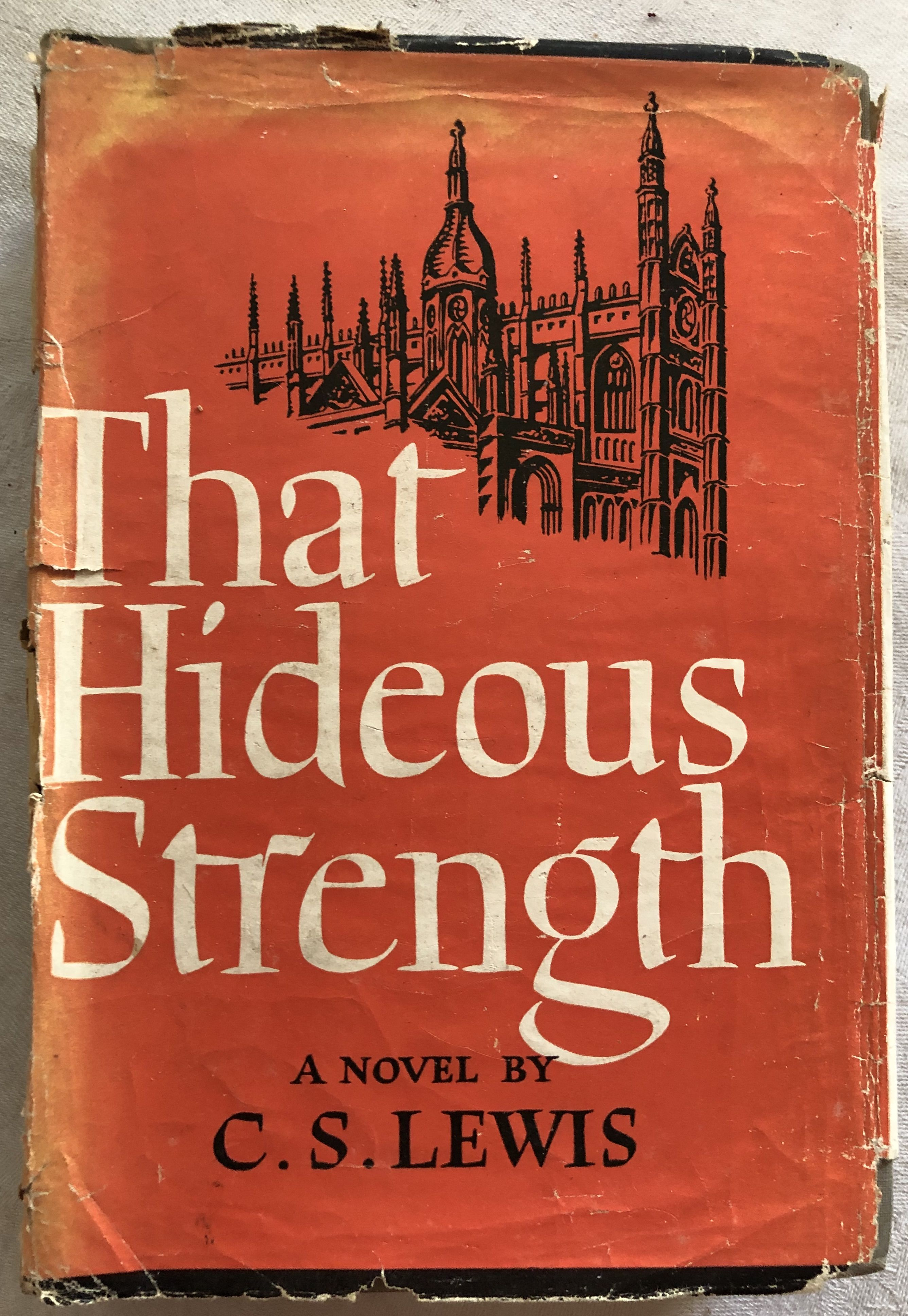
An early edition of THS, the third and final book in Lewis’s Space Trilogy.

The second pair of articles concerns the debate currently a-raging about Christian political involvement, and specifically the idea of Christian Nationalism. I don’t find myself landing firmly in either side of the debate, but I can see that all sides have valid concerns worth considering. Here are two articles, both by men I respect and admire, making their case.

“Christian Nationalism” Misrepresents Jesus, So We Should Reject It – Jonathan Leeman

Identity or Influence? A Protestant Response to Jonathan Leeman – Joe Rigney

Kudos to 9Marks for publishing the critical response to Leeman’s article. I think it’s vital for the brightest and most reasoned voices in the Christian community to make their arguments in public and in good faith. Sadly I’ve seen quite a bit of discussion about Christian Nationalism from both sides of the argument that is dismissive and unhelpful, bringing far more heat than light.