
Re-enchantment and the Surprising Rebirth of Belief in God

The year of our Lord 2023 was the first full year of whatever era comes after the second Elizabethan age, what we might call the long twentieth century. As we turn upon this hinge of history, if you’ll permit me a mechanical metaphor, it feels as though the transmission long left in neutral is grinding its gears and lurching us all forward towards some foreboding edge.

In the wake of Queen Elizabeth’s passing in 2022, I wrote a few words of reflection and poetry. What I tried to express in that piece was the combination of two strong impressions at work in my mind: the decline of our civilization and the hope of renewal. After reading the stimulating but pessimistic Rod Dreher, as well as the piercing but somber insights of Paul Kingsnorth, I feel as though that second element, the hope of renewal, is perhaps more of a distinctly Protestant posture than I had previously realized. Why might that be?

Well, I don’t think it’s terribly complicated. It was the Protestant church which was born in the midst of a bona fide revival as it recovered the glorious gospel which had too long been obscured. For a tiny taste of how that spiritual outpouring was experienced by normal everyday people in medieval Europe at the time of the reformation, see this short clip of pastor Mark Dever holding forth about assurance of salvation. It was the Protestant church which served as the vehicle for the Great Awakening which revitalized not only the church but affected the whole of the British empire (including the American colonies).

This heritage of revival and renewal is part and parcel of evangelical history, it shapes our imagination, and ever directs our hopes and prayers. I’m not at all sure this is true of Roman Catholic or Orthodox believers in the same way.

How fitting then that in the midst of all this talk about re-enchantment and the end of our godless era, it is a Protestant who decides to write a book called “The Surprising Rebirth of Belief in God.” Justin Brierley, the author, is ideally situated to comment on these shifts in public thought as he is perhaps the one person who has moderated the most high-level conversations between Christians and skeptics over the last decade and a half in his role as moderator and host of the UK-based radio show and podcast Unbelievable, as well as The Big Conversation and Re-Enchanting. And also another podcast by the same title as the book. The guy keeps busy.
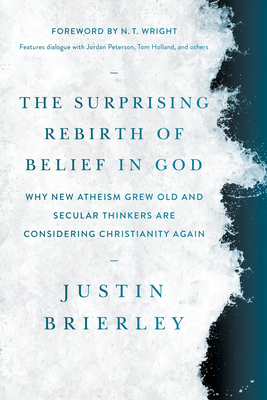
In contrast to the more pessimistic takes on the decline of culture, which abound for understandable reasons, this book looks at the silver lining which we might characterize as the surprising appeal a number of influential public figures (and regular people like them) have been finding in the claims of Christianity. Brierley argues that this may be the first fruits of a coming harvest, the first wave of a newly rising tide of faith.

The metaphor of the tide is taken from Matthew Arnold’s poem, Dover Beach. The key lines are as follows:

The Sea of Faith

Was once, too, at the full, and round earth’s shore

Lay like the folds of a bright girdle furled.

But now I only hear

Its melancholy, long, withdrawing roar,

Retreating, to the breath

Of the night-wind, down the vast edges drear

And naked shingles of the world.

Dover Beach (https://www.poetryfoundation.org/poems/43588/dover-beach)

Brierley opens the book with a stirring reflection on the idea that the powerful pull away from faith that characterized the two hundred years since the Enlightenment is now exhausted, the New Atheists of the 2000s being the last gasp of this spent force. I appreciated the well-researched summary of the New Atheist movement, from its confident rise to its fracturing and dissipation. Its bombastic, overheated rhetoric was matched only by the speed with which it collapsed into infighting and bloviating on Twitter. This dovetails with my own thinking and writing over the last few years, so I found myself agreeing wholeheartedly.

The term that kept coming back to me as I read the book was ‘plausibility structures,’ coined by the sociologist Peter Berger. The idea has a lot of overlap with Taylor’s ‘social imaginary’ in the sense that it tries to capture the intangibles of why certain fashions of thought prevail at certain times. What Brierley describes, through profiles of recent converts like Paul Kingsnorth and Martin Shaw, and Christian-friendly thinkers like Jordan Peterson, Douglas Murray, and Tom Holland, is a profound shift in our culture’s plausibility structures. Suddenly, it doesn’t feel ridiculous to posit that Christianity might be true. Rather, in an unexpected turn, it is those like Richard Dawkins, Sam Harris, or Steven Pinker, still bravely holding the line that Western moral values are self-evident from materialistic premises – despite the incoherence of this view and the rapidly accumulating counter-evidence in the accelerating moral disintegration of our societies – who now seem just a little bit ridiculous.

Time will tell whether Brierley, and I with him, are too optimistic about a turn back towards Christ. One of the interesting aspects of the “surprising rebirth of belief in God” is to note which streams of Christianity these people are being drawn to. There is certainly a draw to Orthodoxy that I never encountered until a few years ago, with the rising popularity of Jonathan Pageau and now Paul Kingsnorth and Martin Shaw. In my own circles I certainly see many people being drawn to faith and baptized into healthy evangelical Protestant churches in a way that wasn’t typical five years ago. As Protestants firmly in the tradition of the great revivals, I think we cannot help thinking in the categories of renewal and longing for the same in our day. How could it be otherwise? The evangelical Protestant heart studies those high points of church history and says, “Lord, do it again.”

This brings me to another point which I have been pondering since Rod Dreher picked up on my psychedelics piece over at Mere Orthodoxy and wrote about it on his Substack. It’s behind a paywall, but Dreher interacted robustly and appreciatively with the claims of the piece before turning to a reflection on his own college LSD experience and the metaphysical questions it brought up for him.

He goes on to clarify what he does and doesn’t mean:

Let me be clear: we are NOT animistic! We do not believe that material things are God. There is an ontological gulf between Creator and Created. Yet we also believe that the divine energies (as distinct from the divine essence) fills all things. It’s like when the sun warms a meadow in the summer, we believe that the energies of the sun penetrate the meadow, and in some sense become part of the meadow’s existence. The lesson for us in this newsletter’s context is that the barrier between matter and spirit is far more porous than most of us moderns think. This is how the cosmos is truly constructed. This was far easier for pre-modern people to perceive; the use of psychedelics is a way to temporarily recover some of that pre-modern perception.

I find this all extremely interesting for a couple of reasons. First, the idea of modern and pre-modern metaphysics. Canadian Baptist theologian Craig Carter, author of the highly regarded ‘Great Tradition’ books, has written very helpfully on his Substack about these different approaches to metaphysics. Here is what he writes in a post called ‘Can Theology Do Without Metaphysics?‘:

The classical metaphysics of premodern Western culture sought to articulate what C. S. Lewis called “the Dao,” that is, the natural law that many cultures have recognized as built in to the fabric of reality. This natural law or wisdom has functioned as the foundation of cultures from Egypt to China to Israel. Positive law is an elaboration of it. Religion reinforces it. Political arrangements are judged by it. Morals are based on it.

After explaining how Plato made the foundational contribution to this project, he argues that “[d]uring the first five centuries of church history, the Platonic tradition was integrated with biblical revelation and the result was the Christian Platonism of Augustine.” He goes on to claim that the medieval synthesis of Aquinas was a high water mark for metaphysics, the undoing of which gave us modernity. After discussing how modernity manifests in three different modern approaches to theology (liberal, fundamentalist, and Barthian), he writes the following conclusion, which I will quote at length:

What can we take away from all of this? It seems to me that three points stand out as most important:

  1. Christian theology is not merely a narrative we tell each other to express our experience of God. Rather, it is a metaphysical description of reality, that is, of God and all things in relation to God. It deals with objective truth, not merely subjective opinion.
  2. Since metaphysical realism is a deduction from biblical revelation and necessary for an adequate statement of Christian orthodoxy, we must go back before the Enlightenment to the period of Protestant scholastic orthodoxy to pick up the thread of the Great Tradition and build further on the foundations of the tradition handed down to us from the church fathers, medieval schoolmen, and Protestant reformers.
  3. Evangelicalism, as the heir of fundamentalism, has failed us and so we need a revival of historic Protestantism. We need “Evangelical Protestantism” not merely “Evangelicalism.”

Theological liberalism, reactionary fundamentalism, and neo-orthodox Barthianism involve various degrees of compromise with modernity. But we should read the signs of the times and conclude that modernity has run its course and is now in the process of self-destruction. Those who marry the spirit of the age will soon find themselves widowed.

We are entering into a period of Ressourcement in which premodern exegesis, doctrine, and metaphysics are being recovered and used to reinvigorate twenty-first [century] theology. The recovery of Christian metaphysics is a massive task that will require the efforts of many historical and systematic theologians in the decades ahead. But it will be worthwhile because ultimately a theology without classical metaphysics can never be classical orthodoxy.

What’s the point of all this? In sum, that there is a core agreement between Dreher, an Orthodox believer and astute observer of culture, and Carter, a Canadian evangelical Protestant like myself, that modern metaphysics is a dead end, and that the future involves a ressourcement or a return to classical (pre-modern) metaphysics, which includes a more enchanted view of the world.

The second thing I find fascinating about the quote above from Dreher is the talk of a porous barrier between matter and spirit:

The lesson for us in this newsletter’s context is that the barrier between matter and spirit is far more porous than most of us moderns think. This is how the cosmos is truly constructed. This was far easier for pre-modern people to perceive; the use of psychedelics is a way to temporarily recover some of that pre-modern perception.

This is very important. I think you will find that many people in our society today are intuiting this porousness in a new way. Not everyone, of course, but there is a sizeable shift. For instance, many have noted that the events of the last three years have awakened them to the reality of evil, even of supernatural evil – Naomi Wolf would be one example of this. We see also the long-ridiculed and suppressed testimonies of those who have had some kind of contact with entities (extra-terrestrial or otherwise) finding unprecedented coverage and attention. We see a fascination with lost ancient civilizations and alternative narratives to the standard historical model teasing at lost high technologies and abilities. We see, as I’ve written about, a renaissance of interest in psychedelics and other ways to achieve altered states of consciousness. In other words, lots of weird stuff.

I recently got my hands on a book of essays by the philosopher Charles Taylor, in which I found the following quote in an essay titled “Disenchantment-Reenchantment”:

But the big change [brought about by disenchantment], which would be hard to undo, is that which has replaced the porous selves of yore with what I would describe as “buffered” selves. Let’s look again at the enchanted world, the world of spirits, demons, moral forces which our predecessors acknowledged. The process of disenchantment is the disappearance of this world, and the substitution of what we live today: a world in which the only locus of thoughts, feelings, and spiritual élan is what we call minds; the only minds in the cosmos are those of humans (grosso modo, with apologies to possible Martians or extraterrestrials); and minds are bounded, so that these thoughts, feelings, and so forth are situated “within” them.

I agree with Taylor that, circa 2011, when this book was released, there seemed to be no chink in the armor of the buffered self. New Atheism was at its height and materialism had the glossy shine of triumphant explanatory power. But today we seem to be entering a different moment, the plausibility structures have shifted, and many today experience a porousness that I think Taylor may find positively medieval, or even pagan.

This is the theme of professor (of religious studies) Diana Pasulka’s recent book, Encounters, which traces the stories of a number of people who experience encounters with… beings, or entities, beyond normal classification. Scratch beneath the surface of people into these fringe topics, and what you find is precisely the opposite of what Taylor asserts about the modern mind: the “only locus of thoughts, feelings, and spiritual élan,” “bounded, so that these thoughts, feelings, and so forth are situated ‘within’ them.” Rather, you find people whose experience is that there are others who can reach into our lives, our homes, and our very minds seemingly at will.

The last thing Dreher turned to is the way in which Orthodoxy, in his view, is uniquely positioned to meet this porous reality:

I believe that Orthodoxy — which is a Way of Life attached to a religious institution — is the best and most complete way to prepare oneself for that encounter [with God]. This is something hard to express to a Western Christian, whose idea of Christianity typically has more to do with propositional thought — with thinking about God, as opposed to experiencing Him.

I’m not sure how to respond to this as a Protestant. In fact, it’s a question I’d like to pose to Mr. Brierley and other evangelicals who are attuned to this whole discussion: How does evangelical Protestantism address this desire for the supernatural to infuse our everyday reality? How can those who are searching for some touch of the transcendent through psychedelics or other pursuits find their true heart’s desire in the form of faith our churches teach?

I think Protestantism can and does meet those desires through, in part, its stream of warm-hearted pietism – the intimacy of a close walk with Christ – but I’m also open to the idea that we have something to learn from the Orthodox in this regard. What would you say?

Whatever the case, we certainly live in interesting days, and my hope and prayer is that by the Father’s good will we might see a glorious outpouring of the Spirit causing a glorious ingathering of souls into the divine enchantment of Christ. Lord, do it again.

In the Valley of the Shadow of Ego Death

That was the proposed title for my newest article, but I can understand why the editor opted to go with something a little more accessible: The Coming Psychedelic Moment. You can find it over at Mere Orthodoxy, an online and print publication that regularly features very thoughtful engagement with the culture from a broadly Protestant perspective. It’s my first piece there, and I’m thankful for the editor, Jake Meador, showing interest in my work and giving me an opportunity to contribute to the intelligent conversation which takes place in their pages.

The idea for this piece came to me one random morning while driving to work. I remember dictating some scattered thoughts and big ideas to my phone and texting it to myself. I saw in a moment of clarity that there was a collision coming our way as two speeding trains were heading for one another.

The first was the downward spiral of worsening mental health among young people. Too complex in its variegated causes to be parsed by me, it could still be presented as a fact. And a fact that meant a growing market demand for answers and solutions.

The second speeding train was the fast-growing level of interest in psychedelics for its medical, therapeutic, and spiritual benefits. With unprecedented institutional support, medical research, and breathless endorsements from celebrities, this train has been gaining steam for quite some time now.

Without some unforeseen intervention, I cannot see what would prevent the popularity of psychedelics from continuing to rise as a primary vehicle for meeting the demands of the mental sufferers that our nihilistic and digitally-addicted age produces. But what will be the result of this collision?

The article is my attempt to answer that question, and to frame all this as part of the broader re-enchantment overtaking the West in our time. The tide of atheism is receding, and the fringes are washing in towards the center again. The world will get weirder and weirder as our overdue payments to reality, which is endlessly weird, come due after deferring them under the pleasant illusions of materialistic naturalism.

This was one of those articles that took a few months to write, bit by bit. I find these the most demanding and most rewarding. I hope you’ll click over and give it a read and share it with someone who might be helped by it. You know, “like and subscribe” and all that self-serving nonsense that is part and parcel of the digital content-creation game.

One of the joys of writing and reading online is stumbling upon hidden gems, and that happened to me shortly after the article above went live. It was linked and suggested to a certain Ashley Lande, who it turns out is one of these New-Age-to-Jesus converts and the author of a fantastic essay, The Self Destroyed, about that journey. It was published at Ekstasis Magazine, an artistic offshoot of Christianity Today. It is a beautifully-written account of her journey through psychedelics and New Age practices (read: endless wheel of religious works) to Christ. You can find it here: Link.

One of the aspects of her story which struck me was how the experience of having a baby helped to deconstruct her false belief system. This was uncannily similar to the testimony of the brilliant and contrarian writer Mary Harrington, whose book I reviewed here a while ago. It has often been remarked that the idealism and ideologies of youth do not always survive the transition to family life, and perhaps these are two more examples of that. But for women there seems to be something particularly powerful about the process of growing a life, a soul, inside one’s body, and then getting to hold and behold that little person in one’s arms.

Is there anything more undeniably real and powerful than this miraculous experience? How can it not slip a few shafts of light through whatever umbrella of protective beliefs we have collected around ourselves? And I think there is another level of meaning here, for in the Christian story the salvation of the world is wrapped up in this very thing: the birth of a baby. We glimpse the first echoes of this in Genesis 3, when we read that the offspring of the woman will crush the head of the offspring of the serpent. And you might have heard of this thing called Christmas, or the Incarnation.

The experiences of our lives connect us to these biggest-of-all themes in ways that our modern, truncated, and flattened mindset cannot easily grasp. But at a deeper level—on the mythic, symbolic level where most humans have lived throughout history—these experiences have purchase and weight enough to move the unseen things.

One of the great joys of the Christian life is making those connections at this deeper level; to recognize that we all participate in the patterns that govern all of reality, and that these patterns exist and extend fractally from the heavenly host around the throne to the church gathered in worship to the children sitting around my table – He upholds “all things by the word of his power.”

Four Lessons from Writing History

“Of making many books there is no end” – Ecclesiastes 12:12

Last week I traveled to Toronto for the annual convention of my denomination, the Fellowship of Evangelical Baptist Churches in Canada – or The Fellowship for short. It was there that every delegate from around the country received a free copy of the book I’ve been working on for over a year, a revised and expanded second edition of A Glorious Fellowship of Churches, which tells the history of our little denomination. This was a collaborative effort with the esteemed historian Dr. Michael Haykin, our second such partnership. In this post I describe a bit of what that process was like and then reflect on what I took away from the experience.

These things are subjective but I think the new cover is quite nice.

As I’ve mentioned before, this was a special project for me to work on because the first edition, published in 2003, was worked on by my mother, Ginette Cotnoir, who served as the editor of the Fellowship’s magazine: then called The Evangelical Baptist and subsequently rebranded to Thrive. She worked with longtime missionary pastor Ernie Keefe on the chapter dealing with Quebec. For the second edition, updating that chapter to cover the time period from its publication in 2003 to current day (2023) was my main writing assignment. This meant interviews with several key leaders and research through annual reports, books, etc. The chapter was already quite long, so there was quite a bit of tightening up to do to make room for the new content. Then the whole thing needed a careful edit so that the narrative voice of the chapter was consistent and enjoyable to read. The main challenge there was to create a bit of distance between the narrator and the narrative. Mr. Keefe – a good and godly man – was a bit wordy and wrote in a style more reminiscent of a missionary update than a history book.

Beyond the writing, the project required a lot of communication, coordination, and editing. Each chapter needed to be expanded to cover the last twenty years, but aside from one chapter, none of the original authors were available to do the work. So this meant finding someone willing to take on the unenviable task of researching and writing a few thousand words of recent history and trying to meld it smoothly into an existing chapter written by someone else completely – with nothing but a “Thank You” and a free copy of the book to show for it. No wonder we had such a hard time finding willing souls for some of the chapters. But in the end we got contributors lined up and I gave them clear instructions as well as a deadline. All of this started well over a year ago, in August of 2022.

Once I received all the chapter updates, I simply blocked off chunks of time in the evenings and went through all the new text with a fine-toothed comb, and then the entire chapter as a whole. There was also one entirely new chapter, written by Steven Jones, the president of the Fellowship since 2011, which dealt with national ministries and how the head office has morphed and changed over the years. It was a needed addition as the first edition did not really deal with the big picture national issues at all.

The last few weeks were a blur of proofreading, sourcing pictures, and putting the finishing touches on the book. Then off to the printers it went, with no small worry in my mind that they might not actually be ready in time for the convention. I could just imagine showing up there and having to tell everyone it would be a week late. But then an email came in on the Friday, just three days before the opening day. The books had arrived! I slept well that night.

My first glimpse of the physical copies happened as I approached the registration tables to get my lanyard and nametag. Then my name wasn’t in their system, and I had to go to another table. After a few minutes, they printed one up for me, and handed me a tote bag with pamphlets and brochures for the conference, but no book. I pointed a bit sheepishly at the pile of books and asked if I could perhaps have a copy. “Sorry, the book is only for those registered as delegates.”

I was not a delegate that year, so I wasn’t sure what to say. I knew I’d be getting a free copy somehow, but I didn’t really want to plead my case at the busy registration table, so I was about to smile and walk away when my friend spoke up and told them that I had worked on it and pointed out my name on the front cover. How nice to have an advocate. So I got a copy of the book and held it in my hands, a very satisfying moment. It looks and feels great. It’s a bit thicker than we expected, but the font is quite large, with generous margins, and lots of colour pictures throughout. So while it feels a bit thick in the hand, it doesn’t feel dense, and therefore not overly intimidating.


So what did I take away from all this? Let me single out four things:

  1. The Importance of Roots

We all love a good tree analogy, do we not? Trees need strong roots. They cannot grow tall or broad without them. Christians and churches and denominations are similar. If there is a consistent weakness in evangelical Baptist groups, it is historical rootlessness. Many of us simply do not know where we came from. This was certainly the case for me growing up. And although this was probably exacerbated by the unusual context of my upbringing, being a part of a church filled with first-generation Christians coming out of a dead French-Canadian Catholicism, it is still a defining feature of evangelicals more broadly. This explains to some part the exodus from evangelicalism to Roman Catholicism, Eastern Orthodoxy, and Anglicanism – three branches of Christianity which emphasize their historical continuity far more than we do.

This was illustrated powerfully by a comment made by Dr. Haykin during a workshop session he gave at the conference. He described how, upon coming to Christ as a young man through the ministry of Stanley Park Baptist Church in Hamilton, he asked his leaders: “Where do Baptists come from?!” But he received no real compelling answer, aside from a suggestion that maybe the folks at Wycliffe College could help him, and that set him on the path to becoming one of the foremost Baptist church historians in the world.

This rootlessness has driven a lot of my own reading and intellectual curiosity over the last two decades. I’ve become convinced that within historic Protestantism, which is in continuity with the best of the ancient and medieval church, we have abundant resources for growing deep, healthy roots. So the problem is not a lack of nutrients but the prevailing alienation from those nutrients and, even worse, an attitude that assumes that the modern church has no need for all that old stuff.

Working on this book reminded me in a fresh way how stabilizing and encouraging it can be to discover one’s roots. The history of the churches that make up the Fellowship in some cases go back to the 18th and 19th centuries. The list of faithful men and women who built and sustained all those churches is long, and we shuffle onto the stage in their wake, holding their props, and seeking to carry on the faithful work they left us. Each new generation receives this legacy from the one before. And that, if it sinks down deep, helps us chart a path that is straight and true.

2. The Nearly-Forgotten Faithful

There are a few names in church history that everybody knows: Augustine, Aquinas, Luther, Whitefield, Spurgeon, Billy Graham. We continue to read and write books about them because of their compelling personalities and the momentous nature of their ministries. But for each of us, there is another, closer set of ancestors – locally, regionally, and nationally – who more directly shaped the church family in which we find ourselves. It is good and right for us to make the effort to remember these men and women. Unlike with Luther and Augustine, if we don’t remember them, no one will. As the spiritual descendants of these saints, it is our responsibility to remember them, to rehearse the works God did through them, and to honour their memory. This seems to me to flow naturally out of the repeated chorus we find throughout the Old Testament to remember the works of God in previous generations.

I’m so glad to have been a part of writing a history of The Fellowship, for I think it helps preserve the health and future of that movement of churches. It helps us remember who we are, and what we’re a part of. The narrower scope means that the book won’t sell thousands of copies, that’s true, but I think it has the potential to have a deeper impact on those who are part of The Fellowship as a result of that narrower focus.

3. The Forgotten Faithful

But here is the reality that we all must embrace: the vast majority of God’s people are, in a human sense, utterly forgotten within a short period of time after their death. This was a curious effect of my research and reading. As I came across name after name I had never heard of before, it impressed upon my mind the reality that there was simply no end to the names or the stories. I could never hear all of them, know all of them, or capture them rightly in words. And yet each of them played their parts through prayer and service and teaching and outreach and building and sowing and reaping, no less than anyone else.

Friends, this is going to be case with you and me, almost certainly. Few will make it into whatever history books are written, and that’s okay. As I heard it put many years ago, there will be only one name lifted high in the new heavens and new earth, and it won’t be yours or mine. The sooner we get on board with that, the better.

4. Don’t Live for the Next Achievement

If you had told me three years ago that I would have gotten multiple articles published and edited a couple of books with real publishers I would hardly have believed it was possible. I had wanted to explore the writing and publishing world for years, but never really saw how that could happen. So I find myself both deeply grateful for these opportunities and also sobered by the fact that the buzz I get from every new venture doesn’t last long.

Thankfully, I am not looking to my writing and editing to give my life meaning; it already has that. I get a joy from using my gifts and all the usual human sensations that come with trying your hand at something new and getting positive feedback. And on the flip side, when that new article is submitted to a new outlet or the new book manuscript sits almost finished but unsent to the publisher, there’s a typical insecurity wondering if it’s any good at all. This is par for the course for writers (and a recurring joke – Anne Lamott’s writing is pretty hilarious on this point). I hate to think how neurotic I would be if I was looking to these kinds of achievements to give my life meaning or secure my identity.

Let me close with an application of this truth. It may not be writing in your life, but maybe there’s some next thing that you’re aiming for and investing just a little too much security and joy into. Maybe it’s a new ministry position, a new relationship, a new church, a work promotion, or even a new car. Well, get ready to be disappointed. None of these things can fill our cup to overflowing.

But there is something which can: a living union with the risen Christ through the Holy Spirit; knowing and being known by God our exceeding joy.


(Update: The book is available to purchase via this link: https://www.fellowship.ca/GloriousFellowship70thAnniversaryEdition)

Spurgeon’s Sorrows and Our Own

Charles Haddon Spurgeon, the famous 19th-century British Baptist preacher, is known for his booming voice, eloquence, and nearly-perfect memory. However, he has not generally been known for his long bouts of deep depression and despondence. This book seeks to bring balance to our view of Spurgeon, but it also manages to do a lot more, since it is not really a biography. It is not really a work of practical theology or advice for Christian living, either. It doesn’t fit neatly into any of these categories, and yet it is powerful and memorable.

At only 144 pages, it is a quick and edifying read.

Perhaps the best category for it is what we call retrieval: A modern writer, Zack Eswine, has immersed himself in the works of a historical figure and seeks to ‘translate’ it for a modern audience, to take the crucial insights and strengths of that older teaching and make it available for the present day. This is wonderful because most Christians, sadly, aren’t going to pick up a collection of Spurgeon’s sermons, or books by the early church fathers – not even short ones with an introduction by C.S. Lewis! And I can understand why. The linguistic and cultural gap is usually too great, requiring too much effort.

But if we are ignorant of the past, we are impoverished, cut off from the rich heritage of time-tested truths, and also far more vulnerable to the lies and half-truths embedded in the culture of our own day and age. This is why I am so glad to see so many publishers engaging in the selective reprinting of worthy and edifying classics.

Why did I love this book? It beautifully captures the merciful heart of God towards sufferers of depression and melancholy. You sometimes can get the sense that Christians from other ages were all made of granite and would have told the depressed to repent of their sadness. But Spurgeon does not even begin to fit this caricature. In fact, the more I read the writings of Christian leaders in centuries past the less this caricature seems to fit at all. This book helped me to be more merciful to those going through depression, and wiser in how I try to help.

It should come as no surprise that Spurgeon did not use the medicalized language of our modern time. He was not speaking in terms of “clinical depression,” although I think everything he said could be applied to the experiences we now label thus as well as all the other conditions of heart and mind he meant to cover: sadness, sorrow, despondency, melancholy, discouragement, and so on.

The road to sorrow has been well trodden, it is the regular sheep track to heaven, and all the flock of God have had to pass along it.

Especially judge not the sons and daughters of sorrow. Allow no ungenerous suspicions of the afflicted, the poor, and the despondent. Do not hastily say they ought to be more brave, and exhibit a greater faith. Ask not – “why are they so nervous, and so absurdly fearful?” No… I beseech you, remember that you understand not your fellow man.

Time for some highlights. Chapter 7 is titled “Help that Harms” and in it there is a small section called “Why We Are Harsh with Sufferers.” Allow me just to list the four items which the author expands upon:

  1. We judge others according to our circumstances rather than theirs.
  2. We still think that trite sayings or a raised voice can heal deep wounds.
  3. We try to control what should be rather than surrender to what is.
  4. We resist humility regarding our own lack of experience.

Whew. As someone who has failed on all these points to some degree, that is convicting but helpful. Some more quotes from the book:

“The mind can descend far lower than the body, for in it there are bottomless pits. The flesh can bear only a certain number of wounds and no more, but the soul can bleed in ten thousand ways, and die over and over again each hour.”

“But isn’t following Jesus supposed to change all of this? Isn’t Jesus supposed to heal our diseases? Many of us feel that if we were more true to Jesus we wouldn’t struggle this way. Others actually tell us earnestly that our salvation in Jesus is threatened and put into question. But just as a man with asthma or a woman born mute will likely remain this way even though they love Jesus, so our mental disorders and melancholy inclinations often remain with us too. Conversion to Jesus isn’t heaven, but [a foretaste of it]… Christian faith on earth is neither as escape nor heaven.”

“It has long been recognized that a spirituality focused only on sunshine, positive thinking, immediacy and quick-fix Bible quoting ‘breaks down impotently as soon as melancholy comes.'”

“It is here, when dealing with spiritual depression, that Charles takes a marked turn in his usually gentle approach as a caregiver and sufferer. Many circumstantial, biological, and spiritual pains outlast our abilities to control them or understand them. But, when we face this ancient foe, the devil, there remains only one thing we can and must do. ‘Fight!'”

“Six years prior to his death, as he looked back over his life, he startles us with his perspective regarding the use of suffering to do good in life. ‘I am sure that I have run more swiftly with a lame leg than I ever did with a sound one. I am certain that I have seen more in the dark than ever I saw in the light-more stars, most certainly-more things in heaven if fewer things on earth. The anvil, the fire, and the hammer, are the making of us: we do not get fashioned much by anything else. That heavy hammer falling on us helps to shape us; therefore let affliction and trouble and trial come.'”


Zack Eswine has written a wonderful little book that captures the merciful heart of God towards sufferers of depression and melancholy. He accomplishes this by exploring the life and teaching of Charles Spurgeon, that great preacher of the 19th century. Spurgeon was a remarkable man in many ways, but perhaps none more surprising than his deep understanding of human suffering, especially mental anguish.

My experience reading this book reminded me of how it felt to read Richard Sibbes’ The Bruised Reed and Thomas Goodwin’s The Heart of Christ. And since Spurgeon was steeped in the Puritans, perhaps that is no accident. These works all capture the lamb-like tenderhearted mercy of God to the weary, sad, and low.

Therefore I recommend this book highly to anyone struggling with depression and also to anyone in ministry (especially if you have never experienced depression). We who would speak for God better make sure we understand His heart towards the weak and struggling, and better still, to so meditate on that heart that it becomes our own.

The Emotional Life of Our Lord, by B. B. Warfield

I have not read much Warfield, so I welcomed the chance to dip into his writing with this handsome little volume put out by Crossway. I found it to be delightful.

Warfield writes with a crisp, clean prose that flows comfortably into lengthy sentences. He is judicious and careful in his choice of words, poking at an idea with different descriptors until he finds just the right one. I love this kind of writing. It is careful, clear, and yet often includes powerful phrases and images. The exploration of the emotional life of Christ is thorough and insightful. Warfield reveals a deep understanding not only of the Bible, including the original language, but also of human beings and emotions.

Here we find not that caricature of the theologian as the emotionally stunted egghead who cannot seem to understand or enter into normal human experiences, but rather the opposite; an emotionally intelligent, discerning person.

Warfield helps the reader appreciate all the ways in which the humanity of Christ is displayed in the gospels, sparse as the treatment of Christ’s emotions is, and yet he draws the reader’s mind and heart up to a posture of adoration for the way in which this reveals his glory and is a part of his redemptive work.

I conclude with two quotes from the work which illustrate its virtues.

“Joy he had: but it was not the shallow joy of mere pagan delight in living, nor the delusive joy of a hope destined to failure, but the deep exaltation of a conqueror setting captives free. This joy underlay all his sufferings and shed its light along the whole thorn-beset path that was trodden by his torn feet.”

“As we survey the emotional life of our Lord as depicted by the Evangelists, therefore, let us not permit it to slip out of sight that we are not only observing to proofs of the truth of his humanity, and not merely regarding the most perfect example of a human life that is afforded by history, but are contemplating the atoning work of the Savior and its fundamental elements. The cup that he drank to its bitter dregs was not his cup but our cup, and he needed to drink it only because he was set upon our salvation.”

This short work is enjoyable, illuminating, and edifying. I highly recommend it.

Anne Rice’s Christ The Lord: Out of Egypt

I came across this paperback copy of the late Anne Rice’s novel in a thrift store. I had heard about it some years ago and knew she was a popular author, though I had never read anything by her. I’m not really into the whole vampire genre, which she was best known for. It seems that this novel, and the subsequent books in the series, were a departure for her. Rice was a boomerang Catholic, raised in a strict Irish Catholic community until college, at which point she left it all behind and drew on the deposit of Christian ideas and images only to adorn her novels. But then she says she lost faith in her atheism. Her old skeptical certainties started to crumble, leading eventually to a full-hearted return to Catholicism and to belief in Christ. Rice says that she then devoted her subsequent writing efforts to portraying the life of Christ, and this book was the first fruit of that endeavour.

So what about this book, then? Well, it’s a bit difficult to rate. Like most readers, I come to the book with some preconceived notions about the person and life of Christ. But this is not like a book about Caesar, who I also have some notions about. Christ is a singular figure, and for Christians like myself, he steps out of history and into the depths of my inner being. I say this to underline the fact that it’s not possible to sit down and read this book like I might read any other piece of historical fiction. So perhaps I’m not really the ideal audience for this book, seeing as I already have strong convictions about Jesus; perhaps the book is better suited to moderns who think they know who Jesus was, swayed by modern liberal scholarship that claims to have scientifically determined the truth about the Jesus myth. More on that liberal scholarship in a bit.

The book opens in Egypt, with a seven year old Jesus living with his family in Alexandria. The plot follows the family’s migration out of Egypt and back to Israel, featuring brushes with both Israelite zealots and ruthless Roman soldiers. The central intrigue surrounds the unanswered questions that young Jesus has about his early childhood. He knows there was something special about his birth, and he knows that something happened in Bethlehem. The plot then develops as he puts together the pieces and grows in his self-understanding.

The prose is, if I’m honest, a bit clunky and bare. It’s not a book that draws you in by it’s beautiful descriptions or its eloquence. Was this an intentional choice, trying to capture the inner voice of this special 7-year old child? I don’t know, but aside from a couple of moments in the book where Jesus was interacting with some of the Rabbis and teachers, the character didn’t really sound or feel like the Jesus of the Scriptures. But then again… how could he? This is an impossible task, and in this regard the book could never succeed. The person of Jesus, as captured by the gospel writers, is the single most compelling literary character ever put to paper. Obviously I believe that he is far more than a literary character, but he is not less than that.

There were a few ways in which Rice wove future characters from the gospels into the family’s network of relationships such that the reader with knowledge of the New Testament would recognize that a deeper connection was being forged such that when the critical interaction occurred later, this extra freight of history would deepen the meaning of the event. For example, Rice has the family meeting the future high priest Caiaphas as a young man. He would, of course, later be involved in the trial and execution of Christ.

This is a plot device that is used a lot by the popular show, The Chosen, whereby familiar events in the gospels are retold with imagined backstories that make the stories feel deeply layered with extra significance. It’s effective on an emotional level, and when done well it doesn’t do violence to the text by changing anything. It simply adds details that the gospel writers left out, details which are no doubt wrong in their specifics but perhaps correct in a broader sense. What I mean is that each person encountered by Jesus in the gospels really had a full and complex life story like we all do. And no doubt some of those stories and specifics made their encounters with Jesus so powerful that they were never the same. I think that a reverential and imaginative exploration of what some of those backstories might have been is well within the bounds of legitimate Christian art, as long as it’s clear that the fictional additions are not Scriptural or authoritative.

But this brings me to Rice’s use of apocryphal material, such as the legends of Jesus discovering his own miraculous abilities as a child: turning clay birds into living ones, causing the weather to change, healing people, and even, as in the opening pages of the book, supernaturally taking the life of a neighbourhood bully (before miraculously resuscitating him). This was an inauspicious start, immediately signaling to me as a reader that the book was comfortable departing sharply from the Bible. Given the fact that this theme faded as the book progressed, I feel like it was used as a way to hook readers more than anything else. Ultimately, however, it cheapened the book, reminding me far more of a superhero origin story, where a character discovers their super powers and unique destiny, than of an episode from Holy Writ. This underscored an important principle that Christian artists must remember: when it comes to the Scriptures, to add to them in this way is automatically a deterioration; by trying to change things we only end up taking away from their own mysterious power.

It’s true the Bible’s style is to leave out many details and to leave many questions unanswered. The hidden things belong to the Lord. What inevitably happens when some well-meaning writer or artist deems to fill in some of the details is that the work takes on a ham-fisted, all-too-human quality. It takes true genius and a measure of restraint to avoid this result. Perhaps we can say that Milton achieved it in Paradise Lost and Samson Agonistes, and many others through the years. Anne Rice’s Christ the Lord: Out of Egypt is a mixed result, with some elements succeeding well and others falling short.

The real surprising delight of this book however came after the narrative was done. In a lengthy Author’s Note, Rice goes into great detail about her own testimony and the journey of her extensive research into the New Testament era. There are some real gems in this text, which I will quote at some length. The great value to me was Rice’s recounting of her encounters with both liberal New Testament scholars and the more conservative ones. I came away impressed at the breadth of her research and reading, and also at the sensitivity with which she read and interpreted these works. She writes:

I had taken in a lot of fashionable notions about Jesus – that he’d been oversold, that the gospels were “late” documents, that we really didn’t know anything about him, that violence and quarreling marked the movement of Christianity from its start. …

New Testament scholarship included books of every conceivable kind, from skeptical books that sought to disprove Jesus had any real value to theology or an enduring church, to books that conscientiously met every objection of the skeptics with footnotes halfway up the page.

Bibliographies were endless. Disputes sometimes produced rancor.

And the primary source material for the first century was a matter of continuous controversy in which the Gospels were called secondary sources by some, and primary sources by others, and the history of Josephus and the works of Philo were subject to exhaustive examination and contentions as to their relevance or validity or whether they had any truth. …

Having started with this skeptical critics, those who take their cue from the earliest skeptical New Testament scholars of the Enlightenment, I expected to discover that their arguments would be frighteningly strong, and that Christianity was, at heart, a kind of fraud. I’d have to end up compartmentalizing my mind with faith in one part of it, and truth in another. …

These skeptical scholars seemed so very sure of themselves. They built their books on certain assertions without even examining these assertions. How could they be wrong?

What gradually came clear to me was that many of the skeptical arguments – arguments that insisted most of the Gospels were suspect, for instance, or written too late to be eyewitness accounts – lacked coherence. They were not elegant. Arguments about Jesus himself were full of conjecture. Some books were no more than assumptions piled upon assumptions. Absurd conclusions were reached on the basis of little or no data at all.

In some, the whole case for the non-divine Jesus who stumbled into Jerusalem and somehow got crucified by nobody and had nothing to do with the founding of Christianity and would be horrified by it if he knew about it – that whole picture which had floated in the liberal circles I frequented as an atheist for 30 years – that case was not made. Not only was it not made, I discovered in this field some of the worst and most biased scholarship I’d ever read.

I saw almost no skeptical scholarship that was convincing, and the gospels, shredded by critics, lost all intensity when reconstructed by various theorists. They were in no way compelling when treated as composites and records of later “communities.”

I was unconvinced by the wild postulations of those who claim to be the children of the Enlightenment. And I had also sensed something else. Many of these scholars, scholars who apparently devoted their life to New Testament scholarship, disliked Jesus Christ. Some pitied him as a hopeless failure. Others sneered at him, and some felt an outright contempt. This came between the lines of the books. This emerged in the personality of the texts.

I’d never come across this kind of emotion in any other field of research, at least not to this extent. It was puzzling.

Rice describes then encountering a different kind of scholarship, written by believing, conservative, orthodox, and even Evangelical scholars. She heaps praise upon many familiar names, from Larry Hurtado and Craig Blomberg to Craig Keener and D.A. Carson; singling out N.T. Wright as preeminently helpful. The author’s note made me very sympathetic to what she was trying to accomplish in this book. Her experience of reading the voluminous (endless) scholarship is instructive and helpful, for she was a kind of curious neutral observer of the space, something which is rare. But she discerned this consistent undercurrent of both shoddy work and personal animus against Christ in the books by people who had dedicated their careers and lives to this topic.

The fact is that Christ, because of his all-encompassing claims to Lordship over every one of us, leaves very few people on the fence about him. The stakes are too high. Anne Rice’s note makes that clear in a surprising and very helpful way. I am sure that many readers found themselves following her towards a proper reexamination of the Scriptures without the jaundiced eye of the skeptics. That alone is reason enough to be thankful for the book, despite its flaws.

Pornography and Our Anthropological Crisis

I recently had a piece published over at The Gospel Coalition Canada called Pornogaphy Poisons Everything.

I like the image of the bright green snake picked out by the editor, but the title I proposed fell a bit flat. I’m no expert in marketing or anything, but it seems there should be a little twist of intrigue in the title of a piece that piques the interest of the prospective reader. In my case, I just bluntly stated the thesis of my piece in three words and left it at that. No mystery. Upon further reflection, even adding a single word would have helped: How Pornography Poisons Everything. Ah, that’s better. Well, lesson learned.

Despite the title I’ve been very pleased with the engagement the piece has received, as it was linked to by the main TGC website and Twitter account as well as Tim Challies – major boosters of traffic! Such was their reach that I’ve now got a little radio interview scheduled to discuss the topic further with the fine folks at Moody Radio Florida. I expect this will consist of me trying hard not to say anything spectacularly stupid and my wife trying to keep the kids quiet while I talk into my computer.

I have been reflecting on the themes in the article for a number of years, so I am grateful that people seem to find it helpful, or at least confirming of some intuitions they held. What I tried to make clear is some of the subtle ways pornography influences individuals, families, churches, communities, and societies. I found it helpful to use a combination of Scripture and Natural Law reasoning (also known as common sense) to make this case.

I noted in the piece a shifting tide of opinion in some quarters on the question of pornography. The libertarian laissez-faire approach of “do whatever you want as long as it doesn’t hurt me” has proven disastrously inadequate for helping our society, and especially impressionable youth, deal with the wave of pornography that has multiplied proportionally with the spread of Wi-Fi and high-speed data-enabled cellphones with HD screens. And this all the more given the fact that foolish parents anxious to be liked by their teens are pushovers and give them these devices with absolutely no guardrails. Disaster.

So thoughtful people are waking up to the fact that this is noxious and dangerous stuff which is harming a whole generation recently come of age, and that wise leaders will no more allow this to go unrestricted and unregulated as they would let drug dealers open up booths in our community high schools and at local parks. Why? Because young people do not have the moral or even biological resources to muster up a strong defense against the open availability of such powerful stimulants. It’s been interesting to see secular people coming around to this realization and starting to make moral cases against not only open access to pornography for minors but the industry itself.

Another fascinating angle is the growing activism and legal challenge to the frankly criminal behavior of PornHub, the world’s biggest porn site. The lawsuits are huge, and well, money talks. It’s no exaggeration to say that there is a large amount of content on that site which not only depicts heinous crimes but is criminal itself; freely available images and videos that may someday soon be entered as incriminating evidence in a trial. Outrage over that fact should be widespread and non-political, and I have hope that awareness is growing. While we’re on the subject, perhaps you want to sign the online petition over at Traffickinghub.com.

I hope to write more about this in the future, but in the meantime I need to write the promised Part 2 where I try to offer some help for those still ensnared and enslaved to porn. Stay tuned for that in coming weeks.

This brings me to a related topic: anthropology. I know, I know – another big word which we’ve all heard before but aren’t really sure what it means.

“What is man? What is anthropology?”
Photo by Max Duzij on Unsplash

And for my most faithful readers, this will feel like a re-run of a previous post, but I’m firmly convinced that it is a necessary word to understand the nature of the rapid transformations taking place in our time. One of the most helpful thinkers in this regard is Carl Trueman, who has made the transition from church historian to cultural critic with great success. And boy can he write. Consider for example this article just published today over at First Things, where he responds to the same controversy I alluded to in my piece, namely the statement made by Dennis Prager that pornography use and lust are not necessarily morally wrong.

Prager’s statement reveals that he lacks a real grasp of what is causing the social and political problems that he claims to abhor: We live in a time of anthropological chaos, where the very notion of what it means to be human is no longer a matter of broad social and political consensus. 

Pornography is a great example of this. Behind the problems that should have been obvious to Prager—the objectification of other people, the human trafficking, the transformation of sex into something that is self- rather than other-directed, the reduction of the participants to instruments of pleasure for the spectators—lies a basic philosophy of life that sees me, my desires, and my fulfillment at the core of what it means to be human. Pornography is thus part of an anthropological shift that manifests itself most obviously in sexual mores but is far more comprehensive in its significance. 

Later, he adds:

Now, sex and pornography are the most dramatic examples of where this plays out, but they do not exist in isolation from broader considerations of what it means to be a human person. Therefore those, like Prager, who see pornography as having a legitimate function are complicit in this shift. And this change underlies no-fault divorce, gay marriage, and (in its subordination of the body and its functions to the individual’s sense of well-being) even transgenderism. It is foundational to the progressive cause. To concede here is to concede everywhere. 

I do encourage you to read the whole thing. This analysis goes much deeper than the moral outrage of an offended conscience and gets at the roots of what is driving a multitude of bewildering cultural phenomena. We do not need the momentary heat of Twitter-depth indignation which tempts us to feel morally self-righteous. That is cheap. But we do need the light of historically-informed thinking that sees through the chaos and confusion of the day and makes clear the deep tectonic shifts happening in our culture. That is “men of Issachar” type stuff.

I hope, in some small way, to continue making contributions to that good work. As always, thanks for reading.

For the Sheer Joy of It

Photo by Lili Popper on Unsplash

This is the reason you shall do it. For it brings you a pleasure which is unalloyed, an unmitigated good. I don’t know what it might be for you, this thing. I can think of a handful of things for me: writing, driving (not commuting), reading a good book, going for a walk with my wife, playing with my kids until the giggles and shrieks mingle, building or fixing something with my son, and so on.

By dint of our individual natures and life experiences we will each have some set of activities which tap into some simple and primal creaturely mirth. My exhortation is: do that. It’s good. Obviously some caveats are in order, such as, don’t sin, since sin by definition does not satisfy nor is it aligned with who we were made to be. But aside from that, there is broad freedom here.

For some, there are kinds of manual work which fall into this category. Probably not shoveling – though who knows? I’m thinking of something a little bit more skilled which passes the time and brings pleasure. The pleasure should not be dependent on the accomplishment of some task or goal. The thing I have in mind is not done for the sake of productivity or efficiency; it is anti-utilitarian. It’s the kind of thing that fills in the open spaces on the hourly planner, which doesn’t really cross any items off any list, but which never feels like wasted time.

In short, it is good to do some things for the sheer joy of it, and not for any other purpose. There is something here which we share with other creatures. While animals are guided largely by instincts, they each have their own personalities and they also engage in playfulness which has no strict Darwinian logic to it, not that I am a Darwinian. Sometimes a dog just wants to run around the yard in big loops as fast as it can. There’s a pleasure inherent to the sensation of motion, balance, and even the aesthetics of a finely executed jump or swoop. See for example how the birds seem to enjoy playing in the wind, for the same reason children and child-hearted adults enjoy holding their hand out the car window on the highway, playing on the flowing air like the aileron of a jet.

If your life is so full of lists and efficiency and every-moment-scheduled activity such that there is no room for these kinds of things, or if the thought of it induces a mix of anxiety and guilt because you’re captive to an inflexible productivity mindset, I shake my finger at you, though in a friendly way.

My friend, we are human beings, not machines. We are mind, body, soul, and spirit, not algorithm, subroutine, and hydraulics. A human life, at a human pace, is one of those universal aspirations of all people everywhere (with varied manifestations of course). The French term, joie de vivre captures something of this essential joy in being. To lose this thing I’m trying to describe in any measure is to slide towards the mechanistic, robotic, slave-like inhumanity. Chesterton makes a related point in his chapter called The Maniac in the book Orthodoxy. Allow me to quote the relevant section:

The last thing that can be said of a lunatic is that his actions are causeless. If any human acts may loosely be called causeless, they are the minor acts of a healthy man; whistling as he walks; slashing the grass with a stick; kicking his heels or rubbing his hands. It is the happy man who does the useless things; the sick man is not strong enough to be idle. It is exactly such careless and causeless actions that the madman could never understand; for the madman (like the determinist) generally sees too much cause in everything. The madman would read a conspiratorial significance into those empty activities. He would think that the lopping of the grass was an attack on private property. He would think that the kicking of the heels was a signal to an accomplice. If the madman could for an instant become careless, he would become sane. Every one who has had the misfortune to talk with people in the heart or on the edge of mental disorder, knows that their most sinister quality is a horrible clarity of detail; a connecting of one thing with another in a map more elaborate than a maze. If you argue with a madman, it is extremely probable that you will get the worst of it; for in many ways his mind moves all the quicker for not being delayed by the things that go with good judgment. He is not hampered by a sense of humour or by charity, or by the dumb certainties of experience. He is the more logical for losing certain sane affections. Indeed, the common phrase for insanity is in this respect a misleading one. The madman is not the man who has lost his reason. The madman is the man who has lost everything except his reason.

I rarely read Chesterton without a smile on. His writing is so colourful, even playful. His mind jumps around between ideas and is always running here and there on the page, the reader at times struggling to keep up. And then at the end of a few paragraphs he puts the finishing touches on some zany idea and it comes into focus for the reader with a shock, like having been led into the Sistine chapel in darkness and then having someone suddenly flip on the lights. (Does the Sistine chapel have artificial lights? My metaphor depends on it.) I remember when I first read this paragraph above, how delighted I was. I had never thought of reason and madness that way before, and it gave me a new and permanent enjoyment of little ’causeless’ and ‘useless’ actions. Children are, of course, the ultimate example of this. They are playfulness incarnate, and have much to teach us in this regard.

G. K. Chesterton, the so-called prince of paradox.

Another fine example comes from the movie Chariots of Fire, where a conflict arises between the gifted runner Eric Liddell and his ministry-focused sister. She thinks he should quit running since it accomplishes nothing for the kingdom, but he sees something in the running that she cannot – some worth that is in and of itself, not dependent on some other measurable accomplishment. “When I run, I feel God’s pleasure.” But lest this attitude be taken as a being fundamentally at odds with a life lived fully for God’s glory, I want to point out that after his epic performance in the 1924 Olympics, during which his conviction to keep the Sabbath engendered no small amount of publicity, he became a missionary to China where he eventually died at the age of 43, a prisoner in a Japanese internment camp during World War 2. His love, concern, and self-sacrificing generosity towards his fellow inmates left an indelible mark on those who survived.

Eric Liddell

There is an application here for those in demanding and important vocations, perhaps especially ministry, since it concerns eternal things. There is an understandable way of thinking that says something like I can’t possibly read a novel or take up a hobby or learn a new instrument when there are people suffering and I can do something about it. This can work for a while, but I see at least three problems with it. First, this mentality is at odds with the natural rhythms of work and rest that God has designed us for. This attitude leads towards burnout. Second, there is a messiah complex, or the seeds of it, in that approach. Third, a life crammed to the ceiling with work is not a good model for others to emulate. Those in ministry especially are to be ‘an example’ to regular folks. But a life with no margin, no niches carved out for the simple pleasures described above, is not balanced or healthy. This is not to say we should not work hard, put in long hours, or have certain seasons of especially intense exertion. One can do all those things and yet preserve the kind of childlikeness, freedom to rest, and simple pleasures I’ve been trying to describe.

So to return to my opening exhortation: go ahead and do that thing for the sheer joy of it. Who knows? You may even find yourself feeling God’s pleasure in it.

Review of Timothy Keller: His Spiritual and Intellectual Formation

I have been an avid reader and consumer of Tim Keller’s teaching since not long after my conversion to Christ in 2004. I found in him something of a kindred spirit, a person whose temperament and disposition was in many ways similar to my own, and therefore someone whom I could look at and say, “I’d like to learn how to be more like that.” I can say that Keller’s influence on me has been profound and positive. And in the interest of honesty and disclosure, I must admit that Keller and I are very close, by which I mean that I once said a brief hello to him during a large lunch gathering at a conference while he ate macaroni salad. I’m sure he has never forgotten it.

Tim Keller, probably thinking about that macaroni salad.

I therefore approached this book with a warm disposition. Despite the presentation of the book as not quite a biography, it is. Only it’s one that rightly makes no attempt to analyze Keller’s legacy. The book deepened my appreciation for his influences, many of which I was already familiar with: R.C. Sproul, Richard Lovelace, Jack Miller, Harvey Conn, Edmund Clowney, John Owen, and Jonathan Edwards.

The narrative spanned Keller’s entire life and ministry and it filled in many details that I was not familiar with, including some that weren’t so flattering, such as the persistent struggles he had leading the staff of Redeemer church before the arrival of a good executive pastor. The only part I cringed at a little bit was the mention of Francis Collins as the supposed paragon of the ‘faithful presence’ approach to cultural influence. Whatever respect I had for Collins died from the multiple gunshot wounds of this, that, and the other bullets of journalism and public facts. His role in the early days of the pandemic slandering the framers of the Great Barrington Declaration hasn’t helped either. But let’s move on from that unpleasant subject.

Like all of us, Keller’s weaknesses are the inversions of his gifts. His ability to see things from all sides, analyze them, and arrive at a mediatory solution can sometimes slip into the pitfall of false equivalency. His self-confessed disposition towards peacemaking has at times been at the cost of moral clarity. In short, he is not all that the church needs. He is not Luther, and at times we need Luthers. Much of the criticism of Keller in recent years has amounted to just that: the sense among some that the church now needs more of a blunt, Luther-like voice, and that Keller is not the man for that job. I sympathize with that sentiment, but it does not lessen for one moment my gratitude for Keller’s influence on me personally and on the church as a whole.

The church needs men and women with Keller’s uncanny ability to synthesize insights from wide-ranging sources. Rarely have I heard or read Tim Keller and not been stimulated to think more deeply and wisely, as well as to feel (or wish to feel) more affection for Christ. His greatest gift to the church has been the combination of his fertile mind and warm heart. Yet the church needs more than Tim Keller and those like him. This shouldn’t be controversial or surprising, should it? ‘The eye cannot say to the hand, “I don’t need you!” And the head cannot say to the feet, “I don’t need you!”’ (1 Cor 12:21). Likewise, the church which tries to grow into a balanced and healthy body using only one or two body parts will become anything but.

If nothing else, I hope this book encourages many readers to mine the spiritual and intellectual resources that so shaped and animated Keller’s thought. In years past I did it by scouring articles, podcasts, and footnotes, scribbling authors’ names and book titles down and looking them up later in libraries and on iTunes and Amazon. I still remember the thrill of stumbling upon all the audio lectures for Keller and Clowney’s D.Min preaching course from Reformed Theological Seminary, Preaching Christ in a Post-Modern World, on the now-defunct iTunes University platform. I then found the accompanying syllabus as a badly-scanned 188-page PDF somewhere online. For the next few weeks I soaked up the stimulating lectures while doing repetitive manual labour at my cabinet-making job. That experience alone led to permanent shifts in my understanding of sanctification, preaching, and the dynamics of sin in both the preacher’s and listener’s hearts. It was through Keller that I was introduced to Luther’s Shorter Catechism, Lovelace’s Dynamics of Spiritual Life, Edwards’ The Nature of True Virtue, Chalmers’ The Expulsive Power of a New Affection, and other gold mines.

It brings me joy to think of many others now being ushered into those rich deposits, for in them the believer discovers more of Christ and more of the Scriptures which testify to Him.

A Reluctant Review of A Book – Becoming Free Indeed by Jinger Duggar

The book.

Okay, yes, I did read this glossy author-on-the-cover reality TV star’s co-written faith ‘memoir.’ Guilty as charged. As a general rule, I avoid any book with the author on the cover like a slug avoids the salt shaker. I know what I’m likely to find behind the cover: smarmy tone, bland prose, predictable writing – But! There were extenuating circumstances, your Honor. You see, my wife, whom I love, watched the Duggar show for a while (and possibly I sat beside her at various points while it was on – who can say?), and so she was interested in the book, and we were on a long road trip, and we had free access to it via Scribd, and it purported to be a kind of reverse-deconstruction of the author’s faith, a topic which has interested me for some time. So you see? Anyone would have read this book in such circumstances. Good, I’m glad we got that out of the way.

(Interested in my thoughts on Jill Duggar’s memoir, Counting the Cost? You can see a short reflection and review here.)

Frankly, I had quite low expectations, so I can say it was better than I expected. The story, in case you’re not up to speed, is that Jinger Duggar grew up in a uber-conservative subset of American evangelicalism that had many elements of your typical cult. Centered around the person and teaching of Bill Gothard, a one-time Wheaton grad and inner city youth minister, it focused heavily on external issues of morality such modest dress, courting instead of dating, having lots of children, shunning debt and mortgages, not drinking alcohol, not listening to secular music, etc. Her family had a long-running reality TV show because they had 19 kids and seemed like a strange artifact of American culture. The whole thing took a dark turn when the eldest Duggar son, Josh, was accused of molesting some sisters and eventually got caught with child pornography and was hauled off to jail where he remains. Gothard was also accused by scores of the young attractive women he staffed his headquarters with of sexual misconduct of various kinds.

Gothard’s ministry was called the Institute for Biblical Life Principles (IBLP) and the whole thing sounds to me like a giant collection of red flags literally on fire. But clearly quite a few thousand people were taken in hook, line, and sinker, so I’m sure it had a certain appeal. As with other legalistic and unbiblical religious groups, you can’t help but have a lot of compassion for the people raised in it. And it’s not surprising that a huge chunk of them leave Christianity behind completely, imagining it to be equated with what they knew growing up.

This book does a good job of drawing important distinctions between the legalism of IBLP (and ultra-conservative fundamentalism in general) and the gospel of Christ. The story, such as it is, is pretty interesting and is written in a simple, straightforward style. The narrative is interspersed with lengthy treatments of Gothard’s teaching and explanations of Jinger’s new understanding. There is a certain irony in the fact that Jinger recovers from the fundamentalism of IBLP by landing at Grace Church in California, a place which many within evangelicalism would equate with a kind of quasi-fundamentalism under the long and prominent ministry of John MacArthur. I wouldn’t totally agree with that characterization but there’s no denying that Grace is very conservative.

One thing I found particularly interesting was the author’s description of how her view of God changed as she ‘disentangled’ the beliefs she absorbed from Gothard from the truth of Scripture. I recently re-read Sinclair Ferguson’s superb ‘The Whole Christ,’ wherein he shows how legalism and antinomianism share a common rotten root, one which reaches all the way back to the garden, and that this root is a suspicion that the heart of God the Father is not one of love, mercy, and grace. So this God must be appeased with performance and religious duties lest he be angry and withhold the good things we want.

At one point, Jinger quotes Gothard as telling a woman whose life was a sinful mess that she needed to clean up her life before Christ could come into it. As Ferguson shows, this is more or less the same instinct as some in the Church of Scotland had during the Marrow Controversy and the debates over whether the gospel should be freely offered to all or only towards the truly repentent.

It is nothing less than an anti-gospel, and it enslaves rather than frees. It sees the Father as one who holds back the benefits of redemption through his Son until the person has made themselves worthy to receive them. But as Ferguson points out, this results in a grave error, the separation of Christ from His benefits, and it breeds spiritual sickness rather than health.

Rather, the Father has sent the Son because he loves us, and all who turn to Christ in repentance and faith receive Him and all the manifold gifts of redemption. The believer is united to Christ by the Holy Spirit, and Jesus is the greatest gift – for in Him are all the benefits, and through Him we are reconciled to the Father, and it is His Spirit by which we are sealed and with which we are filled.

It’s hard to overstate the distance between this rich and glorious gospel and the paltry saltine cracker ‘gospel’ of IBLP and Bill Gothard. This book made me thankful for the wonderful teaching I found and received early in my Christian life which helped me grasp not only the pulsing heart of the gospel but the grand sweep of Scripture’s united narrative, the history of redemption.

I have to say there’s a certain amount of righteous anger I feel towards the people who run these legalistic religious systems based on the Bible. I was stunned to hear that Jinger, despite having grown up in a supposedly very ‘Christian’ environment for her entire life, had never heard decent expository preaching (only proof-texting), nor an explanation of how the two Testaments fit together, nor how Christ fulfilled the law, nor had she ever heard a real God-centered emphasis on His glory and character, nor been given any sense of the historical placement of her community’s tiny slice of Christian belief within the grand scope of Christendom, nor had Romans 14 or the concept of liberty over disputable matters or the Christian conscience ever been explained to her, nor had she been shown how all of Scripture is ONE story which all culminates in Jesus. What!? Was it really all about how long skirts should be and avoiding rock music? These poor people.

I’m glad Jinger managed to disentangle that mess and find that Christ is far better. Given the size of the audience for their now-ended TV show and the toxic level of interest many Americans have towards the lives of celebrities, I’m sure it will be read by many. I think it could be helpful for some, especially those who grew up in IBLP or similar legalistic groups. If some are thereby guided towards a living faith in the real Christ through a richer understanding of the gospel, then all I have to say is: Thanks be to God.

As an Amazon Affiliate I earn a small commission from qualifying purchases of books purchased through links on my website, while customers do not pay anything extra.