Dave Barry—Still a Clown after All these Years

Dave Barry, true to form, made fun of himself and almost everything else in his memoir. I’ve enjoyed Barry’s writing on and off over the years as I’ve come across it. This book, like many of his columns, had me bursting out with laughter. For that reason alone it was worth reading.

The more serious sections were handled with adequate solemnity, but Barry’s brand of irreverence, as funny as it is, seems inadequate to face up to the realities of the world. The ability to make everything into a joke cuts both ways, of course. It helps one get through tough times with humour and wit, but it also encourages a habit of mind and heart that ultimately undermines one’s ability to take seriously what in fact is serious.

C.S. Lewis is helpful here, lest I be accused of simply being a fun-hating curmudgeon. In the Screwtape Letters, he helpfully distinguishes between four types of laughter: joy, fun, the joke proper, and flippancy. The first two are good and harmless. Barry’s humour contains a fair amount of rejoicing in sheer fun, and this is all to the good. The joke proper relies “on [a] sudden perception of incongruity,” and this is Barry’s bread and butter. Much of the time, it is simply clever and a good deal of fun, but Lewis warns that this type of humour is especially apt to be used to destroy the healthy human instinct towards shame (Brené Brown will just have to deal with it; I’m going with Lewis on this one). Barry certainly deploys jokes in this way, though not nearly as much as so many of the most popular comedians.

The last type of laughter, flippancy, is described memorably in the following lines: “Only a clever
human can make a real Joke about virtue, or indeed about anything else; any of them can be trained to talk as if virtue were funny. Among flippant people the Joke is always assumed to have been made. No one actually makes it; but every serious subject is discussed in a manner which implies that they have already found a ridiculous side to it…. It is a thousand miles away from joy it deadens, instead of sharpening, the intellect; and it excites no affection between those who practice it.”

As much as I enjoyed the book, I did feel this kind of flippancy to be at work in Barry’s writing, and it is the part of it I enjoyed least. Perhaps it is an occupational hazard when one is in the business of comedy. The other thought that came to me was that Barry’s type of humour is particularly situated in the baby boomer generation’s experience of the world. This is not a criticism, only an observation. And it seems to me that it’s unlikely to appear again in any subsequent generation.

I grabbed the (audio)book because I wanted something light and enjoyable to listen to on my commutes that wasn’t a current events podcast riling me up about the latest unbelievable political outrage. It certainly met and exceeded my hopes for such a light and enjoyable read. If that’s what you’re looking for, Dave Barry’s memoir may be just the ticket.

Escaping the Malaise of Modernity

The opening chapter of Samuel Parkison’s ‘To Gaze Upon God’ — a work of theological retrieval for evangelicals on the beatific vision — makes a striking argument.

Parkison states that all Christians throughout history have agreed that the beatific vision — seeing God face to face — is what makes heaven heaven, it is our blessed hope. But evangelicals in the last couple centuries have largely abandoned the term, though thankfully, many have not abandoned the idea. For example, John Piper’s ministry has hammered home the idea that seeing and savouring Christ is the chief delight of the soul; C.S. Lewis’ vision of “further up and further in” forever in Aslan’s country is similar, and so on.

But then Parkison takes aim at what he calls the “fundamentalist-biblicist” approach to the Bible as fatally compromised by the spirit of the Enlightenment. “Tradition, according to the Enlightenment, is a straight jacket, confining the would-be liberated intellect to immaturity.” Sola Scriptura, he argues, was never meant to be a rejection of the “confessional, catechetical, and liturgical life” that is shaped by the wisdom of past generations.

“The contemporary antipathy for tradition that often accompanies fundamentalism and a biblicist approach to theology did not come from sola Scriptura; modernity and the Enlightenment are to blame for this aberration form historic Christianity.”

This is a bold statement. And we are only at page 6. He goes on to argue that we have been largely cut off from our historical inheritance as Christians by this Enlightenment turn, this promise of intellectual maturity that turned out to be more like the journey of the prodigal son. Seeking self-fulfillment and freedom, we’ve ended up as a culture and in much of the evangelical church at a dead end, wondering what went wrong.

In this context of modern confusion, the idea of the beatific vision “touches a nerve within the soul; a nerve for which the post-Enlightenment imagination does not even have a category.”

And here is the conclusion he drives home to conclude the section:

“The way we escape the malaise of modernity is not by embracing individualistic biblicism, for individualistic biblicism is stuck in that very same malaise. The way forward is first the way backward. We must correct our course, and theological retrieval is the way to do this.”

I find myself resonating with this line of argument, though Parkison puts a very sharp point on the matter. One of the challenges here is that not every Christian or lay leader or pastor can be (or *should* be) doing this work of retrieval. There are SO many other good things to give ourselves to.

But I am convinced we do need a broad movement within evangelical Protestantism that consciously works to retrieve the best of the small-c catholic tradition, the ‘Great Tradition’ that forms the central core of Christian belief (including philosophical substructures) in such a way that is accessible and digestible for 21st-century believers of all kinds. Thankfully, there is such a movement already underway.

I’m looking forward to what I’ll find in pages 8-214 of this book, and maybe I’ll have more to share. I expect this book will be intellectually stimulating and, more importantly, spiritually edifying.

C.S. Lewis’ Miracles – Another Prescient Masterpiece

Somehow I have never read ‘Miracles’ until now. I listened to it, narrated by a very good narrator, and really enjoyed it. Lewis’ prose is so striking and memorable – but why? It is a strange mixture of dense rational arguments, conversational tone, and colourful illustrations. There is a strong undercurrent of wit and humour spread throughout the whole thing. This kind of writing is a pleasure to take in, even when you don’t agree with it. Chesterton is the same way, though perhaps more effortlessly funny.

Lewis here is writing in the mid-20th century in an intellectual climate that is modernist and naturalistic. He is concerned about making a robust defense of miracles, but really miracles is just an entryway into a far more expansive discussion that centrally takes aim at the hubris of modernist metaphysics (naturalism) and, having disarmed it, makes a strong case for the reasonableness of the Christian faith which includes the central Christian miracles of the incarnation and resurrection.

It’s worth noting that he presents the incarnation as the central Christian miracle in a way that evangelical apologists have typically presented the resurrection. Lewis is in line with the early church here more than contemporary evangelical apologists, I believe, and my hunch is that this difference is not disconnected from the relative weakness of evangelical anthropology – our understanding of the human person and human nature. Which is not to take anything away from the importance of the bodily resurrection, of course.

This book is also a prime example of what makes Lewis so rewarding to read: his writing has aged so well. In fact, his analysis and prognosis of Western culture was so perceptive and ahead of its time that some of the books that were largely ignored in his lifetime have surged in popularity only in the last couple of decades, such as The Abolition of Man and That Hideous Strength. To a lesser degree, this is true of Miracles as well.

One of the most perceptive writers of recent years has been Dr. Iain McGilchrist, a psychologist and cultural critic who specializes in the way the brain hemispheres affect our modes of thinking. His work is fairly popular now, as one can see by the flowering of discussion about the left vs right brain kinds of thinking. He argues that the left hemisphere, which specializes in a narrow focus of attention for manipulating and controlling elements of our environment, has become dominant in the modern era. But the left hemisphere was always meant to be subservient to the broader-scoped, more intuitive and open right hemisphere. He argues that many of our modern psychological and social ills are related to this left-brain dominated mode of thinking.

Here again Lewis seems to have anticipated this state of affairs, this modern crisis. He was himself a man of unusual gifts in this exact regard, as John Piper helpfully explored in his conference and subsequent collaborative book called ‘The Romantic Rationalist’. In short, Lewis’s mind was a remarkable marriage between the left-brained hardnosed rationalism that he imbibed from his beloved tutor William Kirkpatrick, ‘the Great Knock’, and the right-brained imaginative intuition and romanticism. How many other authors have managed to write works of fiction (imaginative) and non-fiction (rational) that have endured so well?

These two passages here illustrate how prescient Lewis was in his diagnosis of the modern mental malady. The first passage traces the process of increasingly “truncated thought.”

“There is thus a tendency in the study of Nature to make us forget the most obvious fact of all. And since the Sixteenth Century, when Science was born, the minds of men have been increasingly turned outward, to know Nature and to master her. They have been increasingly engaged on those specialised inquiries for which truncated thought is the correct method. It is therefore not in the least astonishing that they should have forgotten the evidence for the Supernatural. The deeply ingrained habit of truncated thought—what we call the ‘scientific’ habit of mind—was indeed certain to lead to Naturalism, unless this tendency were continually corrected from some other source. But no other source was at hand, for during the same period men of science were coming to be metaphysically and theologically uneducated.” (Chapter 6).

In this second passage, Lewis argues that Christianity is uniquely equipped to bridge the “unbridgeable chasm” that has grown between the two different ways of thinking.

“There is thus in the history of human thought, as elsewhere, a pattern of death and re-birth. The old, richly imaginative thought which still survives in Plato has to submit to the deathlike, but indispensable, process of logical analysis: nature and spirit, matter and mind, fact and myth, the literal and the metaphorical, have to be more and more sharply separated, till at last a purely mathematical universe and a purely subjective mind confront one another across an unbridgeable chasm. But from this descent also, if thought itself is to survive, there must be re-ascent and the Christian conception provides for it. Those who attain the glorious resurrection will see the dry bones clothed again with flesh, the fact and the myth remarried, the literal and the metaphorical rushing together.” (Chapter 16).

As you can see, the book is brilliant and worthy of close scrutiny.

Another element that stood out to me was the way Lewis based his central argument against naturalism in the mystery of human consciousness and the mystery of human thought. I don’t know if consciousness studies were in vogue in the mid-20th century, but I know they have exploded in popularity in recent years. And somehow everything Lewis said about cognition and consciousness aligned with what I understand (as a layman) to be the best ‘theory of mind’ out there.

For a book that is nearly 80 years old, that is remarkable.

On Facts & Meaning; Nihilism & Salvation

I recently re-read that great collection of essays & talks by C.S. Lewis, The Weight of Glory. Any regular readers here know I cannot go long without referring to Lewis’s thought in some way. I’m afraid that is just the way it’s going to be. I find reading Lewis to be like spreading a large bag of super-fertilizer all over the garden of my mind – it stimulates growth and activity of all kinds.

One of the essays in that book is called ‘Transposition’. It is on the more philosophical end of things, discussing how things on one level of reality look to the level below it, such as how 3-dimensional shapes can be represented on 2-dimensional paper but only in a flattened and reductionist way. You can find it online (usually bundled with other essays) but here is an audio version of it: https://www.youtube.com/watch?v=PXwJk8WtpUY.

He uses this analogy to make sense of how the reality of the spiritual so often looks and feels prosaic and explainable in material terms. He argues that this is exactly what we should expect, but that when one assumes there cannot be a higher realm then he will always find some such explanation:

And the sceptic’s conclusion that the so-called spiritual is really derived from the natural, that it is a mirage or projection or imaginary extension of the natural, is also exactly what we should expect; for, as we have seen, this is the mistake which an observer who knew only the lower medium would be bound to make in every case of Transposition. The brutal man never can by analysis find anything but lust in love; the Flatlander never can find anything but flat shapes in a picture; physiology never can find anything in thought except twitchings of the grey matter. It is no good browbeating the critic who approaches a Transposition from below. On the evidence available to him his conclusion is the only one possible.

This line of reasoning found its apogee in the New Atheists, who never grew tired of pointing out that such and such transcendent experience was really “just” this or that. You can see this little trick being pulled by Dawkins, Bill Nye, Neil DeGrasse Tyson, and so on. Here is a little clip of Jonathan Pageau making the very same point as Lewis:

It’s surely no accident that Pageau looks at the world hierarchically and symbolically, seeing it as laid out across different levels of being or reality. This is the same basic structure as what Lewis lays out in his essay. Near the end of the essay, Lewis makes his point even more explicitly, and I quite enjoyed it. Allow me to quote it at length:

I have tried to stress throughout the inevitableness of the error made about every transposition by one who approaches it from the lower medium only. The strength of such a critic lies in the words “merely” or “nothing but”. He sees all the facts but not the meaning. Quite truly, therefore, he claims to have seen all the facts. There is nothing else there; except the meaning. He is therefore, as regards the matter in hand, in the position of an animal.

You will have noticed that most dogs cannot understand pointing. You point to a bit of food on the floor: the dog, instead of looking at the floor, sniffs at your finger. A finger is a finger to him, and that is all. His world is all fact and no meaning. And in a period when factual realism is dominant we shall find people deliberately inducing upon themselves this doglike mind. A man who has experienced love from within will deliberately go about to inspect it analytically from outside and regard the results of this analysis as truer than his experience.

The extreme limit of this self-blinding is seen in those who, like the rest of us, have consciousness, yet go about to study the human organism as if they did not know it was conscious. As long as this deliberate refusal to understand things from above, even where such understanding is possible, continues, it is idle to talk of any final victory over materialism. The critique of every experience from below, the voluntary ignoring of meaning and concentration on fact, will always have the same plausibility. There will always be evidence, and every month fresh evidence, to show that religion is only psychological, justice only self-protection, politics only economics, love only lust, and thought itself only cerebral biochemistry.

His line about the one who has experienced love from within analyzing it and finding “the results of this analysis as truer than his experience” reminds me of the Preface to J. Budziszewski’s book “The Revenge of Conscience.” I read this fifteen years ago but I have never forgotten those opening pages. In them the Budziszewski tells the story of his conversion from materialistic naturalism (or nihilism as he refers to it) to Christianity. This is how he describes his love for his wife and family during that time:

I resisted the temptation to believe in good with as much energy as some saints resist the temptation to neglect good. For instance, I loved my wife and children, but I was determined to regard this love as merely a subjective preference with no real and objective value. Think what this did to very capacity to love them. After all, love is a commitment of the will to the true good of another person, and how can one’s will be committed to the true good of another person if he denies the reality of good, denies the reality of persons, and denies that his commitments are in his control?

In another place, he writes this memorable quote:

Though it always comes as a surprise to intellectuals, there are some forms of stupidity that one must be highly intelligent and educated to commit. God keeps them in his arsenal to pull down mulish pride, and I discovered them all.

It was ultimately his existential dread at the kind of person he was becoming that convinced him that if there was horror there must be its opposite as well: “I knew that if there existed a horrible, there had to exist a wonderful of which the horrible was the absence. So my walls of self-deception collapsed all at once.”

As the dominance of New Atheism fades and crumbles, there remain a huge number of people whose operative worldview was shaped and cemented by their arguments. Yes, there may be a “Surprising Rebirth of Belief in God” dawning among leading thinkers but these things take time to filter down to the masses. The fact is that there are still countless millions of people walking around with basically the same form of nihilism as Budziszewski describes above.

May their “walls of self-deception” collapse as well, unto light and life and salvation.

Two Pairs of Articles

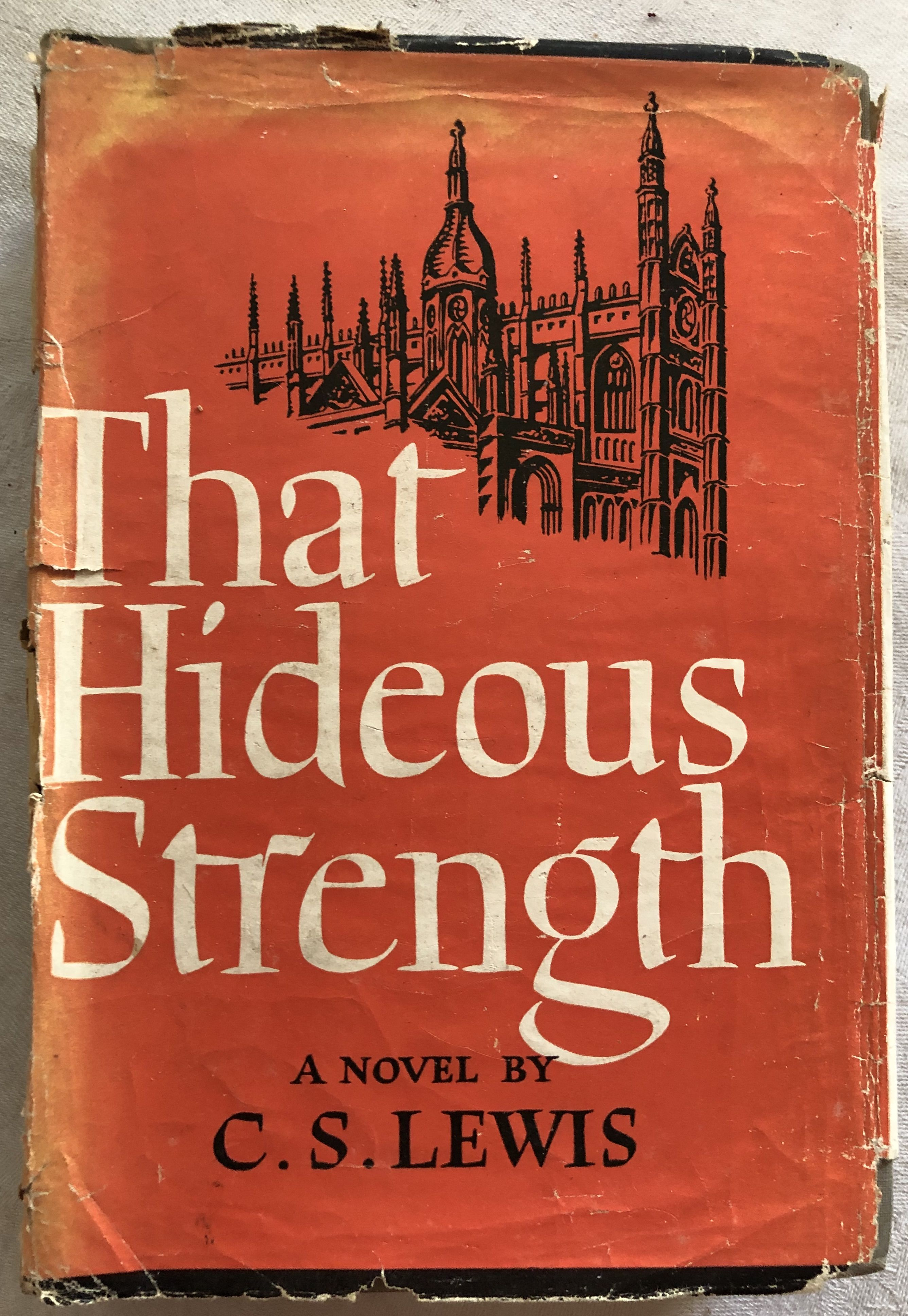
Today I’d like to draw your attention, dear reader, to two pairs of articles that I’ve come across in recent days. The first pair are non-identical twins – strangely similar articles that make essentially the same point. They both look at the gender insanity gripping our culture and reach back to a strange scene from C.S. Lewis’s novel That Hideous Strength to make an important point about the effect of this insanity on everyone, but children most of all. Most of you know I rarely write more than a few paragraphs without coming around to an insight by Lewis, so there’s no big surprise here as to why I was drawn to his particular argument. Take a look at these articles:

Drag Queen Story Hour as the Objective Room – Craig Carter

Welcome to the Objective Room – Joe Rigney

Published two days apart, these two articles really are eerily similar. But rather than plagiarism, I suspect some common flash of insight or perhaps a conversation gave rise to these. If nothing else, these articles join that chorus of appreciative writings which continue to find much value in the thought of Lewis. He was able to see far better than most what was coming, and now that it has arrived, many of us are encountering in Lewis an antidote to what ails our age. The attentive reader will also see an important link between Lewis’ Objective Room and my recent reflections on modern architecture [link].

An early edition of THS, the third and final book in Lewis’s Space Trilogy.

The second pair of articles concerns the debate currently a-raging about Christian political involvement, and specifically the idea of Christian Nationalism. I don’t find myself landing firmly in either side of the debate, but I can see that all sides have valid concerns worth considering. Here are two articles, both by men I respect and admire, making their case.

“Christian Nationalism” Misrepresents Jesus, So We Should Reject It – Jonathan Leeman

Identity or Influence? A Protestant Response to Jonathan Leeman – Joe Rigney

Kudos to 9Marks for publishing the critical response to Leeman’s article. I think it’s vital for the brightest and most reasoned voices in the Christian community to make their arguments in public and in good faith. Sadly I’ve seen quite a bit of discussion about Christian Nationalism from both sides of the argument that is dismissive and unhelpful, bringing far more heat than light.

Why Hollywood Can’t Pull Off Goodness (According to C.S. Lewis)

I’m no movie critic – not even close. I don’t seem to have whatever artistic antennae are required to appreciate the subtleties of the cinematic medium. Nevertheless, like most people, I do have eyes in my head and do enjoy a good movie. And it happens to be a fact that every movie works from a script – a story with characters and dialogue. So the basis for every movie is the written word, while it cannot be said that every book is based on a movie. (Woe to the book that is based on a movie: Thou art a fraud.) My point is that the same dynamics of moral imagination are at play in a movie as in a novel or any other creative work of fiction. And this is where the following quote by C.S. Lewis collided in my mind with a simple observation I’ve made about many of the movies and TV shows made in recent decades, which I’ll get to in a moment.

It remains, of course, true that Satan is the best drawn of Milton’s characters. The reason is not hard to find. Of the major characters whom Milton attempted he is incomparably the easiest to draw. Set a hundred poets to tell the same story and in ninety of the resulting poems Satan will be the best character. In all but a few writers the ‘good’ characters are the least successful, and every one who has ever tried to make even the humblest story ought to know why. To make a character worse than oneself it is only necessary to release imaginatively from control some of the bad passions which, in real life, are always straining at the leash; the Satan, the Iago [the scheming antagonist from Shakespeare’s play Othello], the Becky Sharp [the morally vile protagonist from Thackeray’s novel Vanity Fair], within each of us, is always there and only too ready, the moment the leash is slipped, to come out and have in our books that holiday we try to deny them in our lives. But if you try to draw a character better than yourself, all you can do is to take the best moments you have had and to imagine them prolonged and more consistently embodied in action. But the real high virtues which we do not possess at all, we cannot depict except in a purely external fashion. We do not really know what it feels like to be a man much better than ourselves. His whole inner landscape is one we have never seen, and when we guess it we blunder. It is in their ‘good’ characters that novelists make, unawares, the most shocking self-revelations. … To project ourselves into a wicked character, we have only to stop doing something, and something that we are already tired of doing; to project ourselves into a good one we have to do what we cannot and become what we are not.

C.S. Lewis, A Preface to Paradise Lost, Chapter 13. Emphasis mine.

Now since I’ve already dipped into the mode of the woe-throwing Old Testament prophet, I’ll allow myself one more: Woe to the one who looks to Hollywood for moral clarity. And all the people said Amen. But even without looking to movies for moral clarity, it remains a fact that so much of what is compelling about a movie is the moral fabric of the main characters, both good and evil. I am limiting myself here to those movies which are a essentially a contest between moral opposites: crime dramas, thrillers, action movies, or the never-ending series of original or rebooted or off-shoot superhero movies. The simple observation I am making about such movies and shows is that the good characters are becoming more troubled and morally compromised. It is so very rare to see a compelling protagonist that is good. The anti-hero is the hero for our age; the anti-hero is the only kind of hero we can believe in.

The above quote by Lewis is commenting on the scholarly consensus that Milton’s Satan (in Paradise Lost) is more compelling as a character than any other in the story. Lewis then lays out a morally insightful explanation for why that is necessarily the case in fallen humanity’s literature. Another example of this principle is found in the fact that Dante’s Inferno is by far and away more popular and compelling to the typical reader than either Purgatorio or Paradisio.

I used to think that an author’s characters had no vital connection to them – that an imagination could dream up moral monsters and virtuous heroes without it being a reflection of itself. But this is not true. As Lewis says, “It is in their ‘good’ characters that novelists [and screenwriters] make, unawares, the most shocking self-revelations.” Indeed, we are infected with moral cynicism. We look back on the virtuous heroes of past literature and we groan at the naivety of such caricatures. But this reaction reveals far more about our modern moral weakness than it does about anything else. And our modern writers cannot conceive of a truly virtuous person because our culture has jettisoned objective morality and the priority of character formation.

Adam and Eve and the obedient angels may not have been Milton’s best characters, but I dare say he was able to make them far more compelling than our typical cadre of authors and screenwriters could today. Even when they attempt to treat subjects of similar greatness, it seems they cannot avoid falling into caricatures either of rigid moralists and unhappily repressed religious people on the one hand, or vile hypocrites who are only pretending to be good on the other.

Small wonder then that the heroes we see onscreen, whatever technical mastery and skill they may have, are hardly ever compelling examples of deep moral goodness: Iron Man and the whole Marvel cast, John Wick, Deadpool, and so on. There are of course blessed exceptions to this rule, such as Aragorn in Peter Jackson’s LotR Trilogy and Franz & Fani from Terrence Malick’s recent movie A Hidden Life. It takes real effort to pull off these characters well and avoid portraying a plastic pseudo-goodness that comes across more as naivety than virtue. One common element between them is suffering. Perhaps goodness untested by suffering and evil is never very compelling. But I am straying from my main point, which is that we do learn all too much about the storytellers of our time by the manifestations of goodness that they are able to imagine and conjure for us.

Simply put, we do not have deep and compelling moral goodness manifested in our entertainment because a writer’s imagination is constrained by his or her own moral character and by and large we have forgotten (or rejected) the possibility and priority of conforming ourselves to an objective standard of virtue.

I mean, have you ever seen Caillou? That kid’s a brat.

“Weak point, sir. I’m from Canada, not Hollywood.”

As an Amazon Affiliate I earn a small commission from qualifying purchases of books purchased through links on my website, while customers do not pay anything extra.

Chronological Snobbery – Part 2

In the first post on the topic of chronological snobbery we looked at what C.S. Lewis meant by the phrase and we considered two reasons for its particular prevalence in our own day. In this post I would like to explore related ideas from a thinker that has been helpful to me: René Girard.

Girard was a profound and original thinker whose work ranges over many disciplines. I am familiar with only a few small slices of that work, but some of those slices have been eye-opening. Consider his reflections on the words of Jesus in Matthew 23:29-30.

“Woe to you, scribes and Pharisees, hypocrites! For you build the tombs of the prophets and decorate the monuments of the righteous, saying, ‘If we had lived in the days of our fathers, we would not have taken part with them in shedding the blood of the prophets.’ 

Girard focuses in on the attitude of the scribes and Pharisees as they built tombs and monuments for prophets who were harassed, persecuted, and killed by their forefathers: “If we had lived in the days of our fathers, we would not have taken part with them in shedding the blood of the prophets.” He considers this as a kind of spirit, an attitude of the heart that any of us can adopt.

In the context of his broader theory of mimetic desire and the scapegoating mechanism, he describes this impulse as a mob of the living scapegoating the dead. For our purposes, we can simply say it is the attitude whereby one generation or group condemns those who came before them, exonerating themselves.

Girard points out one historical example of this in the phenomenon of Christian anti-Semitism, the kind that blames the Jews for killing Jesus. It says “if we, who are the spiritual children of Abraham, had been there when Jesus was crucified, we would not have joined the actual children of Abraham in condemning and killing Jesus. We are better than them. We alone would have resisted the mob. We would have stood by him when all had deserted him. We would have been willing to be killed with him rather than deny him.”

When one lays out what such an attitude really claims, as I did above, it starts to be seen for what it is. But usually the claim to superiority is not parsed and exposed for what it is. A claim like that is really more about the person making it than about the people he or she is supposedly superior to. At bottom, such statements are saying something like: “If everyone was as innocent as I am the world would be better. Therefore they must not be innocent like me, because someone has to be responsible for all this mess.”

Ask any high school class if they think they would have stood up against the Nazis if they had lived in Germany leading up to and during WW2. Most will say they would have resisted, which is to claim that if Germany had been populated with 21st-century North American teenagers instead of Weimar-era Germans, Hitler would not have done what he did. More pointedly, it is to claim that each of those students raising their hands, students who allow their wardrobes, attitudes, mannerisms, and vocabulary to be dictated by the passing fads and peer pressures of their social peers, yes these paragons of strict moral virtue, would have had the backbone to stand against what was an immense amount of social pressure and very real threats to their reputations, social standing, finances, and very lives.

In Romans 2:1, the apostle Paul writes “Therefore you have no excuse, O man, every one of you who judges. For in passing judgment on another you condemn yourself, because you, the judge, practice the very same things.” We live in a time when forces all around us seem to be working hard to whip up offense, outrage, and judgment towards the other. But not all judgment is the same. Some judgment is warranted and needed, but a lot of it is spiritually dangerous.

What do I mean by spiritually dangerous? Well, I mean that it is dependent on sin and it fosters sin. To judge others for what I am guilty of is to reinforce my own blindness to that sin, thereby distancing myself further from the truth about myself that might lead me to repentance and freedom. It is much harder to admit to a sin that I have clearly – and perhaps publicly – judged another for. I am less able to see it in myself when I get a kick out of pointing it out in others.

So this leaves the one judging further from the grace of humility, further from the grace of gospel sanity, further from the grace of honesty about my sin. These are graces that flow from Christ and to Christ.

When one takes this principle and applies it, what happens? It becomes very difficult to stand in judgment over our historical predecessors, because we now see that to do so is to fall into a very dangerous spiritual trap. It is the trap of saying that we are better and we would not have done what they did.

But does this rule out any and all criticism of the past? Quite the opposite: It allows for the kind of criticism that is good for us, rather than a danger. When I recognize that in the garden of my own soul grows the same root that in others bore such heinous fruit, it motivates me to weed it out. When I recognize that there is more than a little family resemblance between their sin and my own – if not in the fruit, then in the root – this encourages humility.

Indeed the effect is precisely the opposite of what self-righteous criticism produces, namely a deepening blindness with regard to my own expressions of whatever fault I am pointing out in others married to a swelling pride at being found so much superior.

The best writers of history intuitively (or perhaps intentionally) treat their subjects with this kind of moral sensitivity. They do not fall into moral relativism, which may be an enjoyable intellectual hobby for rich and comfortable Westerners, but is insufferable in the face of actual evil. Neither do they unleash a full one-dimensional moral tirade against historical villains, painting them as uniformly evil characters. Rather they preserve the humanity of both heroes and villains, allowing for nuance and being honest about the shortcomings of the heroes as well as the positive qualities of the villains, all while writing with a sense of moral clarity. This kind of history proves informative and beneficial to the reader. It is humbling, sobering, inspiring.

Moving from history to the contemporary, we can apply this idea to so many current cultural issues. For example, I see a lot of folks these days eager to tear down statues of people who, terribly flawed and implicated in evil as they may have been, are nevertheless in many ways their betters. Leaving aside the specific arguments for or against any particular monument, or even for the taking down of statues in general, I just want to point out that this kind of fury, this kind of one-dimensional judgment of those in the past, is spiritually dangerous for all the reasons described above.

To take an example from the opposite side of the culture wars, we have the phenomenon of so many conservative religious leaders who were so thundering in their denouncing of sexual immorality being revealed to be sexually immoral themselves. Zacharias, Falwell, Hybels, and the list goes on and on. We all know such failures do not happen overnight. So we have someone publicly denouncing a sin in others that they are not just struggling against but positively nurturing in their own hearts.

This can happen on the political left as much as on the right, both inside and outside the church. But from my perspective, which is admittedly conservative, it does seem to be a particularly fashionable attitude among progressives on the left these days. If you think I’m wrong about that, let me know why in the comments.

Peter Nimble

There is lots to love about this book. A great title, a great first line, and moments of brilliance throughout. The story moves at a fine clip and carries the reader along to an exciting finish. My kids read this book as part of their schooling and they adored it, so I wanted to read it also. I can see why they were taken with it! It certainly leaves the reader wondering what will happen next at each chapters’ end. And while I enjoyed reading this book, I wanted to enjoy it more. There were a few hindrances and shortcomings that impeded that enjoyment. As a debut novel, I say bravo and well done! If I were to write a first novel this good, I’d be a happy man indeed. And so I offer some thoughts – in a spirit of constructive criticism – on what kept this book from being, to my mind, on par with the classics.

10806008

First, while the breadth and playfulness of a fertile imagination is on display throughout the book, there is a certain lack of cohesion and gravitational center to that imagination. The worlds, characters, landscapes, buildings, and monsters are all fantastical and creative, but it felt like there was something lacking that would draw them all into a narrative that fit together well. This unpredictability can give the reader a kind of whiplash as she tries to keep pace with the story. A few unexpected twists and turns makes a story interesting; but constant unexpected turns undermines the stability of the narrative and gives it a chaotic feel.

Second, and related to the first point, is the issue of world-building. This is the bread and butter of all fantasy-fiction. The author must build a world that is believable. But believable does not mean it must conform to our world. As Tolkien said, the key is that world must be internally consistent – what happens there must make sense within the framework of that world. This is the secret ingredient that explains why some fantasy worlds feel real, like Middle-Earth, Narnia, and Aerwiar, and others don’t. The author here shows real promise in the world that he creates, and yet fails to fully convince the reader that this place is so real in his own mind that all this could really take place.

Third and last, stories are irreducibly moral. The best stories are deeply moral, for it is the moral instinct in myself as a reader that makes me care deeply about the characters. On this point, once again, the author does a good job with some characters but does not quite pull off a complete victory. We see some development in Peter Nimble, but not a whole lot. His moral character remains quite static, while his self-understanding grows as he discovers his true identity and steps into the role he has been destined for. Sir Tode seems to me to be more promising, for we find out he is largely a fraud and has not truly earned his knighthood. Yet this assumed persona of a brave knight seems to draw out his courage and moral fibre and self-sacrifice. By the end of the book, despite the dubious origins of his knighthood, he has grown into the true picture of knighthood. This seems to exemplify something that C.S. Lewis pointed out: when growing in virtue, we often start by behaving as if we were more virtuous than we really are, which can feel like a kind of pretending or false persona. But if persevered in, this is often the route by which we do really become virtuous.

The best stories have a moral depth that speaks deeply to the reader about right, wrong, goodness and evil. While the book had a pretty clear moral compass (unlike the nihilistic morally-relativistic nonsense that sometimes gets passed off as modern fiction these days), it would have been improved, and would leave a deeper impression on the reader, if the characters’ moral trajectory had been explored more deeply.

All in all, a very fine book. I look forward to reading some more of Auxier’s fiction and seeing how he has grown as an author over the years.

Chronological Snobbery, Part 1

This is part 1 of 2. Click here to skip ahead to part 2, or see the link at the bottom.

It was Owen Barfield who induced a young C.S. Lewis to abandon what he called ‘chronological snobbery.’ I like the term, but its meaning is not immediately clear. Is this what Lewis is referring to when he exhorts us to read old books as a corrective to the errors of the day (most famously argued in his essay “On the Reading of Old Books”)?

But no – it cannot mean simply reading old books since Lewis was already reading old books even at an early age (he loved classical poetry), well before meeting Barfield and having his chronological snobbery apparently cured. So what is it, then?

In this post I’d like to explore these ideas a little bit. Let’s start with what Lewis writes about it:

In Surprised by Joy, he defines chronological snobbery as

“the uncritical acceptance of the intellectual climate common to our own age and the assumption that whatever has gone out of date is on that account discredited. You must find why it went out of date. Was it ever refuted (and if so by whom, where, and how conclusively) or did it merely die away as fashions do? If the latter, this tells us nothing about its truth or falsehood. From seeing this, one passes to the realization that our own age is also “a period,” and certainly has, like all periods, its own characteristic illusions. They are likeliest to lurk in those widespread assumptions which are so ingrained in the age that no one dares to attack or feels it necessary to defend them.”

There is overlap here with his famous quote from the essay mentioned above on reading old books:

Every age has its own outlook. It is specially good at seeing certain truths and specially liable to make certain mistakes. We all, therefore, need the books that will correct the characteristic mistakes of our own period. And that means the old books. … Not, of course, that there is any magic about the past. People were no cleverer then than they are now; they made as many mistakes as we. But not the same mistakes. Two heads are better than one, not because either is infallible, but because they are unlikely to go wrong in the same direction. To be sure, the books of the future would be just as good a corrective as the books of the past, but unfortunately we cannot get at them.

Reading old books is part of the solution, but the assumption of “newer is better” goes deeper, and it will likely take something more than mere exposure to old ideas to cure you of it. The fact that today we have many university humanities departments devoted to exposing the ‘hetero-normative patriarchal misogyny’ of Shakespeare and Dante and Milton makes that clear enough. They are reading the material, but with such a distorted lens that it renders no benefit, like eating a hearty stew but straining out everything except the onions.

This snobbery, like all snobberies, is subtle and mostly invisible to the one infected with it. It is something that one detects in others but never in oneself. Think about how often you have heard “what a snob!” said, and how not once was the person saying it talking about themselves. We accuse ourselves of many things, but snobbery doesn’t tend to be one of them.

I’m cultured, not a snob, you silly peasant.

The attitude, to the degree that one is conscious of it, seems entirely justified by the facts of the case. “After all, I have very good reasons for feeling this way!” So we are dealing with something that must be exposed before it can be dealt with.

I take it as a matter of fact that this attitude is widespread today. And my hunch is that the less historically informed our society becomes, the more this default assumption about the superiority of our fashionable ideas – this snobbery – will spread. I can see two other reasons for its prevalence.

First, there is this myth of progress. Generally speaking, the field of engineering is more advanced now than 400 years ago. The same is true for medicine, physics, and chemistry. These are the hard sciences where a wrong theory pretty quickly slams into the solid wall of objective reality, or better, the world as God made it. Since the delay between theory and result is brief, misguided ideas tend to reveal themselves as dead ends before getting too far, and more importantly, before the theorizers get too attached to the ideas.

But it really is another story when we are talking about fields such as sociology, anthropology, morality, or ethics. The myth of progress is the assumption that steady progress has been taking place in these fields similar to the progress that we can all see happening when we look out the window at the high-speed trains, jet-liners, and orbiting satellites. In this mode of thinking, the latest idea is, by virtue of its novelty, the best idea.

The problem is that the delay between theory and result in these other fields is much longer. By the time the fruit of misbegotten ideas becomes undeniable, not only can there be a huge human cost, but sometimes the entire field of study has become institutionally committed to the bad idea and cannot abandon it despite the growing evidence for its failure.

Second, it is basic human nature to desire to feel superior to others. Simply put: chronological snobbery allows me to feel superior to an awful lot of people – and most of them are not around to call me out on it. It is therefore a satisfying attitude to adopt.

To return to a point in the second quote above, every age – our own included – has its characteristic virtues and its prevalent vices. Future ages, or contemporary observers from outside the culture in question, are able to see and denounce what we cannot. And so we rightly reject the cruel tortures of the medieval world, the inexcusable infanticide of the Romans, and the perverted pedophilia of the ancient Greeks. But if we are not careful, we will miss their virtues and miss the chance to see and address some of our own vices.

In the next post, I’d like to reflect on some related insights I’ve gleaned from René Girard.

Watching Out for the Wrong Thing

“The use of Fashions in thought is to distract the attention of men from their real dangers. We direct the fashionable outcry of each generation against those vices of which it is least in danger and fix its approval on the virtue nearest to that vice which we are trying to make endemic. The game is to have them running about with fire extinguishers whenever there is a flood, and all crowding to that side of the boat which is already nearly gunwale under.”
This short paragraph in letter 25 of the Screwtape Letters made me realize that I often watch out for the wrong thing, or guard against the extreme that I am in the least danger of falling into. For example, I am by nature a bit timid and reserved. I don’t like confrontation at all. If I’m honest with myself I’m far more often a coward than a bully, and yet I am usually far more worried about not being ‘too bold’ or ‘too forceful’ than being a coward. The error I’m likely to fall into is lack of boldness and yet I usually guard against excessive boldness. This seems backwards.
Likewise, in my spiritual life I tend to avoid structure, discipline, and rigid plans. I like my freedom. I guess I tell myself I’m guarding against legalism, but let’s be honest, I am far more likely to fall into laziness and complacency than ritualistic legalism. On top of that, one of the manifestations of the Holy Spirit is “self-control” (Gal. 5:23).
I think this is true corporately as much as it is individually. In some churches, worship times seem to be emotion-free.
“Leave your affections at the door please.” Worship is more of a cognitive assent to propositional truths. They say they are guarding against emotionalism, but let’s be honest – their danger is not emotionalism but intellectualism. The opposite is true of other churches of course. It seems that when there are two groups who emphasize opposite ends of a given spectrum, the effect is to polarize both towards extremes as they react against the other, which frankly leaves each one worse off than before.
We all land at different places on a number of continuums like this. I find it helpful to zoom out a little bit and gain some perspective on the whole.