Among my many interests are a number of fringe topics, those weird subjects that exist on the edges of respectable discussion. One such topic is psychedelics, which I’ve written about quite a bit. Another one, which I have not written about much, is the whole topic of UFOs, now rebranded as UAPs (Unidentified Aerial/Anomalous Phenomenon). I’ve been quietly studying the subject for a number of years, pondering just what is going on with it, and seeing a real change in the public consciousness with regard to it. The topic has steadily been emerging from the shadows of ridiculous TV shows and late night talk radio to Senate hearings, highly decorated and credible whistleblowers from inside the military, and serious engagement by eminent scientific figures.
One of the people at the center of this shift has been Luis Elizondo, a former counter-intelligence officer who went public in December 2017 and helped release three now-infamous videos from the Pentagon that were featured in a controversial and viral New York Times front-page story. Now, seven years after that story was released and ushered in a new era of public conversation about this topic, Elizondo has just published his highly anticipated memoir called Imminent, which I listened to on audiobook. The book was standard memoir fare, competently written, and fast-paced. I won’t summarize the book’s narrative here, you’ll be able to find that elsewhere easily enough. What I’d like to do in this post is reflect on how this topic interfaces with other areas of interest, such as the metaphysical shift taking place in the West.
Imminent traces both Elizondo’s life and his efforts to bring the UFO and UAP topic to the public, out of the confines of Pentagon halls. Much of the material was familiar to me from following this topic, but there were a few surprises, such as Elizondo’s direct involvement and study of ‘Remote Viewing’—a phenomenon I have read about in David Morehouse’s book, ‘Psychic Warrior‘ and in other places. The connection between the UAP topic and Remote Viewing is the notion that reality is not reducible to material, as well as both containing within their orbits various phenomena and behaviors that is usually considered occult.
Elizondo holds the view that UAPs pose a potential threat to national security. I grant that from an intelligence and military point of view, this is the inescapable assessment. And yet Elizondo seems to dismiss out of hand those Christians within the upper levels of our intelligence and security agencies who think that there are some malevolent entities behind much of this. Those people can be ignored, in the view of Elizondo and many others, since they are only “closed-minded fundamentalists.” Maybe. Or maybe they are right—or partially right. The knee-jerk response of dismissing such convictions is interesting to me.
Christians have an intellectual inheritance, a deposit of knowledge handed down across generations that is based on the Bible, yes, but also on the collective wisdom and experience of many of the best thinkers in the past. (If your reaction to that statement is to regurgitate some New Atheist blather about superstition, dark ages, and anti-scientific religious dogma, I don’t know what to say except you haven’t done the reading and you’ve bought into a convenient narrative that ignores the actual history).
Jacques Vallée, one of the foremost experts on UFOs, understood early on that the number of parallels between UAP experiences in the modern age and demonological experiences in the medieval age—before our epistemology was artificially restrained by the enlightenment assumptions—was more than could be explained by mere coincidence. His groundbreaking book ‘Passport to Magonia‘ made this argument all the way back in 1969. He saw that there was some undeniable continuity between those strange and mystifying stories from before the scientific revolution (that the modern mind collectively relegated to the proverbial closet, out of sight) and the similarly strange, mystifying, and sometimes hellish experiences endured by members of the public and the military in the modern era.
One way of seeing the disclosure movement is as the inability of our modern culture, with its strictly materialist metaphysics, to explain or deny these paradigm-busting testimonies any longer. If you spend any time looking into this topic, you’ll find that everyone deeply steeped in it has some other worldview than reductive physicalism. It is usually some variation of Eastern mysticism, New Age, occult, panpsychism, or a ‘materialism’ that is so expansive as to be unrecognizable to someone like Dawkins.
From my perspective, the unwillingness of folks like Elizondo to take seriously the concerns of Christians who have this historically-informed perspective is a blind spot. Whether the Christians he encountered expressed their views intelligently and respectfully is impossible to know—though from his telling it doesn’t seem so. This highlights the reality that within the labyrinth of the US government are numerous factions, including at least one that has been directly involved in trying to study and weaponize occult abilities and the powers of non-human entities (the claim is that our adversaries are doing the same, which I suppose is likely true).
This may not be widely known but the evidence is frankly superabundant. The pragmatic utilitarian “if it works” argument is hard to refute within such circles where results are all that matter and where a “flexible moral framework” (read: willing to do evil that good may come) is a career asset. Another faction clearly has deep moral and spiritual misgivings about all such involvement, as can be seen in the work of Ray Boeche and Nick Redfern about the so-called ‘Collins Elite’. (You can find a lengthy critical interaction with that topic by the late Dr. Michael Heiser here.) What the public sees in the media are the faint contours of a mostly-hidden struggle between such factions, and perhaps others.
What do I think about all this? Well, it’s complex. My working thesis is that we are seeing at least two separate things. First, there are deep-black projects and technologies that are tested, witnessed, and interpreted as non-human but are just exotic and advanced. Second, there is a whole other side which is irreducibly spiritual / occult. And then there is some blurry crossover between the two that doesn’t fit neatly into either category.
One thing is for sure, this strange topic is not going away. Too much of the cat is already out of the bag, and our civilizational moment of tumult and crisis has many people re-examining their most basic assumptions about reality. That, combined with historically-low levels of trust in government and other institutions, means we are primed for momentous revelations and paradigm shifts. And perhaps, as Diana Pasulka has argued in her books ‘American Cosmic‘ and ‘Encounters‘, we are seeing the contours of an emerging religious belief system.
The year of our Lord 2023 was the first full year of whatever era comes after the second Elizabethan age, what we might call the long twentieth century. As we turn upon this hinge of history, if you’ll permit me a mechanical metaphor, it feels as though the transmission long left in neutral is grinding its gears and lurching us all forward towards some foreboding edge.
In the wake of Queen Elizabeth’s passing in 2022, I wrote a few words of reflection and poetry. What I tried to express in that piece was the combination of two strong impressions at work in my mind: the decline of our civilization and the hope of renewal. After reading the stimulating but pessimistic Rod Dreher, as well as the piercing but somber insights of Paul Kingsnorth, I feel as though that second element, the hope of renewal, is perhaps more of a distinctly Protestant posture than I had previously realized. Why might that be?
Well, I don’t think it’s terribly complicated. It was the Protestant church which was born in the midst of a bona fide revival as it recovered the glorious gospel which had too long been obscured. For a tiny taste of how that spiritual outpouring was experienced by normal everyday people in medieval Europe at the time of the reformation, see this short clip of pastor Mark Dever holding forth about assurance of salvation. It was the Protestant church which served as the vehicle for the Great Awakening which revitalized not only the church but affected the whole of the British empire (including the American colonies).
This heritage of revival and renewal is part and parcel of evangelical history, it shapes our imagination, and ever directs our hopes and prayers. I’m not at all sure this is true of Roman Catholic or Orthodox believers in the same way.
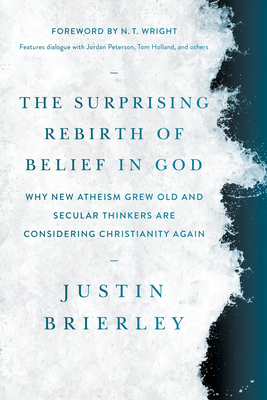
How fitting then that in the midst of all this talk about re-enchantment and the end of our godless era, it is a Protestant who decides to write a book called “The Surprising Rebirth of Belief in God.” Justin Brierley, the author, is ideally situated to comment on these shifts in public thought as he is perhaps the one person who has moderated the most high-level conversations between Christians and skeptics over the last decade and a half in his role as moderator and host of the UK-based radio show and podcast Unbelievable, as well as The Big Conversation and Re-Enchanting. And also another podcast by the same title as the book. The guy keeps busy.
In contrast to the more pessimistic takes on the decline of culture, which abound for understandable reasons, this book looks at the silver lining which we might characterize as the surprising appeal a number of influential public figures (and regular people like them) have been finding in the claims of Christianity. Brierley argues that this may be the first fruits of a coming harvest, the first wave of a newly rising tide of faith.
The metaphor of the tide is taken from Matthew Arnold’s poem, Dover Beach. The key lines are as follows:
The Sea of Faith
Was once, too, at the full, and round earth’s shore
Brierley opens the book with a stirring reflection on the idea that the powerful pull away from faith that characterized the two hundred years since the Enlightenment is now exhausted, the New Atheists of the 2000s being the last gasp of this spent force. I appreciated the well-researched summary of the New Atheist movement, from its confident rise to its fracturing and dissipation. Its bombastic, overheated rhetoric was matched only by the speed with which it collapsed into infighting and bloviating on Twitter. This dovetails with my own thinking and writing over the last few years, so I found myself agreeing wholeheartedly.
The term that kept coming back to me as I read the book was ‘plausibility structures,’ coined by the sociologist Peter Berger. The idea has a lot of overlap with Taylor’s ‘social imaginary’ in the sense that it tries to capture the intangibles of why certain fashions of thought prevail at certain times. What Brierley describes, through profiles of recent converts like Paul Kingsnorth and Martin Shaw, and Christian-friendly thinkers like Jordan Peterson, Douglas Murray, and Tom Holland, is a profound shift in our culture’s plausibility structures. Suddenly, it doesn’t feel ridiculous to posit that Christianity might be true. Rather, in an unexpected turn, it is those like Richard Dawkins, Sam Harris, or Steven Pinker, still bravely holding the line that Western moral values are self-evident from materialistic premises – despite the incoherence of this view and the rapidly accumulating counter-evidence in the accelerating moral disintegration of our societies – who now seem just a little bit ridiculous.
Time will tell whether Brierley, and I with him, are too optimistic about a turn back towards Christ. One of the interesting aspects of the “surprising rebirth of belief in God” is to note which streams of Christianity these people are being drawn to. There is certainly a draw to Orthodoxy that I never encountered until a few years ago, with the rising popularity of Jonathan Pageau and now Paul Kingsnorth and Martin Shaw. In my own circles I certainly see many people being drawn to faith and baptized into healthy evangelical Protestant churches in a way that wasn’t typical five years ago. As Protestants firmly in the tradition of the great revivals, I think we cannot help thinking in the categories of renewal and longing for the same in our day. How could it be otherwise? The evangelical Protestant heart studies those high points of church history and says, “Lord, do it again.”
This brings me to another point which I have been pondering since Rod Dreher picked up on my psychedelics piece over at Mere Orthodoxy and wrote about it on his Substack. It’s behind a paywall, but Dreher interacted robustly and appreciatively with the claims of the piece before turning to a reflection on his own college LSD experience and the metaphysical questions it brought up for him.
He goes on to clarify what he does and doesn’t mean:
Let me be clear: we are NOT animistic! We do not believe that material things are God. There is an ontological gulf between Creator and Created. Yet we also believe that the divine energies (as distinct from the divine essence) fills all things. It’s like when the sun warms a meadow in the summer, we believe that the energies of the sun penetrate the meadow, and in some sense become part of the meadow’s existence. The lesson for us in this newsletter’s context is that the barrier between matter and spirit is far more porous than most of us moderns think. This is how the cosmos is truly constructed. This was far easier for pre-modern people to perceive; the use of psychedelics is a way to temporarily recover some of that pre-modern perception.
I find this all extremely interesting for a couple of reasons. First, the idea of modern and pre-modern metaphysics. Canadian Baptist theologian Craig Carter, author of the highly regarded ‘Great Tradition’ books, has written very helpfully on his Substack about these different approaches to metaphysics. Here is what he writes in a post called ‘Can Theology Do Without Metaphysics?‘:
The classical metaphysics of premodern Western culture sought to articulate what C. S. Lewis called “the Dao,” that is, the natural law that many cultures have recognized as built in to the fabric of reality. This natural law or wisdom has functioned as the foundation of cultures from Egypt to China to Israel. Positive law is an elaboration of it. Religion reinforces it. Political arrangements are judged by it. Morals are based on it.
After explaining how Plato made the foundational contribution to this project, he argues that “[d]uring the first five centuries of church history, the Platonic tradition was integrated with biblical revelation and the result was the Christian Platonism of Augustine.” He goes on to claim that the medieval synthesis of Aquinas was a high water mark for metaphysics, the undoing of which gave us modernity. After discussing how modernity manifests in three different modern approaches to theology (liberal, fundamentalist, and Barthian), he writes the following conclusion, which I will quote at length:
What can we take away from all of this? It seems to me that three points stand out as most important:
Christian theology is not merely a narrative we tell each other to express our experience of God. Rather, it is a metaphysical description of reality, that is, of God and all things in relation to God. It deals with objective truth, not merely subjective opinion.
Since metaphysical realism is a deduction from biblical revelation and necessary for an adequate statement of Christian orthodoxy, we must go back before the Enlightenment to the period of Protestant scholastic orthodoxy to pick up the thread of the Great Tradition and build further on the foundations of the tradition handed down to us from the church fathers, medieval schoolmen, and Protestant reformers.
Evangelicalism, as the heir of fundamentalism, has failed us and so we need a revival of historic Protestantism. We need “Evangelical Protestantism” not merely “Evangelicalism.”
Theological liberalism, reactionary fundamentalism, and neo-orthodox Barthianism involve various degrees of compromise with modernity. But we should read the signs of the times and conclude that modernity has run its course and is now in the process of self-destruction. Those who marry the spirit of the age will soon find themselves widowed.
We are entering into a period of Ressourcement in which premodern exegesis, doctrine, and metaphysics are being recovered and used to reinvigorate twenty-first [century] theology. The recovery of Christian metaphysics is a massive task that will require the efforts of many historical and systematic theologians in the decades ahead. But it will be worthwhile because ultimately a theology without classical metaphysics can never be classical orthodoxy.
What’s the point of all this? In sum, that there is a core agreement between Dreher, an Orthodox believer and astute observer of culture, and Carter, a Canadian evangelical Protestant like myself, that modern metaphysics is a dead end, and that the future involves a ressourcement or a return to classical (pre-modern) metaphysics, which includes a more enchanted view of the world.
The second thing I find fascinating about the quote above from Dreher is the talk of a porous barrier between matter and spirit:
The lesson for us in this newsletter’s context is that the barrier between matter and spirit is far more porous than most of us moderns think. This is how the cosmos is truly constructed. This was far easier for pre-modern people to perceive; the use of psychedelics is a way to temporarily recover some of that pre-modern perception.
This is very important. I think you will find that many people in our society today are intuiting this porousness in a new way. Not everyone, of course, but there is a sizeable shift. For instance, many have noted that the events of the last three years have awakened them to the reality of evil, even of supernatural evil – Naomi Wolf would be one example of this. We see also the long-ridiculed and suppressed testimonies of those who have had some kind of contact with entities (extra-terrestrial or otherwise) finding unprecedented coverage and attention. We see a fascination with lost ancient civilizations and alternative narratives to the standard historical model teasing at lost high technologies and abilities. We see, as I’ve written about, a renaissance of interest in psychedelics and other ways to achieve altered states of consciousness. In other words, lots of weird stuff.
I recently got my hands on a book of essays by the philosopher Charles Taylor, in which I found the following quote in an essay titled “Disenchantment-Reenchantment”:
But the big change [brought about by disenchantment], which would be hard to undo, is that which has replaced the porous selves of yore with what I would describe as “buffered” selves. Let’s look again at the enchanted world, the world of spirits, demons, moral forces which our predecessors acknowledged. The process of disenchantment is the disappearance of this world, and the substitution of what we live today: a world in which the only locus of thoughts, feelings, and spiritual élan is what we call minds; the only minds in the cosmos are those of humans (grosso modo, with apologies to possible Martians or extraterrestrials); and minds are bounded, so that these thoughts, feelings, and so forth are situated “within” them.
I agree with Taylor that, circa 2011, when this book was released, there seemed to be no chink in the armor of the buffered self. New Atheism was at its height and materialism had the glossy shine of triumphant explanatory power. But today we seem to be entering a different moment, the plausibility structures have shifted, and many today experience a porousness that I think Taylor may find positively medieval, or even pagan.
This is the theme of professor (of religious studies) Diana Pasulka’s recent book, Encounters, which traces the stories of a number of people who experience encounters with… beings, or entities, beyond normal classification. Scratch beneath the surface of people into these fringe topics, and what you find is precisely the opposite of what Taylor asserts about the modern mind: the “only locus of thoughts, feelings, and spiritual élan,” “bounded, so that these thoughts, feelings, and so forth are situated ‘within’ them.” Rather, you find people whose experience is that there are others who can reach into our lives, our homes, and our very minds seemingly at will.
The last thing Dreher turned to is the way in which Orthodoxy, in his view, is uniquely positioned to meet this porous reality:
I believe that Orthodoxy — which is a Way of Life attached to a religious institution — is the best and most complete way to prepare oneself for that encounter [with God]. This is something hard to express to a Western Christian, whose idea of Christianity typically has more to do with propositional thought — with thinking about God, as opposed to experiencing Him.
I’m not sure how to respond to this as a Protestant. In fact, it’s a question I’d like to pose to Mr. Brierley and other evangelicals who are attuned to this whole discussion: How does evangelical Protestantism address this desire for the supernatural to infuse our everyday reality? How can those who are searching for some touch of the transcendent through psychedelics or other pursuits find their true heart’s desire in the form of faith our churches teach?
I think Protestantism can and does meet those desires through, in part, its stream of warm-hearted pietism – the intimacy of a close walk with Christ – but I’m also open to the idea that we have something to learn from the Orthodox in this regard. What would you say?
Whatever the case, we certainly live in interesting days, and my hope and prayer is that by the Father’s good will we might see a glorious outpouring of the Spirit causing a glorious ingathering of souls into the divine enchantment of Christ. Lord, do it again.


 Phil's Scribblings