I have not read much Warfield, so I welcomed the chance to dip into his writing with this handsome little volume put out by Crossway. I found it to be delightful.
Warfield writes with a crisp, clean prose that flows comfortably into lengthy sentences. He is judicious and careful in his choice of words, poking at an idea with different descriptors until he finds just the right one. I love this kind of writing. It is careful, clear, and yet often includes powerful phrases and images. The exploration of the emotional life of Christ is thorough and insightful. Warfield reveals a deep understanding not only of the Bible, including the original language, but also of human beings and emotions.
Here we find not that caricature of the theologian as the emotionally stunted egghead who cannot seem to understand or enter into normal human experiences, but rather the opposite; an emotionally intelligent, discerning person.
Warfield helps the reader appreciate all the ways in which the humanity of Christ is displayed in the gospels, sparse as the treatment of Christ’s emotions is, and yet he draws the reader’s mind and heart up to a posture of adoration for the way in which this reveals his glory and is a part of his redemptive work.
I conclude with two quotes from the work which illustrate its virtues.
“Joy he had: but it was not the shallow joy of mere pagan delight in living, nor the delusive joy of a hope destined to failure, but the deep exaltation of a conqueror setting captives free. This joy underlay all his sufferings and shed its light along the whole thorn-beset path that was trodden by his torn feet.”
“As we survey the emotional life of our Lord as depicted by the Evangelists, therefore, let us not permit it to slip out of sight that we are not only observing to proofs of the truth of his humanity, and not merely regarding the most perfect example of a human life that is afforded by history, but are contemplating the atoning work of the Savior and its fundamental elements. The cup that he drank to its bitter dregs was not his cup but our cup, and he needed to drink it only because he was set upon our salvation.”
This short work is enjoyable, illuminating, and edifying. I highly recommend it.
I came across this paperback copy of the late Anne Rice’s novel in a thrift store. I had heard about it some years ago and knew she was a popular author, though I had never read anything by her. I’m not really into the whole vampire genre, which she was best known for. It seems that this novel, and the subsequent books in the series, were a departure for her. Rice was a boomerang Catholic, raised in a strict Irish Catholic community until college, at which point she left it all behind and drew on the deposit of Christian ideas and images only to adorn her novels. But then she says she lost faith in her atheism. Her old skeptical certainties started to crumble, leading eventually to a full-hearted return to Catholicism and to belief in Christ. Rice says that she then devoted her subsequent writing efforts to portraying the life of Christ, and this book was the first fruit of that endeavour.
So what about this book, then? Well, it’s a bit difficult to rate. Like most readers, I come to the book with some preconceived notions about the person and life of Christ. But this is not like a book about Caesar, who I also have some notions about. Christ is a singular figure, and for Christians like myself, he steps out of history and into the depths of my inner being. I say this to underline the fact that it’s not possible to sit down and read this book like I might read any other piece of historical fiction. So perhaps I’m not really the ideal audience for this book, seeing as I already have strong convictions about Jesus; perhaps the book is better suited to moderns who think they know who Jesus was, swayed by modern liberal scholarship that claims to have scientifically determined the truth about the Jesus myth. More on that liberal scholarship in a bit.
The book opens in Egypt, with a seven year old Jesus living with his family in Alexandria. The plot follows the family’s migration out of Egypt and back to Israel, featuring brushes with both Israelite zealots and ruthless Roman soldiers. The central intrigue surrounds the unanswered questions that young Jesus has about his early childhood. He knows there was something special about his birth, and he knows that something happened in Bethlehem. The plot then develops as he puts together the pieces and grows in his self-understanding.
The prose is, if I’m honest, a bit clunky and bare. It’s not a book that draws you in by it’s beautiful descriptions or its eloquence. Was this an intentional choice, trying to capture the inner voice of this special 7-year old child? I don’t know, but aside from a couple of moments in the book where Jesus was interacting with some of the Rabbis and teachers, the character didn’t really sound or feel like the Jesus of the Scriptures. But then again… how could he? This is an impossible task, and in this regard the book could never succeed. The person of Jesus, as captured by the gospel writers, is the single most compelling literary character ever put to paper. Obviously I believe that he is far more than a literary character, but he is not less than that.
There were a few ways in which Rice wove future characters from the gospels into the family’s network of relationships such that the reader with knowledge of the New Testament would recognize that a deeper connection was being forged such that when the critical interaction occurred later, this extra freight of history would deepen the meaning of the event. For example, Rice has the family meeting the future high priest Caiaphas as a young man. He would, of course, later be involved in the trial and execution of Christ.
This is a plot device that is used a lot by the popular show, The Chosen, whereby familiar events in the gospels are retold with imagined backstories that make the stories feel deeply layered with extra significance. It’s effective on an emotional level, and when done well it doesn’t do violence to the text by changing anything. It simply adds details that the gospel writers left out, details which are no doubt wrong in their specifics but perhaps correct in a broader sense. What I mean is that each person encountered by Jesus in the gospels really had a full and complex life story like we all do. And no doubt some of those stories and specifics made their encounters with Jesus so powerful that they were never the same. I think that a reverential and imaginative exploration of what some of those backstories might have been is well within the bounds of legitimate Christian art, as long as it’s clear that the fictional additions are not Scriptural or authoritative.
But this brings me to Rice’s use of apocryphal material, such as the legends of Jesus discovering his own miraculous abilities as a child: turning clay birds into living ones, causing the weather to change, healing people, and even, as in the opening pages of the book, supernaturally taking the life of a neighbourhood bully (before miraculously resuscitating him). This was an inauspicious start, immediately signaling to me as a reader that the book was comfortable departing sharply from the Bible. Given the fact that this theme faded as the book progressed, I feel like it was used as a way to hook readers more than anything else. Ultimately, however, it cheapened the book, reminding me far more of a superhero origin story, where a character discovers their super powers and unique destiny, than of an episode from Holy Writ. This underscored an important principle that Christian artists must remember: when it comes to the Scriptures, to add to them in this way is automatically a deterioration; by trying to change things we only end up taking away from their own mysterious power.
It’s true the Bible’s style is to leave out many details and to leave many questions unanswered. The hidden things belong to the Lord. What inevitably happens when some well-meaning writer or artist deems to fill in some of the details is that the work takes on a ham-fisted, all-too-human quality. It takes true genius and a measure of restraint to avoid this result. Perhaps we can say that Milton achieved it in Paradise Lost and Samson Agonistes, and many others through the years. Anne Rice’s Christ the Lord: Out of Egypt is a mixed result, with some elements succeeding well and others falling short.
The real surprising delight of this book however came after the narrative was done. In a lengthy Author’s Note, Rice goes into great detail about her own testimony and the journey of her extensive research into the New Testament era. There are some real gems in this text, which I will quote at some length. The great value to me was Rice’s recounting of her encounters with both liberal New Testament scholars and the more conservative ones. I came away impressed at the breadth of her research and reading, and also at the sensitivity with which she read and interpreted these works. She writes:
I had taken in a lot of fashionable notions about Jesus – that he’d been oversold, that the gospels were “late” documents, that we really didn’t know anything about him, that violence and quarreling marked the movement of Christianity from its start. …
New Testament scholarship included books of every conceivable kind, from skeptical books that sought to disprove Jesus had any real value to theology or an enduring church, to books that conscientiously met every objection of the skeptics with footnotes halfway up the page.
Bibliographies were endless. Disputes sometimes produced rancor.
And the primary source material for the first century was a matter of continuous controversy in which the Gospels were called secondary sources by some, and primary sources by others, and the history of Josephus and the works of Philo were subject to exhaustive examination and contentions as to their relevance or validity or whether they had any truth. …
Having started with this skeptical critics, those who take their cue from the earliest skeptical New Testament scholars of the Enlightenment, I expected to discover that their arguments would be frighteningly strong, and that Christianity was, at heart, a kind of fraud. I’d have to end up compartmentalizing my mind with faith in one part of it, and truth in another. …
These skeptical scholars seemed so very sure of themselves. They built their books on certain assertions without even examining these assertions. How could they be wrong?
What gradually came clear to me was that many of the skeptical arguments – arguments that insisted most of the Gospels were suspect, for instance, or written too late to be eyewitness accounts – lacked coherence. They were not elegant. Arguments about Jesus himself were full of conjecture. Some books were no more than assumptions piled upon assumptions. Absurd conclusions were reached on the basis of little or no data at all.
In some, the whole case for the non-divine Jesus who stumbled into Jerusalem and somehow got crucified by nobody and had nothing to do with the founding of Christianity and would be horrified by it if he knew about it – that whole picture which had floated in the liberal circles I frequented as an atheist for 30 years – that case was not made. Not only was it not made, I discovered in this field some of the worst and most biased scholarship I’d ever read.
I saw almost no skeptical scholarship that was convincing, and the gospels, shredded by critics, lost all intensity when reconstructed by various theorists. They were in no way compelling when treated as composites and records of later “communities.”
I was unconvinced by the wild postulations of those who claim to be the children of the Enlightenment. And I had also sensed something else. Many of these scholars, scholars who apparently devoted their life to New Testament scholarship, disliked Jesus Christ. Some pitied him as a hopeless failure. Others sneered at him, and some felt an outright contempt. This came between the lines of the books. This emerged in the personality of the texts.
I’d never come across this kind of emotion in any other field of research, at least not to this extent. It was puzzling.
Rice describes then encountering a different kind of scholarship, written by believing, conservative, orthodox, and even Evangelical scholars. She heaps praise upon many familiar names, from Larry Hurtado and Craig Blomberg to Craig Keener and D.A. Carson; singling out N.T. Wright as preeminently helpful. The author’s note made me very sympathetic to what she was trying to accomplish in this book. Her experience of reading the voluminous (endless) scholarship is instructive and helpful, for she was a kind of curious neutral observer of the space, something which is rare. But she discerned this consistent undercurrent of both shoddy work and personal animus against Christ in the books by people who had dedicated their careers and lives to this topic.
The fact is that Christ, because of his all-encompassing claims to Lordship over every one of us, leaves very few people on the fence about him. The stakes are too high. Anne Rice’s note makes that clear in a surprising and very helpful way. I am sure that many readers found themselves following her towards a proper reexamination of the Scriptures without the jaundiced eye of the skeptics. That alone is reason enough to be thankful for the book, despite its flaws.
Okay, yes, I did read this glossy author-on-the-cover reality TV star’s co-written faith ‘memoir.’ Guilty as charged. As a general rule, I avoid any book with the author on the cover like a slug avoids the salt shaker. I know what I’m likely to find behind the cover: smarmy tone, bland prose, predictable writing – But! There were extenuating circumstances, your Honor. You see, my wife, whom I love, watched the Duggar show for a while (and possibly I sat beside her at various points while it was on – who can say?), and so she was interested in the book, and we were on a long road trip, and we had free access to it via Scribd, and it purported to be a kind of reverse-deconstruction of the author’s faith, a topic which has interested me for some time. So you see? Anyone would have read this book in such circumstances. Good, I’m glad we got that out of the way.
(Interested in my thoughts on Jill Duggar’s memoir, Counting the Cost? You can see a short reflection and review here.)
Frankly, I had quite low expectations, so I can say it was better than I expected. The story, in case you’re not up to speed, is that Jinger Duggar grew up in a uber-conservative subset of American evangelicalism that had many elements of your typical cult. Centered around the person and teaching of Bill Gothard, a one-time Wheaton grad and inner city youth minister, it focused heavily on external issues of morality such modest dress, courting instead of dating, having lots of children, shunning debt and mortgages, not drinking alcohol, not listening to secular music, etc. Her family had a long-running reality TV show because they had 19 kids and seemed like a strange artifact of American culture. The whole thing took a dark turn when the eldest Duggar son, Josh, was accused of molesting some sisters and eventually got caught with child pornography and was hauled off to jail where he remains. Gothard was also accused by scores of the young attractive women he staffed his headquarters with of sexual misconduct of various kinds.
Gothard’s ministry was called the Institute for Biblical Life Principles (IBLP) and the whole thing sounds to me like a giant collection of red flags literally on fire. But clearly quite a few thousand people were taken in hook, line, and sinker, so I’m sure it had a certain appeal. As with other legalistic and unbiblical religious groups, you can’t help but have a lot of compassion for the people raised in it. And it’s not surprising that a huge chunk of them leave Christianity behind completely, imagining it to be equated with what they knew growing up.
This book does a good job of drawing important distinctions between the legalism of IBLP (and ultra-conservative fundamentalism in general) and the gospel of Christ. The story, such as it is, is pretty interesting and is written in a simple, straightforward style. The narrative is interspersed with lengthy treatments of Gothard’s teaching and explanations of Jinger’s new understanding. There is a certain irony in the fact that Jinger recovers from the fundamentalism of IBLP by landing at Grace Church in California, a place which many within evangelicalism would equate with a kind of quasi-fundamentalism under the long and prominent ministry of John MacArthur. I wouldn’t totally agree with that characterization but there’s no denying that Grace is very conservative.
One thing I found particularly interesting was the author’s description of how her view of God changed as she ‘disentangled’ the beliefs she absorbed from Gothard from the truth of Scripture. I recently re-read Sinclair Ferguson’s superb ‘The Whole Christ,’ wherein he shows how legalism and antinomianism share a common rotten root, one which reaches all the way back to the garden, and that this root is a suspicion that the heart of God the Father is not one of love, mercy, and grace. So this God must be appeased with performance and religious duties lest he be angry and withhold the good things we want.
At one point, Jinger quotes Gothard as telling a woman whose life was a sinful mess that she needed to clean up her life before Christ could come into it. As Ferguson shows, this is more or less the same instinct as some in the Church of Scotland had during the Marrow Controversy and the debates over whether the gospel should be freely offered to all or only towards the truly repentent.
It is nothing less than an anti-gospel, and it enslaves rather than frees. It sees the Father as one who holds back the benefits of redemption through his Son until the person has made themselves worthy to receive them. But as Ferguson points out, this results in a grave error, the separation of Christ from His benefits, and it breeds spiritual sickness rather than health.
Rather, the Father has sent the Son because he loves us, and all who turn to Christ in repentance and faith receive Him and all the manifold gifts of redemption. The believer is united to Christ by the Holy Spirit, and Jesus is the greatest gift – for in Him are all the benefits, and through Him we are reconciled to the Father, and it is His Spirit by which we are sealed and with which we are filled.
It’s hard to overstate the distance between this rich and glorious gospel and the paltry saltine cracker ‘gospel’ of IBLP and Bill Gothard. This book made me thankful for the wonderful teaching I found and received early in my Christian life which helped me grasp not only the pulsing heart of the gospel but the grand sweep of Scripture’s united narrative, the history of redemption.
I have to say there’s a certain amount of righteous anger I feel towards the people who run these legalistic religious systems based on the Bible. I was stunned to hear that Jinger, despite having grown up in a supposedly very ‘Christian’ environment for her entire life, had never heard decent expository preaching (only proof-texting), nor an explanation of how the two Testaments fit together, nor how Christ fulfilled the law, nor had she ever heard a real God-centered emphasis on His glory and character, nor been given any sense of the historical placement of her community’s tiny slice of Christian belief within the grand scope of Christendom, nor had Romans 14 or the concept of liberty over disputable matters or the Christian conscience ever been explained to her, nor had she been shown how all of Scripture is ONE story which all culminates in Jesus. What!? Was it really all about how long skirts should be and avoiding rock music? These poor people.
I’m glad Jinger managed to disentangle that mess and find that Christ is far better. Given the size of the audience for their now-ended TV show and the toxic level of interest many Americans have towards the lives of celebrities, I’m sure it will be read by many. I think it could be helpful for some, especially those who grew up in IBLP or similar legalistic groups. If some are thereby guided towards a living faith in the real Christ through a richer understanding of the gospel, then all I have to say is: Thanks be to God.
As an Amazon Affiliate I earn a small commission from qualifying purchases of books purchased through links on my website, while customers do not pay anything extra.
The breakdown of political discourse and the crisis of legitimacy that traditional democratic institutions now face is therefore apocalyptic, in that it has unveiled this underlying, technologically fueled anthropological chaos. The “who are we?” question—always important, given that we are intentional, not merely instinctive creatures—has become the only question, no longer anchored in commitment to a notion of universal human nature, with limitations, a moral structure, and some common goal or range of common goals. Without such a foundation, without answering the “what are we” question, how can we answer the “who” question in any stable or meaningful way? How can we build any stable or coherent society?
Covid restrictions highlighted this in a painful way. Virtual Man, who works through his laptop and can thus work anywhere in general and nowhere in particular, found such restrictions to be far more reasonable than Real Man, who has to go to work in a particular time and particular place because he works with material, not virtual, reality. That is not simply a vocational divide. I would suggest it is an anthropological divide. Real Man experiences the world—and his own sense of self—in a fundamentally different way from Virtual Man. This is reflected in so many of the conflicts now straining western democracy, from the French Yellow Jackets to the rise of working-class nationalism to the Canadian truck protests. In each case, we see what Mary Harrington has dubbed the clash of the Virtuals versus the Reals. Underneath that divide lies a conflict of anthropologies between a technologically liberated view of human beings as disembodied wills who can transcend the limitations of the materiality of the world and a belief that embodiment and place are critical to survival.
For the Virtual elite, the most unforgiveable thing about the Physicals, and the physical world in general, is that they stubbornly refuse to yield to full, frictionless control. There is a reason the dominant informational class is today most comfortable in a purely virtual environment – it’s one where they can have direct, instantaneous control over (virtual) matter. Real matter is stubbornly resistant, a reminder that the self doesn’t control the universe. It’s dirty, polluting, a reminder of one’s vulnerability, even mortality. And the need to rely on other humans to deal with it is super awkward.
So expect the Virtuals of the ruling class to double down on trying to exert control, moving with all haste to develop new and innovative methods of information management and coercion to try to eliminate every human vulnerability from the machine. Self-driving truck startups are about to have an excellent next funding round.
So the farmer and the trucker get discipled into a kind of humility with regard to nature. Their relationship to the nature of the cosmos and of human behavior is such that they must adjust themselves, like a partner in a waltz, to the larger forces they reckon with and harness. The best farmers, or plumbers, or electricians, or woodworkers — all those hands-on trades — are those who best discern and adjust themselves to the raw material they handle, and the natural forces which act on that material. This willingness and ability to adjust to nature as we find it is a kind of humility which is absent from those who aim to remake the world.
Trueman’s piece is important and helpful because he focuses in on anthropology. Anthropology is the study of man – what is man? What is human nature? He traces the loss of broad agreement on the answer to those questions from the Reformation to today. He makes an important point that I am not at all convinced most Christians are clear on:
Christianity takes the material world very seriously and sees it as having an authoritative moral structure that limits how we should act. Most obviously, it sees human nature as a real, universal thing, inextricably connected to our embodiment. From identity and sex to family and community, from the private sphere to the public square, this is foundational to Christian thinking. And in a world that wishes to assert the opposite, this means that the emerging terms of membership in civil society are increasingly those that will deny Christianity and Christians the possibility of full membership.
When I was growing up, I saw the conflict between orthodox belief and the unbelieving culture in the issues of exclusivity (Jesus as the only way to salvation) and sexual morality. But then over the course of my 20’s and early 30’s it dawned on me that a more fundamental divide was emerging, that of anthropology. Trueman does a good job making that divide clear in his piece.
What first alerted me to the deep significance of one’s anthropology was the difference I observed between the ‘Christian counseling’ content I read in popular books and through some teachers at my Bible College and the ‘Biblical counseling’ content I was starting to come across from David Powlison, Paul Tripp and others at CCEF. Much of that difference boiled down to two very different ways of seeing the human person. The former approach adopted rather uncritically the concepts of secular psychology and tweaked the therapeutic advice to accord with Biblical statements. But the latter approach questioned the premises of secular psychology and sought to arrive at an understanding of human nature that was deeply informed by the Scriptures. This approach led to a deeper appreciation of the multifaceted effects of indwelling sin and of life lived in a broken world.
The writing and teaching of the folks at CCEF struck me as qualitatively different from what I had encountered in the popular Christian psychologists like Dr. Henry Cloud and Dr. Larry Crabb, though their work was still very helpful in some ways. Nevertheless, this experience settled a conviction for me that a thoroughly Biblical anthropology was crucial for building on. Simply put, it serves as the substructure for your view of sanctification and human flourishing. This experience also convinced me that this was one of the areas where regular church folks and ministry leaders had imbibed an awful lot of unbiblical assumptions from the world around them.
Fast forward to today and we find that many of the most pressing moral issues of our time are directly related to the question of human nature: transgender ideology, the dystopian dreams of the transhumanists, and the advances of AI.
Now, more than ever, the church needs to search the Scriptures diligently and gain a new level of clarity and conviction on what human nature is, what God’s intent for humanity is, and how this informs our response to the challenges that are coming at us with increasing complexity and velocity day by day.
While Trueman closes his piece with a glimmer of hope, his overall analysis is very sobering. I encourage you to read the whole thing. Here is how he wraps it up:
Yet here, perhaps, is a glimmer of hope. The reason for this is something we all intuitively know: we human beings are not simply whoever we wish to be; we are not simply disembodied wills; on the contrary, we do have a nature—a “whatness”—that cannot be indefinitely denied with impunity. We are embodied, and those bodies involve biological limits (we all die, even if we choose to self-identify as immortal) and a moral framework—we never exist in isolation but always within a network of dependence and obligation. If the time of Covid revealed anything, it revealed that most human beings still have some intuition that embodiment, and the communities of obligation and dependence that are intrinsic to our embodiment, are of critical importance to what it means to be human.
The challenge for the church, embedded as she is in this technological age, is to embody that reality in her life. The path forward is to take our coming marginalization seriously, as an opportunity, not merely a setback: an opportunity to embody in our own lives and congregations what it means to be truly human.
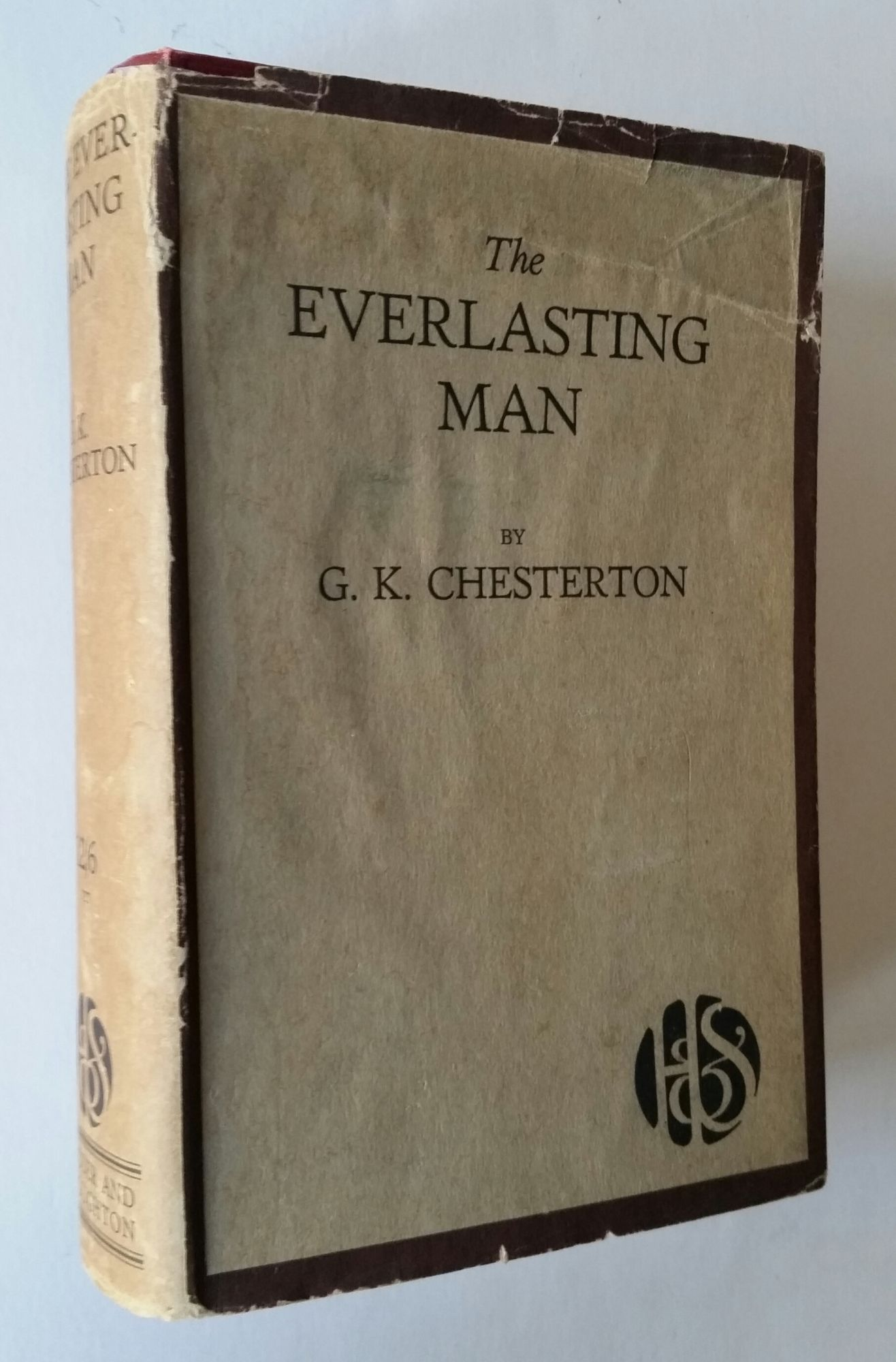
Since reading it over ten years ago, I’ve had lodged in my mind an affectionate fascination with Chesterton’s Everlasting Man. It is a kind of intellectual tour de force of the history of religious thought as only possible from Chesterton’s singular mind and from the vantage point of the early 20th century. If you have some interest in understanding how paganism relates to Christianity, or how Christianity fulfills the philosophy of the classical era, you will enjoy it.
An early edition.
But this is a Christmas post, and so I want to walk you through a few selections from the first chapter of the second half of the book. The chapter is called The God in the Cave, referring to the tradition that the stable was actually a rocky cave. In this chapter Chesterton reflects on the symbolism and meaning of Christmas, teasing out implications from it that do not naturally spring to my mind. And yet, once I read them, they have a certain logic and an undeniable power. My goal here is to deepen your appreciation for Christmas and your wonder at the incarnation.
We start with a some paragraphs about the paradox of Christmas — that of the very high and very big (God) united with the very small and very weak (a baby).
A mass of legend and literature, which increases and will never end, has repeated and rung the changes on that single paradox; that the hands that had made the sun and stars were too small to reach the huge heads of the cattle. Upon this paradox, we might almost say upon this jest, all the literature of our faith is founded. It is at least like a jest in this, that it is something which the scientific critic cannot see. He laboriously explains the difficulty which we have always defiantly and almost derisively exaggerated; and mildly condemns as improbable something that we have almost madly exalted as incredible; as something that would be much too good to be true, except that it is true. When that contrast between the cosmic creation and the little local infancy has been repeated, reiterated, underlined, emphasised, exulted in, sung, shouted, roared, not to say howled, in a hundred thousand hymns, carols, rhymes, rituals, pictures, poems, and popular sermons, it may be suggested that we hardly need a higher critic to draw our attention to something a little odd about it; especially one of the sort that seems to take a long time to see a joke, even his own joke.
… Any agnostic or atheist whose childhood has known a real Christmas has ever afterwards, whether he likes it or not, an association in his mind between two ideas that most of mankind must regard as remote from each other; the idea of a baby and the idea of unknown strength that sustains the stars. His instincts and imagination can still connect them, when his reason can no longer see the need of the connection; for him there will always be some savour of religion about the mere picture of a mother and a baby; some hint of mercy and softening about the mere mention of the dreadful name of God. …
In other words, this combination of ideas has emphatically, in the much disputed phrase, altered human nature. There is really a difference between the man who knows it and the man who does not. Omnipotence and impotence, or divinity and infancy, do definitely make a sort of epigram which a million repetitions cannot turn into a platitude. It is not unreasonable to call it unique. Bethlehem is emphatically a place where extremes meet.
It is true, isn’t it, that even after a hundred thousand hymns, that joining of divinity and infancy retains an inexhaustible power? We return to it again and again. Now we turn to a passage where Chesterton argues that Christmas turned the universe inside out, placed heaven under the earth, and in so doing set off a kind of revolution.
It might be suggested, in a somewhat violent image, that nothing had happened in that fold or crack in the great grey hills except that the whole universe had been turned inside out. I mean that all the eyes of wonder and worship which had been turned outwards to the largest thing were now turned inward to the smallest. […] But it is true in a sense that God who had been only a circumference was seen as a centre; and a centre is infinitely small. It is true that the spiritual spiral henceforward works inwards instead of outwards, and in that sense is centripetal and not centrifugal. The faith becomes, in more ways than one, a religion of little things.
…
Whether as a myth or a mystery, Christ was obviously conceived as born in a hole in the rocks primarily because it marked the position of one outcast and homeless. Nevertheless it is true, as I have said, that the cave has not been so commonly or so clearly used as a symbol as the other realities that surrounded the first Christmas. And the reason for this also refers to the very nature of that new world. It was in a sense the difficulty of a new dimension. Christ was not only born on the level of the world, but even lower than the world. The first act of the divine drama was enacted, not only on no stage set up above the sight-seer, but on a dark and curtained stage sunken out of sight; and that is an idea very difficult to express in most modes of artistic expression. It is the idea of simultaneous happenings on different levels of life. Something like it might have been attempted in the more archaic and decorative medieval art. But the more the artists learned of realism and perspective, the less they could depict at once the angels in the heavens and the shepherds on the hills, and the glory in the darkness that was under the hills. …But in the riddle of Bethlehem it was heaven that was under the earth.
There is in that alone the touch of a revolution, as of the world turned upside down. It would be vain to attempt to say anything adequate, or anything new, about the change which this conception of a deity born like an outcast or even an outlaw had upon the whole conception of law and its duties to the poor and outcast. It is profoundly true to say that after that moment there could be no slaves. There could be and were people bearing that legal title, until the Church was strong enough to weed them out, but there could be no more of the pagan repose in the mere advantage to the state of keeping it a servile state. Individuals became important, in a sense in which no instruments can be important. A man could not be a means to an end, at any rate to any other man’s end.
That last paragraph is quite something. Was the incarnation the beginning of the end for slavery? Perhaps the end was far too long in coming, but there is no question that it was a set of Christians acting on their Christian convictions who led the push to abolish slavery, not pagans or secularists. It was a Christian impulse to dignify the slave, and then to free him.
Later in the chapter he turns to mythology and philosophy, themes which he has developed in the first half of the book. So keep in mind that we are entering partway through a length discussion. Still, I think it is worth considering:
Mythology had many sins; but it had not been wrong in being as carnal as the Incarnation. But something of the ancient voice that was supposed to have rung through the graves, it could cry again, ‘We have seen, he hath seen us, a visible god.’ So the ancient shepherds might have danced, and their feet have been beautiful upon the mountains, rejoicing over the philosophers. But the philosophers had also heard.
It is still a strange story, though an old one, how they came out of orient lands, crowned with the majesty of kings and clothed with something of the mystery of magicians. That truth that is tradition has wisely remembered them almost as unknown quantities, as mysterious as their mysterious and melodious names; Melchior, Caspar, Balthazar. But there came with them all that world of wisdom that had watched the stars in Chaldea and the sun in Persia; and we shall not be wrong if we see in them the same curiosity that moves all the sages. They would stand for the same human ideal if their names had really been Confucius or Pythagoras or Plato. They were those who sought not tales but the truth of things, and since their thirst for truth was itself a thirst for God, they also have had their reward. But even in order to understand that reward, we must understand that for philosophy as much as mythology, that reward was the completion of the incomplete.
Such learned men would doubtless have come, as these learned men did come, to find themselves confirmed in much that was true in their own traditions and right in their own reasoning. Confucius would have found a new foundation for the family in the very reversal of the Holy Family; Buddha would have looked upon a new renunciation, of stars rather than jewels and divinity than royalty. These learned men would still have the right to say, or rather a new right to say, that there was truth in their old teaching. But after all these learned men would have come to learn. They would have come to complete their conceptions with something they had not yet conceived; even to balance their imperfect universe with something they might once have contradicted. Buddha would have come from his impersonal paradise to worship a person. Confucius would have come from his temples of ancestor-worship to worship a child.
You may, at this point, if you are a good evangelical Protestant like me, start to feel things are getting a bit slippery. Is he granting too much here? After all, aren’t these false religions (Confucianism, Buddhism, etc)? Yes — and whatever light and truth were or are in them cannot reconcile us to God. But I think a careful and generous reading of his argument dodges the heart of these concerns, which I share. In fact, one can see here the genesis of much of C.S. Lewis’ later apologetical approach, that of Christianity as a fulfillment of more than the Old Testament, but of everything that was good about every system of belief anywhere — rather than a repudiation of it all.
Chesterton at 17, before growing into his girth, and judging by his face, perhaps also his mirth.
Skipping down a bit, he returns to the Magi and the long history of mysticism and philosophy which they represented.
Here it is the important point that the Magi, who stand for mysticism and philosophy, are truly conceived as seeking something new and even as finding something unexpected. That tense sense of crisis which still tingles in the Christmas story and even in every Christmas celebration, accentuates the idea of a search and a discovery. The discovery is, in this case, truly a scientific discovery. For the other mystical figures in the miracle play; for the angel and the mother, the shepherds and the soldiers of Herod, there may be aspects both simpler and more supernatural, more elemental or more emotional. But the wise Men must be seeking wisdom, and for them there must be a light also in the intellect. …
The philosophy of the Church is universal. The philosophy of the philosophers was not universal. Had Plato and Pythagoras and Aristotle stood for an instant in the light that came out of that little cave, they would have known that their own light was not universal. It is far from certain, indeed, that they did not know it already. Philosophy also, like mythology, had very much the air of a search. It is the realisation of this truth that gives its traditional majesty and mystery to the figures of the Three Kings; the discovery that religion is broader than philosophy and that this is the broadest of religions, contained within this narrow space. The Magicians were gazing at the strange pentacle with the human triangle reversed; and they have never come to the end of their calculations about it. For it is the paradox of that group in the cave, that while our emotions about it are of childish simplicity, our thoughts about it can branch with a never-ending complexity. And we can never reach the end even of our own ideas about the child who was a father and the mother who was a child.
I love the description of that Christmas scene as one which is limitless in its profundity and simplicity — we shall never reach the end of it. That’s something worth pondering this Christmas as we sit by the fire after dinner. Well this has gone long enough, but I leave you with two last paragraphs near the end of this remarkable chapter. Here Chesterton puts his finger on something of the unique ethos and spirit of Christmas, and the way it takes a hold on our minds and memories like nothing else.
Christmas for us in Christendom has become one thing, and in one sense even a simple thing. But like all the truths of that tradition, it is in another sense a very complex thing. Its unique note is the simultaneous striking of many notes; of humility, of gaiety, of gratitude, of mystical fear, but also of vigilance and of drama. It is not only an occasion for the peacemakers any more than for the merry-makers; it is not only a Hindu peace conference any more than it is only a Scandinavian winter feast. There is something defiant in it also; something that makes the abrupt bells at midnight sound like the great guns of a battle that has just been won. All this indescribable thing that we call the Christmas atmosphere only hangs in the air as something like a lingering fragrance or fading vapour from the exultant explosion of that one hour in the Judean hills nearly two thousand years ago. But the savour is still unmistakable, and it is something too subtle or too solitary to be covered by our use of the word peace. …
The truth is that there is a quite peculiar and individual character about the hold of this story on human nature; it is not in its psychological substance at all like a mere legend or the life of a great man. It does not exactly in the ordinary sense turn our minds to greatness; to those extensions and exaggerations of humanity which are turned into gods and heroes, even by the healthiest sort of hero-worship. It does not exactly work outwards, adventurously, to the wonders to be found at the ends of the earth. It is rather something that surprises us from behind, from the hidden and personal part of our being; like that which can some times take us off our guard in the pathos of small objects or the blind pieties of the poor. It is rather as if a man had found an inner room in the very heart of his own house, which he had never suspected; and seen a light from within. It is as if he found something at the back of his own heart that betrayed him into good.
The following is an excerpt from a longer work I’ve been chipping away at for a few months. It’s a mix of storytelling and reflection. My vision for this work is that it would be an ideal companion for sitting quietly and enjoying a half hour of pleasant reading; in a word: enjoyable, thoughtful, at times edifying. If this is something you’d be interested in, let me know in the comments below!
I love trees. They fascinate me, they enchant me. I can stare at a massive tree for a long time, just soaking in the size, solidity, solemnity, and sagacity of that being. I don’t believe trees are conscious like we are, but they do have life as well as a kind of wisdom. They know how to grow, how to find the sun, and how to dig roots down when they feel the wind. Did you know that trees that don’t feel any wind do not put down strong roots? Some researchers found this out when they grew trees inside a completely sealed dome. The trees grew tall but then broke and fell over under their own weight much younger than in the wild. It was discovered that the lack of wind and stress on the body of the tree meant it never put down deep roots. If that’s not a kind of wisdom, I don’t know what is.
A live oak with Spanish moss. Courtesy of David Price, Bok Tower Gardens
My family and I have traveled down to South Carolina a few times near the end of winter to get a jump start on summer. One of my very favorite things about being in the lowcountry (as they call it down there) is the massive live oaks covered in Spanish moss. These behemoth trees have sprawling branches that reach out and up in a way that our trees up here just don’t. It makes for a tree of mesmerizing size and branches with lovely whimsical shapes. The Spanish moss adds a delicate beauty as it hangs down silvery gray from those great limbs, similar to the way freshly fallen snow adorns our northern trees and makes them lovely to behold.
Despite my romanticism about trees, I accept that they must be cut down for our use; and because of my romanticism, I don’t take that reality lightly. It means something to me when I put those logs of fragrant maple, solid oak, or sinewy ash into the fire. These great trees did something we cannot do: transformed CO2, sunlight, water, and ground nutrients into solid substance (and solid fuel). It’s a kind of alchemy, isn’t it? We let the familiarity of it rob us of the proper wonder. You try to take those ingredients and make something that can hold up a house for 100 years (as the logs in my basement have done) and also keep it warm and cozy.
Go ahead, I’ll wait.
Modern man is alienated, buffered. In our suits of technology and mass culture we are far removed from the primal realities of the wilderness from which we all came. Our ancestors knew how to make fire, or they died. They knew how to find food, or they died. They also knew the night sky. So much of our modern fiction and storytelling wrestles with this desire to reconnect with that lost world. A part of us admires the man or family who leaves all behind to live in a remote cabin; a part of us envies the blessed simplicity of the castaway’s life. We cope with this in all kinds of ways: We go camping, we put our kids into scouting or other nature programs, we watch Survivor or other similar survival-themed entertainment.
We do need technology to protect us from the elements. Clothing is the first technology; it shows up in chapter 3 of Genesis. It creates a layer of protective distance between our vulnerable bodies and the things which can harm them. Every subsequent technology adds more protection or helps to facilitate survival; but in so doing it further distances us from the raw experience of nature. And so a part of us always longs for those raw unmediated experiences of nature. As a teenager I walked to my local park in the middle of a violent thunderstorm to better see, feel, hear — to experience the raw power of that event. I wanted to feel small. At the ocean I love to feel the big waves crashing onto shore as they push and pull my body. I want to feel a little bit of the incalculable power of the waters.
Let me bring this back to chopping wood. There’s something raw and real about taking a tree, chopping it down, drying it, and then burning it to keep myself and my family from freezing to death during the long harsh winter months. Unlike electric heat, which needs massive infrastructure to produce and then deliver the energy, or heating oil, which is extracted out of some faraway hole in the ground, refined in some dystopian maze of pipes and tanks, and finally delivered to my house by a large truck, the process of producing the wood to run my woodstove doesn’t need to include anyone or anything outside my own property. And my point is that this distinction is significant, and that this is part of the reason why I — and so many others — enjoy chopping wood and heating with it.
Humans have been gathering around fires since beyond the horizon of memory. Warmth and light. Hands outstretched to thaw stiff fingers. How many endless hours did our distant ancestors spend staring silently into the dancing flames? The flickering light and unpredictable leaps and licks of flame casts a spell over us. It is a kind of hypnotism, and we fall into a trance. The conversations that take place at such a time are of a different quality. They are slower, lower in volume, punctuated by longer silences, and more confidential. It is around the fire that the previously untold chapter is revealed, that some hidden pain or secret hope is unveiled. Time passes differently when we gaze into the fire. And unlike time spent gazing at a screen, I have a hard time imagining that time spent staring into the flames was wasted; some good thing is communicated to the soul.
One of my favorite chapters in the whole Bible is John 21, the restoration of Peter. It’s a masterfully human story of failure, dejection, and doubt. Though the prose is sparse, the scene is charged with emotion. Peter, once a self-strong man, is an empty husk, gutted by his own betrayal of Jesus. The way Jesus takes him aside and gently restores him is, for me, one of the most moving episodes of the entire gospels.
But I’m getting distracted. My point is that tucked away in the first half of that chapter is a little detail which takes on a special significance in the context of this discussion. Namely, in this passage we find the only instance in the gospels of Jesus sitting around a fire. Doubtless it was an almost daily reality, given the nomadic nature of his public ministry, but here is the only time we are given a clear glimpse of the scene. We find Christ having kindled a fire on the shore and cooking some fish for breakfast. And it makes me wonder: what did he think when those first few smoky flames were lit?
Did he think back to the first blast of heat and light on that first day of creation? Did he think of the flaming sword in the hand of the cherubim at the entrance of the now-forbidden garden? Or did he think back to an astonished Moses standing before a flaming, burning bush, somehow unconsumed by the One who calls himself a consuming fire? Or how about the pillar of fire that held back the Egyptian army on the shores of the Red Sea? Perhaps for a moment he thought of that memorable day in Babylon when he (surely it was he, the fourth man in the fire?) stood in the midst of the raging fury of the king’s furnace with his three faithful followers, unscathed.
Who knows what he thought. But here was Jesus, the Lord of heaven and earth, making a fire on the quiet morning shores of Galilee, kindling flames that share their essence with every fire which came before, flames which harken back to all those sacred scenes.
Some important thread holds all those moments together in the mind of God, the architect of history. For in reality there are no unsacred places or moments at all – that is an illusion of the unbelieving mind. Meaninglessness itself is an illusion, it is alien to the world as God made it. All of us are somewhere along in the process of learning to see the world rightly, which is to say, shimmering with meaning. And part of that process, it seems to me, is learning to weave back together the separate and disconnected threads of our experience by following the master key of the Scriptures. This is re-enchantment.
So here are the few threads I’m fumbling with at the moment: God describes himself as a consuming fire. He manifests his presence as fire to Moses and the Israelites. And we all experience fire, its radiant light and warmth along with the dangers of burns and destruction. But do we make the link from the flame to the Father?
Do we, as Lewis said, run back up the sunbeam to the sun?
Do we weave back together what our fallen minds have pulled apart?
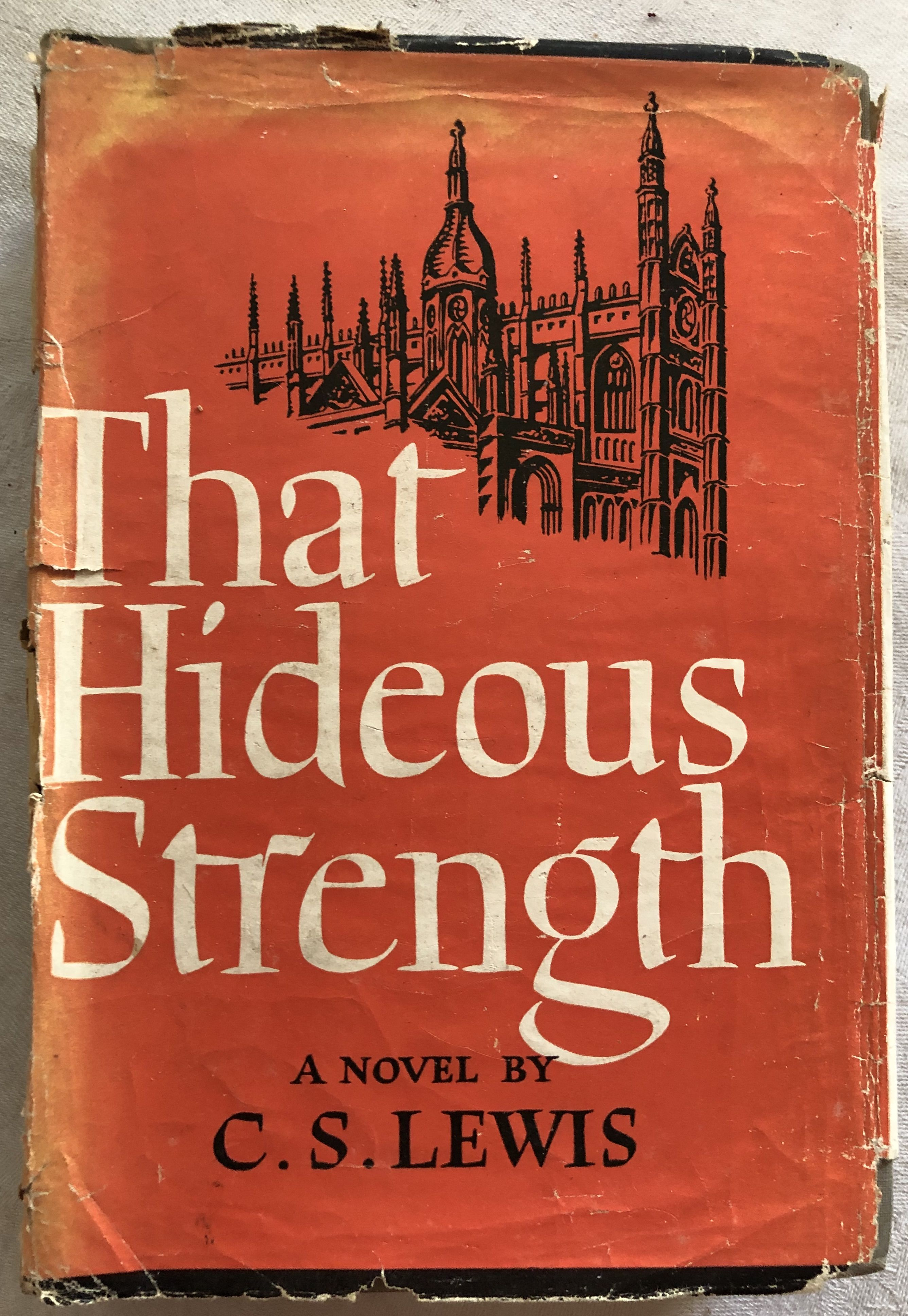
Today I’d like to draw your attention, dear reader, to two pairs of articles that I’ve come across in recent days. The first pair are non-identical twins – strangely similar articles that make essentially the same point. They both look at the gender insanity gripping our culture and reach back to a strange scene from C.S. Lewis’s novel That Hideous Strength to make an important point about the effect of this insanity on everyone, but children most of all. Most of you know I rarely write more than a few paragraphs without coming around to an insight by Lewis, so there’s no big surprise here as to why I was drawn to his particular argument. Take a look at these articles:
Published two days apart, these two articles really are eerily similar. But rather than plagiarism, I suspect some common flash of insight or perhaps a conversation gave rise to these. If nothing else, these articles join that chorus of appreciative writings which continue to find much value in the thought of Lewis. He was able to see far better than most what was coming, and now that it has arrived, many of us are encountering in Lewis an antidote to what ails our age. The attentive reader will also see an important link between Lewis’ Objective Room and my recent reflections on modern architecture [link].
An early edition of THS, the third and final book in Lewis’s Space Trilogy.
The second pair of articles concerns the debate currently a-raging about Christian political involvement, and specifically the idea of Christian Nationalism. I don’t find myself landing firmly in either side of the debate, but I can see that all sides have valid concerns worth considering. Here are two articles, both by men I respect and admire, making their case.
Kudos to 9Marks for publishing the critical response to Leeman’s article. I think it’s vital for the brightest and most reasoned voices in the Christian community to make their arguments in public and in good faith. Sadly I’ve seen quite a bit of discussion about Christian Nationalism from both sides of the argument that is dismissive and unhelpful, bringing far more heat than light.
Only a meathead of a man would dare to speak prescriptively to women’s issues these days.
Anyways, here are some interesting links exploring the intersection of modern technology, womanhood, and feminism.
These issues present themselves in different ways in the church compared to the culture at large. While the church appeals to Scripture as authoritative, the culture does not. And so I see the need for intellectually rigorous discussion in the public square on these issues, and I am grateful when I find it. Today I leave you with three examples.
First, a piece by Mary Harrington, whose writing I’ve enjoyed in a few places recently. I don’t know if she is a Christian or not, but she is a thoughtful voice. Over at First Things, she has a book review called Gender After Eden, based on a book by Abigail Favale. In it she deals with some profound questions:
‘The Genesis of Gender’ addresses what I regard as the central cultural (which is to say theological) struggle of the early twenty-first century: the proper relation between technology and the human person, particularly as it applies to women.
She also interacts with the work of Judith Butler. Here is an extended quote that I think is first-rate:
But for Butler, this is obviously the path of liberation, for the fight against the oppressive structures of power that shape our sense of self is a feminist one, and it requires us to dismantle every structure that might induce us to view our reality as men and women as influenced by our bodies —structures Butler calls “heteronormativity.” Ground Zero for that liberation is unmooring reproduction from sex and our bodies. Following her logic to its end, Butler advocates “replacing the maternal body” with technology, with the aim of “fully decoupling human reproduction from heterosexual relationships.” We are finally free when our bodies have no relevance to our most intimate relationships and deepest commitments.
Favale invites us to consider whether this disaggregation of selfhood, reproduction, and embodiment—already underway technologically—really adds up to a better world. From the perspective of her reading of Genesis, it doesn’t heal but rather deepens the postlapsarian fractures in our “spiritual-somatic unity,” offering a vision of selfhood split from embodiment and a relation to ourselves and one another founded in objectification and control. Rather than affording escape from domination, it reproduces the very splits that make domination and control our fundamental mode of being in the world.
Onto our second link, which deals with similar themes from a different angle. Andrew Klavan, whose memoir of conversion to Christianity, The Great Good Thing, I enjoyed back in 2017, was recently on with Jonathan Van Maren’s podcast to talk about his most recent book, The Truth and Beauty. It purports to show that a close reading of the English romantics—specifically Keats, Wordsworth, Coleridge, and Mary Shelley—can shed light onto the meaning of the words of Christ in the gospels. If nothing else, a fascinating hypothesis.
In the course of the discussion, Klavan lays out some interesting ideas about how Mary Shelley’s Frankenstein—perhaps the very first work of science fiction—is centered around the question of motherhood in a technological age. Shelley’s own biography hints at this, as well as certain elements of the text itself. He goes on to posit that this is in some ways the central question facing our culture. I’m paraphrasing from memory here, so you’ll have to listen for yourself to get the details. It’s the kind of claim that seems implausible at first; it’s too fundamental. Yet the more I think about it, the more I think he may be on to something. And of course he is by no means the first or the only person to suggest these connections. I just started reading his new book The Truth and Beauty and will hope to post a reflection on that when I’m done.
Thirdly, here is some further engagement with the writing of Abigail Favale, over at The Public Discourse. The value I find here is the substantive engagement with feminist literature (which, admittedly, I do not know well at all) from a religious and/or conservative perspective. Rejecting feminism out of hand as an unbiblical ideology is easy to find among conservative Christians. But those approaches are aimed at other Christians, not the culture at large. They do not really take the questions raised by feminism seriously. When it comes to talking with friends or family members who aren’t conservative or Christian, it’s helpful to be able to have more nuanced conversations that do not rely on appeals to Scripture.
Just a quick little post to say that my article got published on Rav Arora’s Substack, Noble Truths: Click here to read it. And I hope you will. I consider it a notable act of hospitality on his part to invite me to publicly disagree with him on this important topic and to offer my perspective.
In the process of writing and editing the piece, Rav and I have had two phone conversations as well. He asks a lot of really good and challenging questions, and forces me to think more carefully about my own positions. I appreciate that. The plan is to record a podcast where we revisit these themes and questions together.
I really didn’t plan to think and write so much about psychedelics, and I’m an unlikely candidate for the job, but here we are.
As I mentioned in a recent update post, I’m at T4G this week. We just finished the first day. It’s quite a production, let me tell you. But it’s been tremendous: encouraging, edifying, enjoyable. And the highlights are the random breakfast conversations in the hotel and reconnecting with people I haven’t seen in 10 years as much as the main sessions – which have been excellent. And I haven’t mentioned the singing or the books. Well, I can see why it’s been popular.
There’s been lots of discussion in the panels about the meaning of the current ‘moment’ in reformed evangelicalism, the conference’s role in that, and what comes next. I’ll surely have more thoughts, but for now I’m enjoying taking it all in.
As we approach Easter week, the Christian’s thoughts turn to those epic events of Christ’s passion week: his triumphal entry, his betrayal, his unjust trial, his crucifixion, his burial, and his resurrection. Now what is missing from that list? Did I forget any major events? At least one evangelical theologian says yes, and he argues that most of us skip over the events of what has historically been referred to as Holy Saturday: that full day where Jesus laid in the tomb between his death and resurrection.
And what were those events? Just what exactly happened on Saturday? The Apostles’ Creed summarizes the Easter weekend with these unforgettable words:
He suffered under Pontius Pilate, was crucified, died, and was buried; he descended to hell. The third day he rose again from the dead.
All Christians have heard or repeated those words: “He descended to the dead” or, “He descended into hell.” But what the Sheol does that really mean? Sounds like some spooky hocus pocus stuff, right? Well, not quite. Enter Matthew Y. Emerson’s helpful book:
Dr. Emerson has written this book in order to metaphorically hold the hands of confused evangelicals and introduce them to this classic doctrine of the ‘descent.’ No, not the classic PC video game by the same name – though many a happy hour did I there spend.
Not this. But if you were into video games in the 90’s, you probably remember this.
Back to our topic. So what is the argument of the book, in a nutshell? From page 103: “… the confession that Christ ‘descended to the dead’ can be summarized like this:
Christ, in remaining dead for three days, experienced death as all humans do: his body remained in the grave, and his soul remained in the place of the righteous dead. He did not suffer there, but, remaining the incarnate Son, proclaimed the victory procured by his penal substitutionary death to all those in the place of the dead – fallen angels, the unrighteous dead, and the OT saints. Christ’s descent is thus primarily the beginning of his exaltation, not a continuation of his humiliation.”
Elsewhere, he expands on this a bit and claims that: “Christ ‘releases’ the OT saints, by which we mean simply that, rather than dwelling in Abraham’s bosom (or paradise) awaiting the Messiah, they now dwell in the presence of the risen Christ.”
One of the interesting aspects of this doctrine is the metaphysical discomfort it brings. It’s one thing to believe in a far-away heavenly realm. But it smacks of an embarrassing medieval credulity to say that Jesus descended through the earth to the realm of the dead, wherever that is. This embarrassment is in part due to the stranglehold that modernity has had on even faithful evangelical theology for the last hundred years or more. Such is the incredible power of the dominant materialistic assumptions that underpin our age. This is what I meant by metaphysical discomfort. This doctrine means agreeing more with the ancient Greeks and Israelites about the existence of Hades or Sheol than with the respectable materialist metaphysics of modernity.
But this so-called respectability is really a house of cards, a mirage, like the ethos of ‘cool’ that hung around certain people in high school. It’s not worth fighting for because it is built on a foundation of weaponized doubt and unbelief.
In later chapters I sometimes found it a bit tedious, and I confess I even skipped a few footnotes. The author takes to time to interact with many academic journal articles and historical arguments related to this and it had a tendency to get a bit overly technical for a non-scholar such as myself. The book is clearly aimed at pastors and Bible college or seminary students. But the author won me back by always keeping an eye on the practical implications both personal and corporate of the truths he was dealing with.
The author states his hope at the very start of the book: “My goal… is simple: to recover the doctrine of the descent for evangelicals today.” I think he is successful in that regard. In most cases, evangelicals have no real argument against the doctrine except for the intuitive metaphysical discomfort that it brings. It’s not like there is some other firmly held belief that Jesus spent Holy Saturday playing Uno with Abraham. There is simply nothing there at all. We don’t have a theology of the descent; and we don’t know what to do with it. We usually just avoid it.
The book therefore serves to cure our ignorance historically, Biblically, and theologically. There are riches and truths to gain and grow from here that we ought not miss out on any longer. And as for that temptation to feel even a little bit embarrassed about believing such a thing? Let it go. I was embarrassed of my parents in High School, but it was I who was wrong. I had breathed that nauseous atmosphere too deeply and it had distorted my view of reality. Likewise, we’ve been living with a truncated and distorted materialistic worldview for far too long already.











 Phil's Scribblings