
I listened to this book a few weeks after reading Rod Dreher’s thought-provoking new book, Living in Wonder. Both books present some challenges to Protestant readers as they take aim at various aspects of modern metaphysical assumptions which, of the three major branches of Christianity, are most embedded within the children of the Reformation. Carlos Eire takes as his subject the levitation of medieval Catholic monks and nuns, prodigiously attested to by copious historical records. I was not aware of this phenomenon before. The book is a serious intellectual and historical treatment of a subject that would be treated as ridiculous by many.
The book traces the historical records of levitation from antiquity to the modern age. It shows up consistently throughout those many centuries in a number of different religious and pagan contexts, though it reaches its apogee in the medieval period within certain Catholic circles.
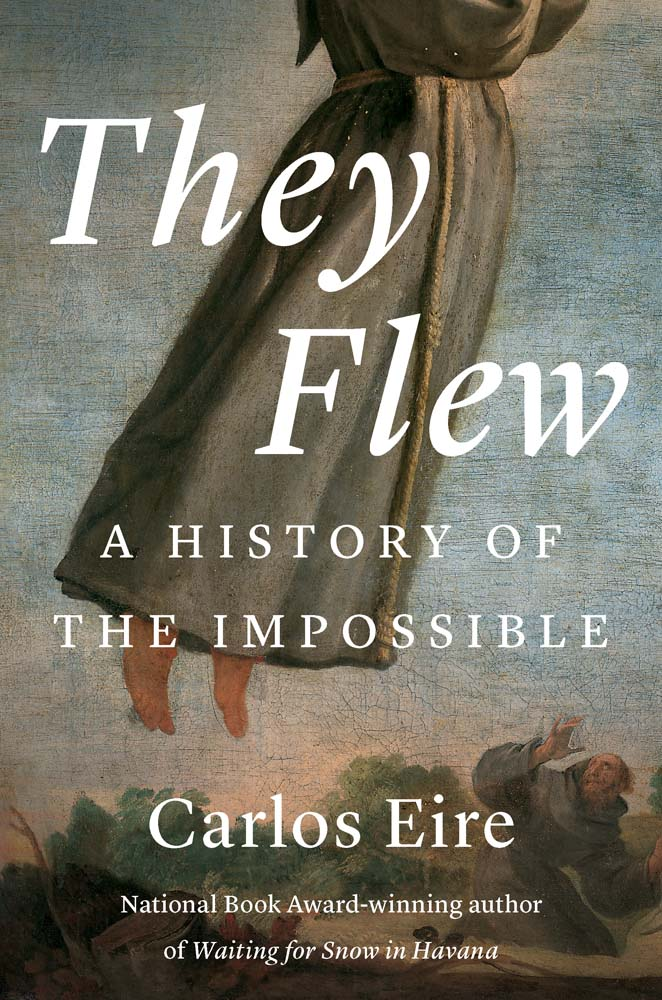
The book focuses in on three specific people for whom levitations and other similar miracles were common and widely attested: St. Teresa of Avila, St. Joseph of Cupertino, and the Venerable María de Ágreda. The overall picture that emerges is one where, despite budgeting for exaggeration and embellishment by hagiographers and admirers, it’s hard to deny that something truly remarkable happened with these people. The volume and variety of witnesses makes it very difficult to explain away.
The strangeness of the topic and the solidity of the evidence offers a direct challenge to our absorbed habits of skepticism and our confidence in the stable laws of nature. We come away with nagging questions. Just what happened, exactly? And how does it make sense within our understanding of reality? The book navigates this challenge carefully, letting the weight of the evidence land on the reader gradually, leaving the uncomfortable questions to nag at our modern minds.
The book includes a substantial and helpful treatment of medieval and early-modern views about the devil, witchcraft, and demons.
I was fascinated to learn that the topic of miraculous levitations became a proxy for the battle between the Roman Catholic church and the new fledgling but energetic Protestant churches, with both treating the phenomenon as real but Protestants largely attributing it to the power of the devil. Thus the rather fascinating phenomenon was reduced to one facet of a high-stakes battle between entrenched religious groups; a battle that not infrequently resulted in torture and death.
The fact that Protestant denunciations of Catholic miracles occurred in this fraught context gives me pause. I don’t think I agree with the esteemed Reformers in this matter, but I can understand how there was a strong impulse to circle the wagons. For their part, Catholic apologists argued forcefully that these miracles were nothing less than a divine seal of approval and approbation on the entire Roman Catholic institution; God’s ‘amen’ to their claim to be the One True Church. Thus there was a powerful partisan incentive, aside from the normal human proclivity, for Catholic chroniclers to exaggerate and inflate the accounts of the miraculous in their midst. This helps me understand why the debate about these kinds of preternatural or supernatural events played out the way they did in the wake of the Reformation.
With a bit of historical distance, and a warming of relations between good-faith members of Catholicism and Protestantism, it seems like a good time to revisit this issue. Here is a sketch of my own still-forming view of this. Levitations can be faked rather easily, especially if they occur indoors, but this cannot explain most of the historical record. The phenomenon is, at least part of the time, real. The physical body somehow is able to suspend the force of gravity, or to be unaffected by it, during a state of spiritual ecstasy. This porous barrier between the physical and the spiritual was the default worldview within medieval Catholicism, though it was considerably hardened within Protestantism, in part as a reaction against Catholic fixation on these and similar topics, and then fully cemented by the time of the enlightenment (which was really the enshrining of the new dogma of mechanistic, reductive materialism).
Within premodern cultures and in certain spiritualist and occult traditions even today, this separation does not exist in the same way, and testimonies of such “impossible” feats regularly trickle out, though hard evidence that would be amenable to scientific analysis is almost never produced. The fact that the real phenomenon was mostly located within certain Catholic institutions like monasteries and convents does not, for me, serve to underwrite the whole of Catholicism. Far from it. But neither do I dismiss it as merely a trick of the devil to deceive the masses. We should leave room for demonic trickery and preternatural manipulations, such as the testimony of one tortured soul in the book who eventually confessed to making a pact with two demons, resulting in her ability to manifest, among other things, inexplicable levitations—I don’t see why that wouldn’t be possible. But if it’s not all demonic, and if I don’t buy what the pro-Roman Catholic apologists were selling, then we need some other framework to fit this into.
And so for me the conclusion is that these weird things did and do happen. They happened for a variety of reasons, perhaps divine and angelic, or demonic and devilish, or maybe even some other source besides that remains mysterious to us. God, in his perpetual purpose to confound the proud and the worldly-wise, perhaps scattered such manifestations among the Catholics in such a way as to frustrate the excesses of the Protestants. The injunction to “test the spirits” (1 John 4:1) applies to individuals. For Catholics to dismiss Protestants because of their lack of miracles (something which is not true today, if it ever was) is just as misguided as Protestants lumping all Catholic miracles together and denouncing them as demonic. In both of these approaches I see an all-too-human pride in one’s institution, one’s group. “You are still worldly. For since there is jealousy and quarreling among you, are you not worldly? Are you not acting like mere humans?” (1 Cor. 3:3:).
If I have taken anything away from my reading of church history, it’s that God does not play favourites with his children. There is enough shameful wreckage in each and every human grouping of Christians to keep us humble, and enough goodness and grace to rightly celebrate. We do well to keep this in mind even as we hold our Biblical, theological, and historical convictions firmly.
Carlos Eire has produced a book that feels very much suited to our moment of metaphysical re-evaluation. Although I struggled and skimmed through some parts of it—the accounts of levitations all blur together after a while—I enjoyed this book and the way it made me wrestle through this fascinating historical thread running from the medieval world well into our modern age.
The central question—they flew?—rests uneasily on the modern mind. Can we really believe they flew without losing all the goods modernity has bequeathed on us? Can we believe it without reverting to a medieval worldview that, if enchanted, also tended to be marked by ignorance and superstition? Can we really believe they flew and still remain well equipped to live and lead in the twenty-first century? My answer to all these questions is yes.
We must let go of reductive materialism and the hold it has on our minds. By this I mean broadening our view of reality in order for it to accord with the way the world really is. In fact, I’ve become convinced that letting go of reductive materialism is going to be a necessary step if we are to hold on to the goods of the modern age; if we are to avoid the ditch of scientism and the ditch of superstition; if we are to have the perceptual tools and the wisdom to navigate the challenges of the twenty-first century—an age when, if my intuition is right, we will see the return of the old gods and every strange being and phenomenon we so eagerly ignored during the age of reason.
In other words, we may well need categories for things even stranger than floating nuns and flying friars.
 Phil's Scribblings