
Healing the Gender War through Christian Marriage

“Marriage is a duel to the death which no man of honour should decline.” – G. K. Chesterton

Photo by Sandy Millar on Unsplash

There is something rotten in the state of the relation between the sexes. The statistics are consistently bleak. Young people are not getting married, or they are getting married much later; birth rates in the developed world are plummeting; a new political divergence between the sexes is emerging, with women predominantly leaning progressive and men increasingly drawn to the right; dating moved from the analog world to the internet, from the internet to dating apps, and now the conclusion seems to be that dating apps have made romance worst, not better.

Even the romantic comedy movie genre seems like an artifact from a previous, more innocent era. It feels like, as a society, we have quite forgotten how to fall in love. We have lost romance, and I almost feel nostalgic for the problems we had with the excess of romance. What killed romance? I don’t pretend to know the full answer to such a question, but clearly pornography has played a leading role. With young men (and women) typically being exposed to violent pornography in early adolescence, what chance does friendship really have to flower into attraction or romance?

Pornography takes the sacred consummation of covenantal love, the apogee of romance between two human persons, and desecrates it, reducing it to mere animal urges. By this defiling of the marriage bed the entire chain of romance is broken. If love is meant to grow organically and naturally between a young man and a young maiden, it’s difficult to come up with anything that could so deeply derail that enchanted procession as the mixture of dating apps and pornography that characterizes the modern mating market.

But there is good news, because I am convinced the church of Christ has an important role to play in preserving and modeling a healthy culture of romance and marriage for a watching world that has so completely lost its way. The culture is disillusioned and exhausted, tired of the cynicism and the failed promises of ever-more-freedom, one-more-hookup, the-transgression-of-one-more-sexual-taboo as the answer to all our problems. Into this dysfunction, the church has an opportunity to show a better way: marriages that reveal a complementarity in harmony with the created order and that manifest genuine friendship, romance, and selfless love.

It’s in Genesis that we find the original blueprint for the relations between the sexes as well as the defining characteristics of how sin has marred this blueprint ever since the fall. When I was a campus student leader at Bible College, I started to notice something troubling percolating among the student body. What I noticed was a spirit of division growing up between the young men and young women, fueled by a narrative of grievances between the two groups. It resembled the kinds of attitudes that are sadly all too common in the public square whenever discussion turns to the relations between the sexes. I also started noticing that the harmony that had existed between the men and women began to be frayed and strained as both sides were pressured to find solidarity primarily within their own gender grouping.

As a student leader this was very concerning to me because one of the most wholesome aspects to on-campus student life had been precisely the absence of these divisions. Indeed there was a healthy amount of brotherly and sisterly affection which was openly expressed between the hundred or so 18-25 year-olds who made up our little community.

It was to Genesis that we turned to find language to describe the problem we were facing. An honest reading of Genesis 3 made the nature of the perennial problem clear: men tended to be too passive or to dominate selfishly and women tended to usurp or undermine the men. Each side can always feel smug and satisfied by focusing on the sins and failures of the other group. And as long as this is what we do, we can be sure we’ll never get anywhere good. Part of the answer was just laying out this deep-rooted dynamic for all to see. These conversations were illuminating and convicting, and many humbled themselves in repentance when they identified how they had been contributing to the division.

The next step was giving them a vision of an alternative to the mutual suspicion and division that we see so much of. The New Testament provides the blueprint: that of the redeemed household, with brothers, sisters, aunts, and uncles. In a healthy family, siblings genuinely want the best for one another. I do think there are natural limits on what kinds of personal friendships can exist between men and women before the inevitable complications arise, but that’s a topic for another time. For now, we can simply assert that the brotherly love Christians are to have for one another includes everyone, male and female.

That addresses, if partially, the division and hostility between the sexes, but what about romance?

Here we find more to work with in the Old Testament than in the New. We have a number of narratives that seem to be more than merely descriptive, even if they are tainted by sin: Jacob and Leah, Ruth and Boaz, but especially the love poetry par excellence, the Song of Songs. Add to that this enigmatic Proverb:

“There are three things that are too amazing for me,

four that I do not understand:

the way of an eagle in the sky,

the way of a snake on a rock,

the way of a ship on the high seas,

and the way of a man with a young woman” (Prov 30:18-19).

Pondering these Scriptural depictions of romance will go a long way to correcting some of the worst confusions and distortions of our day. One of the things that becomes clear from these passages is that the experience of falling in love is a great good gift. Yes, it needs to be informed by wisdom and protected from the predations of sin, but it is good.


The relations between the sexes are fraught. In marriage, we find the reconciliation of the sexes that serves as a blueprint for peace. A happily married person, in view of their love and partnership with someone of the opposite sex, will necessarily be far slower to participate in broadsides against the other sex.

In Christian marriage, we find not only that, but a living picture of the gospel itself. Indeed, the Bible is clear that marriage, far from being an arbitrary arrangement that allows for the continuation of the species, is of cosmic significance, for it was designed from the very beginning to reveal something glorious about God: ”This is a profound mystery—but I am talking about Christ and the church” (Eph. 5:32).

In our day of relational carnage, a thriving marriage is a beacon of light, a promise that there is a better way than what the world offers. May the church be a place that welcomes the many wounded refugees from the gender war, a place where such people can learn God’s good design for men and women and even, perhaps, a place where they can do what men and women have always done: fall in love and get hitched.

(Happy 16th anniversary to my lovely wife, Kaitlyn, God’s great good gift to me).
The State of the Blog (What I’ve Been Up To)

Things have been quiet here at the blog, you might have noticed. Life has its way of crowding in and getting busy, doesn’t it? Work has been a couple notches busier than normal, and then I also recently was voted in to serve as an elder in my local church (again). By the way, I just signed up for the Amazon affiliates program, so that if you are so convinced by my writing to make a purchase on Amazon through a link on my site, I will become an internet millionaire through Bitcoin. I’m pretty sure that’s how it works. Anyways, moving on.

I’ve been keeping up my reading, though. I read Church Elders by Jeramie Rinne – simple and good on the topic. I finally got around to reading Rod Dreher’s Benedict Option, which I found myself resonating with. It’s a bleak perspective on the state of the West, to be sure, but I largely agree with his assessment. I also found that the loudest critiques of the book I’d heard were pretty obviously mis-readings of Dreher’s actual argument. I’ve got an idea to combine a review of it with a review of Aaron Renn’s Life in the Negative World (which is sitting on my shelf), putting the books in conversation with each other.

I also read a Canadian book called Divorcing Marriage, a collection of essays from social conservatives and lawyers from the era a generation ago in 2004 when homosexual marriage was just being pushed through the courts. It was astonishing just how much things have changed in the last twenty years. At the time, I was not politically or socially conscious. I was easily convinced by simple appeals to fairness and empathy that gay marriage regulated by the secular state was fine – it had no bearing on Christians and I could not imagine any reason why society as a whole might wish to retain a traditional view of marriage. Well, this book really helped crystalize my thinking, which I now realize was about as solid as my 100-year old barn that is half fallen over and whose beams are rotted. I hope to write something more extensive on this, we’ll see.

After finishing that I felt I was due for some classics, so I’ve read Sir Gawain and the Green Knight and the story of Percival, and I’m now reading Roger Lancelyn Green’s classic King Arthur and His Knights of the Round Table, which retells those two stories as well as many others. My son, who just turned 13, read it this year in his schooling so we’ve been able to connect over it. Lastly, I started Charles Dickens’ Great Expectations and am enjoying that as well.

Oh, I forgot, I’m also reading Thomas Watson’s The Lord’s Supper as recommended by Gavin Ortlund during his video on the topic. It’s excellent. It argues for what is known as the ‘Spiritual Presence’ view of the Lord’s supper, as a middle way between the excesses of transubstantiation and memorialism. I’ve become very interested in this topic as I’ve been thinking through re-enchantment and the church (more on which in a moment).

Did you know that both the Westminster Confession and the London Baptist Confession of 1689 took this view? Somewhere along the way the default evangelical view seems to have gotten filtered through enlightenment materialism and the supernatural was stripped out, leaving only the human-level interaction with memory and Scripture. This mere memorialism is the view explicitly laid out in the Southern Baptist document, the Baptist Faith and Message, as well as my own denomination’s Affirmation of Faith. But I haven’t been able to find out why. On the strength of which argument was the more classic reformed view replaced? I am eagerly looking forward to reading Dr. Michael Haykin’s book Amidst Us Our Belovèd Stands: Recovering Sacrament in the Baptist Tradition, which argues this point. Here is the short blurb summarizing the book:

When it comes to baptism and the Lord’s Supper, many Baptists reject the language of sacrament. As a people of the book, the logic goes, Baptists must not let tradition supersede the Bible. So Baptists tend to view baptism and Communion as ordinances and symbols, not sacraments.

But the history of Baptists and the sacraments is complicated. In Amidst Us Our Beloved Stands, Michael A. G. Haykin argues that earlier Baptists, such as Charles Spurgeon, stood closer to Reformed sacramental thought than most Baptists today do. More than mere memorials, baptism and Communion have spiritual implications that were celebrated by Baptists of the past. Haykin calls for a renewal of sacramental life in churches today—Baptists can and should be sacramental.

That’s exactly what I have been leaning towards. It marries my interest in historical retrieval & ressourcement and my desire to exhort evangelical churches to steward well the cultural movement towards re-enchantment.

I translated that desire into an article, my latest over at TGC Canada: Leaning into Evangelical Re-enchantment. If you haven’t, I hope you’ll read it. I was pleased to see Aaron Renn & Rod Dreher both linked to it at their Substacks – it’s a real blessing to a small-beans writer to get amplified and shared to much wider audiences.

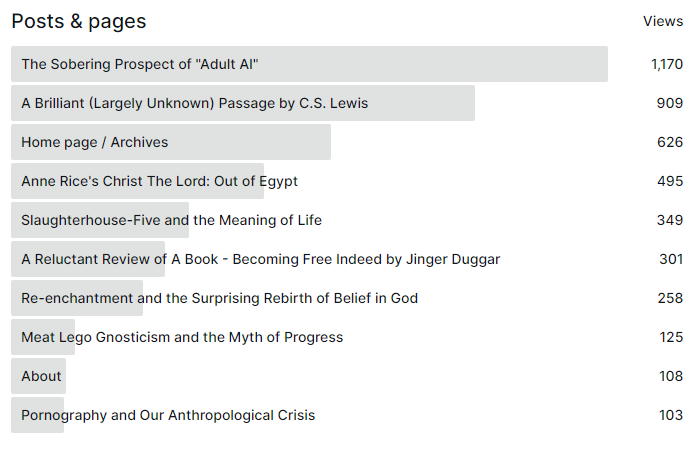
I really don’t know much of anything about internet traffic, but I have to say I have been surprised at the sustained level of reading on this here, my little blog. I have been averaging about 150 visitors and 200 views a week since early this year. This may not interest anyone, but I find it interesting. Here are my most popular posts of 2024. The #1 article, about Adult AI, was boosted by a link from Tim Challies, which also led to an interview with Moody Radio’s Kurt & Kate in the Mornings, which you can listen to if you so wish. Challies is a singular blogging phenomenon.

The #2 post, an extended quote from C.S. Lewis, has been quietly accumulating views week by week as people from all over the world find it, mostly through Google searches and perhaps links on forums. After that it seems that my reviews of popular books are of enduring interest. I would also like to add to my website here a page with links to all my published pieces elsewhere – a kind of central hub where those can be easily found.

Aside from that piece at TGCC, I have one submitted to another outlet (which I haven’t been published at before) and I am waiting to hear back from the editors. It’s another piece about psychedelics. Speaking of psychedelics, I was pleased to be interviewed by none other than Justin Brierley for his excellent documentary podcast series, The Surprising Rebirth of Belief in God. The episode on psychedelics hasn’t been released yet, but I’ll link to it when it comes out. I think I will wind down my writing on psychedelics, however – I’ve said what I had to say, and I think there are others who are better placed to continue writing for the church on this topic.

That about does it for me at this point. I’ve got some articles at various points of completion: on the Pride Rainbow compared to Vaclav Havel’s greengrocer illustration; on cathedral beauty and gospel beauty; and an article on the Haitian Christian community in Montreal which has been commissioned by Faith Today.

As always, thanks for reading.

As an Amazon Affiliate I earn a small commission from qualifying purchases of books purchased through links on my website, while customers do not pay anything extra.

At the Mercy of Narcissists

I reluctantly read Mary Harrington’s recent article about Lauren Southern and the “tradwife” movement. It’s not a happy tale. I won’t blame you for being unaware of Southern—she was a Canadian “media personality” on the alt-right, working at times with Rebel news and featured on various conservative shows as she pursued activism and controversy. She left the media world and sort of disappeared when she got married at the age of 22, around 2017. Her dreams of being a traditional, stay-at-home wife—the ultimate rejection of feminism—had come true.

But those dreams turned into a nightmare. Her husband, it seems, turned out to be a harsh, cruel, selfish man. The marriage eventually fell apart, and she fled back to Canada with her child, where she had to rebuild a life from the ruins. The article goes into a lot more detail, if you’re interested. Harrington’s angle on the story is that these internet-generated ideologies, whether it be transgenderism or tradwifery, are disconnected from reality. The web, she writes, allows these “viral and overly simplistic ideas [to] replicate with seemingly very little reference to reality, human nature, or the world as it actually is.” As far as that goes, I agree with her. Mary Harrington is always a perceptive writer, but especially on the subject of technology. See here for my review of her book, Feminism Against Progress.

My interest, and the main point I’d like to make, takes a different angle on the sad story of Lauren Southern’s marriage. Simply put, it’s that shared values are not enough to build a loving marriage; for that, you need godly character, or what we might call true virtue. Harrington tells the story: “By the time she met her husband, she’d been condensing conservative values into ‘listicle’ form as a media influencer for some years.” (A listicle is an online article that is really just a slightly-expanded list, usually of the ‘how-to’ kind). The man she met obviously agreed with her “conservative values,” which formed the basis for their shared value commitments and future plans together. But when I was retelling this story to my wife, she immediately spotted a problem: Southern had been publicly arguing for a strongly anti-feminist, pro-traditional lifestyle as a single woman. “That’s sure to attract narcissists,” she said. And why not? Any selfish man would want to find himself a woman who believed it was her duty to submit and obey and smile and keep a happy home.

Narcissists are very good at pretending to be something they are not. It’s easy to espouse agreement about values, but the proof is in the track record of relationships past and present. There are so many things I don’t know about this situation, so I can’t speak with any authority on the specifics, but my sense is that we are living through a time when men and women are having a lot of trouble finding one another, falling in love, and forming stable families. This seems to be the case regardless of political persuasion. On the Left, there is a wholesale breakdown of the family, or even gender, as stable categories. As women trend more progressive as a whole, we are seeing a lot of feminine-driven pathologies crop up across our culture, including the fact that women initiate the majority of divorces. But on the Right—where I would find myself (to some degree) politically—I also see all kinds of problems, some of which are illustrated all too well by this emblematic story.

Without virtue, no healthy relationship can grow. Without character, integrity, and humility, no flourishing marriage can form. Shared values are not nearly enough; shared dislikes and hatreds even less so. Have we lost sight of this basic kind of wisdom in our internet age? Are we so entrenched and caught up in culture wars that we think someone on the same side as us is sure to be a good spouse? There is a profoundly ugly misogyny that does exist and spread in some red-pilled, anti-feminist corners of the web. It’s not as widespread as the cultural left would like to claim; they really cannot tell the difference between a godly conservative man and a moral monster. But it’s widespread enough to be an issue that needs to be addressed.

If the women in these kinds of spaces don’t have wisdom, discernment, and good community around them, they are simply at the mercy of narcissists. What about that good community? As I read the article a part of me was thinking that this terrible state of affairs could have been helped so much by a healthy local church community. Such a church could have stepped in and advised against the marriage beforehand, or supported her once the issues arose. Good elders could have confronted the husband. But it doesn’t sound like such a church was ever a part of their lives. And with our increasingly fragmented, individualistic communities, nothing else was there to take its place.

Here is another lesson that returns to the theme of technology. Online communities can be great in some ways, but they cannot replace the embedded, embodied communities that once formed the fabric of our societies. When the marriage is really a nightmare, a friend at the front door or a place to stay is what you need, not an avatar or emojis on a messaging platform. A healthy local church is the last best remnant of this kind of community.

But for those of us with daughters, there is one more lesson to draw: we must model for them what good men are like and teach them to spot bad men. And then let’s embed our families in thick communities that look out for one another and take care of each other.

To be clear, I am not blaming Lauren Southern for the situation she found herself in. As I said above, I really don’t know the details and it’s not my place to render that kind of judgment. I do think the situation, public as it is, can be instructive for us. The article includes an unexpectedly positive note, telling how Southern found healing as she lived with her child in a small cabin in the woods, connecting with working class people living in trailers nearby. She described it as “unexpectedly healing, and filled with a genuine sense of community.”

Listen to that Existential Dread

In the Christian worldview, there is always a god.

In every person, there are desires and drives and values. Every person has purpose. Whatever most controls and compels you, that is your god. Whatever has the strongest hold on your emotions and behavior, that is your god.

In those with powerful addictions, this is easily seen. In others, however, and perhaps in yourself, it is not so easy to discern. But it is there, rest assured, as surely as there is a brain in your head if you are reading this. (Apologies to any brainless readers). This needs some nuance, as I recognize in myself the working of many different gods at different times, although I profess and strive to worship one God alone.

Speaking of the human heart, Thomas Chalmers put it this way: “Its desire for one particular object may be conquered; but as to its desire for having some one object or other, this is unconquerable.” This is from his excellent work, “The Expulsive Power of a New Affection,” which lays this out about as well as I have ever seen.

How can I know what these gods are? Where can I find them? How will I uncover their hiding places? Often this is a good thing that we’ve turned into a god thing. This is a large part of what counseling tries to do—let’s find out why you do what you do and feel what you feel. Discovering the roots of your behavior and emotions can be profound, enlightening, and transformative. For Christians, this rooting out of false gods and replacing them with the worship of the true God is one way (among many) of conceiving of progressive sanctification—the lifelong stuttering journey towards maturity and Christ-likeness.

One sure way to identify such an idol is to find where in your life you experience what I call existential dread. This is the feeling of the ground opening up to swallow you into darkness. We experience this when someone or something threatens one of our gods.

Falling into Pit

For example, as a young single man I took in a lot of solid teaching on marriage and developed a deep desire to be a good and godly husband. At some point this went from being a good thing to a god thing. It subtly became a part of my identity and hope. This was revealed over time as I experienced recurring existential dread when my wife would point out some obvious, glaring, usually minor shortcoming in me as a husband. These conversations would send me into the depths of despair and elicit unbidden a blizzard of dark emotions. Whoa. Touched a nerve, as they say.

This overly strong reaction was a flashing neon sign for those with eyes to see and ears to hear. It took me a few years to develop those eyes and ears. As a child of God I know I am to root my identity and hope in God Himself, but I only do this partially. I couldn’t accept the truth that I was not the kind of husband I wanted to be because I had to be that kind of husband. My worth was tied to it. And when that worth was threatened, a dark pit swallowed my heart.

Armed with this new insight, I can now repent of absolutely needing to be a good husband. In fact, shifting my hope from this god to Christ frees me to listen openly to my wife’s constructive criticism—the very doorway that edges me in the direction of being a good husband. Which, by the way, I still want to be.

Perhaps for you it is being a certain kind of employee, or boss, or leader, or spouse, or parent, or musician, or writer, or pumpkin-spice latte-maker, or anything else under the sun. This is what Calvin meant when he said that our hearts are idol-factories. To quote Chalmers again:

[The heart’s] desire for one particular object may be conquered; but as to its desire for having some one object or other, this is unconquerable.

The Synergy of Responsibility

A close friend who has known me from childhood recently told me that it was impressive to him that I was already a father, that I was married and taking care of my family – day after day putting my family’s needs and wants before my own.

Well first of all I certainly find many opportunities to put myself first. But I know what he’s getting at. Yes – as a husband and a father I regularly, even daily, put my family first. But my first internal sense was that this was not necessarily a praiseworthy thing, because deciding to take responsibility forces you to take responsibility.

I came to embrace some profound beliefs about manhood and responsibility a few years ago, and I have allowed these convictions to guide my life decisions since. So I got married at 23 and became a father at 26. I made some BIG decisions early on that have fundamentally determined what the next few decades of my life are going to consist of. In making those decisions I embraced the responsibility of loving a wife and raising a child (or children, Lord willing).

But those decisions, in a way, have forced my hand. Short of being a completely delinquent father and husband, I have to be responsible day after day. I think that’s a good thing. At the very least, it’s a good thing for me. It has the effect of pulling me out of my insular selfishness in which I would otherwise happily wallow. I would never say that marriage and fatherhood are the only ways to get boys to grow up and take responsibility. Lots of guys do a fantastic job of shedding boyish behavior and embracing responsibilities without getting married or having children, but then again lots of other guys don’t. So even if it’s not the only way, it does usually help.

One last caveat: without a desire for and commitment to responsibility, marriage and fatherhood will not create a man but rather burden a wife and child with an irresponsible guy, so that’s not a good idea if anyone is considering it.