The Real Reason Many Reject Penal Substitutionary Atonement

Ever since Bible College almost 20 years ago (gasp!), I have wondered why there is so much argument and furor over “theories of the atonement.” I remember seeing an essay in the student paper that questioned penal substitutionary atonement (hereafter PSA) and put forward an argument for Christus Victor. It revealed a clear aversion to PSA and this mystified me. Why, I wondered, would someone be so motivated to deny something which seems to be the plain teaching of the Bible?

Over the years I came to better understand the issues at stake, but I admit I still had trouble making it make sense. I could understand why some progressive Christians refused to believe in a God who poured out wrath and judgment (due to liberal theology’s allergy to descriptions of God that went against the grain of respectable modern moral sensibilities), but then what about those who had no problem with those parts of the Bible but who still seemed to have so much animus against PSA? I recently heard Derek Rishmawy make a comment on an episode of the Mere Fidelity podcast that struck me as an excellent answer to that question.

Here is the point he made: penal substitutionary atonement gets pulled out of shape and distorted when the categories of classical theism are not there. The prevalence of modernist metaphysics throughout the 20th century gave us a strange mix: conservatives held onto supernaturalism (like the virgin birth and the resurrection) but unwittingly lost the doctrinal substructure that served to keep PSA in its proper shape. Rishmawy observed that many conservatives in the 20th century (and into the 21st) were defending what they rightly thought of as a doctrinal core (PSA), but doing it in ways that would be contrary to earlier advocates in the tradition who had certain doctrines in place that protected them against the severe distortions. The most obvious stabilizing doctrine would be a classical view of the Trinity. He added that “substitution is an extraordinarily powerful doctrine that, without the right machinery around it, creates severe shearing forces in preaching that that can go wrong.”

This seems quite right to me, like a key piece of the puzzle going right into its place. This insight explains some of the dynamics at play in these discussions and debates. For instance, without a clear understanding of the inseparable operations of the one triune God, then there is no guardrail to keep a preacher from describing the cross as the Father over here pouring his wrath out on the innocent and reticent Son over there, introducing a firm separation between Father and Son, as if they were not together fulfilling the plan of redemption they drew up before the foundation of the world. And without divine impassibility—the idea the God is without passions—then any talk of the wrath or punishment of God conjures images of uncontrolled anger or passionate revenge. But this is not the way to understand the wrath of God.

Here is a possible sequence of steps to summarize this process:

Modern metaphysical assumptions seep into theology —> classical trinitarian theism is revised —> loss of doctrines like divine impassibility and inseparable operations —> PSA language gets pulled out of shape by many of its proponents —> people react against the distortions of PSA by energetically rejecting PSA and pursuing alternative understandings of the atonement.

This would explain the strong overlap between those who reject classical theism and those who reject PSA, of which John Mark Comer would be one obvious example. Without the former, the latter is too easily distorted into absurdity (”cosmic child abuse”). So a twofold dynamic happens: proponents of PSA who haven’t got a firm grasp on classical theism tend to present it in distorted ways since they lack that doctrinal framework, and those who have rejected classical theism have a hard time conceiving of PSA without it quickly devolving into something grotesque, making it easier for them to reject PSA.

The parallel track that runs alongside this, mentioned above, is the rejection of wrath and judgment as fitting for God, a hallmark of liberal theology. Even the great evangelical stalwart John Stott seemed to be affected by the sense that it was not respectable, and perhaps unthinkable, to claim that God would pour out his wrath in judgment for all eternity. Stott’s case was mild — preferring annihilationism to the idea of eternal judgment. But the same impulse has pulled many a Christian to rethink PSA on the grounds that the idea that God’s wrath against sin must be satisfied is beyond the pale.

Even without a thoroughgoing classical trinitarianism, the best exegetes throughout the 20th century always managed to avoid serious problems in their description of the atonement by sticking close to the text of the Bible and letting their preaching and teaching reflect the overall balanced emphasis of the Scriptures. This is a point that D.A. Carson has made repeatedly, and it is worth bearing in mind: it is not enough to find something true that the Bible affirms and then proclaim it from the rooftops. There is a matrix of truths that are all interconnected, and the careful student of the Scriptures pays attention to the relative emphasis and the context of those truths as found in the whole Bible.

Talk of the various theories of the atonement seems to me to start the whole conversation off on the wrong foot. Let us rather seek to understand and rightly represent the multifaceted glory of the atonement. Wonder of wonders—our God has reconciled us to himself through the cross! And how? Let me count the ways, for the Scriptures unfold and tease out multiple threads of wondrous truth about this singular moment in history. One of these, among others, is the idea that in our place condemned he stood, becoming sin for us, bearing the punishment our sins deserved, that in Him we might become the righteousness of God. Our triune God planned and accomplished this for the fame of his name among the nations, and because he loves us. He redeemed us from the curse of sin, becoming a curse for us; he ransomed us, buying us with a price; he defeated the powers of darkness, triumphing over them and disarming them. Yes and amen.

The insight from Rishmawy is helpful because it reminds us that our theology is a complex matrix of interrelated truths. And there are some, it must be said, that are foundational, load-bearing truths. They keep the whole superstructure balanced and strong in ways that are not immediately obvious. And once they are removed or compromised, the whole building may not immediately fall down, but it may sway and wobble and buckle in unhealthy ways. I think this is what we’ve seen with popular-level representations of PSA, with lamentable results in driving people away from any kind of penal substitutionary element in their understanding of the atonement. The answer to overcorrections and pendulum swings, however, is careful and loving attention to the holy Scriptures.


A Double Dose of Psychedelics Content

I’m trying to balance my focus on the psychedelics movement with writing and content that covers a far broader array of topics (AKA my interests!). But this last week, the stars aligned for there to be a strong focus on the topic of psychedelics, with my first TGC (USA) article being released as well as a podcast conversation with the fine folks at What Would Jesus Tech (WWJT). Here’s a direct link to the YouTube version of the WWJT episode. I think they did a pretty good job with the podcast episode thumbnail image:

I wish I could say the same for the TGC article. The image they chose is a little creepy! Hah, oh well.

Many thanks to the hosts of WWJT for having me on and having such good questions. I really enjoyed our conversation. They are a legit podcast with some really legit and impressive guests. If you are a Christian interested in how technology (in all its manifestations) intersects with the faith, you need to check them out.

The TGC article, called “The Psychedelic Renaissance: A Story of Hype and Hubris,” is an “explainer” kind of essay where I try to inform the reader about this large and complex topic, but with an editorial twist where I render a verdict about the psychedelic movement in general. There is certainly some overlap with the article my late-2023 article at Mere Orthodoxy, but this recent one delves more deeply into the current state of the research and especially into the increasingly visible network of activists and funders who are pulling the strings behind the scenes of the public-facing pro-psychedelics movement. Here is how I conclude the first section of the article, which deals with this:

One thing ought to be clear: It simply isn’t the case that disinterested scientists have stumbled on surprising cures for mental health problems. Rather, advocates already committed to the promise of psychedelic therapies, usually bundled with New Age spiritual beliefs, have patiently pursued a strategy to build a veneer of scientific, medical respectability for their agenda.

This state of affairs makes it difficult for the public (and regulators) to parse the data and evaluate possible legitimate medical applications of these substances. It may be many years before those assessments can be made confidently, but that won’t stop a growing number of people from trying psychedelics for themselves.

One way I’ve started thinking about how Christians ought to respond to the psychedelics movement with with a dual response: one at low-resolution and a second one at higher-resolution. (I go into this idea a bit in response to some really thoughtful questions in the WWJT episode.) Here’s what I mean: the low Christian resolution response to the pro-psychedelics movement in general should be a giant waving red flag. In the article, I try to get this across with the following sentence: “The hype of healing will not ultimately deliver on its promises, and the hubris of spiritual exploration outside of Christ will expose many to unbiblical ideas and even demonic spiritual forces.”

That’s the first and most important thing for the church to get clear on, in my humble opinion. But there is a second, higher resolution response that is also legitimate. It has to do with a more narrow discussion about possible legitimate medical uses of psychedelic compounds for the treatment of specific issues such as PTSD, some forms of addiction, etc. This is separate from all discussion of spiritual or recreational uses, which are out of bounds if one takes the Scriptures as inerrant and authoritative.

I am still thinking through some of the nuances of this more narrow question about possible valid uses of these compounds in certain medical cases. The best treatment of the question I’ve come across so far is a journal article by Thomas Carroll, a Catholic medical doctor. He argues, convincingly in my view, that the specific problem with psychedelics is the mystical experience it generates for the user. This is what makes psychedelics unlike other substances, and why they rightly exist in a class of their own. Further, he argues that since Christians have a category for legitimate mystical experiences that are given by God, and since it has never been the teaching of the church that Christians ought to try and contrive these experiences themselves, that it is therefore illicit for Christians to intentionally take these substances for the purposes of some kind of therapy where the mechanism of healing is bound up with the mystical experience itself.

However, these substances have effects other than just the mystical experience. They make one more suggestible and they interrupt some of our deeply ingrained patterns of thinking; both of these effects have the potential to be powerful aids when coupled with wise counseling. There is indeed a little-known branch of psychedelic therapy known as psycholytic therapy (PLT) and it specifically focuses on using small doses in conjunction with talk therapy to work through problems. This approach has been eclipsed in recent years by the big push for and major coverage of psychedelic-assisted therapy (PAT).

Carroll’s article basically concludes that, since the mystical experience is the very mechanism by which psychedelic-assisted therapy functions, it should be considered illicit for Christians, but that participation in psycholytic therapy should be considered a question of personal conscience. This seems right to me, and it’s where I am landing at the moment.

A friend of mine sees this very similarly but takes a slightly different and more open position: he believes that a Christian could partake of psychedelic-assisted therapy as long as he regarded the mystical experience as a negative side-effect to be endured, a bug rather than a feature. This is very different from the general approach to psychedelic therapy, and although I’m not there myself, I don’t think it’s an unreasonable position for a Christian to take. My concern with it is how it actually plays out in practice. How do pastors counsel their church member to go through with this kind of therapy for their PTSD? How does one handle the possibility that despite going into it with the idea that I won’t place my hope in or even lend credence to this mystical experience, it ends up being so profound and powerful that I can’t help it? To me it seems to leave a door open that I think should remain shut.

That’s all for now. As always, thanks for reading and following.

Escaping the Malaise of Modernity

The opening chapter of Samuel Parkison’s ‘To Gaze Upon God’ — a work of theological retrieval for evangelicals on the beatific vision — makes a striking argument.

Parkison states that all Christians throughout history have agreed that the beatific vision — seeing God face to face — is what makes heaven heaven, it is our blessed hope. But evangelicals in the last couple centuries have largely abandoned the term, though thankfully, many have not abandoned the idea. For example, John Piper’s ministry has hammered home the idea that seeing and savouring Christ is the chief delight of the soul; C.S. Lewis’ vision of “further up and further in” forever in Aslan’s country is similar, and so on.

But then Parkison takes aim at what he calls the “fundamentalist-biblicist” approach to the Bible as fatally compromised by the spirit of the Enlightenment. “Tradition, according to the Enlightenment, is a straight jacket, confining the would-be liberated intellect to immaturity.” Sola Scriptura, he argues, was never meant to be a rejection of the “confessional, catechetical, and liturgical life” that is shaped by the wisdom of past generations.

“The contemporary antipathy for tradition that often accompanies fundamentalism and a biblicist approach to theology did not come from sola Scriptura; modernity and the Enlightenment are to blame for this aberration form historic Christianity.”

This is a bold statement. And we are only at page 6. He goes on to argue that we have been largely cut off from our historical inheritance as Christians by this Enlightenment turn, this promise of intellectual maturity that turned out to be more like the journey of the prodigal son. Seeking self-fulfillment and freedom, we’ve ended up as a culture and in much of the evangelical church at a dead end, wondering what went wrong.

In this context of modern confusion, the idea of the beatific vision “touches a nerve within the soul; a nerve for which the post-Enlightenment imagination does not even have a category.”

And here is the conclusion he drives home to conclude the section:

“The way we escape the malaise of modernity is not by embracing individualistic biblicism, for individualistic biblicism is stuck in that very same malaise. The way forward is first the way backward. We must correct our course, and theological retrieval is the way to do this.”

I find myself resonating with this line of argument, though Parkison puts a very sharp point on the matter. One of the challenges here is that not every Christian or lay leader or pastor can be (or *should* be) doing this work of retrieval. There are SO many other good things to give ourselves to.

But I am convinced we do need a broad movement within evangelical Protestantism that consciously works to retrieve the best of the small-c catholic tradition, the ‘Great Tradition’ that forms the central core of Christian belief (including philosophical substructures) in such a way that is accessible and digestible for 21st-century believers of all kinds. Thankfully, there is such a movement already underway.

I’m looking forward to what I’ll find in pages 8-214 of this book, and maybe I’ll have more to share. I expect this book will be intellectually stimulating and, more importantly, spiritually edifying.

Yes, Jesus was Crucified with Nails (and It’s Irresponsible to Suggest Otherwise)

A Response to Christianity Today’s recent article, which featured a subversive argument, a spirit of revisionist speculation, and evinced poor editorial stewardship.

Correction: In a previous version of this post I stated that Gordon College is associated with Gordon-Conwell Theological Seminary, but I was mistaken. Gordon-Conwell was formed in 1969 as a merger between Gordon College’s Divinity School and the Conwell School of Theology, so the two institutions (Gordon College and Gordon-Conwell Theological Seminary) have been separate entities since 1969. I apologize for this error and any confusion it engendered.

Introduction

I do not make a habit of speaking to the latest furor or controversy. It’s not healthy to be fixated on such things, at least for me. Polemics is not my wheelhouse. But I read an article on Good Friday that I found frankly shocking, called ‘Was Jesus Crucified with Nails?’ with the subtitle being ‘Why one evangelical scholar thinks the answer might be no’. It was featured at Christianity Today, under their Church Life section, as a kind of report on the thought of this scholar, Jeffrey P. Arroyo García, from Gordon College.

So I’m breaking from my usual habit and I want to share a few thoughts about this article and the three problems I see in it. The first problem is the argument, which I think is very weak and contrary to the clear teaching of Scripture. The second problem is the spirit of revisionist speculation that motivates the argument in the first place; and the third problem is the editorial decision by CT to publish this and push it during Easter week.

I have already seen a number of responses to this ill-begotten article. And so probably my voice is not needed to push back on it, but this is one of those pieces that I felt compelled to write, if for no other reason than to get it out of my system.

It’s never a good sign when a post has 25 times more comments than likes.

The Argument: Nails or Ropes?

Dr. García’s argument boils down to this: Since the crucifixion narratives themselves don’t explicitly mention nails, and since it is well established that crucifixion during Roman times was often done using ropes instead of nails, then it is quite possible that Jesus was not actually nailed to the cross but only hung with ropes. I think I have represented the argument fairly, but you can read the article for yourself and make of it what you will.

In one sense I am grateful for this article because it sent me, like the Bereans, examining the Scriptures “to see if these things were so.” And lo, I beheld they were not so. The article itself admits this problem about three quarters of the way through, where García deals with John 20:25, which he says is the “one place in the New Testament that mentions nails.” That’s not quite true, as we’ll see, but even if all we had was John 20, it’s a slam dunk that puts this argument to bed.

In John 20:25, Thomas says “Unless I see in his hands the mark of the nails, and place my finger into the mark of the nails, and place my hand into his side, I will never believe.” Then, in verse 27, Jesus makes clear that Thomas was not mistaken in assuming nail holes in his hands, when he responds: “Put your finger here, and see my hands.” It’s hard to imagine how the text could be clearer about the fact that Jesus was crucified with nails. The only way around the clear meaning of John 20 is to undermine the truthfulness of John’s gospel itself. Sadly, that’s exactly what García does:

But he isn’t completely convinced. Jesus doesn’t explicitly say “nails,” and the Bible does not say Thomas touches Christ’s hands or his feet. Many scholars think John was written later—perhaps after crucifixion with nails had become more common, García said.

Come again? I had to read that paragraph over a few times to believe what I was seeing. What does the dating of John’s gospel have to do with the argument? How is this not just refusing to believe what the text clearly says? What does it matter whether Jesus says the word “nails” when he does say “put your finger here.” García seems to be more riddled with doubt than poor Thomas was.

There are a lot of other passages in the Bible that point firmly towards the crucifixion being done with nails, including Colossians 2, Psalm 22, and Luke 24. For an excellent overview of these passages and more, see Benjamin Gladd’s article over at The Gospel Coalition.

To summarize, the Bible clearly teaches that Jesus was nailed to a Roman cross. This was the fulfillment of Old Testament prophecies and served as a powerful symbolic image for Paul to use in Col. 2:14, where he explained that God took “the record of debt that stood against us with its legal demands” and set it aside, “nailing it to the cross.”

It grieves me that this clear teaching was undermined in this subversive and speculative article that only serves to get Christians to question whether the text itself is trustworthy. But it raises the question of what exactly is driving this project? For lack of a better term, I’m calling it a spirit of revisionist speculation.

A Spirit of Revisionist Speculation

One of the few things I didn’t enjoy about my time living on a Bible College campus was the way in which some of the young men seemed to enjoy speculating about all kinds of biblical and theological matters. I hadn’t experienced that before and I wasn’t expecting it. My own formation had been towards seeing these things as weighty, consequential, eternal matters, so I was thrown off by the apparent enjoyment some guys took in questioning and speculating.

I was reminded of this experience as I read the article and came across the words “perhaps,” “unclear,” “maybe,” “not convinced,” and then language like this:

‘“We don’t really know,” García said. “We don’t really have a lot of evidence, and the evidence we do have, it involves interpretation.”’

This is the lexicon of speculation. I don’t mean to imply it’s wrong to ask questions and think through various sides of an issue. There is most certainly a place for that. But what I’m trying to put my finger on is this spirit of taking delight in calling into question things that normal Christians consider to be solid received truth. This is destabilizing for simple Christians, and it strikes me as a problem related to scholars who are divorced from the nitty-gritty sin and glory realities of church life among normal people.

Kevin Vanhoozer addresses this problem in his recent book, ‘Mere Christian Hermeneutics’, where he claims that this division between the academy and the church has led to a theological anemia in the church and an ecclesial anemia in the academy. That seems to apply here, for I cannot imagine how this line of speculation and subversive revisionism about the crucifixion could possibly be edifying for God’s people. As an intellectual exercise between historians and scholars, maybe, but not as a featured article for Easter week for a publication that claims to be the flagship magazine for evangelicals. And that brings me to the third problem.

Publishing as Editorial Stewardship

Christianity Today’s unfortunate trajectory of decline has been well documented. I subscribed to it a few years ago, while it was under the editorial leadership of Mark Galli. It was a mixed bag to be sure, but I found value in keeping abreast of the conversation in broad evangelicalism. But what became clear over time is that it was more reflective of an elite cadre of left-leaning evangelicals than actual normal evangelicals. Galli left his post and then converted to Catholicism, which is perhaps not the ideal trajectory we are looking for in the people who fill these very consequential editorial positions. He was replaced by Russell Moore, who has had his own troubling theological trajectory.

The magazine and website still publishes good straight news reporting on issues facing evangelicals around the world, and it also still publishes good, thoughtful writing, but it certainly does seem to suffer from what some have dubbed living under the progressive gaze. This latest article is sadly on brand for what CT has come to represent, though it is the most egregious I have seen because of its direct attack on the truthfulness of the Gospel of John.

Whether John’s gospel was written early or late makes no difference when we are talking about the canon of Holy Scripture. Consider the staggering hubris of the argument once again. Consider what John himself writes in verse 24 of chapter 21, “This is the disciple who is bearing witness about these things, and who has written these things, and we know that his testimony is true.” But here comes a scholar who, having studied extra-biblical sources, decides that they are a better guide to what really happened than the divinely inspired biblical author.

Should we also question wedding at Cana? The conversation with Nicodemus? The encounter with the woman at the well? The raising of Lazarus? After all, these stories only appear in the gospel of John, which “many scholars think was written later.” And if we shouldn’t question the truth of those stories, why not? On what basis are we deciding which parts of the gospel of John are trustworthy?

Whatever this is, it isn’t an evangelical view of the Bible.

Vanhoozer warns about the danger of allowing the world behind the text (historical context and research) to eclipse the text itself. I think that is what has happened here because it’s stated plainly in the article, here in the penultimate paragraph:

“The most important thing for me is that we read the text,” García said. “And then there is a world lying behind the text—but it takes some work for us as moderns to get to the point where we know something about that world, and for me, that deepens, that broadens and focuses how you read the text, how you understand it.” (emphasis mine).

Historical context is helpful, but it should not be used to contradict the plain meaning of the biblical text.

Any publishing outlet that puts content out has to decide what it will feature. These editorial decisions are what give each publication its own flavour and voice, and are therefore a stewardship of the trust and attention that readers grant. I think every publication has at times put out content that wasn’t so good in retrospect, but over time a publication does reveal what its agenda and priorities are—and readers will take note.

It strikes me as a staggeringly poor editorial choice to feature this article prominently on the week of Easter, and a poor stewardship of the trust and attention that regular churchgoers place in the masthead of Christianity Today.

I hope and pray that CT learns from this decision and recommits itself to building up the faith of its readers with robust, wholesome, edifying content. Especially during Easter, when the focus should be on the wonder and cosmic significance of the resurrection of the Son of God, as testified to by the trustworthy Scriptures.

Happy Easter, dear reader.


Update: The article’s author, Daniel Silliman, has since written an apology at the Christianity Today website, which is commendable and for which I am grateful. My critiques of the original article and of CT more generally remain the same, but good on them for course-correcting.

Philosophy for the People – A Review of Francis Schaeffer’s ‘He is There and He is Not Silent’

I haven’t read very much by Francis Schaeffer, so I was glad to come across this handsome reprint by Crossway, a publisher who continues to impress with the aesthetic and editorial quality of their books. And I came across it while browsing in a local library in Southwest Florida – something that I feel quite sure would never happen in Canada.

The book is short, moving along at a fine clip. And yet it is anything but simplistic. What it is is a readable popular-level work of Christian philosophy responding to the particular shape and blind spots of contemporary culture circa 1970. But despite the fifty-five years that have elapsed since its publishing, the insights are certainly still relevant.

I was impressed with Schaeffer’s use of simple language to cut through academic jargon and get at the nub of the issue. You can tell he cares little about academic respectability and a lot about the lives of regular people. He rightly identifies two areas of catastrophic error in the modern mind: metaphysics and epistemology. This comes back to the title of the book: He Is There (Metaphysics) and He Is Not Silent (Epistemology).

An alternative title might have been: “A Christian Response to Contemporary Metaphysical and Epistemological Thought.” And then we would never have heard of it because it would have been read by exactly seven people. So Schaeffer had a gift for boiling things down to their essentials. This comes across strongly in this brisk and fast-paced book, which leaves the reader with the impression that it might have been written in a week-end. The style of writing is conversational, and not especially eloquent. It’s a workmanlike prose that gets the job done.

The drawback of Schaeffer’s style is that he deals very briefly with those he disagrees with. He boils down their view to some essential points and then explains why he disagrees. This is actually quite helpful for the layman who is not and cannot be familiar with the finer points of, let’s say, logical positivism, but I am sure it would be objected to by a logical positivist, who might rightly point out that Schaeffer glossed over many important nuances. Be that as it may, for a work this brief, it manages to cover a lot of terrain in contemporary philosophy.

Schaeffer’s driving concern seems to be twofold: To speak to the seeker who is dismayed and confused by the spiritually devastating consequences of modern philosophical materialism; and to build up the believer in holding fast to a Biblical view of metaphysics and epistemology which is so out of step with the late 20th-century mind. When this is kept in mind, the pace and style of the book makes a lot of sense.

It is a work of evangelistic and pastoral philosophy. It’s central message is something like: “The world now says that ‘the material world is all there is and that the best we can say about God is that God-language is comforting to the mind’, but in reality, despite this modern hubris, there really is a God Who Is There. He is not just a projection of religious hopes, not just the composite picture of responses to religious experiences, but an eternal, self-existent, Triune Being who can and does reach down into the universe he made at His pleasure. And despite the claim that we can never truly know anything with certainty, the truth is that God Is Not Silent — He has chosen to reveal himself using human language. That revelation, it is true, cannot lead to exhaustive knowledge, but it is true revelation that does lead to true knowledge of God. Modern man is wrong. There *is* a God. He is There and He is Not Silent.”

While some of the references in Schaeffer’s book may be a bit dated, the central argument is fresh and relevant. It is a message that not only remains relevant, but may in fact receive a warmer response now than at any point since its original publication in 1972. I say this because of the massive shifts roiling the Western world in recent years. In God’s providence, people are open to reconsidering these most fundamental questions in a way they were not before. Call it the vibe-shift or the ‘Surprising Rebirth of Belief in God’ as Justin Brierley does, it is a real phenomenon.

I for one hope that this short and readable treatment finds its way into many more hands.

The Everlasting People: A Second Reading

Back in 2022, I read an interesting little book called The Everlasting People. I wrote up a brief review on Goodreads and then went on with my life. And then I got a reply from the author, gently pushing back on some of my comments. It was a strange experience, which I wrote about here.

I thought about what the author – Dr. Matthew Milliner – wrote back to me and I decided I needed to re-read the book. Fast forward to 2024, and it became time for me to keep my promise. So a few weeks ago I cracked it open again and gave it a second reading.

I tried to have a more open and positive posture towards the book this time around. It really is a remarkable project, trying to adopt the general approach and insights of the inimitable G.K. Chesterton, and applying them to the Native peoples of the Americas (or Turtle Island), especially their art and mythology. Having just re-read Chesterton’s great book, The Everlasting Man, I was all set.

The book, derived from a set of lectures that were delivered, is made up of three chapters, followed by three ‘responses’. The first thing to say is that I learned so much from the book (in both readings). I learned a ton about First Nations history, a lot about Chesterton himself, and much about the surprising degree to which those early indigenous people accepted Christianity. The fact that I – along with most North Americans – do not know this history well is a sad testament to our particular blindness when it comes to these matters.

So the first reaction is a genuine lament for the way in which human persons, indeed entire communities and peoples, were mistreated, cheated, and wiped out by bloodthirsty men who too often claimed the name of Christ. Milliner is to be commended for the evenhanded way he did not ignore the sins and atrocities of First Nations people (a common enough manipulation of the story in our day of cultural self-hatred). The third respondent came closest to this particular malady of the mind, but we can just leave that to the side since it was written in 2020; one can still catch the aroma of the peak wokeness and racial angst convulsing our educated classes at the time.

One concern I had in my initial review, the usage of terms like whiteness, is still worthy of comment. Having read the book more carefully, I don’t really see any compromise here. And yet the cultural turmoil of recent years is necessarily the context into which this book must be understood, and everyone knows that a term like ‘whiteness’ is strongly coded as leftwing-progressive. Here at the end of 2024, it feels like the winds have shifted and the reactionary populism of the normies has rejected the progressive left’s project of anti-Western critical theories. So while I am happy to gloss over the term in my reading of the book, it’s inescapable that it will signal certain political and cultural alignments whether the author intends it to or not.

The meat of the book, however, is far more interesting that culture wars. The Mishipeshu (underwater panther) and Thunderbird (Animiki), two mythical creatures found within indigenous mythology, are explored for their evocative imagery and the way in which these figures were adapted by Native Christians. It is powerful to consider the Native Christian, sorrowful after so much suffering, persevering in Christ and expressing that faith in ways that are genuine to the best aspects of their culture. That is good missiology, and a good example of the kind of thing Chesterton loved.

The last chapter, which reflects on Chesterton’s poem about the Virgin Mary (The Queen of Seven Swords) as well as the medieval Virgin of the Passion (a suffering Virgin Mary, later renamed Our Lady of Perpetual Help), and how devotion to her permeated through the region where the Lenape people had once lived, was the hardest for me to wrap my head around.

But that’s okay. Gotta leave something for the third reading, I guess.

My Review of Rod Dreher’s ‘Living in Wonder’

I am happy to share with you that my review of Rod Dreher’s newest book, Living in Wonder, was released this week over at Mere Orthodoxy. I hope you’ll check it out. I really enjoyed Dreher’s book but also concluded that it presented some stumbling blocks to widespread appreciation by Protestant evangelicals. I tried to get both of those elements across in my review. I was a bit surprised to see that TGC’s review of it was so thoroughly critical, without recognizing that there are imbalances and weaknesses within Reformed evangelicalism that Dreher’s book actually helps us to address.

That was the direction I wanted to take my review. After noting my criticisms, I focused in what evangelicals can take away from the ideas in the book. This dovetails with my larger project in recent years to think through the nature of evangelicalism and Protestantism, the state of the culture with regard to spiritual matters (re-enchantment and the demise of modernity), and gleaning the best insights from the sharpest minds wherever I can find them.

While I’m a thorough-going Protestant, or rather because I am settled in my rejection of key, fundamental historical claims made by both Eastern Orthodox and Roman Catholic authorities, I feel free to read and engage with them without fear of being drawn in. I do not feel threatened by them, and I think it inevitable that each branch of Christendom, especially to the degree that they are shaped by sharp polemics aimed against other branches, will be imbalanced and in need of continual course correction. This is necessarily an endless process of discernement, reformation, and renewal. The end goal is always spiritual renewal, walking with the Spirit, and having the mind of Christ.

I also believe deeply in true small-c catholicity, the Biblical principle of affirming wherever possible, without dishonesty or sentimentality, the true spiritual unity we share with genuine believers which are scattered in many different institutions. It was a bit of a dodge when Billy Graham resolutely refused to pronounce who was in and who was out when it came to salvation, but there is something good about being slow and hesitant to pronounce on such matters when we take into account the incredible human capacity for inconsistency, and the mystery of genuine Spirit-wrought faith. I also recognize that for many people with busy lives and a simple faith, it’s not possible to navigate, assess, and discern all these things and they need trustworthy authority figures in their lives who can do a lot of that work for them.

These things shape my vocation as a writer and thinker for the church. I want to hold my convictions firmly and deeply, and yet be able to converse fruitfully with people from a wide range of perspectives. I want to offer helpful insights into culture, literature, and arts, and yet always make sure to remain in touch and appreciative of simple, hard-working, hands-on people. I want to continually hone my ability to write clearly and creatively, saying what I have to say with a dash of style that makes it enjoyable to read. I have a long way to go in each of these respects, but that is the direction I am aiming towards.

I have been mulling over once again the idea of moving this sleepy little blog of mine over to Substack, the it-place for writers. If I do, I would keep it free and try to move my previous articles and my subscribers over.

In coming days I should have a piece coming out at TGC Canada that I have been working on for quite a few months called Why We Need Beautiful Churches. It’s an attempt to piece together a whole bunch of reading and thinking on aesthetics, beauty, architecture, and the evangelical church. As always, I’m grateful for readers who take time out of their busy lives to consider my words. I don’t take that lightly, and I hope it’s a blessing and benefit to you. And if you do enjoy my writing or glean some benefit from it, I hope you’ll pass it on to others, share widely, and maybe even let me know.

The Long Way Home – A Review of Ashley Lande’s ‘The Thing That Would Make Everything Okay Forever’

Here is a book that tells a beautiful story in a beautiful way. And yet, there is a lot of darkness to get through before the dawn breaks. The raw honesty of Lande’s story, the power of her effervescent prose, and the drastic nature of her conversion are just some of the elements that make this book difficult to put down and impossible to forget.

For anyone interested in psychedelics, especially those drawn to spiritual illumination via that route, this book is for you. Lande speaks the language, has been down that road, done that, got the t-shirt. And she found something far, far better, in the very last place she thought to look. If I have any complaints about the book, it’s that the conversion comes late in the narrative and then the book ends a bit too abruptly, even if those last two chapters among the most moving things I’ve ever read. Before reaching the back cover, I wanted to learn a bit more about how Christ had transformed different aspects of her life and relationships that had been explored in previous chapters.

There is some debate both inside and outside the church regarding the use of psychedelics. One of the common complaints from psychedelic enthusiasts is that Christians forbid psychedelics out of some blind dogma. But rather than seeing it as a silly religious bias to avoid psychedelics, perhaps it would be better to see two different sources of very ancient spiritual wisdom. One, the Judeo-Christian heritage, teaches us that there is danger in such things, and that practices such as the ingesting of psychoactive substances put us in contact with a world of spirits that is not our assigned place. And yet Christianity fully validates that longing for a connection to the spiritual. The Scriptures make clear that this God-given hunger for the transcendent is meant to be satisfied by God himself, through Christ his Son, as mediated by the Holy Spirit.

The other ancient source of spiritual wisdom comes from those traditions who have for millennia partaken of psychoactive substances to connect with the spirit world and transcend one’s embodied consciousness. To some degree they can deliver on that promise. People can and do make contact with personal spiritual forces, and aside from the thrill of that experience, there is the added buzz that comes from knowing something that so much of society seems oblivious to. These practices make no personal moral demands. There are no ten commandments, no golden rule, no ultimate moral Judge. This makes it particularly compatible with the moral relativism of our age. Lastly, there is no creed or structure of authority like in a church, which resonates with our current cultural suspicion of authority and institutions.

We in the West are now firmly post-Christian. As we cast about for a solution to the spiritual malaise afflicting us, the last place we will tend to look is the place we think we have just been: Christianity. Haven’t we just decided we’re done with those old superstitions? So a journey to the island paradise of paganism, earth religion, eastern philosophy, or psychedelics seems to be just the thing we need for our starved souls in our disenchanted world. But we perhaps forget (or have never learned) that the best of paganism was fulfilled and transcended by Christianity, as G.K. Chesterton chronicled in his book ‘The Everlasting Man’.

For Ashley Lande, and perhaps for many others now journeying through the twists and turns of psychedelia and new age spirituality, the way home spiritually seems to include going round the whole world before arriving back and finding in Christ the Thing That Would Make Everything Okay Forever.

East of Eden by John Steinbeck- Outside the Garden, Far from the Cross

In the Salinas Valley of California, a novel was born. John Steinbeck wove together strands from his own life, the character of the land, and the first few chapters of Genesis to form a story that is epic, loaded with meaning. The book is both broad and narrow in scope; broad in its tracing of multiple generations of the two main families, the Hamiltons and the Trasks, and narrow in the way it focuses its gaze into the lives of its main characters.

The book was criticized by some as being too heavy-handed in its message. It’s true that the author does not try too hard to hide what he really believes about human nature, good and evil, and the purpose of life. And yet, Steinbeck is an excellent prose writer, and aside from a few bits of dialogue that I felt were clunky, the book holds together, flows easily, and stands as a massive achievement. I found the clarity of the message to be a positive, not a negative, and the clear allusions to Scripture gave it added depth for me.

While some might complain that the self-conscious patterning of the narrative after the Cain and Abel story betrays a lack of imagination or creativity, this objection is a characteristically modern stupidity. In previous eras, it was expected that great art would be patterned after earlier works. Authors were less originators of novel ideas and more stewards of literary traditions. As they retold the same stories, they modified and added to the tradition, making it their own to some extent, leaving their imprint upon it. Although I love creativity and originality, I think there is a particular kind of literary genius in the older kind of storytelling. And what we think of as original work is often drawing on traditions and stories we simply don’t know, so it feels fresh and new to us even though it isn’t. In fact, there is a special joy in discovering the sources that one’s favourite authors have drawn from: “Oh, that’s where she got that from.”

Steinbeck considered East of Eden to be his magnum opus. It has that kind of feel, both in its length (300,000+ words, 600 pages) and in its gravitas. There is not much levity in the book. It takes hold of the heaviest themes that trouble humanity and wrestles with them page after page. It took eleven years of gestation and one year of uninterrupted writing to complete it. Steinbeck said of it, “It has everything in it I have been able to learn about my craft or profession in all these years.” And also: “I think everything else I have written has been, in a sense, practice for this.”

One of the ways this shows up is in the little bits of wisdom Steinbeck seems to have wanted to include in the book. They adorn the narrative but are not in any way necessary to it. For example: “You can boast about anything if it’s all you have have. Maybe the less you have, the more you are required to boast.” Or, describing how some years were rich and others were lean in the Salinas Valley, “it never failed that during the dry years the people forgot about the rich years, and during the wet years they lost all memory of the dry years. It was always that way.”

The Salinas Valley in California

The book certainly deals with adult themes—prostitution and murder—but not in a prurient way. I much prefer this handling of such themes to what I encountered in Ken Follet’s Pillars of the Earth, or what sounds like a similar pornographic quality to the Game of Thrones books by George R. R. Martin. Art should be able to depict sin without tempting the reader to it; great art depicts sin in utterly realistic ways and yet manages to encourage virtue in the reader. The divorcing of art from virtue is one of modernity’s great achievements, to our profound detriment. The modern novel is often a kind of literary nihilism, depicting with indifference the beauty and filth and goodness and evil of the world, as if they were all interchangeable and, after all, who can really tell the difference?

In my reading of 20th-century literature, this amorality has often been a prominent feature. Steinbeck himself was known for it. And yet East of Eden concerns itself with good and evil as real categories, and in that sense it feels different from something like Waiting for Godot by Samuel Beckett, Slaughterhouse-Five by Kurt Vonnegut, or The Stranger by Camus. Steinbeck, who grew up Episcopalian (Anglican) but called himself an agnostic, held on to solid moral categories even as he lost the surest foundation for them. It is said that his last novel, The Winter of Our Discontent, explores the moral decline of Americans. It was not especially well received, which makes me think I might like it.


Back to East of Eden. I really enjoyed seeing how Steinbeck shaped his story to mirror the Cain and Abel narrative. But more than that, he included in the novel itself an extended reflection on the Cain and Abel story by some of the main characters, including a detailed discussion of the Hebrew translation into English of Genesis 4:7, “If thou doest well, shalt thou not be accepted? and if thou doest not well, sin lieth at the door. And unto thee shall be his desire, and thou shalt rule over him” (KJV). The crux of the matter is the last phrase. The KJV renders is “thou shalt rule over him [sin].” Now I happen to have studied this verse in some detail in Bible College during my ‘Exegetical Methods’ class, with a focus on the word translated desire. But here the focus is the verb shalt rule, transliterated as “timshal” (תִּמְשָׁל). In contrast to the KJV, the ASV rendered it do thou rule over it. In the novel, the wisest and best character, the servant Lee, rejects both of these translations because the KJV seems to promise that Cain will rule over sin, while the ASV seems to merely command it. Lee concludes that it should be rendered thou mayest rule over it. The key, for Steinbeck’s purposes, is that it is conditional, that it comes down to Cain’s choice. The consensus among all the main modern translations is that the verb should be translated as you must. I see why Steinbeck did what he did, making clear the conditional aspect that I think is nevertheless present in all the translations.

This central challenge to overcome sin and evil is what animates the drama of the book. Will the Cain-like characters give into the malicious impulses that course through their veins, or will they choose to master sin? In the novel, this struggle is personified in Cal, who learns that his mother is a sociopath, a deeply wicked and malicious person. He finds in himself a mix of malice and goodness, and this discovery tempts him to believe that he is in some way fated towards evil, or helpless in the face of it. Lee, who raised him and knows him best, discerns this and speaks directly to it:

Cal drifted toward the door, slowly, softly. He shoved his fists deep in his pockets. “It’s like you said about knowing people. I hate her because I know why she went away. I know—because I’ve got her in me.” His head was down and his voice was heartbroken.

Lee jumped up. “You stop that!” he said sharply. “You hear me? Don’t let me catch you doing that. Of course you may have that in you. Everybody has. But you’ve got the other too. Here—look up! Look at me!”

Cal raised his head and said wearily, “What do you want?”

“You’ve got the other too. Listen to me! You wouldn’t even be wondering if you didn’t have it. Don’t you dare take the lazy way. It’s too easy to excuse yourself because of your ancestry. Don’t let me catch you doing it! Now—look close at me so you will remember. Whatever you do, it will be you who do it—not your mother.”

The novel intends to leave us with the same challenge.


But for all of its moral force and Biblical pathos, the novel is Christless and devoid of redemption. (This is an observation, not necessarily a criticism.) It manages to capture the essence of life East of Eden, that is, life outside of the garden, life among the thorns. Steinbeck captures as much beauty and goodness as can be found in the created world, and I would argue he borrows heavily from the accumulated capital of Christianity in that effort, but ultimately we are left confronted with a moral law, the imperative to choose between good and evil, and the haunting sense that we have not the power to choose rightly, so powerful is the pull of sin.

Here is where a writer like Tolstoy or Dickens would, after a few hundred pages of wallowing in the deepest human misery, bring in the transformative power of love and of grace to serve as an illustration of the gospel. Steinbeck therefore reflects the exhausted and lifeless character of so much mainline Protestant Christianity in the 20th century. It reminds me of what Alan Jacobs described so movingly in his book, Original Sin, where he traced the views of human sinfulness throughout various times and cultures. He showed how many people have tried to deny the depth and severity of human sin, recasting it or ignoring it. This can be a pleasant sort of delusion. Others accepted the true nature of our depravity but then entered into the joy of salvation in Christ, who alone can solve the problem at its root by generating a new heart, new birth, and new creation within the human person. But the bleakest prospect, and the darkest literature, is produced by those who fully accept the depth of human depravity while, for whatever reason, remaining outside of Christ. These people see and feel the problem rightly but not the solution. East of Eden is firmly in this category.

What we don’t find in East of Eden is any mention of the seed of the woman, the promised one who would crush the head of serpent with bruised heel. But this shadowy figure stands above the entire Genesis narrative and alone gives it cohesion. Why was it important that Abel should live? To produce the promised snake-crusher. And contra Steinbeck’s claim in the novel, we are not the descendants of Cain, but of Seth (see Gen. 5). Yes, we have a little bit of Cain in each of us, but it’s Seth, who Eve says God has given her “in the place of Abel,” who produces both Noah and eventually the Messiah himself, Jesus.

Ultimately, it isn’t our ability to choose good over evil, to resist the sin crouching at our door, which makes the decisive difference. That choice, which we make every day to some extent, is a reflection of what is happening more deeply in our hearts, and what is happening on the vertical, spiritual plane which is all but absent in the novel.

The world-historical event that serves as the great hinge of history occurred on a hill not too terribly far from the land of Cain and Abel, on which a man who was also the Lord bled and died like Abel, murdered by his brothers. Hebrews 12:24 says that Christ’s blood “speaks a better word than the blood of Abel.” Jon Bloom explains: “For though Abel’s innocent blood cried out for justice against sin, Jesus’s innocent blood cried out for mercy for sinners. Abel’s blood exposed Cain in his wretchedness. Jesus’s blood covers our wretchedness and cleanses us from all sin.”

This may not have been Steinbeck’s understanding, but as I ponder the meaning of the magnificent work of fiction he wrote, I cannot help thanking God that he did not leave us to our own devices in the arid lands East of Eden. Rather, he made a way, through the blood of the cross, to a place even better than the Salinas Valley in the spring.

As an Amazon Affiliate I earn a small commission from qualifying purchases of books purchased through links on my website, while customers do not pay anything extra.

The State of the Blog (What I’ve Been Up To)

Things have been quiet here at the blog, you might have noticed. Life has its way of crowding in and getting busy, doesn’t it? Work has been a couple notches busier than normal, and then I also recently was voted in to serve as an elder in my local church (again). By the way, I just signed up for the Amazon affiliates program, so that if you are so convinced by my writing to make a purchase on Amazon through a link on my site, I will become an internet millionaire through Bitcoin. I’m pretty sure that’s how it works. Anyways, moving on.

I’ve been keeping up my reading, though. I read Church Elders by Jeramie Rinne – simple and good on the topic. I finally got around to reading Rod Dreher’s Benedict Option, which I found myself resonating with. It’s a bleak perspective on the state of the West, to be sure, but I largely agree with his assessment. I also found that the loudest critiques of the book I’d heard were pretty obviously mis-readings of Dreher’s actual argument. I’ve got an idea to combine a review of it with a review of Aaron Renn’s Life in the Negative World (which is sitting on my shelf), putting the books in conversation with each other.

I also read a Canadian book called Divorcing Marriage, a collection of essays from social conservatives and lawyers from the era a generation ago in 2004 when homosexual marriage was just being pushed through the courts. It was astonishing just how much things have changed in the last twenty years. At the time, I was not politically or socially conscious. I was easily convinced by simple appeals to fairness and empathy that gay marriage regulated by the secular state was fine – it had no bearing on Christians and I could not imagine any reason why society as a whole might wish to retain a traditional view of marriage. Well, this book really helped crystalize my thinking, which I now realize was about as solid as my 100-year old barn that is half fallen over and whose beams are rotted. I hope to write something more extensive on this, we’ll see.

After finishing that I felt I was due for some classics, so I’ve read Sir Gawain and the Green Knight and the story of Percival, and I’m now reading Roger Lancelyn Green’s classic King Arthur and His Knights of the Round Table, which retells those two stories as well as many others. My son, who just turned 13, read it this year in his schooling so we’ve been able to connect over it. Lastly, I started Charles Dickens’ Great Expectations and am enjoying that as well.

Oh, I forgot, I’m also reading Thomas Watson’s The Lord’s Supper as recommended by Gavin Ortlund during his video on the topic. It’s excellent. It argues for what is known as the ‘Spiritual Presence’ view of the Lord’s supper, as a middle way between the excesses of transubstantiation and memorialism. I’ve become very interested in this topic as I’ve been thinking through re-enchantment and the church (more on which in a moment).

Did you know that both the Westminster Confession and the London Baptist Confession of 1689 took this view? Somewhere along the way the default evangelical view seems to have gotten filtered through enlightenment materialism and the supernatural was stripped out, leaving only the human-level interaction with memory and Scripture. This mere memorialism is the view explicitly laid out in the Southern Baptist document, the Baptist Faith and Message, as well as my own denomination’s Affirmation of Faith. But I haven’t been able to find out why. On the strength of which argument was the more classic reformed view replaced? I am eagerly looking forward to reading Dr. Michael Haykin’s book Amidst Us Our Belovèd Stands: Recovering Sacrament in the Baptist Tradition, which argues this point. Here is the short blurb summarizing the book:

When it comes to baptism and the Lord’s Supper, many Baptists reject the language of sacrament. As a people of the book, the logic goes, Baptists must not let tradition supersede the Bible. So Baptists tend to view baptism and Communion as ordinances and symbols, not sacraments.

But the history of Baptists and the sacraments is complicated. In Amidst Us Our Beloved Stands, Michael A. G. Haykin argues that earlier Baptists, such as Charles Spurgeon, stood closer to Reformed sacramental thought than most Baptists today do. More than mere memorials, baptism and Communion have spiritual implications that were celebrated by Baptists of the past. Haykin calls for a renewal of sacramental life in churches today—Baptists can and should be sacramental.

That’s exactly what I have been leaning towards. It marries my interest in historical retrieval & ressourcement and my desire to exhort evangelical churches to steward well the cultural movement towards re-enchantment.

I translated that desire into an article, my latest over at TGC Canada: Leaning into Evangelical Re-enchantment. If you haven’t, I hope you’ll read it. I was pleased to see Aaron Renn & Rod Dreher both linked to it at their Substacks – it’s a real blessing to a small-beans writer to get amplified and shared to much wider audiences.

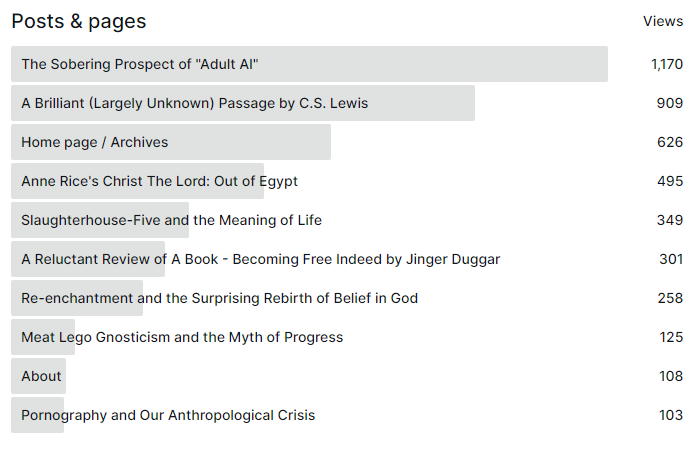
I really don’t know much of anything about internet traffic, but I have to say I have been surprised at the sustained level of reading on this here, my little blog. I have been averaging about 150 visitors and 200 views a week since early this year. This may not interest anyone, but I find it interesting. Here are my most popular posts of 2024. The #1 article, about Adult AI, was boosted by a link from Tim Challies, which also led to an interview with Moody Radio’s Kurt & Kate in the Mornings, which you can listen to if you so wish. Challies is a singular blogging phenomenon.

The #2 post, an extended quote from C.S. Lewis, has been quietly accumulating views week by week as people from all over the world find it, mostly through Google searches and perhaps links on forums. After that it seems that my reviews of popular books are of enduring interest. I would also like to add to my website here a page with links to all my published pieces elsewhere – a kind of central hub where those can be easily found.

Aside from that piece at TGCC, I have one submitted to another outlet (which I haven’t been published at before) and I am waiting to hear back from the editors. It’s another piece about psychedelics. Speaking of psychedelics, I was pleased to be interviewed by none other than Justin Brierley for his excellent documentary podcast series, The Surprising Rebirth of Belief in God. The episode on psychedelics hasn’t been released yet, but I’ll link to it when it comes out. I think I will wind down my writing on psychedelics, however – I’ve said what I had to say, and I think there are others who are better placed to continue writing for the church on this topic.

That about does it for me at this point. I’ve got some articles at various points of completion: on the Pride Rainbow compared to Vaclav Havel’s greengrocer illustration; on cathedral beauty and gospel beauty; and an article on the Haitian Christian community in Montreal which has been commissioned by Faith Today.

As always, thanks for reading.

As an Amazon Affiliate I earn a small commission from qualifying purchases of books purchased through links on my website, while customers do not pay anything extra.