The Pornographers and Those who make them Rich

It is a fact universally acknowledged that great evils persist because the good men and women who could stop them do nothing. Laila Mickelwait is not one of those who do nothing, not one to stand by while evil has its way. Instead, armed with her conscience, her compassion for victims, her moral certitude, and an indefatigable fighting spirit, Mickelwait has singlehandedly brought a multi-billion dollar business to its knees under the growing weight of lawsuits, criminal investigations, and the righteous anger of an outraged public.

This is the story told in her new book, Takedown. It is an unflinching (and at times disturbing) tale of the author’s crusade against the execrable PornHub. It reads like a hybrid memoir and crime thriller. The writing is competent for the task at hand, which is telling a story dramatically from the first person perspective. Potential readers should know that Mickelwait doesn’t hold back from describing the criminal videos she discovers in her efforts to hold PornHub accountable, and for this reason the book is harrowing to read (or listen to); it’s not for the faint of heart.

A Distinction

The book, like the law, makes a distinction between ‘regular’ pornography on the one hand and criminal pornography—content involving children or non-consensual acts—on the other. This is an important moral and legal distinction, but it was striking to see just how much and how often the author took pains to assure the reader that she was not against ‘legal’ pornography. What the typical reader might not realize however is that the legality of pornography itself has always been in question, with numerous courts adjudicating the tension between free expression and obscene materials in the US and Canada in recent decades.

This insistence on the part of the author is a strong signal as to what kind of moral compass a mass-market book can assume in its audience. It is taken as a matter of fact that pornography featuring consenting adults is perfectly fine, while the non-consensual variety is a heinous evil that should be tirelessly opposed. I agree of course with the second part of the previous sentence, but what I want to point out is how much moral significance is invested into the rather thin category of consent. Can consent really serve as the north star for our morality? And do we realize just how recently, as a society, we swapped out older and deeper moral foundations for the proverbial duct tape of consent?

My own view of pornography is that it is a poison for all involved, and that this can be established without necessarily drawing on Scripture. For example, consider the words of Roger Scruton from his book, Beauty:

The old morality, which told us that selling the body is incompatible with giving the self, touched on a truth. Sexual feeling is not a sensation that can be turned on and off at will: it is a tribute from one self to another and—at its height—an incandescent revelation of what you are. To treat it as a commodity, that can be bought and sold like any other, is to damage both present self and future other. The condemnation of prostitution was not just puritan bigotry; it was a recognition of a profound truth, which is that you and your body are not two things but one, and by selling the body you harden the soul. And that which is true of prostitution is true of pornography too. It is not a tribute to human beauty but a desecration of it.

Not only is this kind of moral clarity foreign to much of our society, there is even an inversion at work such that people who hold views like mine (and yours?) are discredited from having something worthwhile to say in the public square. Don’t believe me? Consider that the main strategy of PornHub’s apologists to discredit Laila Mickelwait was the claim that she was “one of those anti-pornography crusaders.” And this accusation was countered strategically by Mickelwait listing her pro-porn bona fides.

That is really something, if you stop and think about it.

A Criminal Enterprise

The book makes it abundantly, disturbingly clear that PornHub—and one has to assume there are many websites like it—has been involved in facilitating, profiting from, and committing crimes. For years the site has employed top-shelf PR firms and marketing companies to burnish their image and present themselves in a way not unlike Playboy did in decades past; as sophisticated and a little naughty. A knowing smile and a wink, “Hey, everyone does it, right?

The dirty little secret was that the site was a rats’ nest of criminal child pornography and video evidence of serious sexual crimes—and that PornHub not only knew this but embraced it as a lucrative aspect of their business. Laila Mickelwait led the charge to uncover this reality, thus taking on one of the biggest and most profitable websites in the world. Unsurprisingly, the men who were comfortable getting rich off the life-destroying trauma of victims had no problem hacking, harassing, doxing, and threatening physical injury to Mickelwait and her family. The reality is that the owners of PornHub, just like its content, were more than just ‘a little naughty’—they were criminal and evil.

The fact that it has taken such a Herculean effort to get the authorities to treat PornHub like a criminal organization is a sad reflection on our culture’s moral confusion. And yet the book focuses in on those people who decided to do something rather than looking away, and that is a heroic act. I wholeheartedly applaud them for that, and hope that many others rise up to join them. People are clearly hungry for moral clarity and a worthy cause to fight for—here is one where even at this point in our divided culture we can still find a general consensus.

The Enablers

But what is also clear from the book is that we cannot expect corporations to do the right thing, no matter how black and white the case looks. Consider the example of the credit card giants, VISA and Mastercard. It was not enough for the VPs of these companies to be given direct evidence that PornHub was hosting illegal content, that the site was knowingly doing this, and that they were prioritizing making money off the illegal content—the traumatic sexual abuse of minors, lest we forget—over the frantic requests of those very same victims to have the videos taken down. No, all of that was not nearly enough, because large corporations tend to function like sociopaths. If there is a good chance they might get away with something immoral, even illegal, they will tend to do it, guided by the profit motive.

Don’t underestimate the almost limitless ability of people in these corporations to rationalize their behaviour away. In order for them to do the right thing, only one thing must be clearly demonstrated: that they will lose far more money or face criminal prosecution if they continue than if they stop. In VISA and Mastercard’s case, they had to be pressured intensely and relentlessly not only by customers through petitions but also by power brokers: billionaire hedge fund managers like Bill Ackman, Pulitzer-prize-winning New York Times columnists like Nicholas Kristoff, and elite lawyers armed with track records of billion-dollar settlements like Michael Bowe. These companies do not deserve any credit for “doing the right thing.”


A Failure of Education

The experience of reading this book got me thinking about what kind of people become pornographers, profiting on the exploitation of vulnerable women and boys. This question is especially poignant because of my geographical proximity to many of the people working at and leading PornHub. I grew up in the English community in the greater Montreal area, and many of my friends (and some family) have studied at Concordia, where two of the founders of PornHub first met and got their start. This reflection has connected in my mind with the larger theme of education and moral formation, which I’ve written about recently. Here is what I mean.

It’s become clear to me that as a society we have lost the ability to educate young people in a way that would have been recognizable to the great thinkers of the past: Plato, Aristotle, Augustine, Boethius, Aquinas, etc. Modern education is focused on pragmatics, utilitarianism, and increasingly aligned with the radically nominalist ideology of the LGBT movement. The goal of the modern educational approach has been: helping students get a good job and succeed in the world. That’s the pragmatic utilitarian side. Increasingly even this has been jettisoned for progressive activism in the classroom. But in contrast to both of these modern approaches, the older approach to education was about the cultivation of the virtues, forming not just the mind but the chest (to borrow from C.S. Lewis); not just right thinking, but right feeling.

Today we have almost totally lost the idea that one’s emotions and affections need to be trained, but this is something the best of our forebears knew. We tell students to look within themselves to discover what great wonderful uniqueness is just waiting to come out. A properly educated person in centuries past was trained to know and to love the good, the true, and the beautiful. We utterly abandoned this approach to education in the late 19th and early 20th century, and I would argue that this goes a long way to explain the moral decrepitude of the obviously intelligent and well-educated (in computer programming or whatever discipline) men and women working at PornHub. But in the deepest sense, these people are not educated, they are not properly formed. There is a corruption deep in the soul that is at odds with the moral fibre of the universe.

I went to school with these guys, and I recognize the type. Cut adrift from a clear moral foundation to build upon, and with all that modern life and the internet makes available within easy reach, it’s not surprising to me that so many today think nothing of consuming violent pornography or working for a company that exists to peddle and get rich off such filth—even if some of it isn’t technically illegal. It’s a toxic cocktail of nihilism, cynicism, and ennui.

While children are not morally pure, they have a beautiful innocence that can mature into a love for what is good and a hatred for evil. But the appetites are malleable, and our hearts can be drawn away towards evil in all kinds of directions, not only from outside influences, but by the evil that grows naturally in every fallen human heart. And let’s not forget the Biblical testimony about the spiritual beings who prey on the sinful human heart and lead it to ever darker domains of depravity; indeed the depth of evil and cruelty one encounters in this realm is difficult to explain without reference to the demonic.

The Troubled Conscience

One interesting theme in the book is the role of the whistleblowers and insiders, former and current PornHub employees who reach out to Mickelwait to help her. When some of the early stories about PornHub came out a few years ago, I went to a popular employer-rating website and looked up what employees were saying about PornHub. I was fascinated by the people who would admit to working there. I remember reading many complaints about the management, but the most fascinating were those who were complaining about the soul-crushing nature of the work, especially content moderation (which involves watching the worst flagged videos for 8 hours a day).

One has to wonder what kind of person agrees to this work in the first place, and then what kind of reflection takes place—some flowering sense of morality, guilt, and shame—such that they turn against their employer and partner with Mickelwait in her efforts to take it down. This offers us a lens into the human conscience. Even after it has been seared and suppressed for years, it can be awakened by the suffering of innocent people and by the proper human response: righteous moral outrage. We might even say such people are taking their first steps in their true education.

Something Dark was Let Loose

As encouraging as it is to see these criminals get their comeuppance as the lawsuits and investigations pile up, I confess this book has left me with gloomy thoughts. Why? Because by all available evidence the problems of child sexual abuse and the prevalence of pornography, especially of a violent nature, are getting worse, not better. The reason we’re talking about this is because there is an endless and insatiable market for this material, a black teeming mass of abusing and abused souls, perpetrators and victims—the pornographers and those who make them rich.

The sexual revolution promised to set free the repressed love and desire that was making unfulfilled people miserable, but considered from this vantage point, it delivered instead a spirit of unbridled desire that commodified and objectified the human person, a spirit which too often revealed itself as desiring not just the bodies of others but the suffering of others. And once set free, it has proven impossible to bind that spirit of lust and destruction. PornHub’s empire was but one large and visible manifestation of what is a far more pervasive and profound moral rot.

When the only forbidden thing is to forbid, it is the weakest, the women and children, who inevitably suffer the most. One can be forgiven for wondering if the sexual revolution was such a good idea after all, whether consent can really be the guide for our morality, and whether that older morality was not altogether better than what we’ve got now.

As an Amazon Affiliate I earn a small commission from qualifying purchases of books purchased through links on my website, while customers do not pay anything extra.

Imminent: Thoughts on Luis Elizondo’s Book and the UFO/UAP Topic

Among my many interests are a number of fringe topics, those weird subjects that exist on the edges of respectable discussion. One such topic is psychedelics, which I’ve written about quite a bit. Another one, which I have not written about much, is the whole topic of UFOs, now rebranded as UAPs (Unidentified Aerial/Anomalous Phenomenon). I’ve been quietly studying the subject for a number of years, pondering just what is going on with it, and seeing a real change in the public consciousness with regard to it. The topic has steadily been emerging from the shadows of ridiculous TV shows and late night talk radio to Senate hearings, highly decorated and credible whistleblowers from inside the military, and serious engagement by eminent scientific figures.

One of the people at the center of this shift has been Luis Elizondo, a former counter-intelligence officer who went public in December 2017 and helped release three now-infamous videos from the Pentagon that were featured in a controversial and viral New York Times front-page story. Now, seven years after that story was released and ushered in a new era of public conversation about this topic, Elizondo has just published his highly anticipated memoir called Imminent, which I listened to on audiobook. The book was standard memoir fare, competently written, and fast-paced. I won’t summarize the book’s narrative here, you’ll be able to find that elsewhere easily enough. What I’d like to do in this post is reflect on how this topic interfaces with other areas of interest, such as the metaphysical shift taking place in the West.

Imminent traces both Elizondo’s life and his efforts to bring the UFO and UAP topic to the public, out of the confines of Pentagon halls. Much of the material was familiar to me from following this topic, but there were a few surprises, such as Elizondo’s direct involvement and study of ‘Remote Viewing’—a phenomenon I have read about in David Morehouse’s book, ‘Psychic Warrior‘ and in other places. The connection between the UAP topic and Remote Viewing is the notion that reality is not reducible to material, as well as both containing within their orbits various phenomena and behaviors that is usually considered occult.

Elizondo holds the view that UAPs pose a potential threat to national security. I grant that from an intelligence and military point of view, this is the inescapable assessment. And yet Elizondo seems to dismiss out of hand those Christians within the upper levels of our intelligence and security agencies who think that there are some malevolent entities behind much of this. Those people can be ignored, in the view of Elizondo and many others, since they are only “closed-minded fundamentalists.” Maybe. Or maybe they are right—or partially right. The knee-jerk response of dismissing such convictions is interesting to me.

Christians have an intellectual inheritance, a deposit of knowledge handed down across generations that is based on the Bible, yes, but also on the collective wisdom and experience of many of the best thinkers in the past. (If your reaction to that statement is to regurgitate some New Atheist blather about superstition, dark ages, and anti-scientific religious dogma, I don’t know what to say except you haven’t done the reading and you’ve bought into a convenient narrative that ignores the actual history).

Jacques Vallée, one of the foremost experts on UFOs, understood early on that the number of parallels between UAP experiences in the modern age and demonological experiences in the medieval age—before our epistemology was artificially restrained by the enlightenment assumptions—was more than could be explained by mere coincidence. His groundbreaking book ‘Passport to Magonia‘ made this argument all the way back in 1969. He saw that there was some undeniable continuity between those strange and mystifying stories from before the scientific revolution (that the modern mind collectively relegated to the proverbial closet, out of sight) and the similarly strange, mystifying, and sometimes hellish experiences endured by members of the public and the military in the modern era.

One way of seeing the disclosure movement is as the inability of our modern culture, with its strictly materialist metaphysics, to explain or deny these paradigm-busting testimonies any longer. If you spend any time looking into this topic, you’ll find that everyone deeply steeped in it has some other worldview than reductive physicalism. It is usually some variation of Eastern mysticism, New Age, occult, panpsychism, or a ‘materialism’ that is so expansive as to be unrecognizable to someone like Dawkins.

From my perspective, the unwillingness of folks like Elizondo to take seriously the concerns of Christians who have this historically-informed perspective is a blind spot. Whether the Christians he encountered expressed their views intelligently and respectfully is impossible to know—though from his telling it doesn’t seem so. This highlights the reality that within the labyrinth of the US government are numerous factions, including at least one that has been directly involved in trying to study and weaponize occult abilities and the powers of non-human entities (the claim is that our adversaries are doing the same, which I suppose is likely true).

This may not be widely known but the evidence is frankly superabundant. The pragmatic utilitarian “if it works” argument is hard to refute within such circles where results are all that matter and where a “flexible moral framework” (read: willing to do evil that good may come) is a career asset. Another faction clearly has deep moral and spiritual misgivings about all such involvement, as can be seen in the work of Ray Boeche and Nick Redfern about the so-called ‘Collins Elite’. (You can find a lengthy critical interaction with that topic by the late Dr. Michael Heiser here.) What the public sees in the media are the faint contours of a mostly-hidden struggle between such factions, and perhaps others.

What do I think about all this? Well, it’s complex. My working thesis is that we are seeing at least two separate things. First, there are deep-black projects and technologies that are tested, witnessed, and interpreted as non-human but are just exotic and advanced. Second, there is a whole other side which is irreducibly spiritual / occult. And then there is some blurry crossover between the two that doesn’t fit neatly into either category.

One thing is for sure, this strange topic is not going away. Too much of the cat is already out of the bag, and our civilizational moment of tumult and crisis has many people re-examining their most basic assumptions about reality. That, combined with historically-low levels of trust in government and other institutions, means we are primed for momentous revelations and paradigm shifts. And perhaps, as Diana Pasulka has argued in her books ‘American Cosmic‘ and ‘Encounters‘, we are seeing the contours of an emerging religious belief system.

Speaking on Justin Brierley’s Podcast & More

I wrote in June that I’d done an interview with Justin Brierley for his documentary-style podcast, The Surprising Rebirth of Belief in God. There is a book by the same name which I discussed here. Well, the podcast episode ‘dropped’ (as the cool kids say) yesterday and (okay one more) it is a ‘banger’. I can feel my kids cringing with embarrassment at my attempts to use dope slang, so I’ll stop. Here is the link to the episode:

EPISODE 26 – Psychedelics and the Search for God: Ashley Lande’s surprising journey to faith

What a privilege to be featured in this series – I honestly don’t know how it happened. Justin reached out on Twitter so I guess he saw my original article at Mere Orthodoxy and he just happened to be planning to deal with this topic. I found the episode informative and moving as it incorporated the testimony of Ashley Lande, who was formerly heavily into psychedelics. I hope you’ll check it out if you’re not already familiar with the series. The content and production quality are really top notch.

One of the themes that I touched on in my responses to Justin’s questions was the organized effort by various individuals and organizations to synthesize psychedelic use with mainstream religion, including Christianity. This evidently fell outside the scope of the episode’s focus, so all of that was edited out (which is totally fine). But it’s one of the things that most struck me and worried me as I researched the topic. On the more moderate and progressive side of mainline Protestantism and evangelicalism, I already see activists advocating for the spiritual benefits of psychedelics for Christians.

And one more comment before moving on from this topic. I do wish I had been a bit more clear and blunt in my conclusion of the dangers of psychedelics. So lest there be any confusion, I’ll do it now: Yes, some of the entities people encounter and engage with while on psychedelics are definitely demonic. And no, they don’t present themselves that way. I believe that using psychedelics puts you in great spiritual danger regardless of the other benefits that may be had. Thankfully not everyone who uses them encounters dark spiritual entities, and not everyone who encounters a demonic being while tripping finds themselves harassed and afflicted by that being subsequently, but these things most definitely happen. So, as encouraged as I am when I see a significant number of people being redeemed by Christ out of psychedelics use, I have no illusions about the scope of spiritual danger represented by widespread psychedelics use in our culture.


Staying on the theme of podcasts, I had the opportunity to join Jeremy Pryor and some other guests for a couple of Family Teams Podcast episodes. These were not about psychedelics. Rather, we discussed fatherhood, masculinity, family vision, the LGBT revolution, identity formation, Jordan Peterson, and Elon Musk. It was a good time, even though I was not able to be home in my office at recording time, so my audio quality is not great. You can find those here:

The Stranger by Albert Camus – The Distilled Nectar of Meaninglessness

Here is one of the quintessential 20th-century novels. Often assigned to college students as an introduction to Existentialism, it is the story (quoting from the back of the book now) “an ordinary man who unwittingly gets drawn into a senseless murder on a sun-drenched Algerian beach.” It is an exploration of, in Camus’ own words, “the nakedness of man faced with the absurd.”

It is well written, draws you in, and certainly has an unusual and distinctive feel. Perhaps more than any other novel I have read, it captured the bleakest essence of the absence of morality and meaning that characterized the post-war era, ending more or less around the passing of Queen Elizabeth II. I was struck by many things as I read it.

The protagonist, Meursault, exists in a moral vacuum. He is utterly passive in almost every situation he finds himself in, even in the face of evil. The 20th-century taught us that passivity in the face of evil is evil. Camus knew this better than you and me—he was a brave man who joined the French resistance under Nazi occupation during WW2, risking his life countless times. But rather than make any moral judgments about anything, Meursault merely finds things ‘interesting’ or not. When a moral pronouncement is made in his presence, he abdicates completely and says, “Who’s to say?” As the narrative picks up momentum, we find him saying “it doesn’t matter” (or variations of it) to all kinds of events that obviously matter very much.

Therefore everything is reduced to the absurd, the amoral meaninglessness of existence in an accidental universe. Death, abuse, lies, oppression, and murder are all meaningless. The only time we see Meursault caring about anything is when it involves his imprisonment and possible execution.

Camus once said that there was only one serious philosophical problem, and that is suicide. The fundamental question for him then was whether life is worth living or not.

I have read a number of books by these kinds of thinkers now and they all seem very brave and bold, willing to face the cold dark winds of an uncaring universe while the rest of us simpletons huddle stupidly around the warm fires of our comforting delusions. And I get that—there is certainly something seemingly absurd about life. The wise have recognized that for some thousands of years, such as the teacher in Ecclesiastes who said that everything under the sun was meaningless. But ultimately the conclusion of Ecclesiastes is quite different than anything offered by existentialist literature.

The scene where the Christian accosts Meursault is painful to read. The Christian says, “all men believe in God, even those who turn their backs on him.” I hear echoes of Romans 1. Meursault comments: “That was his belief, and if he were ever to doubt it, his life would become meaningless.” The Christian then shouts “Do you want my life to become meaningless?” It is a good scene, a good rebuke and warning. Faith can have many pathologies, such as the cringing insecurity Camus exposes in this scene. It is right for me to read that and ponder whether my faith is so fragile that it cannot abide the indifference of a Meursault.

But Camus ought to have turned the tables on himself a little. The more I read these folks, the more I am struck by the fleeting vapidity of their lives. Which of them has actually produced anything? Have they raised flourishing families of whole and happy children and grandchildren—legacies of truth flowering into maturity? Have they built lasting institutions of learning that have these great insights as foundation-stones for a growing body of wisdom and knowledge that can guide future generations? Have they taught us how to live in such a way that a society or culture based on these teachings would grow and flourish into a great civilization?

And these comforting delusions they have so confidently thrown aside, are they really without any merit? Is there no baby in that bathwater? Has enlightenment thinking really dealt a death-blow to belief in God? Or has it merely managed to create that illusion with smoke and mirrors and the bleating insistence of our cultural elites for the last two hundred years? Haven’t we witnessed a group of very brilliant people enamored with the idea and possibilities of a godless existence and the resulting emancipation from moral imperatives?

Well, you know what I think.

Camus and others tried to stave off nihilism with existentialism. Life is worth living, despite the pointlessness of everything, because it is nice to eat ice cream on a hot day, and the grass on your feet is nice, and many things are interesting. But this is like treating a 6 inch cannon-ball wound through the chest with a dab of Polysporin and grape-flavored Children’s Advil. It will not hold, and it does not hold, and we today are everywhere seeing and feeling just how badly it has not held. There is no buttress against vice, no strength to deny the self and build strong families, no roots to draw from, no meaning to guide you, and ultimately nothing to satisfy what Augustine rightly described as the restlessness of the soul. If anything, Camus shows us what it looks like to try and make your bed in that restlessness, like that dog who says “this is fine.”

 “On Fire” by KC Green

These 80 years later, with the youth of the West mired in ‘The Meaning Crisis,’ and suicide sharply on the rise, and all sorts of troubling trends on the rise, it seems clear that the bed is not very comfortable, or safe. More foreboding still is the sense that the vacuum is quickly collapsing. The nihilists and existentialists are mostly forgotten. The energy now is with a rising tide of what R. R. Reno calls the Strong Gods, which range from faceless ideologies that colonize young minds to a panoply of paganisms, including human sacrifice and contact with spiritual entities. But as I have tried to argue elsewhere, there is a heartening stream of conversions to Christianity among the currents flowing in to fill the yawning void.

I enjoyed the book, but I am so glad I am not a disciple of Camus.

Resisting the Rainbow Mafia (with Philosophy)

The opening illustration is unforgettable. I speak of Vaclav Havel’s essay, ‘The Power of the Powerless,’ which opens with an examination of a typical small shop owner living in communist Romania. He puts a sign in his shop window: “Workers of the world, unite!” But does he really believe this? Does he believe it so much that he feels an urge to inform his customers of this ideal? Or is something else going on? Havel explains: “The slogan is really a sign, and as such it contains a subliminal but very definite message.” And what is that message? “I am afraid and therefore unquestioningly obedient.” Or in other words:

“I, the greengrocer XY, live here and I know what I must do. I behave in the manner expected of me. I can be depended upon and am beyond reproach. I am obedient and therefore I have the right to be left in peace.”

Is something similar going on in the West in our own day? It sure feels like it. In my travels through quaint and quiet Ontario towns, it seems like every shop feels the need to advertise its most excellent moral qualities by having a rainbow flag in the window. Some even boast of being “Rainbow Registered,” which refers to the “Canada’s 2SLGBTQI+ Chamber of Commerce (CGLCC)” Accreditation program for “2SLGBTQI+ Friendly Spaces,” a program that is generously funded by the Government of Canada.

In our day, there is no shortage of breathless outrage over every aspect of the culture war. I really have no interest in joining the chorus of baying dogs barking at each other incessantly across the fence. If you’re looking for that, the good news is there is plenty to be found — just find yourself some social media influencer who agrees with you and go from there.

I am more interested in digging down beneath the surface in a calm and irenic way to understand what is going on. What is animating this froth on the surface? What really divides us? Is it really the case that “they are evil” as so many on both sides claim? That is too easy, too convenient, and too dangerous a notion to embrace, as Solzhenitsyn taught us:

The line separating good and evil passes not through states, nor between classes, nor between political parties either — but right through every human heart — and through all human hearts. This line shifts. Inside us, it oscillates with the years. And even within hearts overwhelmed by evil, one small bridgehead of good is retained.

So this isn’t about getting worked up in fiery indignation at the latest provocation of the other side. Instead, let’s ask the question: what does it mean to have a flag in one’s window, or flying over one’s house, or — more significantly still — over our municipal or church buildings? To answer that question, we need to back up a bit and consider what a flag signifies.

In the last episode of the Masters of the Air series, documenting the story of the 100th Bomber wing of the American forces, captured airmen in a Nazi POW camp rise up against their captors as the allied forces close in. As the fighting subsides, one of the main characters of the show decides to make a bold and symbolic move. He finds himself a contraband American flag, climbs up a wooden structure, tears down the Nazi swastika that had been flying over the camp and raises the stars and stripes amid triumphant shouts and swelling orchestral music. It’s a moving scene (viewer discretion: Violence).

Flags have always carried symbolic weight, not only in their visual designs but also in their usage. To raise a flag over a place is to claim it, and to declare that place’s submission to the authority to which the flag points. To choose to display a flag is an inherently powerful statement of allegiance.

So what does the rainbow flag signify? That question could be answered in a number of different ways. Some would say it means equality and the freedom to love whomever one wants, and to be whoever one feels he or she (or they?) is inside. Others would say it means sexual perversion and the wholesale rejection of both traditional morality and even more fundamentally the binary of male and female.

But I would like to argue that at a deeper level, the flag really represents a rejection of classical metaphysics, the belief that nature has a given shape and order which must be discovered and honoured. Trying to engage this topic on the level of sexual morality is a dead end. The differences are too fundamental. Instead, I’ve found that tackling the topic from the lens of philosophy is less personal and heated.

This is street-level philosophy to be sure. I’m not qualified to debate academic philosophy, nor do I have any desire to. But philosophy at a more basic level is thinking carefully about the nature of the world, knowledge, and reality. One of the major fault lines we find in philosophy is that between nominalism and realism.

In short, nominalism argues that the material world takes the shape it does rather accidentally, and that the names (nomen in the Latin) we give things are arbitrary. There is therefore no reason why trees shouldn’t be boiled down to green soup and no reason why we cannot take it upon ourselves to reshape and reconfigure ourselves and our world to suit the desires we find within.

Realism, on the other hand, believes that the shape of the world and everything in it is purposeful — has telos. Therefore everything has a nature that informs its shape, function, and proper purpose. In this view, there is a moral imperative attached to the world, which is to honour the design and purpose of the world.

These ways of thinking are rarely discussed but they nevertheless function as deeply-held assumptions about the world that shape our moral intuitions. Returning to the LGBT Rainbow flag discussion, I would argue that to embrace the ideology of that flag is to embrace a radical form of nominalism.

Framing this discussion along the lines of philosophy has at least two positives that I can see. First, it gets away from arguing about morality and religion, which is often a dead end. Don’t get me wrong, I love talking about religion and morality, but when engaging someone on the other side of this issue, it’s been my experience that we get nowhere at all. Second, it draws a distinction that doesn’t run cleanly along religious lines. What I mean is that some Christians are clearly nominalists, like progressive Christians who find ways to embrace the LGBT movement while holding on to some semblance of belief in Christ, while many secular atheists, Muslims, or non-religious types have a deeply held belief in realism which makes it impossible for them to get on board with the idea that a man can become a woman.

So what about those small-shop owners with the Rainbow flags in their windows? Perhaps some of them are true believers in the LGBT revolution, but many of them are probably just trying to run a small business and be left alone. The rainbow mafia, as some have called it, has all kinds of ways to pressure people to get on the ‘right side’ of this issue. Add to that the social dynamics of small towns, where everyone knows everyone, and also the Canadian temperament to be polite and avoid direct conflicts when possible, and you get many people saying, just like the Romanian greengrocers:

“I, the small business owner, live here and I know what I must do. I won’t be any trouble. I behave in the manner expected of me and put up the Rainbow flag. I am obedient and therefore I have the right to be left in peace to sell my wares to townsfolk and tourists.“

But just like those suffering under communism, choosing to live by lies is a tragic mistake. It weakens and demoralizes the one who does it. It reinforces the power of the totalitarians, or in our case the soft totalitarians. I believe the flag represents a metaphysical lie, an incredibly damaging lie, and that it is good and right to resist the ideology which animates the LGBT movement, for the sake of our society, for the sake of those caught up in that ideology, and for the sake of the Truth. For Christians, that opposition ought to be both courageous and virtuous, which is not an easy balance to find. But hopefully a deeper understanding of the philosophical questions embedded in this front of the culture war can help us find that balance.

The State of the Blog (What I’ve Been Up To)

Things have been quiet here at the blog, you might have noticed. Life has its way of crowding in and getting busy, doesn’t it? Work has been a couple notches busier than normal, and then I also recently was voted in to serve as an elder in my local church (again). By the way, I just signed up for the Amazon affiliates program, so that if you are so convinced by my writing to make a purchase on Amazon through a link on my site, I will become an internet millionaire through Bitcoin. I’m pretty sure that’s how it works. Anyways, moving on.

I’ve been keeping up my reading, though. I read Church Elders by Jeramie Rinne – simple and good on the topic. I finally got around to reading Rod Dreher’s Benedict Option, which I found myself resonating with. It’s a bleak perspective on the state of the West, to be sure, but I largely agree with his assessment. I also found that the loudest critiques of the book I’d heard were pretty obviously mis-readings of Dreher’s actual argument. I’ve got an idea to combine a review of it with a review of Aaron Renn’s Life in the Negative World (which is sitting on my shelf), putting the books in conversation with each other.

I also read a Canadian book called Divorcing Marriage, a collection of essays from social conservatives and lawyers from the era a generation ago in 2004 when homosexual marriage was just being pushed through the courts. It was astonishing just how much things have changed in the last twenty years. At the time, I was not politically or socially conscious. I was easily convinced by simple appeals to fairness and empathy that gay marriage regulated by the secular state was fine – it had no bearing on Christians and I could not imagine any reason why society as a whole might wish to retain a traditional view of marriage. Well, this book really helped crystalize my thinking, which I now realize was about as solid as my 100-year old barn that is half fallen over and whose beams are rotted. I hope to write something more extensive on this, we’ll see.

After finishing that I felt I was due for some classics, so I’ve read Sir Gawain and the Green Knight and the story of Percival, and I’m now reading Roger Lancelyn Green’s classic King Arthur and His Knights of the Round Table, which retells those two stories as well as many others. My son, who just turned 13, read it this year in his schooling so we’ve been able to connect over it. Lastly, I started Charles Dickens’ Great Expectations and am enjoying that as well.

Oh, I forgot, I’m also reading Thomas Watson’s The Lord’s Supper as recommended by Gavin Ortlund during his video on the topic. It’s excellent. It argues for what is known as the ‘Spiritual Presence’ view of the Lord’s supper, as a middle way between the excesses of transubstantiation and memorialism. I’ve become very interested in this topic as I’ve been thinking through re-enchantment and the church (more on which in a moment).

Did you know that both the Westminster Confession and the London Baptist Confession of 1689 took this view? Somewhere along the way the default evangelical view seems to have gotten filtered through enlightenment materialism and the supernatural was stripped out, leaving only the human-level interaction with memory and Scripture. This mere memorialism is the view explicitly laid out in the Southern Baptist document, the Baptist Faith and Message, as well as my own denomination’s Affirmation of Faith. But I haven’t been able to find out why. On the strength of which argument was the more classic reformed view replaced? I am eagerly looking forward to reading Dr. Michael Haykin’s book Amidst Us Our Belovèd Stands: Recovering Sacrament in the Baptist Tradition, which argues this point. Here is the short blurb summarizing the book:

When it comes to baptism and the Lord’s Supper, many Baptists reject the language of sacrament. As a people of the book, the logic goes, Baptists must not let tradition supersede the Bible. So Baptists tend to view baptism and Communion as ordinances and symbols, not sacraments.

But the history of Baptists and the sacraments is complicated. In Amidst Us Our Beloved Stands, Michael A. G. Haykin argues that earlier Baptists, such as Charles Spurgeon, stood closer to Reformed sacramental thought than most Baptists today do. More than mere memorials, baptism and Communion have spiritual implications that were celebrated by Baptists of the past. Haykin calls for a renewal of sacramental life in churches today—Baptists can and should be sacramental.

That’s exactly what I have been leaning towards. It marries my interest in historical retrieval & ressourcement and my desire to exhort evangelical churches to steward well the cultural movement towards re-enchantment.

I translated that desire into an article, my latest over at TGC Canada: Leaning into Evangelical Re-enchantment. If you haven’t, I hope you’ll read it. I was pleased to see Aaron Renn & Rod Dreher both linked to it at their Substacks – it’s a real blessing to a small-beans writer to get amplified and shared to much wider audiences.

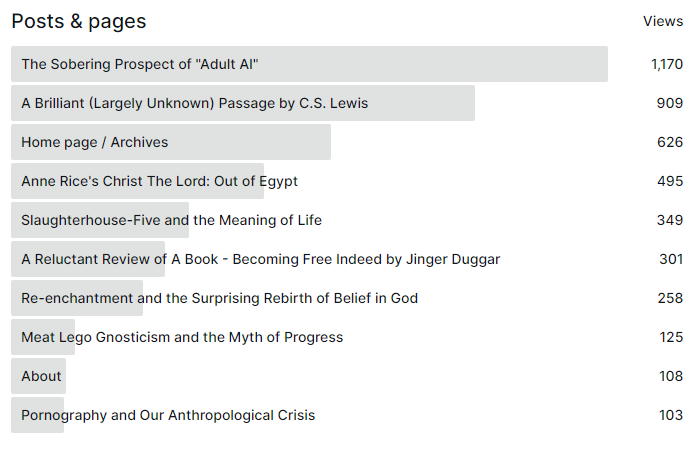
I really don’t know much of anything about internet traffic, but I have to say I have been surprised at the sustained level of reading on this here, my little blog. I have been averaging about 150 visitors and 200 views a week since early this year. This may not interest anyone, but I find it interesting. Here are my most popular posts of 2024. The #1 article, about Adult AI, was boosted by a link from Tim Challies, which also led to an interview with Moody Radio’s Kurt & Kate in the Mornings, which you can listen to if you so wish. Challies is a singular blogging phenomenon.

The #2 post, an extended quote from C.S. Lewis, has been quietly accumulating views week by week as people from all over the world find it, mostly through Google searches and perhaps links on forums. After that it seems that my reviews of popular books are of enduring interest. I would also like to add to my website here a page with links to all my published pieces elsewhere – a kind of central hub where those can be easily found.

Aside from that piece at TGCC, I have one submitted to another outlet (which I haven’t been published at before) and I am waiting to hear back from the editors. It’s another piece about psychedelics. Speaking of psychedelics, I was pleased to be interviewed by none other than Justin Brierley for his excellent documentary podcast series, The Surprising Rebirth of Belief in God. The episode on psychedelics hasn’t been released yet, but I’ll link to it when it comes out. I think I will wind down my writing on psychedelics, however – I’ve said what I had to say, and I think there are others who are better placed to continue writing for the church on this topic.

That about does it for me at this point. I’ve got some articles at various points of completion: on the Pride Rainbow compared to Vaclav Havel’s greengrocer illustration; on cathedral beauty and gospel beauty; and an article on the Haitian Christian community in Montreal which has been commissioned by Faith Today.

As always, thanks for reading.

As an Amazon Affiliate I earn a small commission from qualifying purchases of books purchased through links on my website, while customers do not pay anything extra.

At the Mercy of Narcissists

I reluctantly read Mary Harrington’s recent article about Lauren Southern and the “tradwife” movement. It’s not a happy tale. I won’t blame you for being unaware of Southern—she was a Canadian “media personality” on the alt-right, working at times with Rebel news and featured on various conservative shows as she pursued activism and controversy. She left the media world and sort of disappeared when she got married at the age of 22, around 2017. Her dreams of being a traditional, stay-at-home wife—the ultimate rejection of feminism—had come true.

But those dreams turned into a nightmare. Her husband, it seems, turned out to be a harsh, cruel, selfish man. The marriage eventually fell apart, and she fled back to Canada with her child, where she had to rebuild a life from the ruins. The article goes into a lot more detail, if you’re interested. Harrington’s angle on the story is that these internet-generated ideologies, whether it be transgenderism or tradwifery, are disconnected from reality. The web, she writes, allows these “viral and overly simplistic ideas [to] replicate with seemingly very little reference to reality, human nature, or the world as it actually is.” As far as that goes, I agree with her. Mary Harrington is always a perceptive writer, but especially on the subject of technology. See here for my review of her book, Feminism Against Progress.

My interest, and the main point I’d like to make, takes a different angle on the sad story of Lauren Southern’s marriage. Simply put, it’s that shared values are not enough to build a loving marriage; for that, you need godly character, or what we might call true virtue. Harrington tells the story: “By the time she met her husband, she’d been condensing conservative values into ‘listicle’ form as a media influencer for some years.” (A listicle is an online article that is really just a slightly-expanded list, usually of the ‘how-to’ kind). The man she met obviously agreed with her “conservative values,” which formed the basis for their shared value commitments and future plans together. But when I was retelling this story to my wife, she immediately spotted a problem: Southern had been publicly arguing for a strongly anti-feminist, pro-traditional lifestyle as a single woman. “That’s sure to attract narcissists,” she said. And why not? Any selfish man would want to find himself a woman who believed it was her duty to submit and obey and smile and keep a happy home.

Narcissists are very good at pretending to be something they are not. It’s easy to espouse agreement about values, but the proof is in the track record of relationships past and present. There are so many things I don’t know about this situation, so I can’t speak with any authority on the specifics, but my sense is that we are living through a time when men and women are having a lot of trouble finding one another, falling in love, and forming stable families. This seems to be the case regardless of political persuasion. On the Left, there is a wholesale breakdown of the family, or even gender, as stable categories. As women trend more progressive as a whole, we are seeing a lot of feminine-driven pathologies crop up across our culture, including the fact that women initiate the majority of divorces. But on the Right—where I would find myself (to some degree) politically—I also see all kinds of problems, some of which are illustrated all too well by this emblematic story.

Without virtue, no healthy relationship can grow. Without character, integrity, and humility, no flourishing marriage can form. Shared values are not nearly enough; shared dislikes and hatreds even less so. Have we lost sight of this basic kind of wisdom in our internet age? Are we so entrenched and caught up in culture wars that we think someone on the same side as us is sure to be a good spouse? There is a profoundly ugly misogyny that does exist and spread in some red-pilled, anti-feminist corners of the web. It’s not as widespread as the cultural left would like to claim; they really cannot tell the difference between a godly conservative man and a moral monster. But it’s widespread enough to be an issue that needs to be addressed.

If the women in these kinds of spaces don’t have wisdom, discernment, and good community around them, they are simply at the mercy of narcissists. What about that good community? As I read the article a part of me was thinking that this terrible state of affairs could have been helped so much by a healthy local church community. Such a church could have stepped in and advised against the marriage beforehand, or supported her once the issues arose. Good elders could have confronted the husband. But it doesn’t sound like such a church was ever a part of their lives. And with our increasingly fragmented, individualistic communities, nothing else was there to take its place.

Here is another lesson that returns to the theme of technology. Online communities can be great in some ways, but they cannot replace the embedded, embodied communities that once formed the fabric of our societies. When the marriage is really a nightmare, a friend at the front door or a place to stay is what you need, not an avatar or emojis on a messaging platform. A healthy local church is the last best remnant of this kind of community.

But for those of us with daughters, there is one more lesson to draw: we must model for them what good men are like and teach them to spot bad men. And then let’s embed our families in thick communities that look out for one another and take care of each other.

To be clear, I am not blaming Lauren Southern for the situation she found herself in. As I said above, I really don’t know the details and it’s not my place to render that kind of judgment. I do think the situation, public as it is, can be instructive for us. The article includes an unexpectedly positive note, telling how Southern found healing as she lived with her child in a small cabin in the woods, connecting with working class people living in trailers nearby. She described it as “unexpectedly healing, and filled with a genuine sense of community.”

Sorry, Finch: Robots Aren’t Humans

My wife and I like Tom Hanks. When we are flipping through the options on a quiet evening, if we see a Tom Hanks movie we haven’t seen, we’re more inclined to look into it and watch the trailer than not. So here we were with access to Apple TV (because we got it for free when we bought our TV recently, and then paid for an extra month to finish Masters of the Air, and then forgot to cancel it), and this Tom Hanks movie shows up: Finch. Post-Apocalyptic? Hmm, we aren’t really into cannibalism. Oh it’s just PG-13, and apparently mostly about a dog. Okay sure, let’s try it.

Fair warning: I’ll be dropping some real spoilers here. The story is that Finch, a man dying of radiation poisoning (we are never told how he got it), has been living by himself in a wind-turbine powered facility outside St. Louis after a worldwide cataclysm caused by a freak solar flare. I’ll give them points for going with a climate catastrophe that isn’t human-caused; very counter-cultural. He stays away from people because they are doing what people always do in post-apocalyptic movies: hunting and stealing and killing and eating each other. Thankfully all of that is left pretty much off-screen – there are plenty of movies where you can get your fill of such things. Finch has a dog who he really loves, and a couple of robotic helpers that he designed, built, and programmed.

His greatest creation is the robot we meet near the start of the film, a bipedal, humanoid robot with a kind of advanced AI ability to learn and pre-loaded with a huge chunk of the accumulated knowledge of humankind. This robot is eventually given the name Jeff. What becomes clear as the movie progresses is that Finch has designed Jeff to take care of the dog when he is gone. And in order to escape a deadly storm, they take a dangerous road trip to San Francisco in a special RV.

Hanks is a good enough actor to carry this movie by himself just like with the classic, Cast Away. “Wilson!” But what I found particularly interesting was the way in which the writers and moviemakers decided to present the robot, Jeff. Everything was designed to make the audience like Jeff. His questions and foibles early on are exactly those of a curious and naïve toddler. Later he takes on the character of a typical teenager as he insists on driving the RV before Finch is ready to trust him with it. Lastly, he matures into the caretaker Finch wanted for his beloved dog. What it boils down to is this: everything likeable about Jeff is what reminds us of humans and not robots. Robots cannot and do not have agency or will, they do not have consciousness or conscience. But we are pretty obsessed with projecting our own internal experience of human selfhood onto the robotic creations we make.

So this is why the robots like C-3P0 and R2-D2 in Star Wars are actual characters – because they behave like human beings and not robots. Back in the 70s the kinds of robotics in the movie were a far-off dream. But not anymore. The more technology and AI advances, the more this spell will be cast, trying to convince us that somehow robots can be as human as we are, that they can think and feel as we do. If you pay attention, this messaging is already out there loud and clear. I will not here divert into the separate but related conversation about whether AI or any other artificial brain-like technology can be somehow influenced or occupied by discarnate intelligences. The answer to that question is a thorny mess of nightmare fuel. For now, let’s stick to the movies.

There is an interesting comparison to be made between Cast Away and Finch. In Cast Away, Hanks’s character becomes so lonely that he paints a face on Wilson and starts talking to him like a friend. The audience knows Wilson is not real, but we also understand that there is something deeply human about the need to connect with someone else like us. It is not good for man to be alone. After all the animals had passed by Adam, the conclusion of the matter was: “But for Adam no suitable helper was found.” This goes deep. We understand that extreme solitude will strain and fray the sanity of almost anyone. But Cast Away does not try to convince us that Wilson is really a suitable friend for Hanks. If anything, the movie helps us realize that pretending to have a friend as a way of holding on to your sanity is better than losing it entirely.

But Finch is a different story. After a pretty interesting opening and middle section—the character is compelling, the robot and dog are amusing, the adventures are exciting—the ending is one of the most dissatisfying movie experiences I can remember. And it is so dissatisfying exactly because it tries to present itself as a happy ending. What is that ending? A montage multiple minutes long of the robot, Jeff, taking care of Finch’s dog after Finch dies. Playing fetch. Feeding it. Ta-da! A robot taking care of a dog, and all the humans dead and gone, or still killing each other like animals off screen somewhere. Finch tries to convince the audience that humans are expendable, and that the best parts of humanity—the love, care, and goodness—can be pulled off just as well by clever robots. Cast Away took away all the humans except one to reveal something profoundly true about humanity; Finch took away all the humans and pretended it didn’t matter.

I’ll tell you – this really did not sit well with me. “Who cares?” I said to myself. If there are no humans to experience it, remember it, tell of it; no children to raise and bequeath what little we have to— then who cares if a robot takes care of a hundred dogs for eternity? The image of God resides not in robots and dogs, as good and glorious as technology and the canine species is. How could that be the ending of the movie? How could that possibly feel like a happy ending to anyone? Because—guess what?—there will not be any robots or dogs watching and comprehending this movie. Why? Because they can’t.

The way this movie resolved, it felt like an advertisement for post-humanity. “Time for this failed experiment called humans to shuffle off the stage and leave things for the robots and animals.” It felt like it was trying to get me to feel good about something that my whole soul was screaming “this is BAD” about. I hope I’m not being unfair here. I love dogs and robots! But they aren’t humans. And no movie made by humans for humans should pretend it’s somehow going to have a satisfying ending for human hearts and minds if that ending has all the humans we spent 90 minutes getting emotionally invested into dead and buried. The only way people could make this movie is if they really convinced themselves that, at bottom, there is no fundamental difference between humans and dogs (just slightly different mammals) or between humans and robots (just computers in bodies).

This gets back to a theme I’ve been returning to repeatedly in this space, and that is the idea of a robust, Christian anthropology. What is a human being? The church really needs to get a handle on its answer to this question, because the assaults against human nature are going to get exponentially worse. If a robot can demonstrate some evidence of consciousness, should we grant it human rights? What about DNA alterations? What about the integration of digital hardware directly into human bodies, like the recent Neuralink patient? What is the Christian response to these things? Are they good? Permissible? Sinful? Demonic?

In a recent podcast interview with Annie Crawford, she quoted a certain Stratford Caldecott as saying: “We don’t know how to educate, because we don’t know what a human is; we don’t know what a human is because we don’t know what reality is; and we don’t know what reality is because we don’t know the One who made reality.” This sums up the depth of the problem nicely, as well as the beauty and nestled, fractal unity of the ultimate Answer.

Digging for Roots: Theological Retrieval

Amid the tumult of our times, a lot of people have been looking for answers. Among Christians, one of the ways that has manifested itself is a search for rootedness, or solid foundations. And because evangelical Protestants are often ignorant of the roots of their tradition, or have been taught to be suspicious of any appeals to tradition and history, they are primed for the idea that all of this – their upbringing – has been wrong and that what they really need is the oldest church with the strongest claim to have preserved the unbroken practice of the early church. I’m sympathetic to that impulse.

Photo by Eilis Garvey on Unsplash

Another related challenge is the transition to adulthood. This is true for believers of all stripes and traditions, since integrating one’s life into the structures and institutions of this world does not encourage faith but undermines it. I think it’s worth thinking about why that is.

It’s only natural that we adopt the beliefs of our parents as we grow. This state of affairs typically enjoys a phase of equilibrium until adolescence or early adulthood. Growing minds and widening spheres of life experience cause us to rub shoulders with all kinds of people who hold all kinds of different beliefs. This experience can be destabilizing; we encounter people who believe that what we believe is utter nonsense. And who’s to say they’re not right and we’re not wrong?

It’s worth mentioning that this is largely a modern phenomenon. In premodern times there was usually a consensus of beliefs within one’s village or town, with perhaps a few exceptions – eccentrics, weirdos, outcasts. But nothing like the cosmopolitan culture of today where every religion and every shocking variation of no religion can be seen walking the streets of any mid-size town.

Sociologist Peter Berger speaks of plausibility structures as a way to understand how one’s social environment contributes to certain beliefs, not by argument, but by making them look reasonable and respectable. In a homogeneous society, the structures of belief are extremely strong and rigid – all the people in one’s life basically share the same worldview. In such contexts it takes courage, imagination, and a fiercely independent spirit to dissent from the rigid consensus. Dissenters are then met with a wide variety of social pressures aimed at discouraging such non-conformity. Examples of this would be pre-reformation medieval towns or current-day middle-eastern Muslim societies.

Families and church communities have their own sets of plausibility structures, but when nested within a larger secular culture, that framework of shared beliefs and relationships is far less robust. Going to public high school, university, or getting one’s first job plunges a person into a pot pourri of different beliefs, philosophies, and lifestyles. For many growing up in the church, the experience of this plunge is bewildering. They are simply not equipped to process it. They hear compelling arguments from authority figures like competent teachers or successful bosses that undermine Christianity’s claims. 

But more subversive than the arguments themselves are the subtle workings of other dynamics: the social pressures that play on our desires to be liked, included, and accepted. To be thought clever, right-thinking, and on the correct side of important issues.

Under these kinds of pressures, it is quite easy for a faith that isn’t deeply rooted to wither away. My own experience has taught me that theological and historical retrieval can serve as a kind of inoculation to these forces. That brings me to the work of Gavin Ortlund, and specifically his book Theological Retrieval for Evangelicals as well as his thoughtful and substantive video content on his YouTube channel, Truth Unites.

Gavin’s strengths are his academic rigor, his irenic demeanour, and the depth of his familiarity with the primary sources of church history, including Roman Catholicism and Orthodoxy. And for bonus points, he regularly interacts with the work of C.S. Lewis.

Speaking of Lewis, I often think of this memorable passage from Screwtape Letters when pondering this issue:

One of our great allies at present is the Church itself. Do not misunderstand me. I do not mean the Church as we see her spread out through all time and space and rooted in eternity, terrible as an army with banners. That, I confess, is a spectacle which makes our boldest tempters uneasy. But fortunately it is quite invisible to these humans. All your patient sees is the half-finished, sham Gothic erection on the new building estate.

When he goes inside, he sees the local grocer with rather an oily expression on his face bustling up to offer him one shiny little book containing a liturgy which neither of them understands, and one shabby little book containing corrupt texts of a number of religious lyrics, mostly bad, and in very small print. When he gets to his pew and looks round him he sees just that selection of his neighbours whom he has hitherto avoided.

You want to lean pretty heavily on those neighbours. Make his mind flit to and fro between an expression like “the body of Christ” and the actual faces in the next pew. It matters very little, of course, what kind of people that next pew really contains. You may know one of them to be a great warrior on the Enemy’s side. No matter. Your patient, thanks to Our Father below, is a fool. Provided that any of those neighbours sing out of tune, or have boots that squeak, or double chins, or odd clothes, the patient will quite easily believe that their religion must therefore be somehow ridiculous.

Screwtape Letters, chapter 2.

Notice the inadvertent revelation that the Church is glorious and rooted in eternity. Every true church is in some way connected to that vital reality. But the enemy works hard to set up plausibility structures such that the humdrum and all-too-human quality of any one local church can seem “somehow ridiculous.” Surely this cannot be the Church, the vehicle of God’s plan for the world. But here is a beautiful thing we should be reminding our congregations of regularly: that this little local church is in spiritual continuity and communion with the great stream of Christianity flowing directly from the apostolic headwaters all those centuries ago. 

So if you find yourself among the growing number of evangelicals troubled by the lack of historical rootedness in your tradition, dissatisfied by the shallowness of the faith that was passed on to you through your upbringing in Sunday school and youth groups, and hungering for a faith that has a tangible connection to that unbroken string of believers joining us to the first disciples, then I commend to you the work of Gavin Ortlund.

He has shown himself to be a worthy guide for introducing evangelicals and Protestants to the ways in which the Christian past can inform and deepen our faith. He has also done excellent work engaging with the claims of those branches of the Christian tree which most often attract disaffected evangelicals: Roman Catholicism and Eastern Orthodoxy. This engagement has been mostly on his YouTube channel, but it connects to the book on a number of levels.

The book itself is written at a fairly high academic level, with copious footnotes and robust engagement with academic journal articles and books. The book also ranges from extremely readable to quite challenging at points, using rarified theological language without bothering to explain and define terms. I’ve taken theological courses at a college level and am generally quite conversant with that world but I admit I had to google at least one term for which I was drawing a blank: perichoresis. Beyond the sometimes technical language, it can be mentally taxing to wrap one’s mind around the way that medieval or patristic Christians thought. Gavin does a good job guiding the modern reader across that conceptual gap but it is demanding nonetheless. The flip side of that effort as a reader is the reward of really grasping a foreign way of thinking. For example, I really enjoyed it when I finally started to grasp how the medievals understood God as being outside of time. Maybe understood is too strong a term, but I grasped something that had previously escaped me.

The most useful parts of the book for me were the introduction, the chapter on atonement, and the engagement with Gregory’s work on pastoral practice. The atonement discussion, for me at least, alone was worth the price of the book. Very helpful and edifying. Gavin’s YouTube content is more approachable and less academic than the book. He speaks to a popular audience but still makes regular use of primary sources when making his points. I don’t always agree with him, but he works hard to engage opponents in ways that I think demonstrate a good faith approach.

In conclusion, I think the book – Theological Retrieval for Evangelicals – as well as his increasingly popular YouTube channel, are both profoundly helpful to the evangelical Protestant church. There are large swaths of evangelicals who are not struggling with the kinds of questions this book seeks to address. But for those who are, I believe it could be paradigm-shifting. And if my reading of the cultural moment is correct, the number of people asking these kinds of questions will only be increasing for years to come.

As an Amazon Affiliate I earn a small commission from qualifying purchases of books purchased through links on my website, while customers do not pay anything extra.

The Work in My Hand

Enough for today, the demands of the moment
The thing on my mind is the work in my hand
Wood for the woodstove and water for coffee
Somethin’ I can still understand
.

James Taylor, Montana.

The theme of manual work is something I’ve returned to again and again, and I think that is because I reliably come away with a glowing conviction that the particular blindness our society has to the demands and merits of manual work is integrally connected to so many of the things that ail us. There is a thread, so to speak, that connects the philosophical analysis of Western civilization’s malaise and the realities of the proverbial shop floor.

We need amphibians to make sense of this and get the message out, people who can exist in both worlds. For whatever reason, I am such a person. I’ve always had these two parallel interests in my life: the world of things and the world of words, of matter and of books. My earliest work experiences were manual – working for a neighbour who had a small business doing maintenance for grocery stores. We built out of wood, tiled floors, poured cement. For a few weeks I was sent to a rural lumbermill to build wooden crates out of rough planks that would be sold to grocery stores to use as displays for produce. There I had my first introduction to some basics of woodworking: planing planks to a certain thickness (there is no noise quite like it), cutting them to length, using a router and jig to cut out the handles, and a pneumatic nailgun to assemble it all.

What an education. I learned to respect that spinning router bit, seeing how effortlessly it ate through the wood. I learned to handle the wood with a firm hand, for the softer wood sometimes pulled the tool almost out of my grip, while the hard knots and denser sections smoked and resisted and needed to be pushed. I learned not to put my fingers anywhere near the reach of the nails coming out the nailgun, for they had a way of careening off wildly at various angles as they encountered knots and different densities in the wood. My ideas about how to go about the work of building had to be constantly adjusted and reconsidered in light of the immovable realities I kept bumping up against.

And then there was the lunchroom, where I rubbed shoulders with men whose lives were quite different from my own. One of them was a wiry little guy named Mo (perhaps short for Maurice?), all sinew and muscle, with a few missing teeth and an accent so rural and thick I just couldn’t understand a word he said despite my best efforts. I smiled and nodded a lot. Simple, rough, hard-working men, with plenty of common sense and not much time for book learning. But they understood their craft, the materials they handled, and the giant machines they operated. They knew well that one mistake could be the end of limb or life.

Later I completed a diploma in automobile mechanics, worked briefly in a Volvo dealership garage, and later still found myself doing electro-mechanical maintenance in an industrial setting: bolting, wiring, greasing, and troubleshooting large, complex machinery. All through this time I read and read, books of all kinds. I went off to Bible College and dove into philosophy, theology, Biblical studies, cultural studies, and history. I read everything I could get my hands on by Lewis. New worlds opened up to me, and I started to make sense of politics and the history of ideas. I worked part-time for a cabinet maker as I finished my degree in Theology, loading up my iPod with hours and hours of sermons and lectures to stimulate my mind as I sanded, painted, varnished, cut, and edge-banded stacks of wood.

I had no appreciation at the time for the particular contribution these experiences with manual work would make to my view of the world, but it has been dawning on me now for a few years. I realize now that these profound experiences working with the material world fostered a skepticism towards all forms of utopianism and ideology, since I know the world is not as simple as any of those systems make it. One of the writers who has helped me realize this is Matthew B. Crawford, and what follows is some interaction with his book Shop Class as Soulcraft.

Crawford seems to be one of those amphibian types as well. He kept up his interest in motorcycle mechanics even as he completed advanced university studies and took a coveted job at a DC think tank. But a few months later, he left that position and opened up a repair shop specializing in rare and vintage motorcycles. He found the complex troubleshooting of temperamental machinery more intellectually stimulating than the academic work:

“What is required then is the kind of judgment that arises only from experience; hunches rather than rules. I quickly realized there was more thinking going on in the bike shop than in my previous job at the think tank.”

He goes on to describe how this kind of work fosters the virtue of attentiveness. In order to “diagnose and fix things that are variable, complex, and not of our own making, and therefore not fully knowable,” one must have “a certain disposition toward the thing you are trying to fix. This disposition is at once cognitive and moral. Getting it right demands that you be attentive in the way of a conversation rather than assertive in the way of a demonstration. I believe the mechanical arts have a special significance in our time because they cultivate not creativity, but the less glamorous virtue of attentiveness.” This is the attentiveness of the natural philosophers, the attentiveness that gives birth to a posture of humility towards the “authority” of things-as-they-are.

“Any discipline that deals with an authoritative, independent reality requires honesty and humility. I believe this is especially so of the stochastic arts [repairing the work of another] that fix things, such as doctoring and wrenching, in which we are not the makers of the things we tend. […] If we fail to respond appropriately to these authoritative realities, we remain idiots. If we succeed, we experience the pleasure that comes with progressively more acute vision, and the growing sense that our actions are fitting or just, as we bring them into conformity with that vision.”

This insight alone illuminates a core difference between the conservative instinct and the progressive one. The conservative sees the world as already having a given shape that we must discern and adapt to. The progressive sees the world as so much raw material, like play-doh, endlessly malleable to fit his or her dreams and visions of how the world should be. As N.S. Lyons has recently argued, quite convincingly, this Conservative-Progressive spectrum is actually quite different from the Right-Left political spectrum, which he boils down to the difference between an egalitarian vision vs a hierarchical one.

Turning to the topic of education, Crawford notes, “When the point of education becomes the production of credentials rather than the cultivation of knowledge, it forfeits the motive recognized by Aristotle: ‘All human beings by nature desire to know.’ Students become intellectually disengaged.”

He fell into this trap of credentialism as he earned his Master’s Degree and began work in a corporate office. He quickly became disillusioned with this new life among the educated class when he compared the pay and rewarding nature of his previous work as an electrician.

“How was it that I, once a proudly self-employed electrician, had ended up among these walking wounded, a ‘knowledge worker’ at a salary of $23,000? I hadn’t gone to graduate school for the sake of a career (rather, I wanted guidance reading some difficult books), but once I had the master’s degree I felt like I belonged to a certain order of society, and was entitled to its forms. Despite the beautiful ties I wore, it turned out to be a more proletarian existence then I had known as a manual worker.” 

Crawford writes with an eloquence and ease that frankly makes me a little envious. He uses language to describe realities that resonate with me intuitively but which I would not have known how to express. This is the mark of a good writer and clear thinker. Aside from this book, I also really enjoyed his Why We Drive. If these kinds of subjects are of interest to you, you won’t be disappointed.