A Double Dose of Psychedelics Content

I’m trying to balance my focus on the psychedelics movement with writing and content that covers a far broader array of topics (AKA my interests!). But this last week, the stars aligned for there to be a strong focus on the topic of psychedelics, with my first TGC (USA) article being released as well as a podcast conversation with the fine folks at What Would Jesus Tech (WWJT). Here’s a direct link to the YouTube version of the WWJT episode. I think they did a pretty good job with the podcast episode thumbnail image:

I wish I could say the same for the TGC article. The image they chose is a little creepy! Hah, oh well.

Many thanks to the hosts of WWJT for having me on and having such good questions. I really enjoyed our conversation. They are a legit podcast with some really legit and impressive guests. If you are a Christian interested in how technology (in all its manifestations) intersects with the faith, you need to check them out.

The TGC article, called “The Psychedelic Renaissance: A Story of Hype and Hubris,” is an “explainer” kind of essay where I try to inform the reader about this large and complex topic, but with an editorial twist where I render a verdict about the psychedelic movement in general. There is certainly some overlap with the article my late-2023 article at Mere Orthodoxy, but this recent one delves more deeply into the current state of the research and especially into the increasingly visible network of activists and funders who are pulling the strings behind the scenes of the public-facing pro-psychedelics movement. Here is how I conclude the first section of the article, which deals with this:

One thing ought to be clear: It simply isn’t the case that disinterested scientists have stumbled on surprising cures for mental health problems. Rather, advocates already committed to the promise of psychedelic therapies, usually bundled with New Age spiritual beliefs, have patiently pursued a strategy to build a veneer of scientific, medical respectability for their agenda.

This state of affairs makes it difficult for the public (and regulators) to parse the data and evaluate possible legitimate medical applications of these substances. It may be many years before those assessments can be made confidently, but that won’t stop a growing number of people from trying psychedelics for themselves.

One way I’ve started thinking about how Christians ought to respond to the psychedelics movement with with a dual response: one at low-resolution and a second one at higher-resolution. (I go into this idea a bit in response to some really thoughtful questions in the WWJT episode.) Here’s what I mean: the low Christian resolution response to the pro-psychedelics movement in general should be a giant waving red flag. In the article, I try to get this across with the following sentence: “The hype of healing will not ultimately deliver on its promises, and the hubris of spiritual exploration outside of Christ will expose many to unbiblical ideas and even demonic spiritual forces.”

That’s the first and most important thing for the church to get clear on, in my humble opinion. But there is a second, higher resolution response that is also legitimate. It has to do with a more narrow discussion about possible legitimate medical uses of psychedelic compounds for the treatment of specific issues such as PTSD, some forms of addiction, etc. This is separate from all discussion of spiritual or recreational uses, which are out of bounds if one takes the Scriptures as inerrant and authoritative.

I am still thinking through some of the nuances of this more narrow question about possible valid uses of these compounds in certain medical cases. The best treatment of the question I’ve come across so far is a journal article by Thomas Carroll, a Catholic medical doctor. He argues, convincingly in my view, that the specific problem with psychedelics is the mystical experience it generates for the user. This is what makes psychedelics unlike other substances, and why they rightly exist in a class of their own. Further, he argues that since Christians have a category for legitimate mystical experiences that are given by God, and since it has never been the teaching of the church that Christians ought to try and contrive these experiences themselves, that it is therefore illicit for Christians to intentionally take these substances for the purposes of some kind of therapy where the mechanism of healing is bound up with the mystical experience itself.

However, these substances have effects other than just the mystical experience. They make one more suggestible and they interrupt some of our deeply ingrained patterns of thinking; both of these effects have the potential to be powerful aids when coupled with wise counseling. There is indeed a little-known branch of psychedelic therapy known as psycholytic therapy (PLT) and it specifically focuses on using small doses in conjunction with talk therapy to work through problems. This approach has been eclipsed in recent years by the big push for and major coverage of psychedelic-assisted therapy (PAT).

Carroll’s article basically concludes that, since the mystical experience is the very mechanism by which psychedelic-assisted therapy functions, it should be considered illicit for Christians, but that participation in psycholytic therapy should be considered a question of personal conscience. This seems right to me, and it’s where I am landing at the moment.

A friend of mine sees this very similarly but takes a slightly different and more open position: he believes that a Christian could partake of psychedelic-assisted therapy as long as he regarded the mystical experience as a negative side-effect to be endured, a bug rather than a feature. This is very different from the general approach to psychedelic therapy, and although I’m not there myself, I don’t think it’s an unreasonable position for a Christian to take. My concern with it is how it actually plays out in practice. How do pastors counsel their church member to go through with this kind of therapy for their PTSD? How does one handle the possibility that despite going into it with the idea that I won’t place my hope in or even lend credence to this mystical experience, it ends up being so profound and powerful that I can’t help it? To me it seems to leave a door open that I think should remain shut.

That’s all for now. As always, thanks for reading and following.

Letter to a Brother Stuck in Pornography

The following is a letter I wrote to a brother some years ago. It has been anonymized and lightly edited.

Photo by Aaron Burden on Unsplash

Dear Brother,

You have been on my mind for a few days and so I have been praying for you. What prompted it was that I listened to an interview podcast episode with a pastor who struggled with porn for years while in ministry. It was really amazing, but it made me think of you. You were honest and open enough last year to let me into this area of your life. I don’t take that lightly, and I thank you for taking that important step. But unless there have been developments I don’t know about, it doesn’t seem like there has been much traction or forward progress in this area of your life.

Assuming things are more or less the same as they were when you shared this struggle with us, I have a few things I want to share with you.

            1. I Am Not Better

I write to you as a fellow sin-struggler. I write to you as one who knows what it is like to be stuck in that cycle of sinning, repenting, self-loathing, promising God to do better, and falling again. I write to you as someone who spent years turning to broken cisterns filled with filthy stagnant water over and over. This is the language in Jeremiah 2:13-14 “Be appalled at this, you heavens, and shudder with great horror,” declares the Lord. “My people have committed two sins: They have forsaken me, the spring of living water, and have dug their own cisterns, broken cisterns that cannot hold water.”

This was my reality and (if you are still continually turning to pornography and sexual sin) it is yours as well. And with this intake of poison over a long period of time come serious effects and consequences. The most dangerous of them all is blindness. You are deceived, and cannot see, your real and true spiritual state. That is probably why your initial reaction to this letter may be negative. Sin and Satan have got a deep, deep hold on your heart by now. So I have been praying that you will have a few moments of clarity as I share some good but difficult truths with you.

            2. You Can be Free

One of the worst deceptions you are believing is that you are going to be stuck here forever. If I was to boil down the Bible’s teaching on sin to a single truth, it would be: The gospel exists to defeat sin! Really, sin is nothing compared with the power of the gospel when it starts to work in a heart. Jesus came and died and rose again to deal with sin. Not just the guilt of it, but the power and grip of it in your life. Countless thousands have experienced true and lasting and supernatural freedom from the chains and slavery of habitual sin, and you can too. “For if the Son sets you free, you will be free indeed” (John 8:36).

I believe that you have experienced the gift of forgiveness, but it seems to me that you have yet to really experience the joy, happiness, and delight, of walking in the light of the fellowship with God that your forgiveness is meant to lead to. I stress those three words: joy, happiness, delight. Listening to that interview with that pastor, I was reminded in fresh ways of just how delightful Jesus is to our souls compared to everything else we try and find satisfaction in. And it reminded me of how miserable it is to be a slave to sin.

Aren’t you just sick of it?

This misery is what those verses from Jeremiah are about – we compulsively dig our own filthy broken cisterns which end up just holding muddy rain water that tastes good only in the moment, while just behind us there is “the spring of living water” that we have forsaken and which truly satisfies the deepest longings of the soul. As C.S. Lewis wrote, “It would seem that our Lord finds our desires not too strong, but too weak. We are half-hearted creatures, fooling about with drink and sex and ambition when infinite joy is offered us, like an ignorant child who wants to go on making mud pies in a slum because he cannot imagine what is meant by the offer of a holiday at the sea. We are far too easily pleased.”

            3. Spiritual Power

One of the worst effects of giving in habitually to willful sin (making choices by habit or addiction that you know are sinful), is that it saps you of spiritual power. It is like a cup with a hole in the bottom. You never can stay full even when God’s Spirit moves in you and revives you because “the flesh desires what is contrary to the Spirit, and the Spirit what is contrary to the flesh.” Yes – “So I say, walk by the Spirit, and you will not gratify the desires of the flesh” and “Since we live by the Spirit, let us keep in step with the Spirit” (Gal 5:16, 17, 25). How can I be filled with this Spirit when I am continually grieving it? “And do not grieve the Holy Spirit of God, with whom you were sealed for the day of redemption” (Eph 4:30).

It is one thing if I mistakenly trip my friend. I can honestly apologize and be reconciled easily. The tripping was real but it wasn’t a personal rejection or attack. But it is another thing entirely if I slap my friend across the face and call him a pathetic loser. I cannot so easily apologize and be reconciled, since the sin was so personal. It is like that in our relationship with God too – how can I come to Him for the millionth time about the same sin and say I’m sorry? Am I really? I know I’m just going to do it again. My repentance feels shallow and fake, and perhaps it is. Intimacy with God is therefore impossible, and I would rather not face the pain of that distance, so I numb it with distractions.

In this state, I have almost no spiritual power. How can I genuinely share the hope and joy of the gospel when I am not able to enter into it myself? How can I lovingly rebuke my brother for sin when I am secretly indulging it in my own life? How can I look my son in the eye and promise him that virtue, integrity, honesty, and purity are so much better than vice and sin when I am not walking in those virtues myself? So I stay silent, and the voice of my conscience grows quieter and quieter, and in a thousand little ways I therefore fail to minister to those God has placed around me, and my spiritual impact is reduced to almost nothing. What a victory for Satan! Here is a soldier in God’s army that has been rendered almost completely ineffective. Brother, don’t let this be true of you.

            4. Looking Ahead

I want you to think ahead with me. You have two paths set before you. You will definitely walk down one of these two paths. The first path is the one you’re currently on, and the second is quite different. You’ll have to forgive me for being very blunt here.

Let’s imagine the first. You get this letter, you give it a reading, but things don’t change. You’re middle-aged now, so in just a few years, you’re officially a dirty old man, still looking at pictures of much much younger naked women. Let’s be honest – it’s a pathetic picture of manhood that you would not wish for your sons. Hopefully the perversions of your lust haven’t taken you down any darker paths, but they very likely have since that is the law of diminishing returns.

I know it’s painful but follow this through with me. In a few short years, you are confronted with the devastating reality that you are lusting after women the same age as your daughter (who is by then a young woman). You are confronted with the devastating hypocrisy of your actions. Namely, you want men not to lust after your daughter, not to degrade her and fantasize sexually about her (the very thought of it enrages you – as it should), but you are doing that exact thing to other men’s daughters, some of whom are probably brothers in Christ who are heartbroken about what their daughters have gotten caught up in. What else? Your marriage will certainly not be any better, and you will not be any more satisfied, despite giving away more of yourself. You will continue reaping the fruit of the seeds you’re currently sowing, only with compound interest – the cost will continue to rise and you will continue to be more miserable.

The second path is, as I said, quite different. Maybe, in a sovereign act of divine mercy, as you read this you experience godly grief over your sin – the heinous filthiness of it in the eyes of God, the shame and betrayal of it in the heart of your marriage where you are called to imitate the self-giving and self-sacrificial love of Christ, the pattern of failure to set an example at home and in the church in resisting sin and repenting of it. Maybe God grants you this conviction and grief and a blessed repentance as you turn away from these broken cisterns and back to the spring of living water that is the Living God who redeemed you, who gladly laid down His life for someone like me, and someone like you.

This repentance would lead to a painful confession to your wife – there is no other way. “In the same way, the husband does not have authority over his own body but yields it to his wife” (1 Cor 7:4). Your body is not yours alone, so you don’t have the authority before God to keep this from the wife He has given you. Not that you must share every gory detail, but she needs to know the truth. This extremely scary and painful step is the very door through which healing will come into your marriage. Jesus holds out free and full forgiveness, but also a cleansing and purifying that you desperately need. He offers you true joy and satisfaction in place of the fleeting, defiling pleasure of sin.

If you do start walking down this new path, you need to know it will be extremely difficult. There are spiritual, emotional, and physiological realities that will push back hard. But you will not be alone. You have brothers here who are more than willing, more than ready to do battle with you, to be there to lean on when you’re weak, and celebrate every little step forward. In ten years, there is literally no telling where you might be in your walk with God, in your marriage, in your family. You could be reaping the fruit of grace and restoration and undeserved flourishing. By God’s grace that is how I feel today, and no words can describe how meaningful it is.

Make no mistake, you will reap what you sow. You already have been. The brokenness in your marriage is not all your fault, by any means, but it is largely your responsibility (don’t miss the difference). Perhaps you have used the brokenness and pain of your unfulfilling marriage as an excuse for your sin, but your Savior did not wait for you to make the first move – He initiated our incredible salvation while we were still enemies, rejecting and crucifying him. This is the pattern for husbands to follow, as Ephesians 5 makes so clear: “Husbands, love your wives, just as Christ loved the church and gave himself up for her to make her holy, cleansing her by the washing with water through the word, and to present her to himself as a radiant church, without stain or wrinkle or any other blemish, but holy and blameless.” This is something you can only do by God’s Spirit.

Brother, let’s sow something better from now on, for God’s glory, for your good, and for your joy.

Start by taking a long walk (or drive) and getting it all out with God. Pour out your heart. Allow yourself to get to that lowest place where you’re fully honest with yourself and Him just how messed up you are and how badly you need help. This is humility – God likes it. And devour some Scripture. Read Proverbs 5-7 (you’ll recognize yourself there!). Read Hosea. Read the Gospel of John and encounter again this Jesus who is so amazing. Read Galatians and get clarity on the gospel and walking in the Spirit.

I’m also including a passage from C.S. Lewis’ book The Great Divorce where he describes an incredible conversation with a man enslaved by lust.

I’ve shared this with our mutual friend and we are both praying for you. We love you.

Phil

Appendix: From The Great Divorce, by C.S. Lewis:

I saw coming towards us a Ghost who carried something on his shoulder. Like all the Ghosts, he was unsubstantial, but they differed from one another as smokes differ. Some had been whitish; this one was dark and oily. What sat on his shoulder was a little red lizard, and it was twitching its tail like a whip and whispering things in his ear. As we caught sight of him he turned his head to the reptile with a snarl of impatience. “Shut up, I tell you!” he said. It wagged its tail and continued to whisper to him. He ceased snarling, and presently began to smile. Then be turned and started to limp westward, away from the mountains.

“Off so soon?” said a voice.

The speaker was more or less human in shape but larger than a man, and so bright that I could hardly look at him. His presence smote on my eyes and on my body too (for there was heat coming from him as well as light) like the morning sun at the beginning of a tyrannous summer day.

“Yes. I’m off,” said the Ghost. “Thanks for all your hospitality. But it’s no good, you see. I told this little chap,” (here he indicated the lizard), “that he’d have to be quiet if he came—which he insisted on doing. Of course his stuff won’t do here: I realise that. But he won’t stop. I shall just have to go home.”

‘Would you like me to make him quiet?” said the flaming Spirit—an angel, as I now understood.

“Of course I would,” said the Ghost.

“Then I will kill him,” said the Angel, taking a step forward.

“Oh-ah-look out! You’re burning me. Keep away,” said the Ghost, retreating.

“Don’t you want him killed?”

“You didn’t say anything about killing him at first. I hardly meant to bother you with anything so drastic as that.”

“It’s the only way,” said the Angel, whose burning hands were now very close to the lizard. “Shall I kill it?”

“Well, that’s a further question. I’m quite open to consider it, but it’s a new point, isn’t it? I mean, for the moment I was only thinking about silencing it because up here—well, it’s so damned embarrassing.”

“May I kill it?”

“Well, there’s time to discuss that later.”

“There is no time. May I kill it?”

“Please, I never meant to be such a nuisance. Please—really—don’t bother. Look! It’s gone to sleep of its own accord. I’m sure it’ll be all right now. Thanks ever so much.”

“May I kill it?”

“Honestly, I don’t think there’s the slightest necessity for that. I’m sure I shall be able to keep it in order now. I think the gradual process would be far better than killing it.”

“The gradual process is of no use at all.”

“Don’t you think so? Well, I’ll think over what you’ve said very carefully. I honestly will. In fact I’d let you kill it now, but as a matter of fact I’m not feeling frightfully well today. It would be silly to do it now. I’d need to be in good health for the operation. Some other day, perhaps.”

“There is no other day. All days are present now.”

“Get back! You’re burning me. How can I tell you to kill it? You’d kill me if you did.”

“It is not so.”

“Why, you’re hurting me now.”

“I never said it wouldn’t hurt you. I said it wouldn’t kill you.”

“Oh, I know. You think I’m a coward. But it isn’t that. Really it isn’t. I say! Let me run back by tonight’s bus and get an opinion from my own doctor. I’ll come again the first moment I can.”

“This moment contains all moments.”

“Why are you torturing me? You are jeering at me. How can I let you tear me to pieces? If you wanted to help me, why didn’t you kill the damned thing without asking me—before I knew? It would be all over by now if you had.”

“I cannot kill it against your will. It is impossible. Have I your permission?”

The Angel’s hands were almost closed on the Lizard, but not quite. Then the Lizard began chattering to the Ghost so loud that even I could hear what it was saying.

“Be careful,” it said. “He can do what he says. He can kill me. One fatal word from you and he will! Then you’ll be without me for ever and ever. It’s not natural. How could you live? You’d be only a sort of ghost, not a real man as you are now. He doesn’t understand. He’s only a cold, bloodless abstract thing. It may be natural for him, but it isn’t for us. Yes, yes. I know there are no real pleasures now, only dreams. But aren’t they better than nothing? And I’ll be so good. I admit I’ve sometimes gone too far in the past, but I promise I won’t do it again. I’ll give you nothing but really nice dreams—all sweet and fresh and almost innocent. You might say, quite innocent . . .”

“Have I your permission?” said the Angel to the Ghost.

“I know it will kill me.”

“It won’t. But supposing it did?”

“You’re right. It would be better to be dead than to live with this creature.”

“Then I may?”

“Damn and blast you! Go on can’t you? Get it over. Do what you like,” bellowed the Ghost: but ended, whimpering, “God help me. God help me.”

Next moment the Ghost gave a scream of agony such as I never heard on Earth. The Burning One closed his crimson grip on the reptile: twisted it, while it bit and writhed, and then flung it, broken backed, on the turf.

“Ow! That’s done for me,” gasped the Ghost, reeling backwards.

For a moment I could make out nothing distinctly. Then I saw, between me and the nearest bush, unmistakably solid but growing every moment solider, the upper arm and the shoulder of a man. Then, brighter still and stronger, the legs and hands. The neck and golden head materialized while I watched, and if my attention had not wavered I should have seen the actual completing of a man—an immense man, naked, not much smaller than the Angel. What distracted me was the fact that at the same moment something seemed to be happening to the Lizard. At first I thought the operation had failed. So far from dying, the creature was still struggling and even growing bigger as it struggled. And as it grew it changed. Its hinder parts grew rounder. The tail, still flickering, became a tail of hair that flickered between huge and glossy buttocks. Suddenly I started back, rubbing my eyes. What stood before me was the greatest stallion I have ever seen, silvery white but with mane and tail of gold. It was smooth and shining, rippled with swells of flesh and muscle, whinnying and stamping with its hoofs. At each stamp the land shook and the trees dindled.

The new-made man turned and clapped the new horse’s neck. It nosed his bright body. Horse and master breathed each into the other’s nostrils. The man turned from it, flung himself at the feet of the Burning One, and embraced them. When he rose I thought his face shone with tears, but it may have been only the liquid love and brightness (one cannot distinguish them in that country) which flowed from him. I had not long to think about it. In joyous haste the young man leaped upon the horse’s back. Turning in his seat he waved a farewell, then nudged the stallion with his heels. They were off before I well knew what was happening. There was riding if you like! I came out as quickly as I could from among the bushes to follow them with my eyes; but already they were only like a shooting star far off on the green plain, and soon among the foothills of the mountains. Then, still like a star, I saw them winding up, scaling what seemed impossible steeps, and quicker every moment, till near the dim brow of the landscape, so high that I must strain my neck to see them, they vanished, bright themselves, into the rose-brightness of that everlasting morning.

Dave Barry—Still a Clown after All these Years

Dave Barry, true to form, made fun of himself and almost everything else in his memoir. I’ve enjoyed Barry’s writing on and off over the years as I’ve come across it. This book, like many of his columns, had me bursting out with laughter. For that reason alone it was worth reading.

The more serious sections were handled with adequate solemnity, but Barry’s brand of irreverence, as funny as it is, seems inadequate to face up to the realities of the world. The ability to make everything into a joke cuts both ways, of course. It helps one get through tough times with humour and wit, but it also encourages a habit of mind and heart that ultimately undermines one’s ability to take seriously what in fact is serious.

C.S. Lewis is helpful here, lest I be accused of simply being a fun-hating curmudgeon. In the Screwtape Letters, he helpfully distinguishes between four types of laughter: joy, fun, the joke proper, and flippancy. The first two are good and harmless. Barry’s humour contains a fair amount of rejoicing in sheer fun, and this is all to the good. The joke proper relies “on [a] sudden perception of incongruity,” and this is Barry’s bread and butter. Much of the time, it is simply clever and a good deal of fun, but Lewis warns that this type of humour is especially apt to be used to destroy the healthy human instinct towards shame (Brené Brown will just have to deal with it; I’m going with Lewis on this one). Barry certainly deploys jokes in this way, though not nearly as much as so many of the most popular comedians.

The last type of laughter, flippancy, is described memorably in the following lines: “Only a clever
human can make a real Joke about virtue, or indeed about anything else; any of them can be trained to talk as if virtue were funny. Among flippant people the Joke is always assumed to have been made. No one actually makes it; but every serious subject is discussed in a manner which implies that they have already found a ridiculous side to it…. It is a thousand miles away from joy it deadens, instead of sharpening, the intellect; and it excites no affection between those who practice it.”

As much as I enjoyed the book, I did feel this kind of flippancy to be at work in Barry’s writing, and it is the part of it I enjoyed least. Perhaps it is an occupational hazard when one is in the business of comedy. The other thought that came to me was that Barry’s type of humour is particularly situated in the baby boomer generation’s experience of the world. This is not a criticism, only an observation. And it seems to me that it’s unlikely to appear again in any subsequent generation.

I grabbed the (audio)book because I wanted something light and enjoyable to listen to on my commutes that wasn’t a current events podcast riling me up about the latest unbelievable political outrage. It certainly met and exceeded my hopes for such a light and enjoyable read. If that’s what you’re looking for, Dave Barry’s memoir may be just the ticket.

Escaping the Malaise of Modernity

The opening chapter of Samuel Parkison’s ‘To Gaze Upon God’ — a work of theological retrieval for evangelicals on the beatific vision — makes a striking argument.

Parkison states that all Christians throughout history have agreed that the beatific vision — seeing God face to face — is what makes heaven heaven, it is our blessed hope. But evangelicals in the last couple centuries have largely abandoned the term, though thankfully, many have not abandoned the idea. For example, John Piper’s ministry has hammered home the idea that seeing and savouring Christ is the chief delight of the soul; C.S. Lewis’ vision of “further up and further in” forever in Aslan’s country is similar, and so on.

But then Parkison takes aim at what he calls the “fundamentalist-biblicist” approach to the Bible as fatally compromised by the spirit of the Enlightenment. “Tradition, according to the Enlightenment, is a straight jacket, confining the would-be liberated intellect to immaturity.” Sola Scriptura, he argues, was never meant to be a rejection of the “confessional, catechetical, and liturgical life” that is shaped by the wisdom of past generations.

“The contemporary antipathy for tradition that often accompanies fundamentalism and a biblicist approach to theology did not come from sola Scriptura; modernity and the Enlightenment are to blame for this aberration form historic Christianity.”

This is a bold statement. And we are only at page 6. He goes on to argue that we have been largely cut off from our historical inheritance as Christians by this Enlightenment turn, this promise of intellectual maturity that turned out to be more like the journey of the prodigal son. Seeking self-fulfillment and freedom, we’ve ended up as a culture and in much of the evangelical church at a dead end, wondering what went wrong.

In this context of modern confusion, the idea of the beatific vision “touches a nerve within the soul; a nerve for which the post-Enlightenment imagination does not even have a category.”

And here is the conclusion he drives home to conclude the section:

“The way we escape the malaise of modernity is not by embracing individualistic biblicism, for individualistic biblicism is stuck in that very same malaise. The way forward is first the way backward. We must correct our course, and theological retrieval is the way to do this.”

I find myself resonating with this line of argument, though Parkison puts a very sharp point on the matter. One of the challenges here is that not every Christian or lay leader or pastor can be (or *should* be) doing this work of retrieval. There are SO many other good things to give ourselves to.

But I am convinced we do need a broad movement within evangelical Protestantism that consciously works to retrieve the best of the small-c catholic tradition, the ‘Great Tradition’ that forms the central core of Christian belief (including philosophical substructures) in such a way that is accessible and digestible for 21st-century believers of all kinds. Thankfully, there is such a movement already underway.

I’m looking forward to what I’ll find in pages 8-214 of this book, and maybe I’ll have more to share. I expect this book will be intellectually stimulating and, more importantly, spiritually edifying.

The Last Gasps of Liberalism – Reflections on Patrick Deneen’s ‘Why Liberalism Failed’

I’ve had this book on my radar for some years, but until now haven’t found the opportunity to read it. I was happy to find a copy in a library and pick it up. As a novice in the field of political theory, I feared the book would be confusing, boring, or some mix of the two, but it really wasn’t. In fact, it was very well written, with long flowing sentences that were easy to follow, sprinkled with some advanced vocabulary fitting for a distinguished professor at an elite University.

So what is this book? It is a diagnosis and critique. But not just any critique; Deneen offers a radical-to the roots-critique of liberalism as an ideology. For that is exactly what he claims it is. Born out of the myth of the autonomous individual freely choosing to form a state by way of the social contract, it was in fact a revolution in anthropology, he claims. The free market was devised to serve the telos of this new project: the emancipation of the human person, not from vice and passions, but from any unchosen external restraint or limit.

Deneen argues that what we today call conservatives and progressives are actually both united in their adherence to the liberal project. The difference between them is that conservatives restrain the liberalizing scope to freeing humanity from the constraints and limits of nature, while progressives expand the scope to include the limits of human nature and biology.

The author contrasts this modern revolutionary view of liberty with the classical vision of liberty. The earlier notion of liberty was of mastery over one’s passions, the freedom to choose the good. If enough people could be formed to exercise such self-control in a given social context like a town, then a self-governing group could emerge. This group could only govern well insofar as a critical mass of them were habituated in virtue and able to constrain their own passions for selfish gain. What stands out as the key element in this classical view is the role of the virtues. The new view of liberty, however, is fundamentally different: freedom from constraints, oppression, and limitations. And in practicality, this means freedom to indulge in the passions, as long as no one “picks my pocket nor breaks my leg,” to quote Jefferson.

Deneen argues then that liberalism, in one sense, has not failed at all. It delivered exactly what it was destined to deliver given its philosophical and anthropological foundations. But in another sense, it has failed to deliver the promises of ever-greater freedom and ever-growing economic prosperity that are central to it. This cycle of failed promises and the idea that more freedom will finally bring about the desired prosperity and liberty is where the book’s title comes from.


Any regular readers of my little blog will know I have had a keen interest in the topic of Biblical anthropology for some years. I was surprised and delighted to find that Deneen points to the turn away from a classical view of the human person to the one devised by the early liberal thinkers as a key to understanding the essential nature of liberalism — and why it will fail. Simply put, it gets humanity wrong. As Deneen describes it, liberalism is built on the notion that the individual is the starting point for everything else. It dreams up an Edenic scenario of unattached, autonomous individuals who come together freely to make a social contract about how they shall govern themselves. But in reality, humans always exist in families and tribes. There is no lone ranger, at least not for long.

This unsound foundation creates a tension, or even a contradiction, between liberalism’s ideals and the inescapable realities of human nature and society.


Deneen goes on to identify another contradiction. He argues that an ever-growing government is inherent in liberalism since it is needed to secure the expanding individual rights of the autonomous self. But here is a central contradiction: the expanding state apparatus itself must control more and more of its citizens lives in order to accomplish this. Such a diagnosis certainly has the ring of truth.

The book also touches upon the topic of culture in a way that I found helpful. Deneen argues that true culture is always local, organic, connected to history, and rooted in place. These are the hallmarks of local cultures all over the world and throughout history. Liberalism, by contrast, flattens, homogenizes, abstracts, and can only mimic such real cultures. It does not and cannot create real culture. This was an interesting point that I think has a lot of merit. Culture arises organically out of the shared life and practices of a group of people, and that culture cannot help but be made unique by the unique circumstances, geography, history, particularities of that group of people. And so almost by definition you cannot have a global culture.

What people call a global culture will necessarily leave almost everyone still connected to a local culture alienated from it.


The lens of Deneen’s analysis provides some interesting insights into more recent events. He claims that the death of self-governance (a classical virtue overthrown by liberalism) is the common thread between the widespread campus chaos of the 2010s and the 2008 mortgage crisis. The campus chaos arises from the fact that young adults are given the wafer-thin moral guidance of consent to guide them through the impossible moral maze of campus Life. And since these young people have not been taught to master their appetites, they wreak havoc in their relationships because their inner lives are a mess of conflicting desires.

Similarly, the investment bankers getting rich off dubious loans were shaped in a context where financial self-restraint was unheard of, where the profit motive was not moderated by other moral considerations. The inner desires for riches trumped everything else, and the result was a catastrophic global economic crisis that ruined the financial lives of millions. There are certainly other decisive factors at play in both these phenomena, but the connective tissue Deneen identifies is not imaginary. The loss of virtue that comes bundled with the ideology of liberalism certainly played a part.


Deneen offers an interesting perspective on the interplay between classical liberalism and progressivism. While classical liberalism created inequalities (intentionally), progressivism came in and argued for a new form of liberalism to deal with those inequalities. But it was not a deep rejection of liberalism’s core values.

“But this embrace of economic equality [by progressivism] was not intended to secure an opposite outcome to classical liberalism: rather, it sought to extend the weakening of social forms and cultural traditions already advanced by classical liberalism, with an end to increasing political consolidation. Under classical liberalism, this end could best be achieved by limiting government’s authority over individuals. For progressive liberalism, it was best achieved by empowering the State to equalize the fruits of an increasingly prosperous society while intervening more actively in the realms of church, family, and even human sexuality” (p. 142).

Melt down local connections, reforge strong partisan political ones. This is certainly what we have seen as progressives has advanced across Western democracies in the early 21st century. Deneen’s depth-charge criticism gets underneath the froth of contemporary partisan politics.


While I was ready for the critique of liberalism and progressivism, I had not come across a non-progressive critique of free market capitalism before this book. This is probably the aspect of the book that gave me the most food for thought. As someone with firmly conservative leanings, I’ve tended to buy into the idea that the free market is a de facto good which has lifted billions out of poverty. I still believe the free market is preferable to central control, or monopolies, or the corruptions of crony capitalism, but this book helped me see the very real local costs which were part of the package of global free markets, as well as the dehumanizing effects of reducing local economic production to dollar amounts and fungible units to be traded across the global market.

All in all, I really enjoyed the book and learned a lot from it. While published in 2018, so much has happened since then culturally that it was very interesting to read it in early 2025 as Trump started his second term. J.D. Vance is perhaps the clearest contemporary example of a post-liberal ‘conservative’ (we are all struggling with finding the right terms here), who is friendly with Deneen, and willing to entertain ideas and approaches to governing which go against some of the sacred cows of classical liberalism. As N.S. Lyons has argued recently, the second Trump term seems like the clearest end-point for the “long twentieth century.” And with it, perhaps, the end of liberalism as we have known it.

The question is: What comes next?

Philosophy for the People – A Review of Francis Schaeffer’s ‘He is There and He is Not Silent’

I haven’t read very much by Francis Schaeffer, so I was glad to come across this handsome reprint by Crossway, a publisher who continues to impress with the aesthetic and editorial quality of their books. And I came across it while browsing in a local library in Southwest Florida – something that I feel quite sure would never happen in Canada.

The book is short, moving along at a fine clip. And yet it is anything but simplistic. What it is is a readable popular-level work of Christian philosophy responding to the particular shape and blind spots of contemporary culture circa 1970. But despite the fifty-five years that have elapsed since its publishing, the insights are certainly still relevant.

I was impressed with Schaeffer’s use of simple language to cut through academic jargon and get at the nub of the issue. You can tell he cares little about academic respectability and a lot about the lives of regular people. He rightly identifies two areas of catastrophic error in the modern mind: metaphysics and epistemology. This comes back to the title of the book: He Is There (Metaphysics) and He Is Not Silent (Epistemology).

An alternative title might have been: “A Christian Response to Contemporary Metaphysical and Epistemological Thought.” And then we would never have heard of it because it would have been read by exactly seven people. So Schaeffer had a gift for boiling things down to their essentials. This comes across strongly in this brisk and fast-paced book, which leaves the reader with the impression that it might have been written in a week-end. The style of writing is conversational, and not especially eloquent. It’s a workmanlike prose that gets the job done.

The drawback of Schaeffer’s style is that he deals very briefly with those he disagrees with. He boils down their view to some essential points and then explains why he disagrees. This is actually quite helpful for the layman who is not and cannot be familiar with the finer points of, let’s say, logical positivism, but I am sure it would be objected to by a logical positivist, who might rightly point out that Schaeffer glossed over many important nuances. Be that as it may, for a work this brief, it manages to cover a lot of terrain in contemporary philosophy.

Schaeffer’s driving concern seems to be twofold: To speak to the seeker who is dismayed and confused by the spiritually devastating consequences of modern philosophical materialism; and to build up the believer in holding fast to a Biblical view of metaphysics and epistemology which is so out of step with the late 20th-century mind. When this is kept in mind, the pace and style of the book makes a lot of sense.

It is a work of evangelistic and pastoral philosophy. It’s central message is something like: “The world now says that ‘the material world is all there is and that the best we can say about God is that God-language is comforting to the mind’, but in reality, despite this modern hubris, there really is a God Who Is There. He is not just a projection of religious hopes, not just the composite picture of responses to religious experiences, but an eternal, self-existent, Triune Being who can and does reach down into the universe he made at His pleasure. And despite the claim that we can never truly know anything with certainty, the truth is that God Is Not Silent — He has chosen to reveal himself using human language. That revelation, it is true, cannot lead to exhaustive knowledge, but it is true revelation that does lead to true knowledge of God. Modern man is wrong. There *is* a God. He is There and He is Not Silent.”

While some of the references in Schaeffer’s book may be a bit dated, the central argument is fresh and relevant. It is a message that not only remains relevant, but may in fact receive a warmer response now than at any point since its original publication in 1972. I say this because of the massive shifts roiling the Western world in recent years. In God’s providence, people are open to reconsidering these most fundamental questions in a way they were not before. Call it the vibe-shift or the ‘Surprising Rebirth of Belief in God’ as Justin Brierley does, it is a real phenomenon.

I for one hope that this short and readable treatment finds its way into many more hands.

C.S. Lewis’ Miracles – Another Prescient Masterpiece

Somehow I have never read ‘Miracles’ until now. I listened to it, narrated by a very good narrator, and really enjoyed it. Lewis’ prose is so striking and memorable – but why? It is a strange mixture of dense rational arguments, conversational tone, and colourful illustrations. There is a strong undercurrent of wit and humour spread throughout the whole thing. This kind of writing is a pleasure to take in, even when you don’t agree with it. Chesterton is the same way, though perhaps more effortlessly funny.

Lewis here is writing in the mid-20th century in an intellectual climate that is modernist and naturalistic. He is concerned about making a robust defense of miracles, but really miracles is just an entryway into a far more expansive discussion that centrally takes aim at the hubris of modernist metaphysics (naturalism) and, having disarmed it, makes a strong case for the reasonableness of the Christian faith which includes the central Christian miracles of the incarnation and resurrection.

It’s worth noting that he presents the incarnation as the central Christian miracle in a way that evangelical apologists have typically presented the resurrection. Lewis is in line with the early church here more than contemporary evangelical apologists, I believe, and my hunch is that this difference is not disconnected from the relative weakness of evangelical anthropology – our understanding of the human person and human nature. Which is not to take anything away from the importance of the bodily resurrection, of course.

This book is also a prime example of what makes Lewis so rewarding to read: his writing has aged so well. In fact, his analysis and prognosis of Western culture was so perceptive and ahead of its time that some of the books that were largely ignored in his lifetime have surged in popularity only in the last couple of decades, such as The Abolition of Man and That Hideous Strength. To a lesser degree, this is true of Miracles as well.

One of the most perceptive writers of recent years has been Dr. Iain McGilchrist, a psychologist and cultural critic who specializes in the way the brain hemispheres affect our modes of thinking. His work is fairly popular now, as one can see by the flowering of discussion about the left vs right brain kinds of thinking. He argues that the left hemisphere, which specializes in a narrow focus of attention for manipulating and controlling elements of our environment, has become dominant in the modern era. But the left hemisphere was always meant to be subservient to the broader-scoped, more intuitive and open right hemisphere. He argues that many of our modern psychological and social ills are related to this left-brain dominated mode of thinking.

Here again Lewis seems to have anticipated this state of affairs, this modern crisis. He was himself a man of unusual gifts in this exact regard, as John Piper helpfully explored in his conference and subsequent collaborative book called ‘The Romantic Rationalist’. In short, Lewis’s mind was a remarkable marriage between the left-brained hardnosed rationalism that he imbibed from his beloved tutor William Kirkpatrick, ‘the Great Knock’, and the right-brained imaginative intuition and romanticism. How many other authors have managed to write works of fiction (imaginative) and non-fiction (rational) that have endured so well?

These two passages here illustrate how prescient Lewis was in his diagnosis of the modern mental malady. The first passage traces the process of increasingly “truncated thought.”

“There is thus a tendency in the study of Nature to make us forget the most obvious fact of all. And since the Sixteenth Century, when Science was born, the minds of men have been increasingly turned outward, to know Nature and to master her. They have been increasingly engaged on those specialised inquiries for which truncated thought is the correct method. It is therefore not in the least astonishing that they should have forgotten the evidence for the Supernatural. The deeply ingrained habit of truncated thought—what we call the ‘scientific’ habit of mind—was indeed certain to lead to Naturalism, unless this tendency were continually corrected from some other source. But no other source was at hand, for during the same period men of science were coming to be metaphysically and theologically uneducated.” (Chapter 6).

In this second passage, Lewis argues that Christianity is uniquely equipped to bridge the “unbridgeable chasm” that has grown between the two different ways of thinking.

“There is thus in the history of human thought, as elsewhere, a pattern of death and re-birth. The old, richly imaginative thought which still survives in Plato has to submit to the deathlike, but indispensable, process of logical analysis: nature and spirit, matter and mind, fact and myth, the literal and the metaphorical, have to be more and more sharply separated, till at last a purely mathematical universe and a purely subjective mind confront one another across an unbridgeable chasm. But from this descent also, if thought itself is to survive, there must be re-ascent and the Christian conception provides for it. Those who attain the glorious resurrection will see the dry bones clothed again with flesh, the fact and the myth remarried, the literal and the metaphorical rushing together.” (Chapter 16).

As you can see, the book is brilliant and worthy of close scrutiny.

Another element that stood out to me was the way Lewis based his central argument against naturalism in the mystery of human consciousness and the mystery of human thought. I don’t know if consciousness studies were in vogue in the mid-20th century, but I know they have exploded in popularity in recent years. And somehow everything Lewis said about cognition and consciousness aligned with what I understand (as a layman) to be the best ‘theory of mind’ out there.

For a book that is nearly 80 years old, that is remarkable.

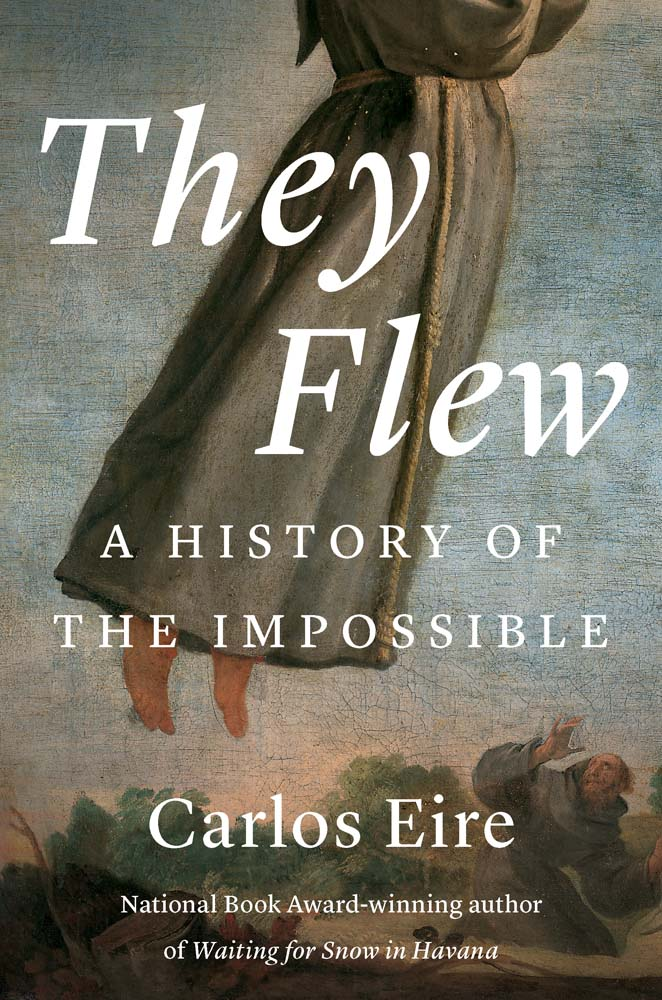
‘They Flew’ by Carlos Eire – A Review Essay

I listened to this book a few weeks after reading Rod Dreher’s thought-provoking new book, Living in Wonder. Both books present some challenges to Protestant readers as they take aim at various aspects of modern metaphysical assumptions which, of the three major branches of Christianity, are most embedded within the children of the Reformation. Carlos Eire takes as his subject the levitation of medieval Catholic monks and nuns, prodigiously attested to by copious historical records. I was not aware of this phenomenon before. The book is a serious intellectual and historical treatment of a subject that would be treated as ridiculous by many.

The book traces the historical records of levitation from antiquity to the modern age. It shows up consistently throughout those many centuries in a number of different religious and pagan contexts, though it reaches its apogee in the medieval period within certain Catholic circles.

The book focuses in on three specific people for whom levitations and other similar miracles were common and widely attested: St. Teresa of Avila, St. Joseph of Cupertino, and the Venerable María de Ágreda. The overall picture that emerges is one where, despite budgeting for exaggeration and embellishment by hagiographers and admirers, it’s hard to deny that something truly remarkable happened with these people. The volume and variety of witnesses makes it very difficult to explain away.

The strangeness of the topic and the solidity of the evidence offers a direct challenge to our absorbed habits of skepticism and our confidence in the stable laws of nature. We come away with nagging questions. Just what happened, exactly? And how does it make sense within our understanding of reality? The book navigates this challenge carefully, letting the weight of the evidence land on the reader gradually, leaving the uncomfortable questions to nag at our modern minds.

The book includes a substantial and helpful treatment of medieval and early-modern views about the devil, witchcraft, and demons.

I was fascinated to learn that the topic of miraculous levitations became a proxy for the battle between the Roman Catholic church and the new fledgling but energetic Protestant churches, with both treating the phenomenon as real but Protestants largely attributing it to the power of the devil. Thus the rather fascinating phenomenon was reduced to one facet of a high-stakes battle between entrenched religious groups; a battle that not infrequently resulted in torture and death.

The fact that Protestant denunciations of Catholic miracles occurred in this fraught context gives me pause. I don’t think I agree with the esteemed Reformers in this matter, but I can understand how there was a strong impulse to circle the wagons. For their part, Catholic apologists argued forcefully that these miracles were nothing less than a divine seal of approval and approbation on the entire Roman Catholic institution; God’s ‘amen’ to their claim to be the One True Church. Thus there was a powerful partisan incentive, aside from the normal human proclivity, for Catholic chroniclers to exaggerate and inflate the accounts of the miraculous in their midst. This helps me understand why the debate about these kinds of preternatural or supernatural events played out the way they did in the wake of the Reformation.

With a bit of historical distance, and a warming of relations between good-faith members of Catholicism and Protestantism, it seems like a good time to revisit this issue. Here is a sketch of my own still-forming view of this. Levitations can be faked rather easily, especially if they occur indoors, but this cannot explain most of the historical record. The phenomenon is, at least part of the time, real. The physical body somehow is able to suspend the force of gravity, or to be unaffected by it, during a state of spiritual ecstasy. This porous barrier between the physical and the spiritual was the default worldview within medieval Catholicism, though it was considerably hardened within Protestantism, in part as a reaction against Catholic fixation on these and similar topics, and then fully cemented by the time of the enlightenment (which was really the enshrining of the new dogma of mechanistic, reductive materialism).

Within premodern cultures and in certain spiritualist and occult traditions even today, this separation does not exist in the same way, and testimonies of such “impossible” feats regularly trickle out, though hard evidence that would be amenable to scientific analysis is almost never produced. The fact that the real phenomenon was mostly located within certain Catholic institutions like monasteries and convents does not, for me, serve to underwrite the whole of Catholicism. Far from it. But neither do I dismiss it as merely a trick of the devil to deceive the masses. We should leave room for demonic trickery and preternatural manipulations, such as the testimony of one tortured soul in the book who eventually confessed to making a pact with two demons, resulting in her ability to manifest, among other things, inexplicable levitations—I don’t see why that wouldn’t be possible. But if it’s not all demonic, and if I don’t buy what the pro-Roman Catholic apologists were selling, then we need some other framework to fit this into.

And so for me the conclusion is that these weird things did and do happen. They happened for a variety of reasons, perhaps divine and angelic, or demonic and devilish, or maybe even some other source besides that remains mysterious to us. God, in his perpetual purpose to confound the proud and the worldly-wise, perhaps scattered such manifestations among the Catholics in such a way as to frustrate the excesses of the Protestants. The injunction to “test the spirits” (1 John 4:1) applies to individuals. For Catholics to dismiss Protestants because of their lack of miracles (something which is not true today, if it ever was) is just as misguided as Protestants lumping all Catholic miracles together and denouncing them as demonic. In both of these approaches I see an all-too-human pride in one’s institution, one’s group. “You are still worldly. For since there is jealousy and quarreling among you, are you not worldly? Are you not acting like mere humans?” (1 Cor. 3:3:).

If I have taken anything away from my reading of church history, it’s that God does not play favourites with his children. There is enough shameful wreckage in each and every human grouping of Christians to keep us humble, and enough goodness and grace to rightly celebrate. We do well to keep this in mind even as we hold our Biblical, theological, and historical convictions firmly.

Carlos Eire has produced a book that feels very much suited to our moment of metaphysical re-evaluation. Although I struggled and skimmed through some parts of it—the accounts of levitations all blur together after a while—I enjoyed this book and the way it made me wrestle through this fascinating historical thread running from the medieval world well into our modern age.

The central question—they flew?—rests uneasily on the modern mind. Can we really believe they flew without losing all the goods modernity has bequeathed on us? Can we believe it without reverting to a medieval worldview that, if enchanted, also tended to be marked by ignorance and superstition? Can we really believe they flew and still remain well equipped to live and lead in the twenty-first century? My answer to all these questions is yes.

We must let go of reductive materialism and the hold it has on our minds. By this I mean broadening our view of reality in order for it to accord with the way the world really is. In fact, I’ve become convinced that letting go of reductive materialism is going to be a necessary step if we are to hold on to the goods of the modern age; if we are to avoid the ditch of scientism and the ditch of superstition; if we are to have the perceptual tools and the wisdom to navigate the challenges of the twenty-first century—an age when, if my intuition is right, we will see the return of the old gods and every strange being and phenomenon we so eagerly ignored during the age of reason.

In other words, we may well need categories for things even stranger than floating nuns and flying friars.

My Review of Rod Dreher’s ‘Living in Wonder’

I am happy to share with you that my review of Rod Dreher’s newest book, Living in Wonder, was released this week over at Mere Orthodoxy. I hope you’ll check it out. I really enjoyed Dreher’s book but also concluded that it presented some stumbling blocks to widespread appreciation by Protestant evangelicals. I tried to get both of those elements across in my review. I was a bit surprised to see that TGC’s review of it was so thoroughly critical, without recognizing that there are imbalances and weaknesses within Reformed evangelicalism that Dreher’s book actually helps us to address.

That was the direction I wanted to take my review. After noting my criticisms, I focused in what evangelicals can take away from the ideas in the book. This dovetails with my larger project in recent years to think through the nature of evangelicalism and Protestantism, the state of the culture with regard to spiritual matters (re-enchantment and the demise of modernity), and gleaning the best insights from the sharpest minds wherever I can find them.

While I’m a thorough-going Protestant, or rather because I am settled in my rejection of key, fundamental historical claims made by both Eastern Orthodox and Roman Catholic authorities, I feel free to read and engage with them without fear of being drawn in. I do not feel threatened by them, and I think it inevitable that each branch of Christendom, especially to the degree that they are shaped by sharp polemics aimed against other branches, will be imbalanced and in need of continual course correction. This is necessarily an endless process of discernement, reformation, and renewal. The end goal is always spiritual renewal, walking with the Spirit, and having the mind of Christ.

I also believe deeply in true small-c catholicity, the Biblical principle of affirming wherever possible, without dishonesty or sentimentality, the true spiritual unity we share with genuine believers which are scattered in many different institutions. It was a bit of a dodge when Billy Graham resolutely refused to pronounce who was in and who was out when it came to salvation, but there is something good about being slow and hesitant to pronounce on such matters when we take into account the incredible human capacity for inconsistency, and the mystery of genuine Spirit-wrought faith. I also recognize that for many people with busy lives and a simple faith, it’s not possible to navigate, assess, and discern all these things and they need trustworthy authority figures in their lives who can do a lot of that work for them.

These things shape my vocation as a writer and thinker for the church. I want to hold my convictions firmly and deeply, and yet be able to converse fruitfully with people from a wide range of perspectives. I want to offer helpful insights into culture, literature, and arts, and yet always make sure to remain in touch and appreciative of simple, hard-working, hands-on people. I want to continually hone my ability to write clearly and creatively, saying what I have to say with a dash of style that makes it enjoyable to read. I have a long way to go in each of these respects, but that is the direction I am aiming towards.

I have been mulling over once again the idea of moving this sleepy little blog of mine over to Substack, the it-place for writers. If I do, I would keep it free and try to move my previous articles and my subscribers over.

In coming days I should have a piece coming out at TGC Canada that I have been working on for quite a few months called Why We Need Beautiful Churches. It’s an attempt to piece together a whole bunch of reading and thinking on aesthetics, beauty, architecture, and the evangelical church. As always, I’m grateful for readers who take time out of their busy lives to consider my words. I don’t take that lightly, and I hope it’s a blessing and benefit to you. And if you do enjoy my writing or glean some benefit from it, I hope you’ll pass it on to others, share widely, and maybe even let me know.

The Long Way Home – A Review of Ashley Lande’s ‘The Thing That Would Make Everything Okay Forever’

Here is a book that tells a beautiful story in a beautiful way. And yet, there is a lot of darkness to get through before the dawn breaks. The raw honesty of Lande’s story, the power of her effervescent prose, and the drastic nature of her conversion are just some of the elements that make this book difficult to put down and impossible to forget.

For anyone interested in psychedelics, especially those drawn to spiritual illumination via that route, this book is for you. Lande speaks the language, has been down that road, done that, got the t-shirt. And she found something far, far better, in the very last place she thought to look. If I have any complaints about the book, it’s that the conversion comes late in the narrative and then the book ends a bit too abruptly, even if those last two chapters among the most moving things I’ve ever read. Before reaching the back cover, I wanted to learn a bit more about how Christ had transformed different aspects of her life and relationships that had been explored in previous chapters.

There is some debate both inside and outside the church regarding the use of psychedelics. One of the common complaints from psychedelic enthusiasts is that Christians forbid psychedelics out of some blind dogma. But rather than seeing it as a silly religious bias to avoid psychedelics, perhaps it would be better to see two different sources of very ancient spiritual wisdom. One, the Judeo-Christian heritage, teaches us that there is danger in such things, and that practices such as the ingesting of psychoactive substances put us in contact with a world of spirits that is not our assigned place. And yet Christianity fully validates that longing for a connection to the spiritual. The Scriptures make clear that this God-given hunger for the transcendent is meant to be satisfied by God himself, through Christ his Son, as mediated by the Holy Spirit.

The other ancient source of spiritual wisdom comes from those traditions who have for millennia partaken of psychoactive substances to connect with the spirit world and transcend one’s embodied consciousness. To some degree they can deliver on that promise. People can and do make contact with personal spiritual forces, and aside from the thrill of that experience, there is the added buzz that comes from knowing something that so much of society seems oblivious to. These practices make no personal moral demands. There are no ten commandments, no golden rule, no ultimate moral Judge. This makes it particularly compatible with the moral relativism of our age. Lastly, there is no creed or structure of authority like in a church, which resonates with our current cultural suspicion of authority and institutions.

We in the West are now firmly post-Christian. As we cast about for a solution to the spiritual malaise afflicting us, the last place we will tend to look is the place we think we have just been: Christianity. Haven’t we just decided we’re done with those old superstitions? So a journey to the island paradise of paganism, earth religion, eastern philosophy, or psychedelics seems to be just the thing we need for our starved souls in our disenchanted world. But we perhaps forget (or have never learned) that the best of paganism was fulfilled and transcended by Christianity, as G.K. Chesterton chronicled in his book ‘The Everlasting Man’.

For Ashley Lande, and perhaps for many others now journeying through the twists and turns of psychedelia and new age spirituality, the way home spiritually seems to include going round the whole world before arriving back and finding in Christ the Thing That Would Make Everything Okay Forever.