‘They Flew’ by Carlos Eire – A Review Essay

I listened to this book a few weeks after reading Rod Dreher’s thought-provoking new book, Living in Wonder. Both books present some challenges to Protestant readers as they take aim at various aspects of modern metaphysical assumptions which, of the three major branches of Christianity, are most embedded within the children of the Reformation. Carlos Eire takes as his subject the levitation of medieval Catholic monks and nuns, prodigiously attested to by copious historical records. I was not aware of this phenomenon before. The book is a serious intellectual and historical treatment of a subject that would be treated as ridiculous by many.

The book traces the historical records of levitation from antiquity to the modern age. It shows up consistently throughout those many centuries in a number of different religious and pagan contexts, though it reaches its apogee in the medieval period within certain Catholic circles.
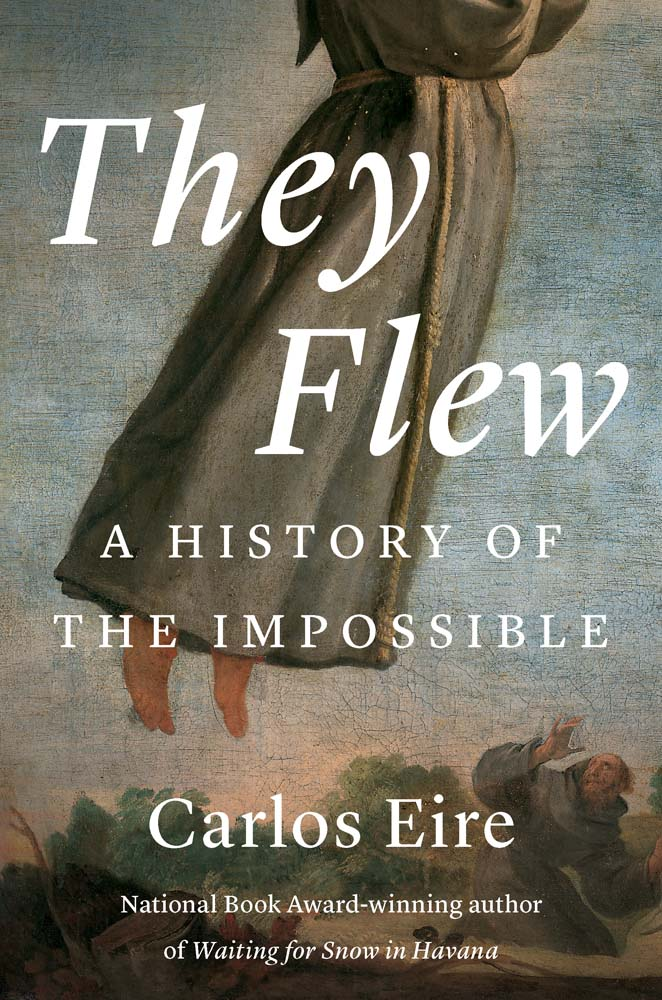
The book focuses in on three specific people for whom levitations and other similar miracles were common and widely attested: St. Teresa of Avila, St. Joseph of Cupertino, and the Venerable María de Ágreda. The overall picture that emerges is one where, despite budgeting for exaggeration and embellishment by hagiographers and admirers, it’s hard to deny that something truly remarkable happened with these people. The volume and variety of witnesses makes it very difficult to explain away.

The strangeness of the topic and the solidity of the evidence offers a direct challenge to our absorbed habits of skepticism and our confidence in the stable laws of nature. We come away with nagging questions. Just what happened, exactly? And how does it make sense within our understanding of reality? The book navigates this challenge carefully, letting the weight of the evidence land on the reader gradually, leaving the uncomfortable questions to nag at our modern minds.

The book includes a substantial and helpful treatment of medieval and early-modern views about the devil, witchcraft, and demons.

I was fascinated to learn that the topic of miraculous levitations became a proxy for the battle between the Roman Catholic church and the new fledgling but energetic Protestant churches, with both treating the phenomenon as real but Protestants largely attributing it to the power of the devil. Thus the rather fascinating phenomenon was reduced to one facet of a high-stakes battle between entrenched religious groups; a battle that not infrequently resulted in torture and death.

The fact that Protestant denunciations of Catholic miracles occurred in this fraught context gives me pause. I don’t think I agree with the esteemed Reformers in this matter, but I can understand how there was a strong impulse to circle the wagons. For their part, Catholic apologists argued forcefully that these miracles were nothing less than a divine seal of approval and approbation on the entire Roman Catholic institution; God’s ‘amen’ to their claim to be the One True Church. Thus there was a powerful partisan incentive, aside from the normal human proclivity, for Catholic chroniclers to exaggerate and inflate the accounts of the miraculous in their midst. This helps me understand why the debate about these kinds of preternatural or supernatural events played out the way they did in the wake of the Reformation.

With a bit of historical distance, and a warming of relations between good-faith members of Catholicism and Protestantism, it seems like a good time to revisit this issue. Here is a sketch of my own still-forming view of this. Levitations can be faked rather easily, especially if they occur indoors, but this cannot explain most of the historical record. The phenomenon is, at least part of the time, real. The physical body somehow is able to suspend the force of gravity, or to be unaffected by it, during a state of spiritual ecstasy. This porous barrier between the physical and the spiritual was the default worldview within medieval Catholicism, though it was considerably hardened within Protestantism, in part as a reaction against Catholic fixation on these and similar topics, and then fully cemented by the time of the enlightenment (which was really the enshrining of the new dogma of mechanistic, reductive materialism).

Within premodern cultures and in certain spiritualist and occult traditions even today, this separation does not exist in the same way, and testimonies of such “impossible” feats regularly trickle out, though hard evidence that would be amenable to scientific analysis is almost never produced. The fact that the real phenomenon was mostly located within certain Catholic institutions like monasteries and convents does not, for me, serve to underwrite the whole of Catholicism. Far from it. But neither do I dismiss it as merely a trick of the devil to deceive the masses. We should leave room for demonic trickery and preternatural manipulations, such as the testimony of one tortured soul in the book who eventually confessed to making a pact with two demons, resulting in her ability to manifest, among other things, inexplicable levitations—I don’t see why that wouldn’t be possible. But if it’s not all demonic, and if I don’t buy what the pro-Roman Catholic apologists were selling, then we need some other framework to fit this into.

And so for me the conclusion is that these weird things did and do happen. They happened for a variety of reasons, perhaps divine and angelic, or demonic and devilish, or maybe even some other source besides that remains mysterious to us. God, in his perpetual purpose to confound the proud and the worldly-wise, perhaps scattered such manifestations among the Catholics in such a way as to frustrate the excesses of the Protestants. The injunction to “test the spirits” (1 John 4:1) applies to individuals. For Catholics to dismiss Protestants because of their lack of miracles (something which is not true today, if it ever was) is just as misguided as Protestants lumping all Catholic miracles together and denouncing them as demonic. In both of these approaches I see an all-too-human pride in one’s institution, one’s group. “You are still worldly. For since there is jealousy and quarreling among you, are you not worldly? Are you not acting like mere humans?” (1 Cor. 3:3:).

If I have taken anything away from my reading of church history, it’s that God does not play favourites with his children. There is enough shameful wreckage in each and every human grouping of Christians to keep us humble, and enough goodness and grace to rightly celebrate. We do well to keep this in mind even as we hold our Biblical, theological, and historical convictions firmly.

Carlos Eire has produced a book that feels very much suited to our moment of metaphysical re-evaluation. Although I struggled and skimmed through some parts of it—the accounts of levitations all blur together after a while—I enjoyed this book and the way it made me wrestle through this fascinating historical thread running from the medieval world well into our modern age.

The central question—they flew?—rests uneasily on the modern mind. Can we really believe they flew without losing all the goods modernity has bequeathed on us? Can we believe it without reverting to a medieval worldview that, if enchanted, also tended to be marked by ignorance and superstition? Can we really believe they flew and still remain well equipped to live and lead in the twenty-first century? My answer to all these questions is yes.

We must let go of reductive materialism and the hold it has on our minds. By this I mean broadening our view of reality in order for it to accord with the way the world really is. In fact, I’ve become convinced that letting go of reductive materialism is going to be a necessary step if we are to hold on to the goods of the modern age; if we are to avoid the ditch of scientism and the ditch of superstition; if we are to have the perceptual tools and the wisdom to navigate the challenges of the twenty-first century—an age when, if my intuition is right, we will see the return of the old gods and every strange being and phenomenon we so eagerly ignored during the age of reason.

In other words, we may well need categories for things even stranger than floating nuns and flying friars.

My Review of Rod Dreher’s ‘Living in Wonder’

I am happy to share with you that my review of Rod Dreher’s newest book, Living in Wonder, was released this week over at Mere Orthodoxy. I hope you’ll check it out. I really enjoyed Dreher’s book but also concluded that it presented some stumbling blocks to widespread appreciation by Protestant evangelicals. I tried to get both of those elements across in my review. I was a bit surprised to see that TGC’s review of it was so thoroughly critical, without recognizing that there are imbalances and weaknesses within Reformed evangelicalism that Dreher’s book actually helps us to address.

That was the direction I wanted to take my review. After noting my criticisms, I focused in what evangelicals can take away from the ideas in the book. This dovetails with my larger project in recent years to think through the nature of evangelicalism and Protestantism, the state of the culture with regard to spiritual matters (re-enchantment and the demise of modernity), and gleaning the best insights from the sharpest minds wherever I can find them.

While I’m a thorough-going Protestant, or rather because I am settled in my rejection of key, fundamental historical claims made by both Eastern Orthodox and Roman Catholic authorities, I feel free to read and engage with them without fear of being drawn in. I do not feel threatened by them, and I think it inevitable that each branch of Christendom, especially to the degree that they are shaped by sharp polemics aimed against other branches, will be imbalanced and in need of continual course correction. This is necessarily an endless process of discernement, reformation, and renewal. The end goal is always spiritual renewal, walking with the Spirit, and having the mind of Christ.

I also believe deeply in true small-c catholicity, the Biblical principle of affirming wherever possible, without dishonesty or sentimentality, the true spiritual unity we share with genuine believers which are scattered in many different institutions. It was a bit of a dodge when Billy Graham resolutely refused to pronounce who was in and who was out when it came to salvation, but there is something good about being slow and hesitant to pronounce on such matters when we take into account the incredible human capacity for inconsistency, and the mystery of genuine Spirit-wrought faith. I also recognize that for many people with busy lives and a simple faith, it’s not possible to navigate, assess, and discern all these things and they need trustworthy authority figures in their lives who can do a lot of that work for them.

These things shape my vocation as a writer and thinker for the church. I want to hold my convictions firmly and deeply, and yet be able to converse fruitfully with people from a wide range of perspectives. I want to offer helpful insights into culture, literature, and arts, and yet always make sure to remain in touch and appreciative of simple, hard-working, hands-on people. I want to continually hone my ability to write clearly and creatively, saying what I have to say with a dash of style that makes it enjoyable to read. I have a long way to go in each of these respects, but that is the direction I am aiming towards.

I have been mulling over once again the idea of moving this sleepy little blog of mine over to Substack, the it-place for writers. If I do, I would keep it free and try to move my previous articles and my subscribers over.

In coming days I should have a piece coming out at TGC Canada that I have been working on for quite a few months called Why We Need Beautiful Churches. It’s an attempt to piece together a whole bunch of reading and thinking on aesthetics, beauty, architecture, and the evangelical church. As always, I’m grateful for readers who take time out of their busy lives to consider my words. I don’t take that lightly, and I hope it’s a blessing and benefit to you. And if you do enjoy my writing or glean some benefit from it, I hope you’ll pass it on to others, share widely, and maybe even let me know.

Speaking on Justin Brierley’s Podcast & More

I wrote in June that I’d done an interview with Justin Brierley for his documentary-style podcast, The Surprising Rebirth of Belief in God. There is a book by the same name which I discussed here. Well, the podcast episode ‘dropped’ (as the cool kids say) yesterday and (okay one more) it is a ‘banger’. I can feel my kids cringing with embarrassment at my attempts to use dope slang, so I’ll stop. Here is the link to the episode:

EPISODE 26 – Psychedelics and the Search for God: Ashley Lande’s surprising journey to faith

What a privilege to be featured in this series – I honestly don’t know how it happened. Justin reached out on Twitter so I guess he saw my original article at Mere Orthodoxy and he just happened to be planning to deal with this topic. I found the episode informative and moving as it incorporated the testimony of Ashley Lande, who was formerly heavily into psychedelics. I hope you’ll check it out if you’re not already familiar with the series. The content and production quality are really top notch.

One of the themes that I touched on in my responses to Justin’s questions was the organized effort by various individuals and organizations to synthesize psychedelic use with mainstream religion, including Christianity. This evidently fell outside the scope of the episode’s focus, so all of that was edited out (which is totally fine). But it’s one of the things that most struck me and worried me as I researched the topic. On the more moderate and progressive side of mainline Protestantism and evangelicalism, I already see activists advocating for the spiritual benefits of psychedelics for Christians.

And one more comment before moving on from this topic. I do wish I had been a bit more clear and blunt in my conclusion of the dangers of psychedelics. So lest there be any confusion, I’ll do it now: Yes, some of the entities people encounter and engage with while on psychedelics are definitely demonic. And no, they don’t present themselves that way. I believe that using psychedelics puts you in great spiritual danger regardless of the other benefits that may be had. Thankfully not everyone who uses them encounters dark spiritual entities, and not everyone who encounters a demonic being while tripping finds themselves harassed and afflicted by that being subsequently, but these things most definitely happen. So, as encouraged as I am when I see a significant number of people being redeemed by Christ out of psychedelics use, I have no illusions about the scope of spiritual danger represented by widespread psychedelics use in our culture.


Staying on the theme of podcasts, I had the opportunity to join Jeremy Pryor and some other guests for a couple of Family Teams Podcast episodes. These were not about psychedelics. Rather, we discussed fatherhood, masculinity, family vision, the LGBT revolution, identity formation, Jordan Peterson, and Elon Musk. It was a good time, even though I was not able to be home in my office at recording time, so my audio quality is not great. You can find those here:

East of Eden by John Steinbeck- Outside the Garden, Far from the Cross

In the Salinas Valley of California, a novel was born. John Steinbeck wove together strands from his own life, the character of the land, and the first few chapters of Genesis to form a story that is epic, loaded with meaning. The book is both broad and narrow in scope; broad in its tracing of multiple generations of the two main families, the Hamiltons and the Trasks, and narrow in the way it focuses its gaze into the lives of its main characters.

The book was criticized by some as being too heavy-handed in its message. It’s true that the author does not try too hard to hide what he really believes about human nature, good and evil, and the purpose of life. And yet, Steinbeck is an excellent prose writer, and aside from a few bits of dialogue that I felt were clunky, the book holds together, flows easily, and stands as a massive achievement. I found the clarity of the message to be a positive, not a negative, and the clear allusions to Scripture gave it added depth for me.

While some might complain that the self-conscious patterning of the narrative after the Cain and Abel story betrays a lack of imagination or creativity, this objection is a characteristically modern stupidity. In previous eras, it was expected that great art would be patterned after earlier works. Authors were less originators of novel ideas and more stewards of literary traditions. As they retold the same stories, they modified and added to the tradition, making it their own to some extent, leaving their imprint upon it. Although I love creativity and originality, I think there is a particular kind of literary genius in the older kind of storytelling. And what we think of as original work is often drawing on traditions and stories we simply don’t know, so it feels fresh and new to us even though it isn’t. In fact, there is a special joy in discovering the sources that one’s favourite authors have drawn from: “Oh, that’s where she got that from.”

Steinbeck considered East of Eden to be his magnum opus. It has that kind of feel, both in its length (300,000+ words, 600 pages) and in its gravitas. There is not much levity in the book. It takes hold of the heaviest themes that trouble humanity and wrestles with them page after page. It took eleven years of gestation and one year of uninterrupted writing to complete it. Steinbeck said of it, “It has everything in it I have been able to learn about my craft or profession in all these years.” And also: “I think everything else I have written has been, in a sense, practice for this.”

One of the ways this shows up is in the little bits of wisdom Steinbeck seems to have wanted to include in the book. They adorn the narrative but are not in any way necessary to it. For example: “You can boast about anything if it’s all you have have. Maybe the less you have, the more you are required to boast.” Or, describing how some years were rich and others were lean in the Salinas Valley, “it never failed that during the dry years the people forgot about the rich years, and during the wet years they lost all memory of the dry years. It was always that way.”

The Salinas Valley in California

The book certainly deals with adult themes—prostitution and murder—but not in a prurient way. I much prefer this handling of such themes to what I encountered in Ken Follet’s Pillars of the Earth, or what sounds like a similar pornographic quality to the Game of Thrones books by George R. R. Martin. Art should be able to depict sin without tempting the reader to it; great art depicts sin in utterly realistic ways and yet manages to encourage virtue in the reader. The divorcing of art from virtue is one of modernity’s great achievements, to our profound detriment. The modern novel is often a kind of literary nihilism, depicting with indifference the beauty and filth and goodness and evil of the world, as if they were all interchangeable and, after all, who can really tell the difference?

In my reading of 20th-century literature, this amorality has often been a prominent feature. Steinbeck himself was known for it. And yet East of Eden concerns itself with good and evil as real categories, and in that sense it feels different from something like Waiting for Godot by Samuel Beckett, Slaughterhouse-Five by Kurt Vonnegut, or The Stranger by Camus. Steinbeck, who grew up Episcopalian (Anglican) but called himself an agnostic, held on to solid moral categories even as he lost the surest foundation for them. It is said that his last novel, The Winter of Our Discontent, explores the moral decline of Americans. It was not especially well received, which makes me think I might like it.


Back to East of Eden. I really enjoyed seeing how Steinbeck shaped his story to mirror the Cain and Abel narrative. But more than that, he included in the novel itself an extended reflection on the Cain and Abel story by some of the main characters, including a detailed discussion of the Hebrew translation into English of Genesis 4:7, “If thou doest well, shalt thou not be accepted? and if thou doest not well, sin lieth at the door. And unto thee shall be his desire, and thou shalt rule over him” (KJV). The crux of the matter is the last phrase. The KJV renders is “thou shalt rule over him [sin].” Now I happen to have studied this verse in some detail in Bible College during my ‘Exegetical Methods’ class, with a focus on the word translated desire. But here the focus is the verb shalt rule, transliterated as “timshal” (תִּמְשָׁל). In contrast to the KJV, the ASV rendered it do thou rule over it. In the novel, the wisest and best character, the servant Lee, rejects both of these translations because the KJV seems to promise that Cain will rule over sin, while the ASV seems to merely command it. Lee concludes that it should be rendered thou mayest rule over it. The key, for Steinbeck’s purposes, is that it is conditional, that it comes down to Cain’s choice. The consensus among all the main modern translations is that the verb should be translated as you must. I see why Steinbeck did what he did, making clear the conditional aspect that I think is nevertheless present in all the translations.

This central challenge to overcome sin and evil is what animates the drama of the book. Will the Cain-like characters give into the malicious impulses that course through their veins, or will they choose to master sin? In the novel, this struggle is personified in Cal, who learns that his mother is a sociopath, a deeply wicked and malicious person. He finds in himself a mix of malice and goodness, and this discovery tempts him to believe that he is in some way fated towards evil, or helpless in the face of it. Lee, who raised him and knows him best, discerns this and speaks directly to it:

Cal drifted toward the door, slowly, softly. He shoved his fists deep in his pockets. “It’s like you said about knowing people. I hate her because I know why she went away. I know—because I’ve got her in me.” His head was down and his voice was heartbroken.

Lee jumped up. “You stop that!” he said sharply. “You hear me? Don’t let me catch you doing that. Of course you may have that in you. Everybody has. But you’ve got the other too. Here—look up! Look at me!”

Cal raised his head and said wearily, “What do you want?”

“You’ve got the other too. Listen to me! You wouldn’t even be wondering if you didn’t have it. Don’t you dare take the lazy way. It’s too easy to excuse yourself because of your ancestry. Don’t let me catch you doing it! Now—look close at me so you will remember. Whatever you do, it will be you who do it—not your mother.”

The novel intends to leave us with the same challenge.


But for all of its moral force and Biblical pathos, the novel is Christless and devoid of redemption. (This is an observation, not necessarily a criticism.) It manages to capture the essence of life East of Eden, that is, life outside of the garden, life among the thorns. Steinbeck captures as much beauty and goodness as can be found in the created world, and I would argue he borrows heavily from the accumulated capital of Christianity in that effort, but ultimately we are left confronted with a moral law, the imperative to choose between good and evil, and the haunting sense that we have not the power to choose rightly, so powerful is the pull of sin.

Here is where a writer like Tolstoy or Dickens would, after a few hundred pages of wallowing in the deepest human misery, bring in the transformative power of love and of grace to serve as an illustration of the gospel. Steinbeck therefore reflects the exhausted and lifeless character of so much mainline Protestant Christianity in the 20th century. It reminds me of what Alan Jacobs described so movingly in his book, Original Sin, where he traced the views of human sinfulness throughout various times and cultures. He showed how many people have tried to deny the depth and severity of human sin, recasting it or ignoring it. This can be a pleasant sort of delusion. Others accepted the true nature of our depravity but then entered into the joy of salvation in Christ, who alone can solve the problem at its root by generating a new heart, new birth, and new creation within the human person. But the bleakest prospect, and the darkest literature, is produced by those who fully accept the depth of human depravity while, for whatever reason, remaining outside of Christ. These people see and feel the problem rightly but not the solution. East of Eden is firmly in this category.

What we don’t find in East of Eden is any mention of the seed of the woman, the promised one who would crush the head of serpent with bruised heel. But this shadowy figure stands above the entire Genesis narrative and alone gives it cohesion. Why was it important that Abel should live? To produce the promised snake-crusher. And contra Steinbeck’s claim in the novel, we are not the descendants of Cain, but of Seth (see Gen. 5). Yes, we have a little bit of Cain in each of us, but it’s Seth, who Eve says God has given her “in the place of Abel,” who produces both Noah and eventually the Messiah himself, Jesus.

Ultimately, it isn’t our ability to choose good over evil, to resist the sin crouching at our door, which makes the decisive difference. That choice, which we make every day to some extent, is a reflection of what is happening more deeply in our hearts, and what is happening on the vertical, spiritual plane which is all but absent in the novel.

The world-historical event that serves as the great hinge of history occurred on a hill not too terribly far from the land of Cain and Abel, on which a man who was also the Lord bled and died like Abel, murdered by his brothers. Hebrews 12:24 says that Christ’s blood “speaks a better word than the blood of Abel.” Jon Bloom explains: “For though Abel’s innocent blood cried out for justice against sin, Jesus’s innocent blood cried out for mercy for sinners. Abel’s blood exposed Cain in his wretchedness. Jesus’s blood covers our wretchedness and cleanses us from all sin.”

This may not have been Steinbeck’s understanding, but as I ponder the meaning of the magnificent work of fiction he wrote, I cannot help thanking God that he did not leave us to our own devices in the arid lands East of Eden. Rather, he made a way, through the blood of the cross, to a place even better than the Salinas Valley in the spring.

As an Amazon Affiliate I earn a small commission from qualifying purchases of books purchased through links on my website, while customers do not pay anything extra.

The Stranger by Albert Camus – The Distilled Nectar of Meaninglessness

Here is one of the quintessential 20th-century novels. Often assigned to college students as an introduction to Existentialism, it is the story (quoting from the back of the book now) “an ordinary man who unwittingly gets drawn into a senseless murder on a sun-drenched Algerian beach.” It is an exploration of, in Camus’ own words, “the nakedness of man faced with the absurd.”

It is well written, draws you in, and certainly has an unusual and distinctive feel. Perhaps more than any other novel I have read, it captured the bleakest essence of the absence of morality and meaning that characterized the post-war era, ending more or less around the passing of Queen Elizabeth II. I was struck by many things as I read it.

The protagonist, Meursault, exists in a moral vacuum. He is utterly passive in almost every situation he finds himself in, even in the face of evil. The 20th-century taught us that passivity in the face of evil is evil. Camus knew this better than you and me—he was a brave man who joined the French resistance under Nazi occupation during WW2, risking his life countless times. But rather than make any moral judgments about anything, Meursault merely finds things ‘interesting’ or not. When a moral pronouncement is made in his presence, he abdicates completely and says, “Who’s to say?” As the narrative picks up momentum, we find him saying “it doesn’t matter” (or variations of it) to all kinds of events that obviously matter very much.

Therefore everything is reduced to the absurd, the amoral meaninglessness of existence in an accidental universe. Death, abuse, lies, oppression, and murder are all meaningless. The only time we see Meursault caring about anything is when it involves his imprisonment and possible execution.

Camus once said that there was only one serious philosophical problem, and that is suicide. The fundamental question for him then was whether life is worth living or not.

I have read a number of books by these kinds of thinkers now and they all seem very brave and bold, willing to face the cold dark winds of an uncaring universe while the rest of us simpletons huddle stupidly around the warm fires of our comforting delusions. And I get that—there is certainly something seemingly absurd about life. The wise have recognized that for some thousands of years, such as the teacher in Ecclesiastes who said that everything under the sun was meaningless. But ultimately the conclusion of Ecclesiastes is quite different than anything offered by existentialist literature.

The scene where the Christian accosts Meursault is painful to read. The Christian says, “all men believe in God, even those who turn their backs on him.” I hear echoes of Romans 1. Meursault comments: “That was his belief, and if he were ever to doubt it, his life would become meaningless.” The Christian then shouts “Do you want my life to become meaningless?” It is a good scene, a good rebuke and warning. Faith can have many pathologies, such as the cringing insecurity Camus exposes in this scene. It is right for me to read that and ponder whether my faith is so fragile that it cannot abide the indifference of a Meursault.

But Camus ought to have turned the tables on himself a little. The more I read these folks, the more I am struck by the fleeting vapidity of their lives. Which of them has actually produced anything? Have they raised flourishing families of whole and happy children and grandchildren—legacies of truth flowering into maturity? Have they built lasting institutions of learning that have these great insights as foundation-stones for a growing body of wisdom and knowledge that can guide future generations? Have they taught us how to live in such a way that a society or culture based on these teachings would grow and flourish into a great civilization?

And these comforting delusions they have so confidently thrown aside, are they really without any merit? Is there no baby in that bathwater? Has enlightenment thinking really dealt a death-blow to belief in God? Or has it merely managed to create that illusion with smoke and mirrors and the bleating insistence of our cultural elites for the last two hundred years? Haven’t we witnessed a group of very brilliant people enamored with the idea and possibilities of a godless existence and the resulting emancipation from moral imperatives?

Well, you know what I think.

Camus and others tried to stave off nihilism with existentialism. Life is worth living, despite the pointlessness of everything, because it is nice to eat ice cream on a hot day, and the grass on your feet is nice, and many things are interesting. But this is like treating a 6 inch cannon-ball wound through the chest with a dab of Polysporin and grape-flavored Children’s Advil. It will not hold, and it does not hold, and we today are everywhere seeing and feeling just how badly it has not held. There is no buttress against vice, no strength to deny the self and build strong families, no roots to draw from, no meaning to guide you, and ultimately nothing to satisfy what Augustine rightly described as the restlessness of the soul. If anything, Camus shows us what it looks like to try and make your bed in that restlessness, like that dog who says “this is fine.”

 “On Fire” by KC Green

These 80 years later, with the youth of the West mired in ‘The Meaning Crisis,’ and suicide sharply on the rise, and all sorts of troubling trends on the rise, it seems clear that the bed is not very comfortable, or safe. More foreboding still is the sense that the vacuum is quickly collapsing. The nihilists and existentialists are mostly forgotten. The energy now is with a rising tide of what R. R. Reno calls the Strong Gods, which range from faceless ideologies that colonize young minds to a panoply of paganisms, including human sacrifice and contact with spiritual entities. But as I have tried to argue elsewhere, there is a heartening stream of conversions to Christianity among the currents flowing in to fill the yawning void.

I enjoyed the book, but I am so glad I am not a disciple of Camus.

Resisting the Rainbow Mafia (with Philosophy)

The opening illustration is unforgettable. I speak of Vaclav Havel’s essay, ‘The Power of the Powerless,’ which opens with an examination of a typical small shop owner living in communist Romania. He puts a sign in his shop window: “Workers of the world, unite!” But does he really believe this? Does he believe it so much that he feels an urge to inform his customers of this ideal? Or is something else going on? Havel explains: “The slogan is really a sign, and as such it contains a subliminal but very definite message.” And what is that message? “I am afraid and therefore unquestioningly obedient.” Or in other words:

“I, the greengrocer XY, live here and I know what I must do. I behave in the manner expected of me. I can be depended upon and am beyond reproach. I am obedient and therefore I have the right to be left in peace.”

Is something similar going on in the West in our own day? It sure feels like it. In my travels through quaint and quiet Ontario towns, it seems like every shop feels the need to advertise its most excellent moral qualities by having a rainbow flag in the window. Some even boast of being “Rainbow Registered,” which refers to the “Canada’s 2SLGBTQI+ Chamber of Commerce (CGLCC)” Accreditation program for “2SLGBTQI+ Friendly Spaces,” a program that is generously funded by the Government of Canada.

In our day, there is no shortage of breathless outrage over every aspect of the culture war. I really have no interest in joining the chorus of baying dogs barking at each other incessantly across the fence. If you’re looking for that, the good news is there is plenty to be found — just find yourself some social media influencer who agrees with you and go from there.

I am more interested in digging down beneath the surface in a calm and irenic way to understand what is going on. What is animating this froth on the surface? What really divides us? Is it really the case that “they are evil” as so many on both sides claim? That is too easy, too convenient, and too dangerous a notion to embrace, as Solzhenitsyn taught us:

The line separating good and evil passes not through states, nor between classes, nor between political parties either — but right through every human heart — and through all human hearts. This line shifts. Inside us, it oscillates with the years. And even within hearts overwhelmed by evil, one small bridgehead of good is retained.

So this isn’t about getting worked up in fiery indignation at the latest provocation of the other side. Instead, let’s ask the question: what does it mean to have a flag in one’s window, or flying over one’s house, or — more significantly still — over our municipal or church buildings? To answer that question, we need to back up a bit and consider what a flag signifies.

In the last episode of the Masters of the Air series, documenting the story of the 100th Bomber wing of the American forces, captured airmen in a Nazi POW camp rise up against their captors as the allied forces close in. As the fighting subsides, one of the main characters of the show decides to make a bold and symbolic move. He finds himself a contraband American flag, climbs up a wooden structure, tears down the Nazi swastika that had been flying over the camp and raises the stars and stripes amid triumphant shouts and swelling orchestral music. It’s a moving scene (viewer discretion: Violence).

Flags have always carried symbolic weight, not only in their visual designs but also in their usage. To raise a flag over a place is to claim it, and to declare that place’s submission to the authority to which the flag points. To choose to display a flag is an inherently powerful statement of allegiance.

So what does the rainbow flag signify? That question could be answered in a number of different ways. Some would say it means equality and the freedom to love whomever one wants, and to be whoever one feels he or she (or they?) is inside. Others would say it means sexual perversion and the wholesale rejection of both traditional morality and even more fundamentally the binary of male and female.

But I would like to argue that at a deeper level, the flag really represents a rejection of classical metaphysics, the belief that nature has a given shape and order which must be discovered and honoured. Trying to engage this topic on the level of sexual morality is a dead end. The differences are too fundamental. Instead, I’ve found that tackling the topic from the lens of philosophy is less personal and heated.

This is street-level philosophy to be sure. I’m not qualified to debate academic philosophy, nor do I have any desire to. But philosophy at a more basic level is thinking carefully about the nature of the world, knowledge, and reality. One of the major fault lines we find in philosophy is that between nominalism and realism.

In short, nominalism argues that the material world takes the shape it does rather accidentally, and that the names (nomen in the Latin) we give things are arbitrary. There is therefore no reason why trees shouldn’t be boiled down to green soup and no reason why we cannot take it upon ourselves to reshape and reconfigure ourselves and our world to suit the desires we find within.

Realism, on the other hand, believes that the shape of the world and everything in it is purposeful — has telos. Therefore everything has a nature that informs its shape, function, and proper purpose. In this view, there is a moral imperative attached to the world, which is to honour the design and purpose of the world.

These ways of thinking are rarely discussed but they nevertheless function as deeply-held assumptions about the world that shape our moral intuitions. Returning to the LGBT Rainbow flag discussion, I would argue that to embrace the ideology of that flag is to embrace a radical form of nominalism.

Framing this discussion along the lines of philosophy has at least two positives that I can see. First, it gets away from arguing about morality and religion, which is often a dead end. Don’t get me wrong, I love talking about religion and morality, but when engaging someone on the other side of this issue, it’s been my experience that we get nowhere at all. Second, it draws a distinction that doesn’t run cleanly along religious lines. What I mean is that some Christians are clearly nominalists, like progressive Christians who find ways to embrace the LGBT movement while holding on to some semblance of belief in Christ, while many secular atheists, Muslims, or non-religious types have a deeply held belief in realism which makes it impossible for them to get on board with the idea that a man can become a woman.

So what about those small-shop owners with the Rainbow flags in their windows? Perhaps some of them are true believers in the LGBT revolution, but many of them are probably just trying to run a small business and be left alone. The rainbow mafia, as some have called it, has all kinds of ways to pressure people to get on the ‘right side’ of this issue. Add to that the social dynamics of small towns, where everyone knows everyone, and also the Canadian temperament to be polite and avoid direct conflicts when possible, and you get many people saying, just like the Romanian greengrocers:

“I, the small business owner, live here and I know what I must do. I won’t be any trouble. I behave in the manner expected of me and put up the Rainbow flag. I am obedient and therefore I have the right to be left in peace to sell my wares to townsfolk and tourists.“

But just like those suffering under communism, choosing to live by lies is a tragic mistake. It weakens and demoralizes the one who does it. It reinforces the power of the totalitarians, or in our case the soft totalitarians. I believe the flag represents a metaphysical lie, an incredibly damaging lie, and that it is good and right to resist the ideology which animates the LGBT movement, for the sake of our society, for the sake of those caught up in that ideology, and for the sake of the Truth. For Christians, that opposition ought to be both courageous and virtuous, which is not an easy balance to find. But hopefully a deeper understanding of the philosophical questions embedded in this front of the culture war can help us find that balance.

The State of the Blog (What I’ve Been Up To)

Things have been quiet here at the blog, you might have noticed. Life has its way of crowding in and getting busy, doesn’t it? Work has been a couple notches busier than normal, and then I also recently was voted in to serve as an elder in my local church (again). By the way, I just signed up for the Amazon affiliates program, so that if you are so convinced by my writing to make a purchase on Amazon through a link on my site, I will become an internet millionaire through Bitcoin. I’m pretty sure that’s how it works. Anyways, moving on.

I’ve been keeping up my reading, though. I read Church Elders by Jeramie Rinne – simple and good on the topic. I finally got around to reading Rod Dreher’s Benedict Option, which I found myself resonating with. It’s a bleak perspective on the state of the West, to be sure, but I largely agree with his assessment. I also found that the loudest critiques of the book I’d heard were pretty obviously mis-readings of Dreher’s actual argument. I’ve got an idea to combine a review of it with a review of Aaron Renn’s Life in the Negative World (which is sitting on my shelf), putting the books in conversation with each other.

I also read a Canadian book called Divorcing Marriage, a collection of essays from social conservatives and lawyers from the era a generation ago in 2004 when homosexual marriage was just being pushed through the courts. It was astonishing just how much things have changed in the last twenty years. At the time, I was not politically or socially conscious. I was easily convinced by simple appeals to fairness and empathy that gay marriage regulated by the secular state was fine – it had no bearing on Christians and I could not imagine any reason why society as a whole might wish to retain a traditional view of marriage. Well, this book really helped crystalize my thinking, which I now realize was about as solid as my 100-year old barn that is half fallen over and whose beams are rotted. I hope to write something more extensive on this, we’ll see.

After finishing that I felt I was due for some classics, so I’ve read Sir Gawain and the Green Knight and the story of Percival, and I’m now reading Roger Lancelyn Green’s classic King Arthur and His Knights of the Round Table, which retells those two stories as well as many others. My son, who just turned 13, read it this year in his schooling so we’ve been able to connect over it. Lastly, I started Charles Dickens’ Great Expectations and am enjoying that as well.

Oh, I forgot, I’m also reading Thomas Watson’s The Lord’s Supper as recommended by Gavin Ortlund during his video on the topic. It’s excellent. It argues for what is known as the ‘Spiritual Presence’ view of the Lord’s supper, as a middle way between the excesses of transubstantiation and memorialism. I’ve become very interested in this topic as I’ve been thinking through re-enchantment and the church (more on which in a moment).

Did you know that both the Westminster Confession and the London Baptist Confession of 1689 took this view? Somewhere along the way the default evangelical view seems to have gotten filtered through enlightenment materialism and the supernatural was stripped out, leaving only the human-level interaction with memory and Scripture. This mere memorialism is the view explicitly laid out in the Southern Baptist document, the Baptist Faith and Message, as well as my own denomination’s Affirmation of Faith. But I haven’t been able to find out why. On the strength of which argument was the more classic reformed view replaced? I am eagerly looking forward to reading Dr. Michael Haykin’s book Amidst Us Our Belovèd Stands: Recovering Sacrament in the Baptist Tradition, which argues this point. Here is the short blurb summarizing the book:

When it comes to baptism and the Lord’s Supper, many Baptists reject the language of sacrament. As a people of the book, the logic goes, Baptists must not let tradition supersede the Bible. So Baptists tend to view baptism and Communion as ordinances and symbols, not sacraments.

But the history of Baptists and the sacraments is complicated. In Amidst Us Our Beloved Stands, Michael A. G. Haykin argues that earlier Baptists, such as Charles Spurgeon, stood closer to Reformed sacramental thought than most Baptists today do. More than mere memorials, baptism and Communion have spiritual implications that were celebrated by Baptists of the past. Haykin calls for a renewal of sacramental life in churches today—Baptists can and should be sacramental.

That’s exactly what I have been leaning towards. It marries my interest in historical retrieval & ressourcement and my desire to exhort evangelical churches to steward well the cultural movement towards re-enchantment.

I translated that desire into an article, my latest over at TGC Canada: Leaning into Evangelical Re-enchantment. If you haven’t, I hope you’ll read it. I was pleased to see Aaron Renn & Rod Dreher both linked to it at their Substacks – it’s a real blessing to a small-beans writer to get amplified and shared to much wider audiences.

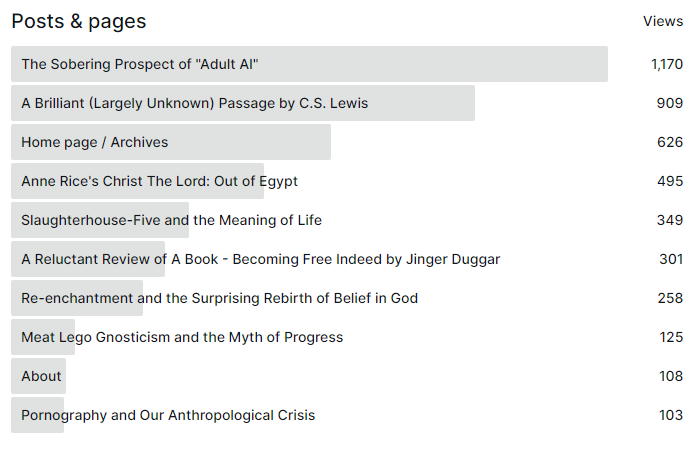
I really don’t know much of anything about internet traffic, but I have to say I have been surprised at the sustained level of reading on this here, my little blog. I have been averaging about 150 visitors and 200 views a week since early this year. This may not interest anyone, but I find it interesting. Here are my most popular posts of 2024. The #1 article, about Adult AI, was boosted by a link from Tim Challies, which also led to an interview with Moody Radio’s Kurt & Kate in the Mornings, which you can listen to if you so wish. Challies is a singular blogging phenomenon.

The #2 post, an extended quote from C.S. Lewis, has been quietly accumulating views week by week as people from all over the world find it, mostly through Google searches and perhaps links on forums. After that it seems that my reviews of popular books are of enduring interest. I would also like to add to my website here a page with links to all my published pieces elsewhere – a kind of central hub where those can be easily found.

Aside from that piece at TGCC, I have one submitted to another outlet (which I haven’t been published at before) and I am waiting to hear back from the editors. It’s another piece about psychedelics. Speaking of psychedelics, I was pleased to be interviewed by none other than Justin Brierley for his excellent documentary podcast series, The Surprising Rebirth of Belief in God. The episode on psychedelics hasn’t been released yet, but I’ll link to it when it comes out. I think I will wind down my writing on psychedelics, however – I’ve said what I had to say, and I think there are others who are better placed to continue writing for the church on this topic.

That about does it for me at this point. I’ve got some articles at various points of completion: on the Pride Rainbow compared to Vaclav Havel’s greengrocer illustration; on cathedral beauty and gospel beauty; and an article on the Haitian Christian community in Montreal which has been commissioned by Faith Today.

As always, thanks for reading.

As an Amazon Affiliate I earn a small commission from qualifying purchases of books purchased through links on my website, while customers do not pay anything extra.

At the Mercy of Narcissists

I reluctantly read Mary Harrington’s recent article about Lauren Southern and the “tradwife” movement. It’s not a happy tale. I won’t blame you for being unaware of Southern—she was a Canadian “media personality” on the alt-right, working at times with Rebel news and featured on various conservative shows as she pursued activism and controversy. She left the media world and sort of disappeared when she got married at the age of 22, around 2017. Her dreams of being a traditional, stay-at-home wife—the ultimate rejection of feminism—had come true.

But those dreams turned into a nightmare. Her husband, it seems, turned out to be a harsh, cruel, selfish man. The marriage eventually fell apart, and she fled back to Canada with her child, where she had to rebuild a life from the ruins. The article goes into a lot more detail, if you’re interested. Harrington’s angle on the story is that these internet-generated ideologies, whether it be transgenderism or tradwifery, are disconnected from reality. The web, she writes, allows these “viral and overly simplistic ideas [to] replicate with seemingly very little reference to reality, human nature, or the world as it actually is.” As far as that goes, I agree with her. Mary Harrington is always a perceptive writer, but especially on the subject of technology. See here for my review of her book, Feminism Against Progress.

My interest, and the main point I’d like to make, takes a different angle on the sad story of Lauren Southern’s marriage. Simply put, it’s that shared values are not enough to build a loving marriage; for that, you need godly character, or what we might call true virtue. Harrington tells the story: “By the time she met her husband, she’d been condensing conservative values into ‘listicle’ form as a media influencer for some years.” (A listicle is an online article that is really just a slightly-expanded list, usually of the ‘how-to’ kind). The man she met obviously agreed with her “conservative values,” which formed the basis for their shared value commitments and future plans together. But when I was retelling this story to my wife, she immediately spotted a problem: Southern had been publicly arguing for a strongly anti-feminist, pro-traditional lifestyle as a single woman. “That’s sure to attract narcissists,” she said. And why not? Any selfish man would want to find himself a woman who believed it was her duty to submit and obey and smile and keep a happy home.

Narcissists are very good at pretending to be something they are not. It’s easy to espouse agreement about values, but the proof is in the track record of relationships past and present. There are so many things I don’t know about this situation, so I can’t speak with any authority on the specifics, but my sense is that we are living through a time when men and women are having a lot of trouble finding one another, falling in love, and forming stable families. This seems to be the case regardless of political persuasion. On the Left, there is a wholesale breakdown of the family, or even gender, as stable categories. As women trend more progressive as a whole, we are seeing a lot of feminine-driven pathologies crop up across our culture, including the fact that women initiate the majority of divorces. But on the Right—where I would find myself (to some degree) politically—I also see all kinds of problems, some of which are illustrated all too well by this emblematic story.

Without virtue, no healthy relationship can grow. Without character, integrity, and humility, no flourishing marriage can form. Shared values are not nearly enough; shared dislikes and hatreds even less so. Have we lost sight of this basic kind of wisdom in our internet age? Are we so entrenched and caught up in culture wars that we think someone on the same side as us is sure to be a good spouse? There is a profoundly ugly misogyny that does exist and spread in some red-pilled, anti-feminist corners of the web. It’s not as widespread as the cultural left would like to claim; they really cannot tell the difference between a godly conservative man and a moral monster. But it’s widespread enough to be an issue that needs to be addressed.

If the women in these kinds of spaces don’t have wisdom, discernment, and good community around them, they are simply at the mercy of narcissists. What about that good community? As I read the article a part of me was thinking that this terrible state of affairs could have been helped so much by a healthy local church community. Such a church could have stepped in and advised against the marriage beforehand, or supported her once the issues arose. Good elders could have confronted the husband. But it doesn’t sound like such a church was ever a part of their lives. And with our increasingly fragmented, individualistic communities, nothing else was there to take its place.

Here is another lesson that returns to the theme of technology. Online communities can be great in some ways, but they cannot replace the embedded, embodied communities that once formed the fabric of our societies. When the marriage is really a nightmare, a friend at the front door or a place to stay is what you need, not an avatar or emojis on a messaging platform. A healthy local church is the last best remnant of this kind of community.

But for those of us with daughters, there is one more lesson to draw: we must model for them what good men are like and teach them to spot bad men. And then let’s embed our families in thick communities that look out for one another and take care of each other.

To be clear, I am not blaming Lauren Southern for the situation she found herself in. As I said above, I really don’t know the details and it’s not my place to render that kind of judgment. I do think the situation, public as it is, can be instructive for us. The article includes an unexpectedly positive note, telling how Southern found healing as she lived with her child in a small cabin in the woods, connecting with working class people living in trailers nearby. She described it as “unexpectedly healing, and filled with a genuine sense of community.”

Digging for Roots: Theological Retrieval

Amid the tumult of our times, a lot of people have been looking for answers. Among Christians, one of the ways that has manifested itself is a search for rootedness, or solid foundations. And because evangelical Protestants are often ignorant of the roots of their tradition, or have been taught to be suspicious of any appeals to tradition and history, they are primed for the idea that all of this – their upbringing – has been wrong and that what they really need is the oldest church with the strongest claim to have preserved the unbroken practice of the early church. I’m sympathetic to that impulse.

Photo by Eilis Garvey on Unsplash

Another related challenge is the transition to adulthood. This is true for believers of all stripes and traditions, since integrating one’s life into the structures and institutions of this world does not encourage faith but undermines it. I think it’s worth thinking about why that is.

It’s only natural that we adopt the beliefs of our parents as we grow. This state of affairs typically enjoys a phase of equilibrium until adolescence or early adulthood. Growing minds and widening spheres of life experience cause us to rub shoulders with all kinds of people who hold all kinds of different beliefs. This experience can be destabilizing; we encounter people who believe that what we believe is utter nonsense. And who’s to say they’re not right and we’re not wrong?

It’s worth mentioning that this is largely a modern phenomenon. In premodern times there was usually a consensus of beliefs within one’s village or town, with perhaps a few exceptions – eccentrics, weirdos, outcasts. But nothing like the cosmopolitan culture of today where every religion and every shocking variation of no religion can be seen walking the streets of any mid-size town.

Sociologist Peter Berger speaks of plausibility structures as a way to understand how one’s social environment contributes to certain beliefs, not by argument, but by making them look reasonable and respectable. In a homogeneous society, the structures of belief are extremely strong and rigid – all the people in one’s life basically share the same worldview. In such contexts it takes courage, imagination, and a fiercely independent spirit to dissent from the rigid consensus. Dissenters are then met with a wide variety of social pressures aimed at discouraging such non-conformity. Examples of this would be pre-reformation medieval towns or current-day middle-eastern Muslim societies.

Families and church communities have their own sets of plausibility structures, but when nested within a larger secular culture, that framework of shared beliefs and relationships is far less robust. Going to public high school, university, or getting one’s first job plunges a person into a pot pourri of different beliefs, philosophies, and lifestyles. For many growing up in the church, the experience of this plunge is bewildering. They are simply not equipped to process it. They hear compelling arguments from authority figures like competent teachers or successful bosses that undermine Christianity’s claims. 

But more subversive than the arguments themselves are the subtle workings of other dynamics: the social pressures that play on our desires to be liked, included, and accepted. To be thought clever, right-thinking, and on the correct side of important issues.

Under these kinds of pressures, it is quite easy for a faith that isn’t deeply rooted to wither away. My own experience has taught me that theological and historical retrieval can serve as a kind of inoculation to these forces. That brings me to the work of Gavin Ortlund, and specifically his book Theological Retrieval for Evangelicals as well as his thoughtful and substantive video content on his YouTube channel, Truth Unites.

Gavin’s strengths are his academic rigor, his irenic demeanour, and the depth of his familiarity with the primary sources of church history, including Roman Catholicism and Orthodoxy. And for bonus points, he regularly interacts with the work of C.S. Lewis.

Speaking of Lewis, I often think of this memorable passage from Screwtape Letters when pondering this issue:

One of our great allies at present is the Church itself. Do not misunderstand me. I do not mean the Church as we see her spread out through all time and space and rooted in eternity, terrible as an army with banners. That, I confess, is a spectacle which makes our boldest tempters uneasy. But fortunately it is quite invisible to these humans. All your patient sees is the half-finished, sham Gothic erection on the new building estate.

When he goes inside, he sees the local grocer with rather an oily expression on his face bustling up to offer him one shiny little book containing a liturgy which neither of them understands, and one shabby little book containing corrupt texts of a number of religious lyrics, mostly bad, and in very small print. When he gets to his pew and looks round him he sees just that selection of his neighbours whom he has hitherto avoided.

You want to lean pretty heavily on those neighbours. Make his mind flit to and fro between an expression like “the body of Christ” and the actual faces in the next pew. It matters very little, of course, what kind of people that next pew really contains. You may know one of them to be a great warrior on the Enemy’s side. No matter. Your patient, thanks to Our Father below, is a fool. Provided that any of those neighbours sing out of tune, or have boots that squeak, or double chins, or odd clothes, the patient will quite easily believe that their religion must therefore be somehow ridiculous.

Screwtape Letters, chapter 2.

Notice the inadvertent revelation that the Church is glorious and rooted in eternity. Every true church is in some way connected to that vital reality. But the enemy works hard to set up plausibility structures such that the humdrum and all-too-human quality of any one local church can seem “somehow ridiculous.” Surely this cannot be the Church, the vehicle of God’s plan for the world. But here is a beautiful thing we should be reminding our congregations of regularly: that this little local church is in spiritual continuity and communion with the great stream of Christianity flowing directly from the apostolic headwaters all those centuries ago. 

So if you find yourself among the growing number of evangelicals troubled by the lack of historical rootedness in your tradition, dissatisfied by the shallowness of the faith that was passed on to you through your upbringing in Sunday school and youth groups, and hungering for a faith that has a tangible connection to that unbroken string of believers joining us to the first disciples, then I commend to you the work of Gavin Ortlund.

He has shown himself to be a worthy guide for introducing evangelicals and Protestants to the ways in which the Christian past can inform and deepen our faith. He has also done excellent work engaging with the claims of those branches of the Christian tree which most often attract disaffected evangelicals: Roman Catholicism and Eastern Orthodoxy. This engagement has been mostly on his YouTube channel, but it connects to the book on a number of levels.

The book itself is written at a fairly high academic level, with copious footnotes and robust engagement with academic journal articles and books. The book also ranges from extremely readable to quite challenging at points, using rarified theological language without bothering to explain and define terms. I’ve taken theological courses at a college level and am generally quite conversant with that world but I admit I had to google at least one term for which I was drawing a blank: perichoresis. Beyond the sometimes technical language, it can be mentally taxing to wrap one’s mind around the way that medieval or patristic Christians thought. Gavin does a good job guiding the modern reader across that conceptual gap but it is demanding nonetheless. The flip side of that effort as a reader is the reward of really grasping a foreign way of thinking. For example, I really enjoyed it when I finally started to grasp how the medievals understood God as being outside of time. Maybe understood is too strong a term, but I grasped something that had previously escaped me.

The most useful parts of the book for me were the introduction, the chapter on atonement, and the engagement with Gregory’s work on pastoral practice. The atonement discussion, for me at least, alone was worth the price of the book. Very helpful and edifying. Gavin’s YouTube content is more approachable and less academic than the book. He speaks to a popular audience but still makes regular use of primary sources when making his points. I don’t always agree with him, but he works hard to engage opponents in ways that I think demonstrate a good faith approach.

In conclusion, I think the book – Theological Retrieval for Evangelicals – as well as his increasingly popular YouTube channel, are both profoundly helpful to the evangelical Protestant church. There are large swaths of evangelicals who are not struggling with the kinds of questions this book seeks to address. But for those who are, I believe it could be paradigm-shifting. And if my reading of the cultural moment is correct, the number of people asking these kinds of questions will only be increasing for years to come.

As an Amazon Affiliate I earn a small commission from qualifying purchases of books purchased through links on my website, while customers do not pay anything extra.

The Sobering Prospect of “Adult AI”

Samuel D. James has a thought-provoking article over on his Substack that I’d like to interact with a bit. His main point is that we need to prepare for a change in tactics in the fight against the scourge of pornography because one of the main arguments is about to be made largely obsolete:

For many years, one of the key arguments anti-porn crusaders have used is that pornography objectifies and degrades women. Theologically speaking, this is absolutely true. Yet it is not been an effective argument, either in convincing lawmakers to put more legal restrictions on porn, or in persuading individuals to resist it.

I agree. It is a true and important argument, but not a terribly effective one. In my own writing on this subject, I have used this line of argument in a limited way and focused more on wider societal effects and on the personal spiritual effects. James goes on to argue that the church needs to shore up other lines of argumentation in anticipation for the day when pornography is available which does not make use of human actors, but uses AI to generate content. Again, I agree that Christian leaders ought to have a full-orbed view of the harms of pornography, going far beyond a focus on the harm done to those who produce it. But I think Samuel James overstates his case somewhat, and I’d like to lay out a couple of counter-arguments in the spirit of friendly pushback and in the interest of sharpening our thinking on this difficult but vital issue.

Make no mistake: this is no academic debate. This topic forms the battleground where millions of men (and women) are being ensnared by incredibly powerful temptations and progressively transformed into despicable moral cretins.

So while I agree with the main thrust of the argument, I have two pushbacks to offer.

The first regards this statement: “The next era of pornography will almost certainly feature no humans at all, but lifelike computer-generated images that have no souls, no legal status, and no inhibitions.” I think this will be partially true, but perhaps not nearly as much as the author thinks. Why? Because there is a difference that the user will quickly discern between the real and the artificial, and just like the completely CGI-fabricated fight scenes in all the new Marvel movies feel so flat and weightless and unsatisfying, so the novelty of the AI stuff will probably not satisfy the perverted minds and lusts of the users. There is a dark corner of the porn-addicted soul that not only wants to be titillated, but wants to know that this scene really happened.

The second is with respect to this part of the last paragraph: “When there’s no one to exploit, there is still God to offend. When there is no one to be trafficked, there is still God who sees.” True enough about God being offended and God seeing, but the dynamic of sin in the human heart is always towards deeper involvement. So even if we grant that AI-porn will displace most of the Western human actors, the one-way ratchet of this sin-slavery will pull the user towards real-life experience of their dark fantasies, and this will sustain or even increase the tragic demand for trafficked humans to serve as victims to those fantasies.

Related to this, one must ask why OnlyFans grew to be so popular despite an inexhaustible amount of free pornography already available on the web. The answer to this question weakens James’ claim that “porn’s future is post-human.” The lonely lust-addled men clearly find some added value to the OnlyFans experience such that they are happy to part with eye-watering amounts of money. And what is that value? My guess would be the thin veneer of human connection that OnlyFans apparently markets as its main appeal. There is some possibility of direct communication and access. I have my doubts that even the best “Adult AI” offering will be able to replicate the particular thrill this provides.

So I agree that the church needs to articulate a strong and robust argument against porn that does not focus so much on the damage done to the people featured in it. This will be critically important when the so-called “victimless AI porn” becomes even more mainstream. But I am not as optimistic as Samuel James that all this will really lower the demand for content featuring real humans and real bodies, nor that this will result in any decrease in human trafficking for the purpose of sexual exploitation.

Despite my slight disagreements here, I really appreciate Samuel James’ writing both at his Substack and in his recent book, Digital Liturgies. In fact, I’m very pleased to say I have an enthusiastically positive review of it slated for publication in the March/April (print and online) issue of Canada’s biggest evangelical publication, Faith Today. I’ll link to that when it goes live.

Note: The core of this post was first written as a comment on the Substack article and then expanded here.