Ever since Bible College almost 20 years ago (gasp!), I have wondered why there is so much argument and furor over “theories of the atonement.” I remember seeing an essay in the student paper that questioned penal substitutionary atonement (hereafter PSA) and put forward an argument for Christus Victor. It revealed a clear aversion to PSA and this mystified me. Why, I wondered, would someone be so motivated to deny something which seems to be the plain teaching of the Bible?
Over the years I came to better understand the issues at stake, but I admit I still had trouble making it make sense. I could understand why some progressive Christians refused to believe in a God who poured out wrath and judgment (due to liberal theology’s allergy to descriptions of God that went against the grain of respectable modern moral sensibilities), but then what about those who had no problem with those parts of the Bible but who still seemed to have so much animus against PSA? I recently heard Derek Rishmawy make a comment on an episode of the Mere Fidelity podcast that struck me as an excellent answer to that question.
Here is the point he made: penal substitutionary atonement gets pulled out of shape and distorted when the categories of classical theism are not there. The prevalence of modernist metaphysics throughout the 20th century gave us a strange mix: conservatives held onto supernaturalism (like the virgin birth and the resurrection) but unwittingly lost the doctrinal substructure that served to keep PSA in its proper shape. Rishmawy observed that many conservatives in the 20th century (and into the 21st) were defending what they rightly thought of as a doctrinal core (PSA), but doing it in ways that would be contrary to earlier advocates in the tradition who had certain doctrines in place that protected them against the severe distortions. The most obvious stabilizing doctrine would be a classical view of the Trinity. He added that “substitution is an extraordinarily powerful doctrine that, without the right machinery around it, creates severe shearing forces in preaching that that can go wrong.”
This seems quite right to me, like a key piece of the puzzle going right into its place. This insight explains some of the dynamics at play in these discussions and debates. For instance, without a clear understanding of the inseparable operations of the one triune God, then there is no guardrail to keep a preacher from describing the cross as the Father over here pouring his wrath out on the innocent and reticent Son over there, introducing a firm separation between Father and Son, as if they were not together fulfilling the plan of redemption they drew up before the foundation of the world. And without divine impassibility—the idea the God is without passions—then any talk of the wrath or punishment of God conjures images of uncontrolled anger or passionate revenge. But this is not the way to understand the wrath of God.
Here is a possible sequence of steps to summarize this process:
Modern metaphysical assumptions seep into theology —> classical trinitarian theism is revised —> loss of doctrines like divine impassibility and inseparable operations —> PSA language gets pulled out of shape by many of its proponents —> people react against the distortions of PSA by energetically rejecting PSA and pursuing alternative understandings of the atonement.
This would explain the strong overlap between those who reject classical theism and those who reject PSA, of which John Mark Comer would be one obvious example. Without the former, the latter is too easily distorted into absurdity (”cosmic child abuse”). So a twofold dynamic happens: proponents of PSA who haven’t got a firm grasp on classical theism tend to present it in distorted ways since they lack that doctrinal framework, and those who have rejected classical theism have a hard time conceiving of PSA without it quickly devolving into something grotesque, making it easier for them to reject PSA.
The parallel track that runs alongside this, mentioned above, is the rejection of wrath and judgment as fitting for God, a hallmark of liberal theology. Even the great evangelical stalwart John Stott seemed to be affected by the sense that it was not respectable, and perhaps unthinkable, to claim that God would pour out his wrath in judgment for all eternity. Stott’s case was mild — preferring annihilationism to the idea of eternal judgment. But the same impulse has pulled many a Christian to rethink PSA on the grounds that the idea that God’s wrath against sin must be satisfied is beyond the pale.
Even without a thoroughgoing classical trinitarianism, the best exegetes throughout the 20th century always managed to avoid serious problems in their description of the atonement by sticking close to the text of the Bible and letting their preaching and teaching reflect the overall balanced emphasis of the Scriptures. This is a point that D.A. Carson has made repeatedly, and it is worth bearing in mind: it is not enough to find something true that the Bible affirms and then proclaim it from the rooftops. There is a matrix of truths that are all interconnected, and the careful student of the Scriptures pays attention to the relative emphasis and the context of those truths as found in the whole Bible.
Talk of the various theories of the atonement seems to me to start the whole conversation off on the wrong foot. Let us rather seek to understand and rightly represent the multifaceted glory of the atonement. Wonder of wonders—our God has reconciled us to himself through the cross! And how? Let me count the ways, for the Scriptures unfold and tease out multiple threads of wondrous truth about this singular moment in history. One of these, among others, is the idea that in our place condemned he stood, becoming sin for us, bearing the punishment our sins deserved, that in Him we might become the righteousness of God. Our triune God planned and accomplished this for the fame of his name among the nations, and because he loves us. He redeemed us from the curse of sin, becoming a curse for us; he ransomed us, buying us with a price; he defeated the powers of darkness, triumphing over them and disarming them. Yes and amen.
The insight from Rishmawy is helpful because it reminds us that our theology is a complex matrix of interrelated truths. And there are some, it must be said, that are foundational, load-bearing truths. They keep the whole superstructure balanced and strong in ways that are not immediately obvious. And once they are removed or compromised, the whole building may not immediately fall down, but it may sway and wobble and buckle in unhealthy ways. I think this is what we’ve seen with popular-level representations of PSA, with lamentable results in driving people away from any kind of penal substitutionary element in their understanding of the atonement. The answer to overcorrections and pendulum swings, however, is careful and loving attention to the holy Scriptures.
This piece has a narrower focus than most of my other writing. It concerns an issue facing my own denomination, the Fellowship of Evangelical Baptist Churches in Canada, or FEB (or the Fellowship) for short. I wasn’t sure at first whether I wanted to weigh in on this intramural debate, but finally decided to do so after some further thought and conversation.
I will give some disclaimers, some context, and finally my analysis.
Disclaimers
I am not a pastor, or currently an elder (I have served as an elder in my local church), and I do not speak for any group officially or unofficially. I do serve on the regional board of FEB Central, the region that represents Ontario churches and English-speaking churches in Quebec such as mine, and I served as co-editor for the 2023 revision of the Fellowship’s history book (quoted below), so I am at least somewhat familiar with the history and institutional structures of the Fellowship. (I do confess that I love the Fellowship, my home denomination, whose churches and leaders has nurtured my faith and the faith of my family.) What follows are simply my own thoughts and reflections, based on publicly available information.
Also, although I realize that there are disputed claims about personal misconduct, with one pastor and church being suspended in the Pacific region, I have no way of adjudicating such matters, and I think it prudent to focus on the substance of the policies and the history. Therefore I will not focus on the specific actions of any one person or church.
I want to state at the outset that my goal is to lay out some context that I think is important for making a decision on this motion, and then provide what I hope is a fair-minded analysis from my perspective. I have good friends on both sides of this motion and I can understand why someone would land on the other side of where I do.
Context
In a few weeks, on November 3-5, pastors and leaders from all across Canada will gather for the annual National Convention of the Fellowship. As I write these words, pastors and elder boards have been hurriedly discussing and debating what to do about an unexpected issue that arose in early September. A letter was sent to Fellowship pastors informing them of an upcoming motion that would be presented at Convention. The letter presented the issue as urgent.
The proposed motion is quite simple: it would elevate a complementarian position paper (a position paper is non-binding in the Fellowship) to the status of policy (a binding document). This motion is the result of a grassroots movement of conservative complementarian churches across the country who are concerned about the growth of egalitarian practice in the Fellowship, especially out West.
For more context from the perspective of the churches advancing the motion, see here. They have helpfully provided extensive documentation of the relevant communications. Aside from this recent activity, the next most important information is historical, so I now turn to providing some historical context.
Allow me to quote excerpts from A Glorious Fellowship of Churches, and specifically chapter ten, where Steven Jones, the president of the Fellowship since 2011, chronicled the events from two decades ago. I have created a PDF of the five pages that make up the section where this topic is addressed. I consider it required reading for having any kind of informed opinion, not on complementarianism, but on the institutional history of complementarianism in the Fellowship. If you haven’t read the book, let me encourage you to grab a copy. Here are excerpts from that relevant section:
Prior to the new millennium, the subject of women in leadership within Fellowship churches was often debated, sometimes heatedly. What leadership roles could women assume, or not assume, within The Fellowship? At a Fellowship National Convention, a Position Statement on the gender issue in pastoral leadership was affirmed by 83% on November 4, 1997.
While the 1997 Position Statement on Gender was the Fellowship’s official statement, many leaders discussed the possibility of elevating the position to bylaw status, making the position a test of fellowship among our churches.
This alone is a very important piece of information. We have been here before. The text goes on:
Some indicated a desire that this issue be brought to the Convention immediately. Those advocating immediate action graciously allowed National Council to postpone the matter so that the new Fellowship Ministry Plan 2000 might remain the focus of the upcoming Convention. At a National Council meeting in 2001, Council members discussed the ramifications of elevating the Fellowship’s Position Statement to bylaw status. The council reaffirmed the position and asked all churches to fully support the Position Statement. At National Convention in 2001, a notice of motion was presented from the floor informing the delegates that a motion would be presented at the 2002 National Convention, amending the bylaws to make the Position Statement a test of fellowship for member churches. In a letter dated April 24, 2002, National Council informed Fellowship churches about “possible bylaw changes relating to pastoral gender issues.” At the Fellowship National Convention of 2002, two motions failed, one from the floor of the Convention[10] and another from National Council.[11]
Footnotes:
[10] Minutes of Fellowship National Convention, November 4-6, 2002. The motion from the floor was moved by Rev. Willie Oosterman, Westboro Baptist Church, Ottawa. The motion proposed a change to the Affirmation of Faith and Bylaws concerning “qualified men as pastors (elders, overseers).” Thirty-eight delegates spoke to the issue. A motion concluded debate. The motion failed: 564 ballots were cast, 376 were needed to pass and there were 332 Yes to 227 No. There were 580 delegates from 252 churches at the 2002 Convention.
[11] Minutes of Fellowship National Convention, November 4-6, 2002. The motion from the National Council was moved by Dr. Alan Johnson, Église Baptist Evangélique de Gatineau, QC. The motion proposed a change to the bylaws affirming “both men and women are gifted for service in the local church,” but “recognize that office of pastor/elder/overseer is limited to men as qualified in Scripture.” A flurry of motions (5) were offered and discussed until one motion directed the delegates to vote immediately. The original motion failed: 531 ballots were cast, 354 needed to pass. There were 237 Yes and 290 No. Dr. Henry Blackaby spoke on the topic of prayer as the Convention speaker for that year.
I included the footnotes text here as I think the details are important.
National Council informed the churches in a letter dated December 2002 that the motions had failed and that “the vote leaves the 1997 Position Statement as our official statement on this issue.” The council met again in November 2002 where the following motion was passed: “National Council will set in motion a process that will result in a Complementarian bylaw amendment being brought to the floor of the 2003 National Convention.”
As you can see, this issue took up a lot of energy in the early 2000’s, with many motions not at all unlike the one being voted on in 2025 being set forth. We continue the story into 2003:
A letter was sent in June 2003 to all Fellowship pastors and church leaders from the Fellowship National Council with the proposed modifications to the bylaws: “In the New Testament the office of pastor/elder/overseer is gender-specific. Therefore, in Fellowship Baptist churches, this office is for qualified men recognized by the local church for oversight of the doctrine and practice of the church.”
The motion was moved by the National Council at the 2003 National Convention and seconded by René Frey. There was a request for clarification of the motion which caused confusion among the delegates. The parliamentarian attempted to clarify the options stressing the vote was on the motion as presented and not an interpretation of the motion. Delegates were instructed to vote. The motion failed[13] and a motion to suspend the rules of order and extend the session fifteen minutes was carried.
Footnotes:
[13] Minutes of The Fellowship National Convention, November 3-5, 2003.
Motion failed: 524 ballots cast, 346 were needed to pass, 339 Yes and 180 No. Motion failed. There were 537 delegates from 232 churches in attendance.
A new motion from the floor instructed National Council to refrain from presenting any further motions concerning gender and church office prior to the 2005 National Convention, providing adequate time for more consultation on the issue. This motion failed and so the Chair instructed delegates that the Fellowship’s 1997 Position Statement would remain the Fellowship’s official position. The Fellowship constituency was notified of the results of National Convention 2003.
Soon after convention, the National Council received word that a group of over 50 pastors were proposing a notice of motion for a bylaw amendment at the Fellowship’s 2004 National Convention. In March 2004 the National Council gathered a couple of dozen Fellowship leaders from across Canada to continue the dialogue. Dr. Doug Harris facilitated this discussion and the minutes reported: “The options generated were compiled and a poll was done for each option to determine how many participants felt it would be a wise, viable option for National Council to consider.”
In a March 2004 National Council meeting, with the dialogue committee’s report in hand, the Council responded and affirmed the group’s notice of motion and communicated this in a letter dated May 11, 2004, sent to Fellowship church leaders.
At the 2004 National Convention, a new motion was presented amending the Fellowship bylaws and the required two-thirds majority was achieved. “In member churches, the pastoral office is reserved for qualified men recognized by the local church for the oversight of the doctrine and practice of the church.”[16]
[16] Minutes of the Fellowship National Convention, November 1-3, 2004, with 404 ballots cast and needing 271 to pass: 299 Yes and 103 No. There were 418 delegates from 196 churches in attendance.
And so, in 2004, a firmly complementarian position was enshrined in the bylaws of the Fellowship. I am quite sure everyone involved felt the issue had finally been dealt with, after many years of discussion, debate, and dueling motions. But then something happened which I had not heard about until I was editing the book. Here is the very next paragraph in the book:
The Fellowship Pacific Region responded to the new national bylaw by passing a motion at their 2005 Pacific Regional Conference with an 85% vote. The motion specified that the Pacific Region would “apply the new National FEBC Bylaw regarding women and pastoral office as follows: 1. The FEBBC/Y Region only recognizes men as Senior Pastors…”
I don’t have a lot of information about how this precise motion by the Pacific region came about, or why they decided to land on this policy of restricting only the “Senior Pastor” position to men. I can see numerous problems with this policy, the first of which is that “Senior Pastor” is not a biblical category (unlike elder, pastor, or bishop — terms which I understand to be used interchangeably in the NT). The second problem is that the language of the National bylaw refers to “the pastoral office,” which (it seems reasonable to assume) was meant to apply to anyone who uses the word pastor in their job title, even if that was not explicitly laid out.
While I understand that Pacific maintains they are complementarian in light of this restriction, it is understandable that complementarians in other regions look askance at this state of affairs. It looks to many like something of a loophole. Not many complementarians recognize this manifestation—where women can serve as elders or pastors as long as they are not the Senior Pastor—as a legitimate expression of complementarianism. There certainly seems to be disagreement over these terms, which makes the discussion of all this all the more confusing and complex.
I lay out all this history because it is very relevant to the current discussion. Let’s get into the specifics of what this history can tell us and teach us about how to assess the upcoming motion.
Analysis
The first thing to make clear is that I have zero issue with the 1997 Position Statement. I am thoroughly complementarian.
But here is the reality: We already have a binding complementarian bylaw on the books. If anything the existing bylaw is more strongly worded than the position paper. Therefore, is it not wishful thinking to assume that a successful vote on this proposed motion would materially change the situation with FEB Pacific?
And this brings me to another important fact: The consequences of a successful motion are unclear. No one has clearly laid out what exactly will happen if the motion passes. Pacific writes in a letter (dated Oct 16), “if this motion passes, Fellowship Pacific could find itself forced out” of the Fellowship. No one seems to be sure what will happen. It seems to me that clarity on the consequences is critically important for everyone to be able to make a wise decision.
Remember that Pacific voted to interpret the 2004 bylaw by restricting only the senior pastor position in 2005 by a 85% vote. That is an overwhelming consensus. And this overwhelming consensus in the Pacific region is also why the motion that some churches in that region brought to their regional conference on March 5 of 2024 was guaranteed to fail. The motion contained extremely broad language: “BE IT THEREFORE RESOLVED, in accordance with 1 Timothy 2:12, Fellowship Pacific will only recognize churches in which their elders, or pastors who preach to or otherwise have authority over men, are Biblically qualified men.”
Given the position of Pacific, this motion was asking a large percentage of the churches represented at the regional conference to vote themselves out of the Fellowship. So it was never going to pass (it failed by 80%). I’m not sure what the point of such a sure-to-fail motion would be; perhaps simply to force the issue.
How does a normal pastor or elder board navigate all this? For most, they received the letter, and then subsequent communications, and they assume that the vote is basically on complementarianism. They are told the issue is urgent and that there is a rising tide of egalitarianism. But with a bit more historical perspective, we can see the situation in a different light. Whatever egalitarianism exists in the Fellowship, it has mostly been there since the early 2000s (sidenote: I think most would agree that having women pastors and elders is an egalitarian practice, but clearly there is disagreement about the meaning of these terms since Pacific considers its practice to be complementarian).
And while many instances of egalitarianism in evangelicalism has been a vector for a broader progressive agenda, honesty demands that we recognize that this is not always the case, and it is not far from bearing false witness to label any church less complementarian than ours as inherently on their way down the slippery slope. Yes, we’ve all seen that story played out a hundred times, but there are exceptions, too. I may wish FEB Pacific was more complementarian than it is, but it would be dishonest to tar them as theological and cultural progressives when it seems like their belief and practice hasn’t changed since the early 2000s.
I personally was quite surprised to find out about the history and the current practice of the Pacific region when I worked on editing the updated Fellowship History book in 2022 and 2023. I had assumed that the Fellowship was more thoroughly complementarian than it is in reality. I think many ordinary pastors are likewise surprised, and a little shocked, to learn this.
In hindsight, it looks to me like the Pacific decision in 2005, and National’s decision not to make a further issue of it, was the establishment of an uneasy truce. I can imagine that, after so much back and forth debate over a number of years, it was felt that it would be better to get back to a more positive emphasis on health and growth. Did some good come out of this uneasy truce? Of course. But it left the heart of the matter unresolved. Ultimately, it was not a sustainable state of affairs. The current hubbub is, I think, the inevitable consequence of not dealing with this more thoroughly. I say this not to fault those who made such decisions at the time.
Concluding Thoughts
If I had to guess, my sense is that the inevitable result, no matter how it plays out, will be a sizable exodus of Pacific churches. I think the Fellowship is, on the whole, firmly complementarian, and uninterested in blurring that line by having women serve as pastors and elders in our churches (although I could be wrong on that). So from my perspective, the question is how do we get to a point of charitable clarity to settle this question once and for all, in such a way that we won’t need to relitigate this next year (or in 20 years) but also without an acrimonious split that does injury to our precious unity and history.
Will the proposed motion accomplish this? Knowing the history, I just can’t see that it would. I can understand why my fellow complementarians are animated by this issue and why, given the short span of time they’ve been afforded to understand, discuss, and decide, they would opt to support this motion to elevate the 1997 Position Paper to a binding Policy. But I remind you: We already have arguably stronger language in the existing bylaws, and it has not been enough to settle this issue. Clearly we need something else. I fear that a successful motion, followed by a chaotic aftermath where the implications are not clear, will lead to a worst state of affairs, angry words, rash decisions, and injury to the body of Christ.
And that brings me to the process that Fellowship National has proposed: 2-3 year process (I would like to see it firmly settled in 2) to hear from churches and come to a place of clarity on what is permissible or not in the Fellowship. Here is what was communicated about this in an Oct 7, 2025 letter:
National Council would encourage MEMBER churches to task National Council to steward a two to three-year process to bring congruence between the bylaws and our newly revised Affirmation of Faith if passed. However, this motion to make the 1997 Position Statement a Policy Statement was brought forward by 29 MEMBER churches. The signatory churches were asked on two separate occasions to consider not bringing their motion forward and allow National Council to steward a two to three-year process. These requests were denied.
National Council remains convinced that before our churches decide on anything becoming a binding document and test of fellowship, a prudent and reasonable approach would be a longer process (two to three years) of dialogue, consultation, reflection, and prayer. A vote would happen after our constituency has adequate time to prayerfully consider the issue.
All things being equal, I think this is preferable. Clearly the language of the resulting policy or bylaw would need to be watertight, but without being so broad (like the regional Pacific motion quote earlier) that it would enshrine the most hard-edged interpretation of complementarianism possible, such as removing women from any kind of visible leadership (singing on a worship team, reading Scripture, praying publicly, teaching Sunday School), which indeed is the position of some. That would not represent the Fellowship either. Clearly, the time of the uneasy truce is over. We must settle this once and for all. My encouragement is: let’s do that in a thoughtful way that will honour all those involved, bring down the temperature, and properly set the foundation for healthy, biblical complementarian practice for future generations of Fellowship churches.
Related to all this is the need to rightly assess the seriousness and urgency of this issue. I do not think it is so urgent that it requires a hasty and panicked response, as if the Fellowship were about to fall into liberalism should the motion fail. This is not a situation that calls for a thunderous Luther crying out “Here I stand!” in a moment of glorious faithfulness in the face of error and compromise. Those moments do come, and thank God for the Luther-like lions who preserve the church’s doctrine and witness in those days. But we have seen other situations in the history of Protestantism, evangelicalism, and certainly Baptist history, where what was needed was just a wise sheepdog (to continue the animal metaphors) to guide the flock, but instead, the voice of the lions dominated and led to lamentable division, dissension, and rancor.
A cursory knowledge of church history teaches us that the church has always experienced a tension between the priorities of purity and unity. How to hold those two in healthy tension is not easy, and good, godly Christians can disagree on which one ought to be prioritized in this or that situation. J.I. Packer and Martyn Llyod-Jones famously disagreed on this question with regard to the Anglican Church, as have countless other Christians throughout history. I’ve made my case, but I can understand why some would choose to vote for this motion. It’s a matter of prudential judgment and the weighing of priorities. If nothing else, I hope this has been helpful as you think through this question.
May God bless the Fellowship of Evangelical Baptist Churches in Canada, for our good and his glory.
I’m trying to balance my focus on the psychedelics movement with writing and content that covers a far broader array of topics (AKA my interests!). But this last week, the stars aligned for there to be a strong focus on the topic of psychedelics, with my first TGC (USA) article being released as well as a podcast conversation with the fine folks at What Would Jesus Tech (WWJT). Here’s a direct link to the YouTube version of the WWJT episode. I think they did a pretty good job with the podcast episode thumbnail image:
I wish I could say the same for the TGC article. The image they chose is a little creepy! Hah, oh well.
Many thanks to the hosts of WWJT for having me on and having such good questions. I really enjoyed our conversation. They are a legit podcast with some really legit and impressive guests. If you are a Christian interested in how technology (in all its manifestations) intersects with the faith, you need to check them out.
The TGC article, called “The Psychedelic Renaissance: A Story of Hype and Hubris,” is an “explainer” kind of essay where I try to inform the reader about this large and complex topic, but with an editorial twist where I render a verdict about the psychedelic movement in general. There is certainly some overlap with the article my late-2023 article at Mere Orthodoxy, but this recent one delves more deeply into the current state of the research and especially into the increasingly visible network of activists and funders who are pulling the strings behind the scenes of the public-facing pro-psychedelics movement. Here is how I conclude the first section of the article, which deals with this:
One thing ought to be clear: It simply isn’t the case that disinterested scientists have stumbled on surprising cures for mental health problems. Rather, advocates already committed to the promise of psychedelic therapies, usually bundled with New Age spiritual beliefs, have patiently pursued a strategy to build a veneer of scientific, medical respectability for their agenda.
This state of affairs makes it difficult for the public (and regulators) to parse the data and evaluate possible legitimate medical applications of these substances. It may be many years before those assessments can be made confidently, but that won’t stop a growing number of people from trying psychedelics for themselves.
One way I’ve started thinking about how Christians ought to respond to the psychedelics movement with with a dual response: one at low-resolution and a second one at higher-resolution. (I go into this idea a bit in response to some really thoughtful questions in the WWJT episode.) Here’s what I mean: the low Christian resolution response to the pro-psychedelics movement in general should be a giant waving red flag. In the article, I try to get this across with the following sentence: “The hype of healing will not ultimately deliver on its promises, and the hubris of spiritual exploration outside of Christ will expose many to unbiblical ideas and even demonic spiritual forces.”
That’s the first and most important thing for the church to get clear on, in my humble opinion. But there is a second, higher resolution response that is also legitimate. It has to do with a more narrow discussion about possible legitimate medical uses of psychedelic compounds for the treatment of specific issues such as PTSD, some forms of addiction, etc. This is separate from all discussion of spiritual or recreational uses, which are out of bounds if one takes the Scriptures as inerrant and authoritative.
I am still thinking through some of the nuances of this more narrow question about possible valid uses of these compounds in certain medical cases. The best treatment of the question I’ve come across so far is a journal article by Thomas Carroll, a Catholic medical doctor. He argues, convincingly in my view, that the specific problem with psychedelics is the mystical experience it generates for the user. This is what makes psychedelics unlike other substances, and why they rightly exist in a class of their own. Further, he argues that since Christians have a category for legitimate mystical experiences that are given by God, and since it has never been the teaching of the church that Christians ought to try and contrive these experiences themselves, that it is therefore illicit for Christians to intentionally take these substances for the purposes of some kind of therapy where the mechanism of healing is bound up with the mystical experience itself.
However, these substances have effects other than just the mystical experience. They make one more suggestible and they interrupt some of our deeply ingrained patterns of thinking; both of these effects have the potential to be powerful aids when coupled with wise counseling. There is indeed a little-known branch of psychedelic therapy known as psycholytic therapy (PLT) and it specifically focuses on using small doses in conjunction with talk therapy to work through problems. This approach has been eclipsed in recent years by the big push for and major coverage of psychedelic-assisted therapy (PAT).
Carroll’s article basically concludes that, since the mystical experience is the very mechanism by which psychedelic-assisted therapy functions, it should be considered illicit for Christians, but that participation in psycholytic therapy should be considered a question of personal conscience. This seems right to me, and it’s where I am landing at the moment.
A friend of mine sees this very similarly but takes a slightly different and more open position: he believes that a Christian could partake of psychedelic-assisted therapy as long as he regarded the mystical experience as a negative side-effect to be endured, a bug rather than a feature. This is very different from the general approach to psychedelic therapy, and although I’m not there myself, I don’t think it’s an unreasonable position for a Christian to take. My concern with it is how it actually plays out in practice. How do pastors counsel their church member to go through with this kind of therapy for their PTSD? How does one handle the possibility that despite going into it with the idea that I won’t place my hope in or even lend credence to this mystical experience, it ends up being so profound and powerful that I can’t help it? To me it seems to leave a door open that I think should remain shut.
That’s all for now. As always, thanks for reading and following.
The opening chapter of Samuel Parkison’s ‘To Gaze Upon God’ — a work of theological retrieval for evangelicals on the beatific vision — makes a striking argument.
Parkison states that all Christians throughout history have agreed that the beatific vision — seeing God face to face — is what makes heaven heaven, it is our blessed hope. But evangelicals in the last couple centuries have largely abandoned the term, though thankfully, many have not abandoned the idea. For example, John Piper’s ministry has hammered home the idea that seeing and savouring Christ is the chief delight of the soul; C.S. Lewis’ vision of “further up and further in” forever in Aslan’s country is similar, and so on.
But then Parkison takes aim at what he calls the “fundamentalist-biblicist” approach to the Bible as fatally compromised by the spirit of the Enlightenment. “Tradition, according to the Enlightenment, is a straight jacket, confining the would-be liberated intellect to immaturity.” Sola Scriptura, he argues, was never meant to be a rejection of the “confessional, catechetical, and liturgical life” that is shaped by the wisdom of past generations.
“The contemporary antipathy for tradition that often accompanies fundamentalism and a biblicist approach to theology did not come from sola Scriptura; modernity and the Enlightenment are to blame for this aberration form historic Christianity.”
This is a bold statement. And we are only at page 6. He goes on to argue that we have been largely cut off from our historical inheritance as Christians by this Enlightenment turn, this promise of intellectual maturity that turned out to be more like the journey of the prodigal son. Seeking self-fulfillment and freedom, we’ve ended up as a culture and in much of the evangelical church at a dead end, wondering what went wrong.
In this context of modern confusion, the idea of the beatific vision “touches a nerve within the soul; a nerve for which the post-Enlightenment imagination does not even have a category.”
And here is the conclusion he drives home to conclude the section:
“The way we escape the malaise of modernity is not by embracing individualistic biblicism, for individualistic biblicism is stuck in that very same malaise. The way forward is first the way backward. We must correct our course, and theological retrieval is the way to do this.”
I find myself resonating with this line of argument, though Parkison puts a very sharp point on the matter. One of the challenges here is that not every Christian or lay leader or pastor can be (or *should* be) doing this work of retrieval. There are SO many other good things to give ourselves to.
But I am convinced we do need a broad movement within evangelical Protestantism that consciously works to retrieve the best of the small-c catholic tradition, the ‘Great Tradition’ that forms the central core of Christian belief (including philosophical substructures) in such a way that is accessible and digestible for 21st-century believers of all kinds. Thankfully, there is such a movement already underway.
I’m looking forward to what I’ll find in pages 8-214 of this book, and maybe I’ll have more to share. I expect this book will be intellectually stimulating and, more importantly, spiritually edifying.
There is something rotten in the state of the relation between the sexes. The statistics are consistently bleak. Young people are not getting married, or they are getting married much later; birth rates in the developed world are plummeting; a new political divergence between the sexes is emerging, with women predominantly leaning progressive and men increasingly drawn to the right; dating moved from the analog world to the internet, from the internet to dating apps, and now the conclusion seems to be that dating apps have made romance worst, not better.
Even the romantic comedy movie genre seems like an artifact from a previous, more innocent era. It feels like, as a society, we have quite forgotten how to fall in love. We have lost romance, and I almost feel nostalgic for the problems we had with the excess of romance. What killed romance? I don’t pretend to know the full answer to such a question, but clearly pornography has played a leading role. With young men (and women) typically being exposed to violent pornography in early adolescence, what chance does friendship really have to flower into attraction or romance?
Pornography takes the sacred consummation of covenantal love, the apogee of romance between two human persons, and desecrates it, reducing it to mere animal urges. By this defiling of the marriage bed the entire chain of romance is broken. If love is meant to grow organically and naturally between a young man and a young maiden, it’s difficult to come up with anything that could so deeply derail that enchanted procession as the mixture of dating apps and pornography that characterizes the modern mating market.
But there is good news, because I am convinced the church of Christ has an important role to play in preserving and modeling a healthy culture of romance and marriage for a watching world that has so completely lost its way. The culture is disillusioned and exhausted, tired of the cynicism and the failed promises of ever-more-freedom, one-more-hookup, the-transgression-of-one-more-sexual-taboo as the answer to all our problems. Into this dysfunction, the church has an opportunity to show a better way: marriages that reveal a complementarity in harmony with the created order and that manifest genuine friendship, romance, and selfless love.
It’s in Genesis that we find the original blueprint for the relations between the sexes as well as the defining characteristics of how sin has marred this blueprint ever since the fall. When I was a campus student leader at Bible College, I started to notice something troubling percolating among the student body. What I noticed was a spirit of division growing up between the young men and young women, fueled by a narrative of grievances between the two groups. It resembled the kinds of attitudes that are sadly all too common in the public square whenever discussion turns to the relations between the sexes. I also started noticing that the harmony that had existed between the men and women began to be frayed and strained as both sides were pressured to find solidarity primarily within their own gender grouping.
As a student leader this was very concerning to me because one of the most wholesome aspects to on-campus student life had been precisely the absence of these divisions. Indeed there was a healthy amount of brotherly and sisterly affection which was openly expressed between the hundred or so 18-25 year-olds who made up our little community.
It was to Genesis that we turned to find language to describe the problem we were facing. An honest reading of Genesis 3 made the nature of the perennial problem clear: men tended to be too passive or to dominate selfishly and women tended to usurp or undermine the men. Each side can always feel smug and satisfied by focusing on the sins and failures of the other group. And as long as this is what we do, we can be sure we’ll never get anywhere good. Part of the answer was just laying out this deep-rooted dynamic for all to see. These conversations were illuminating and convicting, and many humbled themselves in repentance when they identified how they had been contributing to the division.
The next step was giving them a vision of an alternative to the mutual suspicion and division that we see so much of. The New Testament provides the blueprint: that of the redeemed household, with brothers, sisters, aunts, and uncles. In a healthy family, siblings genuinely want the best for one another. I do think there are natural limits on what kinds of personal friendships can exist between men and women before the inevitable complications arise, but that’s a topic for another time. For now, we can simply assert that the brotherly love Christians are to have for one another includes everyone, male and female.
That addresses, if partially, the division and hostility between the sexes, but what about romance?
Here we find more to work with in the Old Testament than in the New. We have a number of narratives that seem to be more than merely descriptive, even if they are tainted by sin: Jacob and Leah, Ruth and Boaz, but especially the love poetry par excellence, the Song of Songs. Add to that this enigmatic Proverb:
“There are three things that are too amazing for me,
four that I do not understand:
the way of an eagle in the sky,
the way of a snake on a rock,
the way of a ship on the high seas,
and the way of a man with a young woman” (Prov 30:18-19).
Pondering these Scriptural depictions of romance will go a long way to correcting some of the worst confusions and distortions of our day. One of the things that becomes clear from these passages is that the experience of falling in love is a great good gift. Yes, it needs to be informed by wisdom and protected from the predations of sin, but it is good.
The relations between the sexes are fraught. In marriage, we find the reconciliation of the sexes that serves as a blueprint for peace. A happily married person, in view of their love and partnership with someone of the opposite sex, will necessarily be far slower to participate in broadsides against the other sex.
In Christian marriage, we find not only that, but a living picture of the gospel itself. Indeed, the Bible is clear that marriage, far from being an arbitrary arrangement that allows for the continuation of the species, is of cosmic significance, for it was designed from the very beginning to reveal something glorious about God: ”This is a profound mystery—but I am talking about Christ and the church” (Eph. 5:32).
In our day of relational carnage, a thriving marriage is a beacon of light, a promise that there is a better way than what the world offers. May the church be a place that welcomes the many wounded refugees from the gender war, a place where such people can learn God’s good design for men and women and even, perhaps, a place where they can do what men and women have always done: fall in love and get hitched.
(Happy 16th anniversary to my lovely wife, Kaitlyn, God’s great good gift to me).
A Response to Christianity Today’s recent article, which featured a subversive argument, a spirit of revisionist speculation, and evinced poor editorial stewardship.
Correction: In a previous version of this post I stated that Gordon College is associated with Gordon-Conwell Theological Seminary, but I was mistaken. Gordon-Conwell was formed in 1969 as a merger between Gordon College’s Divinity School and the Conwell School of Theology, so the two institutions (Gordon College and Gordon-Conwell Theological Seminary) have been separate entities since 1969. I apologize for this error and any confusion it engendered.
Introduction
I do not make a habit of speaking to the latest furor or controversy. It’s not healthy to be fixated on such things, at least for me. Polemics is not my wheelhouse. But I read an article on Good Friday that I found frankly shocking, called ‘Was Jesus Crucified with Nails?’ with the subtitle being ‘Why one evangelical scholar thinks the answer might be no’. It was featured at Christianity Today, under their Church Life section, as a kind of report on the thought of this scholar, Jeffrey P. Arroyo García, from Gordon College.
So I’m breaking from my usual habit and I want to share a few thoughts about this article and the three problems I see in it. The first problem is the argument, which I think is very weak and contrary to the clear teaching of Scripture. The second problem is the spirit of revisionist speculation that motivates the argument in the first place; and the third problem is the editorial decision by CT to publish this and push it during Easter week.
I have already seen a number of responses to this ill-begotten article. And so probably my voice is not needed to push back on it, but this is one of those pieces that I felt compelled to write, if for no other reason than to get it out of my system.
It’s never a good sign when a post has 25 times more comments than likes.
The Argument: Nails or Ropes?
Dr. García’s argument boils down to this: Since the crucifixion narratives themselves don’t explicitly mention nails, and since it is well established that crucifixion during Roman times was often done using ropes instead of nails, then it is quite possible that Jesus was not actually nailed to the cross but only hung with ropes. I think I have represented the argument fairly, but you can read the article for yourself and make of it what you will.
In one sense I am grateful for this article because it sent me, like the Bereans, examining the Scriptures “to see if these things were so.” And lo, I beheld they were not so. The article itself admits this problem about three quarters of the way through, where García deals with John 20:25, which he says is the “one place in the New Testament that mentions nails.” That’s not quite true, as we’ll see, but even if all we had was John 20, it’s a slam dunk that puts this argument to bed.
In John 20:25, Thomas says “Unless I see in his hands the mark of the nails, and place my finger into the mark of the nails, and place my hand into his side, I will never believe.” Then, in verse 27, Jesus makes clear that Thomas was not mistaken in assuming nail holes in his hands, when he responds: “Put your finger here, and see my hands.” It’s hard to imagine how the text could be clearer about the fact that Jesus was crucified with nails. The only way around the clear meaning of John 20 is to undermine the truthfulness of John’s gospel itself. Sadly, that’s exactly what García does:
But he isn’t completely convinced. Jesus doesn’t explicitly say “nails,” and the Bible does not say Thomas touches Christ’s hands or his feet. Many scholars think John was written later—perhaps after crucifixion with nails had become more common, García said.
Come again? I had to read that paragraph over a few times to believe what I was seeing. What does the dating of John’s gospel have to do with the argument? How is this not just refusing to believe what the text clearly says? What does it matter whether Jesus says the word “nails” when he does say “put your finger here.” García seems to be more riddled with doubt than poor Thomas was.
There are a lot of other passages in the Bible that point firmly towards the crucifixion being done with nails, including Colossians 2, Psalm 22, and Luke 24. For an excellent overview of these passages and more, see Benjamin Gladd’s article over at The Gospel Coalition.
To summarize, the Bible clearly teaches that Jesus was nailed to a Roman cross. This was the fulfillment of Old Testament prophecies and served as a powerful symbolic image for Paul to use in Col. 2:14, where he explained that God took “the record of debt that stood against us with its legal demands” and set it aside, “nailing it to the cross.”
It grieves me that this clear teaching was undermined in this subversive and speculative article that only serves to get Christians to question whether the text itself is trustworthy. But it raises the question of what exactly is driving this project? For lack of a better term, I’m calling it a spirit of revisionist speculation.
A Spirit of Revisionist Speculation
One of the few things I didn’t enjoy about my time living on a Bible College campus was the way in which some of the young men seemed to enjoy speculating about all kinds of biblical and theological matters. I hadn’t experienced that before and I wasn’t expecting it. My own formation had been towards seeing these things as weighty, consequential, eternal matters, so I was thrown off by the apparent enjoyment some guys took in questioning and speculating.
I was reminded of this experience as I read the article and came across the words “perhaps,” “unclear,” “maybe,” “not convinced,” and then language like this:
‘“We don’t really know,” García said. “We don’t really have a lot of evidence, and the evidence we do have, it involves interpretation.”’
This is the lexicon of speculation. I don’t mean to imply it’s wrong to ask questions and think through various sides of an issue. There is most certainly a place for that. But what I’m trying to put my finger on is this spirit of taking delight in calling into question things that normal Christians consider to be solid received truth. This is destabilizing for simple Christians, and it strikes me as a problem related to scholars who are divorced from the nitty-gritty sin and glory realities of church life among normal people.
Kevin Vanhoozer addresses this problem in his recent book, ‘Mere Christian Hermeneutics’, where he claims that this division between the academy and the church has led to a theological anemia in the church and an ecclesial anemia in the academy. That seems to apply here, for I cannot imagine how this line of speculation and subversive revisionism about the crucifixion could possibly be edifying for God’s people. As an intellectual exercise between historians and scholars, maybe, but not as a featured article for Easter week for a publication that claims to be the flagship magazine for evangelicals. And that brings me to the third problem.
Publishing as Editorial Stewardship
Christianity Today’s unfortunate trajectory of decline has been well documented. I subscribed to it a few years ago, while it was under the editorial leadership of Mark Galli. It was a mixed bag to be sure, but I found value in keeping abreast of the conversation in broad evangelicalism. But what became clear over time is that it was more reflective of an elite cadre of left-leaning evangelicals than actual normal evangelicals. Galli left his post and then converted to Catholicism, which is perhaps not the ideal trajectory we are looking for in the people who fill these very consequential editorial positions. He was replaced by Russell Moore, who has had his own troubling theological trajectory.
The magazine and website still publishes good straight news reporting on issues facing evangelicals around the world, and it also still publishes good, thoughtful writing, but it certainly does seem to suffer from what some have dubbed living under the progressive gaze. This latest article is sadly on brand for what CT has come to represent, though it is the most egregious I have seen because of its direct attack on the truthfulness of the Gospel of John.
Whether John’s gospel was written early or late makes no difference when we are talking about the canon of Holy Scripture. Consider the staggering hubris of the argument once again. Consider what John himself writes in verse 24 of chapter 21, “This is the disciple who is bearing witness about these things, and who has written these things, and we know that his testimony is true.” But here comes a scholar who, having studied extra-biblical sources, decides that they are a better guide to what really happened than the divinely inspired biblical author.
Should we also question wedding at Cana? The conversation with Nicodemus? The encounter with the woman at the well? The raising of Lazarus? After all, these stories only appear in the gospel of John, which “many scholars think was written later.” And if we shouldn’t question the truth of those stories, why not? On what basis are we deciding which parts of the gospel of John are trustworthy?
Whatever this is, it isn’t an evangelical view of the Bible.
Vanhoozer warns about the danger of allowing the world behind the text (historical context and research) to eclipse the text itself. I think that is what has happened here because it’s stated plainly in the article, here in the penultimate paragraph:
“The most important thing for me is that we read the text,” García said. “And then there is a world lying behind the text—but it takes some work for us as moderns to get to the point where we know something about that world, and for me, that deepens, that broadens and focuses how you read the text, how you understand it.” (emphasis mine).
Historical context is helpful, but it should not be used to contradict the plain meaning of the biblical text.
Any publishing outlet that puts content out has to decide what it will feature. These editorial decisions are what give each publication its own flavour and voice, and are therefore a stewardship of the trust and attention that readers grant. I think every publication has at times put out content that wasn’t so good in retrospect, but over time a publication does reveal what its agenda and priorities are—and readers will take note.
It strikes me as a staggeringly poor editorial choice to feature this article prominently on the week of Easter, and a poor stewardship of the trust and attention that regular churchgoers place in the masthead of Christianity Today.
I hope and pray that CT learns from this decision and recommits itself to building up the faith of its readers with robust, wholesome, edifying content. Especially during Easter, when the focus should be on the wonder and cosmic significance of the resurrection of the Son of God, as testified to by the trustworthy Scriptures.
Happy Easter, dear reader.
Update: The article’s author, Daniel Silliman, has since written an apology at the Christianity Today website, which is commendable and for which I am grateful. My critiques of the original article and of CT more generally remain the same, but good on them for course-correcting.
I haven’t read very much by Francis Schaeffer, so I was glad to come across this handsome reprint by Crossway, a publisher who continues to impress with the aesthetic and editorial quality of their books. And I came across it while browsing in a local library in Southwest Florida – something that I feel quite sure would never happen in Canada.
The book is short, moving along at a fine clip. And yet it is anything but simplistic. What it is is a readable popular-level work of Christian philosophy responding to the particular shape and blind spots of contemporary culture circa 1970. But despite the fifty-five years that have elapsed since its publishing, the insights are certainly still relevant.
I was impressed with Schaeffer’s use of simple language to cut through academic jargon and get at the nub of the issue. You can tell he cares little about academic respectability and a lot about the lives of regular people. He rightly identifies two areas of catastrophic error in the modern mind: metaphysics and epistemology. This comes back to the title of the book: He Is There (Metaphysics) and He Is Not Silent (Epistemology).
An alternative title might have been: “A Christian Response to Contemporary Metaphysical and Epistemological Thought.” And then we would never have heard of it because it would have been read by exactly seven people. So Schaeffer had a gift for boiling things down to their essentials. This comes across strongly in this brisk and fast-paced book, which leaves the reader with the impression that it might have been written in a week-end. The style of writing is conversational, and not especially eloquent. It’s a workmanlike prose that gets the job done.
The drawback of Schaeffer’s style is that he deals very briefly with those he disagrees with. He boils down their view to some essential points and then explains why he disagrees. This is actually quite helpful for the layman who is not and cannot be familiar with the finer points of, let’s say, logical positivism, but I am sure it would be objected to by a logical positivist, who might rightly point out that Schaeffer glossed over many important nuances. Be that as it may, for a work this brief, it manages to cover a lot of terrain in contemporary philosophy.
Schaeffer’s driving concern seems to be twofold: To speak to the seeker who is dismayed and confused by the spiritually devastating consequences of modern philosophical materialism; and to build up the believer in holding fast to a Biblical view of metaphysics and epistemology which is so out of step with the late 20th-century mind. When this is kept in mind, the pace and style of the book makes a lot of sense.
It is a work of evangelistic and pastoral philosophy. It’s central message is something like: “The world now says that ‘the material world is all there is and that the best we can say about God is that God-language is comforting to the mind’, but in reality, despite this modern hubris, there really is a God Who Is There. He is not just a projection of religious hopes, not just the composite picture of responses to religious experiences, but an eternal, self-existent, Triune Being who can and does reach down into the universe he made at His pleasure. And despite the claim that we can never truly know anything with certainty, the truth is that God Is Not Silent — He has chosen to reveal himself using human language. That revelation, it is true, cannot lead to exhaustive knowledge, but it is true revelation that does lead to true knowledge of God. Modern man is wrong. There *is* a God. He is There and He is Not Silent.”
While some of the references in Schaeffer’s book may be a bit dated, the central argument is fresh and relevant. It is a message that not only remains relevant, but may in fact receive a warmer response now than at any point since its original publication in 1972. I say this because of the massive shifts roiling the Western world in recent years. In God’s providence, people are open to reconsidering these most fundamental questions in a way they were not before. Call it the vibe-shift or the ‘Surprising Rebirth of Belief in God’ as Justin Brierley does, it is a real phenomenon.
I for one hope that this short and readable treatment finds its way into many more hands.
This book is a brief survey of the history of Heritage College & Seminary, with a chapter devoted to Central Baptist Seminary, another to London Baptist Bible College & Seminary, and then finally a chapter on the merged entity of Heritage College & Seminary (from 1993 to 2023 when the school celebrated its 30th anniversary and the book was published).
There is lots of very interesting and salient information to be gleaned in this book about the history of these three schools, even though it left me wishing it was longer. Despite being already somewhat familiar with the material, I learned lots from these essays. For example, I had not appreciated before just how central the topic of eschatology had been to the identity of the two schools (perhaps especially London) — which magnifies the accomplishment of finding a way to merge the schools together in 1993 to form Heritage. We too often hear about Christians splintering apart; it is good and right to celebrate when Christians find ways to come together without compromising on truth.
On a personal note, I was also surprised to hear about how truly dire the financial situation was even while I was living on campus and serving in student leadership from 2006-2009. Yet despite those challenges, the school was a buzzing hive of genuine spiritual transformation, regular deep immersion in the Scriptures, and warm Christian fellowship that has left a mark on me for life. As a student I had picked up on the fact that there were financial concerns, but it’s a credit to the leaders at the time that this did not put a damper on the spiritual and academic experience of students. I don’t deny that the school needed course correction and a way to achieve financial stability, but those were also great years of blessing under the leadership of Marvin Brubacher. If I have one minor criticism to make, it’s that this reality (admittedly based on my personal experience and bias) did not seem to come across in the way the story was told.
As a graduate of the college, a former staff member, and a continuing friend to the school and those who work there, I read the book with great personal interest. (And full disclosure: I also know and like the authors!) Despite whatever challenges it has faced and continues to face, Heritage remains a shining light of doctrinal fidelity and spiritual vitality among Bible Colleges and Seminaries in Canada. I pray that it grows and flourishes in the years to come.
I’m so very grateful for the work that went into researching and preparing this written history. I hope it spurs further writing on the history and leadership of what I consider to be the premier Bible College & Seminary option for broadly-reformed complementarian evangelicals in Canada.
Somehow I have never read ‘Miracles’ until now. I listened to it, narrated by a very good narrator, and really enjoyed it. Lewis’ prose is so striking and memorable – but why? It is a strange mixture of dense rational arguments, conversational tone, and colourful illustrations. There is a strong undercurrent of wit and humour spread throughout the whole thing. This kind of writing is a pleasure to take in, even when you don’t agree with it. Chesterton is the same way, though perhaps more effortlessly funny.
Lewis here is writing in the mid-20th century in an intellectual climate that is modernist and naturalistic. He is concerned about making a robust defense of miracles, but really miracles is just an entryway into a far more expansive discussion that centrally takes aim at the hubris of modernist metaphysics (naturalism) and, having disarmed it, makes a strong case for the reasonableness of the Christian faith which includes the central Christian miracles of the incarnation and resurrection.
It’s worth noting that he presents the incarnation as the central Christian miracle in a way that evangelical apologists have typically presented the resurrection. Lewis is in line with the early church here more than contemporary evangelical apologists, I believe, and my hunch is that this difference is not disconnected from the relative weakness of evangelical anthropology – our understanding of the human person and human nature. Which is not to take anything away from the importance of the bodily resurrection, of course.
This book is also a prime example of what makes Lewis so rewarding to read: his writing has aged so well. In fact, his analysis and prognosis of Western culture was so perceptive and ahead of its time that some of the books that were largely ignored in his lifetime have surged in popularity only in the last couple of decades, such as The Abolition of Man and That Hideous Strength. To a lesser degree, this is true of Miracles as well.
One of the most perceptive writers of recent years has been Dr. Iain McGilchrist, a psychologist and cultural critic who specializes in the way the brain hemispheres affect our modes of thinking. His work is fairly popular now, as one can see by the flowering of discussion about the left vs right brain kinds of thinking. He argues that the left hemisphere, which specializes in a narrow focus of attention for manipulating and controlling elements of our environment, has become dominant in the modern era. But the left hemisphere was always meant to be subservient to the broader-scoped, more intuitive and open right hemisphere. He argues that many of our modern psychological and social ills are related to this left-brain dominated mode of thinking.
Here again Lewis seems to have anticipated this state of affairs, this modern crisis. He was himself a man of unusual gifts in this exact regard, as John Piper helpfully explored in his conference and subsequent collaborative book called ‘The Romantic Rationalist’. In short, Lewis’s mind was a remarkable marriage between the left-brained hardnosed rationalism that he imbibed from his beloved tutor William Kirkpatrick, ‘the Great Knock’, and the right-brained imaginative intuition and romanticism. How many other authors have managed to write works of fiction (imaginative) and non-fiction (rational) that have endured so well?
These two passages here illustrate how prescient Lewis was in his diagnosis of the modern mental malady. The first passage traces the process of increasingly “truncated thought.”
“There is thus a tendency in the study of Nature to make us forget the most obvious fact of all. And since the Sixteenth Century, when Science was born, the minds of men have been increasingly turned outward, to know Nature and to master her. They have been increasingly engaged on those specialised inquiries for which truncated thought is the correct method. It is therefore not in the least astonishing that they should have forgotten the evidence for the Supernatural. The deeply ingrained habit of truncated thought—what we call the ‘scientific’ habit of mind—was indeed certain to lead to Naturalism, unless this tendency were continually corrected from some other source. But no other source was at hand, for during the same period men of science were coming to be metaphysically and theologically uneducated.” (Chapter 6).
In this second passage, Lewis argues that Christianity is uniquely equipped to bridge the “unbridgeable chasm” that has grown between the two different ways of thinking.
“There is thus in the history of human thought, as elsewhere, a pattern of death and re-birth. The old, richly imaginative thought which still survives in Plato has to submit to the deathlike, but indispensable, process of logical analysis: nature and spirit, matter and mind, fact and myth, the literal and the metaphorical, have to be more and more sharply separated, till at last a purely mathematical universe and a purely subjective mind confront one another across an unbridgeable chasm. But from this descent also, if thought itself is to survive, there must be re-ascent and the Christian conception provides for it. Those who attain the glorious resurrection will see the dry bones clothed again with flesh, the fact and the myth remarried, the literal and the metaphorical rushing together.” (Chapter 16).
As you can see, the book is brilliant and worthy of close scrutiny.
Another element that stood out to me was the way Lewis based his central argument against naturalism in the mystery of human consciousness and the mystery of human thought. I don’t know if consciousness studies were in vogue in the mid-20th century, but I know they have exploded in popularity in recent years. And somehow everything Lewis said about cognition and consciousness aligned with what I understand (as a layman) to be the best ‘theory of mind’ out there.
For a book that is nearly 80 years old, that is remarkable.
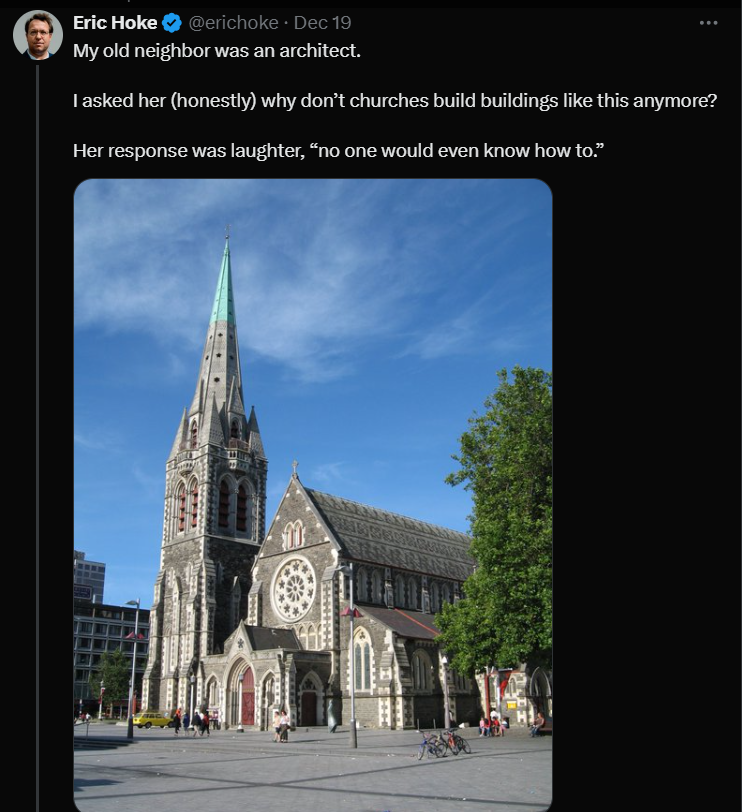
As we near the blessed Christmastide, those twelve (yes, twelve) days of festivity and feasting, I have a few tangentially connected thoughts that seem ripe for scribbling. First, I have a new piece over at TGC Canada: Why We Need Beautiful Churches. This comes out of a growing appreciation for architecture over the last number of years. The article is my attempt to synthesize a whole bunch of different thoughts into a cohesive argument for Christians today about the value and importance of beauty. It’s an exploration of geometry, mysticism, beauty, gothic architecture, and the 20th century aesthetic slippage among most evangelical Protestants that we can and should correct. “To willingly have ugly churches, then, is a kind of inconsistency, if not an untruth.” Extra points to whoever can pick up on the writer whose prose style I (unconsciously) imitated.
I was really gratified to see that Tim Challies picked up on it and shared it on his blog. This led to an appreciative email from a reader in another country that was deeply encouraging. As a writer, it doesn’t really get better than that.
It might be just a function of my own focused attention, but it really does seem like there is more interest and discussion about beautiful old architecture than I can remember. Here is just one example:
My reaction to this is to observe that we are all starved for enduring beauty and it shows. There is also a certain nostalgia at work – longing for a simpler time. These are symptoms of the inhuman pace and shape of so much of modern life. I, like so many others, feel them deeply also.
And yet there is a consistent glimmer of hope that keeps me from any kind of despair. What is that glimmer? It is the steady flowing stream of people who, having been starved for enduring beauty, are finding the Source of beauty in Christ. We all woke up to another example this morning – the brilliant and esteemed historian Niall Ferguson announcing his conversion to Christianity.
I find it fascinating that his conversion, like so many others in recent years, was not the result of reckoning with the compelling evidence for the historicity of the resurrection of Jesus. Rather, it was essentially a negative conclusion based on negative experiences:
In a sense, what we are seeing here is what happens when one finds the cut flowers really are dead and one starts to think deeply about soils, nutrients, and what makes flowers grow in the first place. These kinds of conversions have a distinctively post-Christian shape: thoughtful people who have glimpsed the contours of what it really looks like to leave all this Christian stuff behind and realized that what they really want is back up the road a fair way.
I’ve been thinking about this quite a bit, in conjunction with a passage from a little-known C.S. Lewis essay, and I have the outline of an article shaping up. The main observation is that we are living through a moment where many people are changing their minds, and it’s fascinating to me to watch it all take place. If nothing else, it represents a significant opportunity for the church to reach such people.
Much of my writing in the last while has been in some ways critical of my own tradition. I argued for Protestant re-enchantment, reviewed positively Rod Dreher’s book on the subject, and now this piece about architecture – all of which challenge my fellow Protestant evangelicals to shore up areas of characteristic weakness. But I am conscious of the danger that comes with focusing only criticism. It’s a bit ironic because in my local church involvement my ministry takes an almost entirely positive tone: leading worship, praying for and with the saints, caring for the precious souls both old and new who find their way into our church, and seeking to be an encouragement to the vocational pastors God has given us.
Allow me to try ending on a positive note. I joined my usual podcast buddies Wyatt Graham and Andrew Noble for an episode on The Mystery of the Incarnation that you can find here for your enjoyment and edification: https://www.youtube.com/watch?v=uPh-7ZiJO-Q
The incarnation, the Christmas miracle and mystery, is an inexhaustible wonder. Although the cares and sorrows of the world crowd in and besiege our minds and hearts, here at Christmas, with snow gently adorning the contours of our churches and homes, softening their edges, we get a glimpse of heaven. Grace and truth made flesh, God dwelling with us. May we not grow numb to this. Pray that the shock of it all would wash over you like the bracing chill of cold air into the lungs. Like the deep breath of that cold air that stings and washes over you, a wave of tingling clarity and attention.
Like the shepherds dumbstruck before angelic glory.








 Phil's Scribblings