Here is a book that tells a beautiful story in a beautiful way. And yet, there is a lot of darkness to get through before the dawn breaks. The raw honesty of Lande’s story, the power of her effervescent prose, and the drastic nature of her conversion are just some of the elements that make this book difficult to put down and impossible to forget.
For anyone interested in psychedelics, especially those drawn to spiritual illumination via that route, this book is for you. Lande speaks the language, has been down that road, done that, got the t-shirt. And she found something far, far better, in the very last place she thought to look. If I have any complaints about the book, it’s that the conversion comes late in the narrative and then the book ends a bit too abruptly, even if those last two chapters among the most moving things I’ve ever read. Before reaching the back cover, I wanted to learn a bit more about how Christ had transformed different aspects of her life and relationships that had been explored in previous chapters.
There is some debate both inside and outside the church regarding the use of psychedelics. One of the common complaints from psychedelic enthusiasts is that Christians forbid psychedelics out of some blind dogma. But rather than seeing it as a silly religious bias to avoid psychedelics, perhaps it would be better to see two different sources of very ancient spiritual wisdom. One, the Judeo-Christian heritage, teaches us that there is danger in such things, and that practices such as the ingesting of psychoactive substances put us in contact with a world of spirits that is not our assigned place. And yet Christianity fully validates that longing for a connection to the spiritual. The Scriptures make clear that this God-given hunger for the transcendent is meant to be satisfied by God himself, through Christ his Son, as mediated by the Holy Spirit.
The other ancient source of spiritual wisdom comes from those traditions who have for millennia partaken of psychoactive substances to connect with the spirit world and transcend one’s embodied consciousness. To some degree they can deliver on that promise. People can and do make contact with personal spiritual forces, and aside from the thrill of that experience, there is the added buzz that comes from knowing something that so much of society seems oblivious to. These practices make no personal moral demands. There are no ten commandments, no golden rule, no ultimate moral Judge. This makes it particularly compatible with the moral relativism of our age. Lastly, there is no creed or structure of authority like in a church, which resonates with our current cultural suspicion of authority and institutions.
We in the West are now firmly post-Christian. As we cast about for a solution to the spiritual malaise afflicting us, the last place we will tend to look is the place we think we have just been: Christianity. Haven’t we just decided we’re done with those old superstitions? So a journey to the island paradise of paganism, earth religion, eastern philosophy, or psychedelics seems to be just the thing we need for our starved souls in our disenchanted world. But we perhaps forget (or have never learned) that the best of paganism was fulfilled and transcended by Christianity, as G.K. Chesterton chronicled in his book ‘The Everlasting Man’.
For Ashley Lande, and perhaps for many others now journeying through the twists and turns of psychedelia and new age spirituality, the way home spiritually seems to include going round the whole world before arriving back and finding in Christ the Thing That Would Make Everything Okay Forever.
The opening illustration is unforgettable. I speak of Vaclav Havel’s essay, ‘The Power of the Powerless,’ which opens with an examination of a typical small shop owner living in communist Romania. He puts a sign in his shop window: “Workers of the world, unite!” But does he really believe this? Does he believe it so much that he feels an urge to inform his customers of this ideal? Or is something else going on? Havel explains: “The slogan is really a sign, and as such it contains a subliminal but very definite message.” And what is that message? “I am afraid and therefore unquestioningly obedient.” Or in other words:
“I, the greengrocer XY, live here and I know what I must do. I behave in the manner expected of me. I can be depended upon and am beyond reproach. I am obedient and therefore I have the right to be left in peace.”
Is something similar going on in the West in our own day? It sure feels like it. In my travels through quaint and quiet Ontario towns, it seems like every shop feels the need to advertise its most excellent moral qualities by having a rainbow flag in the window. Some even boast of being “Rainbow Registered,” which refers to the “Canada’s 2SLGBTQI+ Chamber of Commerce (CGLCC)” Accreditation program for “2SLGBTQI+ Friendly Spaces,” a program that is generously funded by the Government of Canada.
In our day, there is no shortage of breathless outrage over every aspect of the culture war. I really have no interest in joining the chorus of baying dogs barking at each other incessantly across the fence. If you’re looking for that, the good news is there is plenty to be found — just find yourself some social media influencer who agrees with you and go from there.
I am more interested in digging down beneath the surface in a calm and irenic way to understand what is going on. What is animating this froth on the surface? What really divides us? Is it really the case that “they are evil” as so many on both sides claim? That is too easy, too convenient, and too dangerous a notion to embrace, as Solzhenitsyn taught us:
The line separating good and evil passes not through states, nor between classes, nor between political parties either — but right through every human heart — and through all human hearts. This line shifts. Inside us, it oscillates with the years. And even within hearts overwhelmed by evil, one small bridgehead of good is retained.
So this isn’t about getting worked up in fiery indignation at the latest provocation of the other side. Instead, let’s ask the question: what does it mean to have a flag in one’s window, or flying over one’s house, or — more significantly still — over our municipal or church buildings? To answer that question, we need to back up a bit and consider what a flag signifies.
In the last episode of the Masters of the Air series, documenting the story of the 100th Bomber wing of the American forces, captured airmen in a Nazi POW camp rise up against their captors as the allied forces close in. As the fighting subsides, one of the main characters of the show decides to make a bold and symbolic move. He finds himself a contraband American flag, climbs up a wooden structure, tears down the Nazi swastika that had been flying over the camp and raises the stars and stripes amid triumphant shouts and swelling orchestral music. It’s a moving scene (viewer discretion: Violence).
Flags have always carried symbolic weight, not only in their visual designs but also in their usage. To raise a flag over a place is to claim it, and to declare that place’s submission to the authority to which the flag points. To choose to display a flag is an inherently powerful statement of allegiance.
So what does the rainbow flag signify? That question could be answered in a number of different ways. Some would say it means equality and the freedom to love whomever one wants, and to be whoever one feels he or she (or they?) is inside. Others would say it means sexual perversion and the wholesale rejection of both traditional morality and even more fundamentally the binary of male and female.
But I would like to argue that at a deeper level, the flag really represents a rejection of classical metaphysics, the belief that nature has a given shape and order which must be discovered and honoured. Trying to engage this topic on the level of sexual morality is a dead end. The differences are too fundamental. Instead, I’ve found that tackling the topic from the lens of philosophy is less personal and heated.
This is street-level philosophy to be sure. I’m not qualified to debate academic philosophy, nor do I have any desire to. But philosophy at a more basic level is thinking carefully about the nature of the world, knowledge, and reality. One of the major fault lines we find in philosophy is that between nominalism and realism.
In short, nominalism argues that the material world takes the shape it does rather accidentally, and that the names (nomen in the Latin) we give things are arbitrary. There is therefore no reason why trees shouldn’t be boiled down to green soup and no reason why we cannot take it upon ourselves to reshape and reconfigure ourselves and our world to suit the desires we find within.
Realism, on the other hand, believes that the shape of the world and everything in it is purposeful — has telos. Therefore everything has a nature that informs its shape, function, and proper purpose. In this view, there is a moral imperative attached to the world, which is to honour the design and purpose of the world.
These ways of thinking are rarely discussed but they nevertheless function as deeply-held assumptions about the world that shape our moral intuitions. Returning to the LGBT Rainbow flag discussion, I would argue that to embrace the ideology of that flag is to embrace a radical form of nominalism.
Framing this discussion along the lines of philosophy has at least two positives that I can see. First, it gets away from arguing about morality and religion, which is often a dead end. Don’t get me wrong, I love talking about religion and morality, but when engaging someone on the other side of this issue, it’s been my experience that we get nowhere at all. Second, it draws a distinction that doesn’t run cleanly along religious lines. What I mean is that some Christians are clearly nominalists, like progressive Christians who find ways to embrace the LGBT movement while holding on to some semblance of belief in Christ, while many secular atheists, Muslims, or non-religious types have a deeply held belief in realism which makes it impossible for them to get on board with the idea that a man can become a woman.
So what about those small-shop owners with the Rainbow flags in their windows? Perhaps some of them are true believers in the LGBT revolution, but many of them are probably just trying to run a small business and be left alone. The rainbow mafia, as some have called it, has all kinds of ways to pressure people to get on the ‘right side’ of this issue. Add to that the social dynamics of small towns, where everyone knows everyone, and also the Canadian temperament to be polite and avoid direct conflicts when possible, and you get many people saying, just like the Romanian greengrocers:
“I, the small business owner, live here and I know what I must do. I won’t be any trouble. I behave in the manner expected of me and put up the Rainbow flag. I am obedient and therefore I have the right to be left in peace to sell my wares to townsfolk and tourists.“
But just like those suffering under communism, choosing to live by lies is a tragic mistake. It weakens and demoralizes the one who does it. It reinforces the power of the totalitarians, or in our case the soft totalitarians. I believe the flag represents a metaphysical lie, an incredibly damaging lie, and that it is good and right to resist the ideology which animates the LGBT movement, for the sake of our society, for the sake of those caught up in that ideology, and for the sake of the Truth. For Christians, that opposition ought to be both courageous and virtuous, which is not an easy balance to find. But hopefully a deeper understanding of the philosophical questions embedded in this front of the culture war can help us find that balance.
Things have been quiet here at the blog, you might have noticed. Life has its way of crowding in and getting busy, doesn’t it? Work has been a couple notches busier than normal, and then I also recently was voted in to serve as an elder in my local church (again). By the way, I just signed up for the Amazon affiliates program, so that if you are so convinced by my writing to make a purchase on Amazon through a link on my site, I will become an internet millionaire through Bitcoin. I’m pretty sure that’s how it works. Anyways, moving on.
I’ve been keeping up my reading, though. I readChurch Elders by Jeramie Rinne – simple and good on the topic. I finally got around to reading Rod Dreher’s Benedict Option, which I found myself resonating with. It’s a bleak perspective on the state of the West, to be sure, but I largely agree with his assessment. I also found that the loudest critiques of the book I’d heard were pretty obviously mis-readings of Dreher’s actual argument. I’ve got an idea to combine a review of it with a review of Aaron Renn’s Life in the Negative World(which is sitting on my shelf), putting the books in conversation with each other.
I also read a Canadian book called Divorcing Marriage, a collection of essays from social conservatives and lawyers from the era a generation ago in 2004 when homosexual marriage was just being pushed through the courts. It was astonishing just how much things have changed in the last twenty years. At the time, I was not politically or socially conscious. I was easily convinced by simple appeals to fairness and empathy that gay marriage regulated by the secular state was fine – it had no bearing on Christians and I could not imagine any reason why society as a whole might wish to retain a traditional view of marriage. Well, this book really helped crystalize my thinking, which I now realize was about as solid as my 100-year old barn that is half fallen over and whose beams are rotted. I hope to write something more extensive on this, we’ll see.
After finishing that I felt I was due for some classics, so I’ve read Sir Gawain and the Green Knight and the story of Percival, and I’m now reading Roger Lancelyn Green’s classic King Arthur and His Knights of the Round Table, which retells those two stories as well as many others. My son, who just turned 13, read it this year in his schooling so we’ve been able to connect over it. Lastly, I started Charles Dickens’ Great Expectations and am enjoying that as well.
Oh, I forgot, I’m also reading Thomas Watson’s The Lord’s Supper as recommended by Gavin Ortlund during his video on the topic. It’s excellent. It argues for what is known as the ‘Spiritual Presence’ view of the Lord’s supper, as a middle way between the excesses of transubstantiation and memorialism. I’ve become very interested in this topic as I’ve been thinking through re-enchantment and the church (more on which in a moment).
Did you know that both the Westminster Confession and the London Baptist Confession of 1689 took this view? Somewhere along the way the default evangelical view seems to have gotten filtered through enlightenment materialism and the supernatural was stripped out, leaving only the human-level interaction with memory and Scripture. This mere memorialism is the view explicitly laid out in the Southern Baptist document, the Baptist Faith and Message, as well as my own denomination’s Affirmation of Faith. But I haven’t been able to find out why. On the strength of which argument was the more classic reformed view replaced? I am eagerly looking forward to reading Dr. Michael Haykin’s book Amidst Us Our Belovèd Stands: Recovering Sacrament in the Baptist Tradition, which argues this point. Here is the short blurb summarizing the book:
When it comes to baptism and the Lord’s Supper, many Baptists reject the language of sacrament. As a people of the book, the logic goes, Baptists must not let tradition supersede the Bible. So Baptists tend to view baptism and Communion as ordinances and symbols, not sacraments.
But the history of Baptists and the sacraments is complicated. In Amidst Us Our Beloved Stands, Michael A. G. Haykin argues that earlier Baptists, such as Charles Spurgeon, stood closer to Reformed sacramental thought than most Baptists today do. More than mere memorials, baptism and Communion have spiritual implications that were celebrated by Baptists of the past. Haykin calls for a renewal of sacramental life in churches today—Baptists can and should be sacramental.
That’s exactly what I have been leaning towards. It marries my interest in historical retrieval & ressourcement and my desire to exhort evangelical churches to steward well the cultural movement towards re-enchantment.
I translated that desire into an article, my latest over at TGC Canada: Leaning into Evangelical Re-enchantment. If you haven’t, I hope you’ll read it. I was pleased to see Aaron Renn & Rod Dreher both linked to it at their Substacks – it’s a real blessing to a small-beans writer to get amplified and shared to much wider audiences.
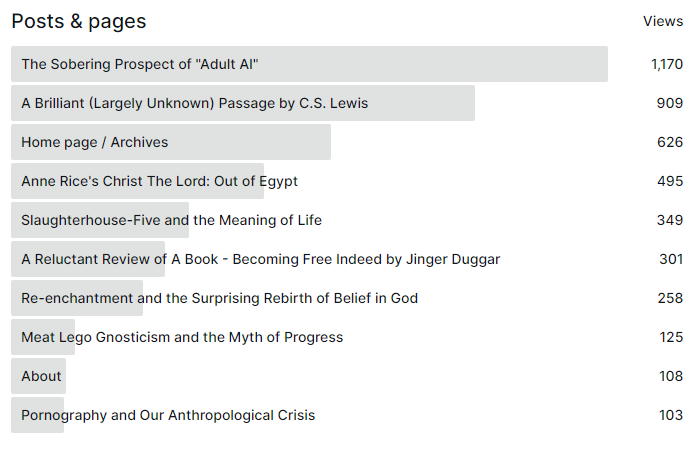
I really don’t know much of anything about internet traffic, but I have to say I have been surprised at the sustained level of reading on this here, my little blog. I have been averaging about 150 visitors and 200 views a week since early this year. This may not interest anyone, but I find it interesting. Here are my most popular posts of 2024. The #1 article, about Adult AI, was boosted by a link from Tim Challies, which also led to an interview with Moody Radio’s Kurt & Kate in the Mornings, which you can listen to if you so wish. Challies is a singular blogging phenomenon.
The #2 post, an extended quote from C.S. Lewis, has been quietly accumulating views week by week as people from all over the world find it, mostly through Google searches and perhaps links on forums. After that it seems that my reviews of popular books are of enduring interest. I would also like to add to my website here a page with links to all my published pieces elsewhere – a kind of central hub where those can be easily found.
Aside from that piece at TGCC, I have one submitted to another outlet (which I haven’t been published at before) and I am waiting to hear back from the editors. It’s another piece about psychedelics. Speaking of psychedelics, I was pleased to be interviewed by none other than Justin Brierley for his excellent documentary podcast series, The Surprising Rebirth of Belief in God. The episode on psychedelics hasn’t been released yet, but I’ll link to it when it comes out. I think I will wind down my writing on psychedelics, however – I’ve said what I had to say, and I think there are others who are better placed to continue writing for the church on this topic.
That about does it for me at this point. I’ve got some articles at various points of completion: on the Pride Rainbow compared to Vaclav Havel’s greengrocer illustration; on cathedral beauty and gospel beauty; and an article on the Haitian Christian community in Montreal which has been commissioned by Faith Today.
As always, thanks for reading.
As an Amazon Affiliate I earn a small commission from qualifying purchases of books purchased through links on my website, while customers do not pay anything extra.
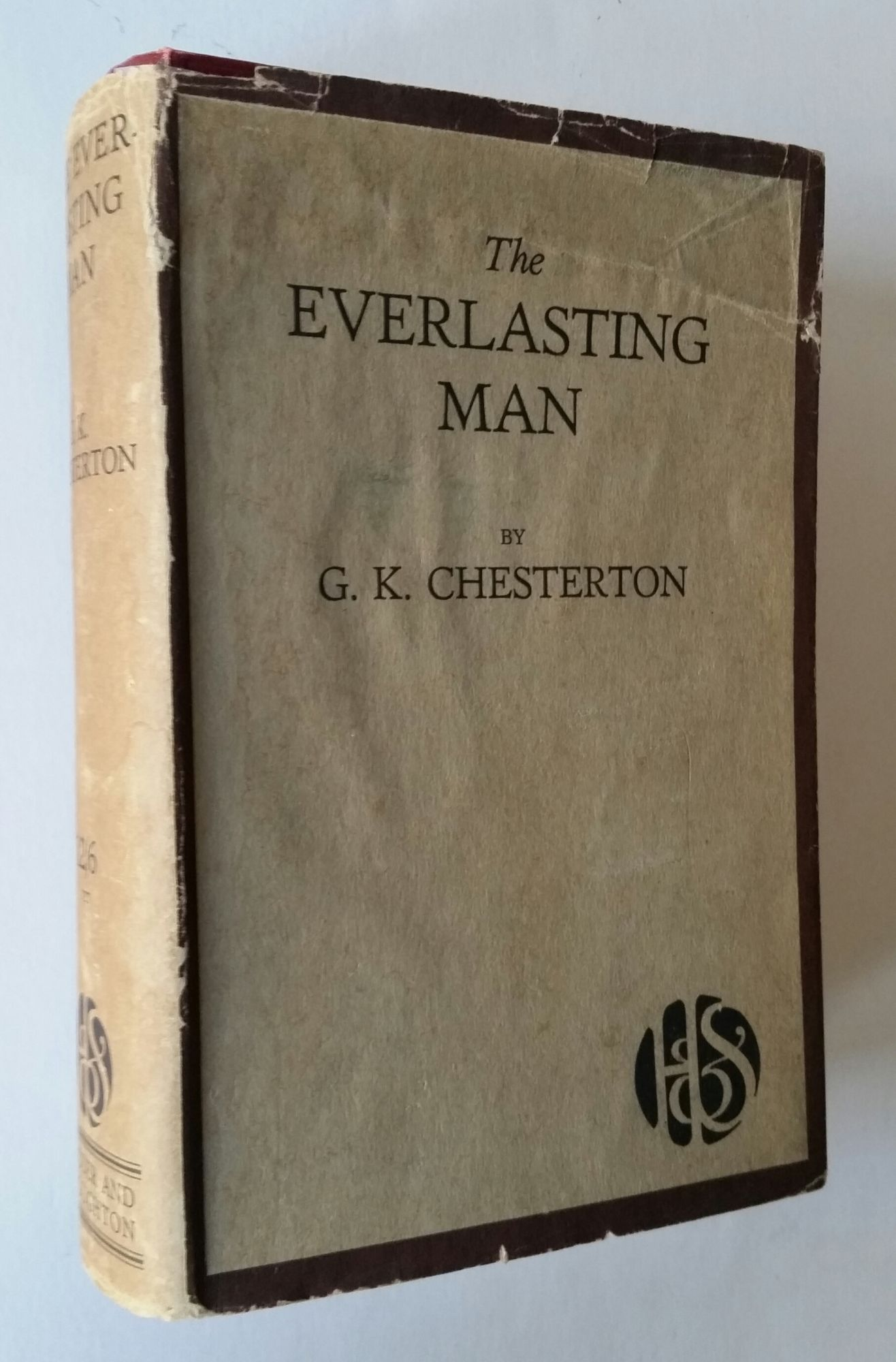
Since reading it over ten years ago, I’ve had lodged in my mind an affectionate fascination with Chesterton’s Everlasting Man. It is a kind of intellectual tour de force of the history of religious thought as only possible from Chesterton’s singular mind and from the vantage point of the early 20th century. If you have some interest in understanding how paganism relates to Christianity, or how Christianity fulfills the philosophy of the classical era, you will enjoy it.
An early edition.
But this is a Christmas post, and so I want to walk you through a few selections from the first chapter of the second half of the book. The chapter is called The God in the Cave, referring to the tradition that the stable was actually a rocky cave. In this chapter Chesterton reflects on the symbolism and meaning of Christmas, teasing out implications from it that do not naturally spring to my mind. And yet, once I read them, they have a certain logic and an undeniable power. My goal here is to deepen your appreciation for Christmas and your wonder at the incarnation.
We start with a some paragraphs about the paradox of Christmas — that of the very high and very big (God) united with the very small and very weak (a baby).
A mass of legend and literature, which increases and will never end, has repeated and rung the changes on that single paradox; that the hands that had made the sun and stars were too small to reach the huge heads of the cattle. Upon this paradox, we might almost say upon this jest, all the literature of our faith is founded. It is at least like a jest in this, that it is something which the scientific critic cannot see. He laboriously explains the difficulty which we have always defiantly and almost derisively exaggerated; and mildly condemns as improbable something that we have almost madly exalted as incredible; as something that would be much too good to be true, except that it is true. When that contrast between the cosmic creation and the little local infancy has been repeated, reiterated, underlined, emphasised, exulted in, sung, shouted, roared, not to say howled, in a hundred thousand hymns, carols, rhymes, rituals, pictures, poems, and popular sermons, it may be suggested that we hardly need a higher critic to draw our attention to something a little odd about it; especially one of the sort that seems to take a long time to see a joke, even his own joke.
… Any agnostic or atheist whose childhood has known a real Christmas has ever afterwards, whether he likes it or not, an association in his mind between two ideas that most of mankind must regard as remote from each other; the idea of a baby and the idea of unknown strength that sustains the stars. His instincts and imagination can still connect them, when his reason can no longer see the need of the connection; for him there will always be some savour of religion about the mere picture of a mother and a baby; some hint of mercy and softening about the mere mention of the dreadful name of God. …
In other words, this combination of ideas has emphatically, in the much disputed phrase, altered human nature. There is really a difference between the man who knows it and the man who does not. Omnipotence and impotence, or divinity and infancy, do definitely make a sort of epigram which a million repetitions cannot turn into a platitude. It is not unreasonable to call it unique. Bethlehem is emphatically a place where extremes meet.
It is true, isn’t it, that even after a hundred thousand hymns, that joining of divinity and infancy retains an inexhaustible power? We return to it again and again. Now we turn to a passage where Chesterton argues that Christmas turned the universe inside out, placed heaven under the earth, and in so doing set off a kind of revolution.
It might be suggested, in a somewhat violent image, that nothing had happened in that fold or crack in the great grey hills except that the whole universe had been turned inside out. I mean that all the eyes of wonder and worship which had been turned outwards to the largest thing were now turned inward to the smallest. […] But it is true in a sense that God who had been only a circumference was seen as a centre; and a centre is infinitely small. It is true that the spiritual spiral henceforward works inwards instead of outwards, and in that sense is centripetal and not centrifugal. The faith becomes, in more ways than one, a religion of little things.
…
Whether as a myth or a mystery, Christ was obviously conceived as born in a hole in the rocks primarily because it marked the position of one outcast and homeless. Nevertheless it is true, as I have said, that the cave has not been so commonly or so clearly used as a symbol as the other realities that surrounded the first Christmas. And the reason for this also refers to the very nature of that new world. It was in a sense the difficulty of a new dimension. Christ was not only born on the level of the world, but even lower than the world. The first act of the divine drama was enacted, not only on no stage set up above the sight-seer, but on a dark and curtained stage sunken out of sight; and that is an idea very difficult to express in most modes of artistic expression. It is the idea of simultaneous happenings on different levels of life. Something like it might have been attempted in the more archaic and decorative medieval art. But the more the artists learned of realism and perspective, the less they could depict at once the angels in the heavens and the shepherds on the hills, and the glory in the darkness that was under the hills. …But in the riddle of Bethlehem it was heaven that was under the earth.
There is in that alone the touch of a revolution, as of the world turned upside down. It would be vain to attempt to say anything adequate, or anything new, about the change which this conception of a deity born like an outcast or even an outlaw had upon the whole conception of law and its duties to the poor and outcast. It is profoundly true to say that after that moment there could be no slaves. There could be and were people bearing that legal title, until the Church was strong enough to weed them out, but there could be no more of the pagan repose in the mere advantage to the state of keeping it a servile state. Individuals became important, in a sense in which no instruments can be important. A man could not be a means to an end, at any rate to any other man’s end.
That last paragraph is quite something. Was the incarnation the beginning of the end for slavery? Perhaps the end was far too long in coming, but there is no question that it was a set of Christians acting on their Christian convictions who led the push to abolish slavery, not pagans or secularists. It was a Christian impulse to dignify the slave, and then to free him.
Later in the chapter he turns to mythology and philosophy, themes which he has developed in the first half of the book. So keep in mind that we are entering partway through a length discussion. Still, I think it is worth considering:
Mythology had many sins; but it had not been wrong in being as carnal as the Incarnation. But something of the ancient voice that was supposed to have rung through the graves, it could cry again, ‘We have seen, he hath seen us, a visible god.’ So the ancient shepherds might have danced, and their feet have been beautiful upon the mountains, rejoicing over the philosophers. But the philosophers had also heard.
It is still a strange story, though an old one, how they came out of orient lands, crowned with the majesty of kings and clothed with something of the mystery of magicians. That truth that is tradition has wisely remembered them almost as unknown quantities, as mysterious as their mysterious and melodious names; Melchior, Caspar, Balthazar. But there came with them all that world of wisdom that had watched the stars in Chaldea and the sun in Persia; and we shall not be wrong if we see in them the same curiosity that moves all the sages. They would stand for the same human ideal if their names had really been Confucius or Pythagoras or Plato. They were those who sought not tales but the truth of things, and since their thirst for truth was itself a thirst for God, they also have had their reward. But even in order to understand that reward, we must understand that for philosophy as much as mythology, that reward was the completion of the incomplete.
Such learned men would doubtless have come, as these learned men did come, to find themselves confirmed in much that was true in their own traditions and right in their own reasoning. Confucius would have found a new foundation for the family in the very reversal of the Holy Family; Buddha would have looked upon a new renunciation, of stars rather than jewels and divinity than royalty. These learned men would still have the right to say, or rather a new right to say, that there was truth in their old teaching. But after all these learned men would have come to learn. They would have come to complete their conceptions with something they had not yet conceived; even to balance their imperfect universe with something they might once have contradicted. Buddha would have come from his impersonal paradise to worship a person. Confucius would have come from his temples of ancestor-worship to worship a child.
You may, at this point, if you are a good evangelical Protestant like me, start to feel things are getting a bit slippery. Is he granting too much here? After all, aren’t these false religions (Confucianism, Buddhism, etc)? Yes — and whatever light and truth were or are in them cannot reconcile us to God. But I think a careful and generous reading of his argument dodges the heart of these concerns, which I share. In fact, one can see here the genesis of much of C.S. Lewis’ later apologetical approach, that of Christianity as a fulfillment of more than the Old Testament, but of everything that was good about every system of belief anywhere — rather than a repudiation of it all.
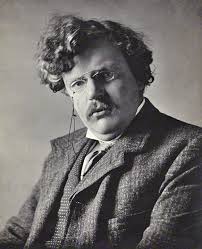
Chesterton at 17, before growing into his girth, and judging by his face, perhaps also his mirth.
Skipping down a bit, he returns to the Magi and the long history of mysticism and philosophy which they represented.
Here it is the important point that the Magi, who stand for mysticism and philosophy, are truly conceived as seeking something new and even as finding something unexpected. That tense sense of crisis which still tingles in the Christmas story and even in every Christmas celebration, accentuates the idea of a search and a discovery. The discovery is, in this case, truly a scientific discovery. For the other mystical figures in the miracle play; for the angel and the mother, the shepherds and the soldiers of Herod, there may be aspects both simpler and more supernatural, more elemental or more emotional. But the wise Men must be seeking wisdom, and for them there must be a light also in the intellect. …
The philosophy of the Church is universal. The philosophy of the philosophers was not universal. Had Plato and Pythagoras and Aristotle stood for an instant in the light that came out of that little cave, they would have known that their own light was not universal. It is far from certain, indeed, that they did not know it already. Philosophy also, like mythology, had very much the air of a search. It is the realisation of this truth that gives its traditional majesty and mystery to the figures of the Three Kings; the discovery that religion is broader than philosophy and that this is the broadest of religions, contained within this narrow space. The Magicians were gazing at the strange pentacle with the human triangle reversed; and they have never come to the end of their calculations about it. For it is the paradox of that group in the cave, that while our emotions about it are of childish simplicity, our thoughts about it can branch with a never-ending complexity. And we can never reach the end even of our own ideas about the child who was a father and the mother who was a child.
I love the description of that Christmas scene as one which is limitless in its profundity and simplicity — we shall never reach the end of it. That’s something worth pondering this Christmas as we sit by the fire after dinner. Well this has gone long enough, but I leave you with two last paragraphs near the end of this remarkable chapter. Here Chesterton puts his finger on something of the unique ethos and spirit of Christmas, and the way it takes a hold on our minds and memories like nothing else.
Christmas for us in Christendom has become one thing, and in one sense even a simple thing. But like all the truths of that tradition, it is in another sense a very complex thing. Its unique note is the simultaneous striking of many notes; of humility, of gaiety, of gratitude, of mystical fear, but also of vigilance and of drama. It is not only an occasion for the peacemakers any more than for the merry-makers; it is not only a Hindu peace conference any more than it is only a Scandinavian winter feast. There is something defiant in it also; something that makes the abrupt bells at midnight sound like the great guns of a battle that has just been won. All this indescribable thing that we call the Christmas atmosphere only hangs in the air as something like a lingering fragrance or fading vapour from the exultant explosion of that one hour in the Judean hills nearly two thousand years ago. But the savour is still unmistakable, and it is something too subtle or too solitary to be covered by our use of the word peace. …
The truth is that there is a quite peculiar and individual character about the hold of this story on human nature; it is not in its psychological substance at all like a mere legend or the life of a great man. It does not exactly in the ordinary sense turn our minds to greatness; to those extensions and exaggerations of humanity which are turned into gods and heroes, even by the healthiest sort of hero-worship. It does not exactly work outwards, adventurously, to the wonders to be found at the ends of the earth. It is rather something that surprises us from behind, from the hidden and personal part of our being; like that which can some times take us off our guard in the pathos of small objects or the blind pieties of the poor. It is rather as if a man had found an inner room in the very heart of his own house, which he had never suspected; and seen a light from within. It is as if he found something at the back of his own heart that betrayed him into good.
With something like 65 million copies sold worldwide, The Alchemist, by Paulo Coehlo, is a phenomenon. Whenever one finds a bestseller on this scale, there is something important to learn. The book may or may not be of much value – just think of 50 Shades or Twilight – but it always tells us something about our own culture and the spirit of the age. It’s my contention that the success of The Alchemist is a powerful indicator of the spiritual poverty of modern secularism and the pull towards re-enchantment that is at work. Ironically, this book was first recommended to me by a coworker who was a very staunch Dawkins-style atheist.
The 25th anniversary edition is very nice, with rough-cut pages, a nice font, and an embossed cover.
The book wraps its narrative around the big ideas it is trying to convey. In this sense it is overly didactic and not like the great novels which embed such lessons deep into the structure of the work. Here it is on the surface, the narrative serving as a platform on which to serve up the lessons the author wishes the reader to learn. But the story makes use of a number of archetypes that lend it narrative power.
The story follows the life of a young boy, a teenager named Santiago, who leaves his seminary studies to become a shepherd because he wants to explore the world. “But ever since he had been a child, he had wanted to know the world, and this was much more important to him than knowing God and learning about man’s sins.” (10-11). “I couldn’t have found God in the seminary, he thought, as he looked at the sunrise.”
The book freely borrows from the Bible. Melchizedek plays a prominent role, as do the Urim and Thummim stones from Israelite law. Characters refer to the story of Joseph and Jesus. Yet the Bible is seen as one religious tradition among others, all of them a kind of fractal of the Universal Language and the Soul of the World. These include Islam, alchemy, Gypsies reading omens, and fortune tellers interpreting twigs. Key phrases, like Personal Legends, are capitalized throughout to make sure we don’t miss their importance. The influence of Eastern philosophy bleeds through heavily in numerous ways, such as when we are told (more than once) that “All things are one.”
These concepts sacralize one’s life. There is undeniable power in their ability to transform one’s experience of everyday life. They are an antidote to the meaninglessness of modern secular thought: rather than the victims of random impersonal forces, we are each of us given a Personal Legend to fulfill, a purpose which was birthed deep in the Soul of the Universe, and the fulfillment of which “is a person’s only real obligation” in life (24). They are amorphous and ambiguous, which locates the authority firmly in each individual’s interpretation of their own Personal Legend – or life mission. Now here is a message custom-made for our age. Sensing the cold emptiness of rigid rationalism, we want the thrill of the supernatural. Allergic to the endless arguments over doctrine and dogma, we want a Oneness which can reconcile all differences. Terrified of any authority outside the autonomous self, we want a spiritual paradigm that evokes wonder without demanding surrender; an impersonal God-force that infuses our lives with transcendent meaning while leaving us firmly in charge.
One can see how comfortably this focus on an individualized life mission fits with the modern elevation of personal autonomy. Somehow I don’t see this teaching leading many to persevere through a difficult marriage or make sacrifices to care for an aging parent. After all, one’s only real obligation is to realize their Personal Legend. This is thin gruel indeed. Small wonder then that this book proved to be so popular with that segment of American life most famous for being ego-driven and selfish: celebrities.
Despite the Biblical language and references, at its heart the message of the book is deeply unbiblical. It borrows from the spiritual capital of the Bible’s more symbolic and flowery phrasing to construct a tower of Babel which leaves Christ very much behind. This is not uncommon in the New Age movement, where every religious tradition is mined for some compatible nuggets of spiritual wisdom. Such an approach pretends to embrace a generous openness by saying all religions see only a part of the whole picture, but really that means it alone has the objective view that incorporates all the rest. This is a claim of epistemological superiority based on sophistry. It claims to see what others are blind to, and it accomplishes it through nice-sounding but vague spiritual language about universal Oneness. This is all done with the stated intention of being very agreeable and inclusive, harmonizing all the different paths into some kind of universal spirituality, but it always does violence to the integrity of those religions to tear bits and pieces out of context and reinterpret them as needed.
We see this repeatedly in the Alchemist’s use of Biblical phrases and ideas. Three examples will suffice. At one point the protagonist is told, “Remember that wherever your heart is, there you will find your treasure.” In context, it is clear that his heart is to be followed, and that it will lead to a real or metaphorical treasure. But this advice is an inversion of the Biblical principle that it resembles: “For where your treasure is, there will your heart be also” (Matthew 6:21). Jesus’ point is that the heart of each person is revealed by what they treasure — by what they love — and that his followers ought to live in such a way that they store up treasures in heaven, not on earth. Not quite the same thing.
In another place, the shepherd boy is told, “Listen to your heart. It knows all things, because it came from the Soul of the World, and it will one day return there.” This is more self-trust than the Christian can ever allow, for we remember that bracing passage in Jeremiah: “The heart is deceitful above all things, and desperately wicked: who can know it?” (Jeremiah 17:9)
One last example, which comes at the culminating moment of the narrative: “The boy reached through to the Soul of the World, and saw that it was part of the Soul of God. And he saw that the Soul of God was his own soul. And that he, a boy, could perform miracles.” Well here we have the whole beating heart of this project laid bare, and it makes a very simple argument: that we can be as God. Or even better: in some way we are already God, if only we would realize it. What is essentially the same promise was made to Eve in the garden; “For God knows that when you eat from it your eyes will be opened, and you will be like God,” (Genesis 3:5). So here is a good reason to know one’s Bible. False teachers love to use the very words of Scripture, and even those of Jesus, to teach what is, at bottom, a satanic doctrine.
It’s not too difficult to render a critique of this spiritual-but-not-religious approach to life. But the question I asked myself as I read this book was whether this might be an improvement over strict materialism or not. I make no bones about the fact that I am Christian, and of the sort who believes what the Bible says: that salvation is found in Christ alone. But I also recognize that to view the world as The Alchemist does is closer to reality than the frigid cement bunker of atheism. It has echoes of that older and more human paganism which Lewis and Chesterton saw as pre-Christian. I wonder if a post-Christian paganism, this New Age view of universal Oneness, can lead back to Christ as readily as the old paganism eventually did. I have my hopes, but also my doubts.
The hope comes in because a non-materialist worldview makes room for a supernatural being and often seeks after some kind of spiritual connection. These are the spiritual-but-not-religious types, and I get the appeal of that approach. It leaves the door open, as it were. And yes, sometimes Christ comes through that door. But I also have my doubts because spiritual experiences can have the effect of thoroughly blinding one’s heart and pulling people deep into half-truths and deceptions. In its worst forms, it leads to the occult.
Whatever else we might say, the massive popularity of this book belies the fact that our secular age has a strong undertow of spiritual hunger. And yet the dish of choice, this amorphous New Age spirituality of universal Oneness, is one which leaves our preferred idol of the autonomous self-defined individual unchallenged.
Be warned, a paragraph for ol’ Gee-Kay is a five page article for most of us, but nevertheless, here ’tis.
Context: He is here near the end of his book, and working to show how Christianity differs from both mythology and philosophy. I’ve adjusted the formatting for improved ease of reading, since as superiorly intelligent people in the age of the perpetual interruption we are quite unable to follow a train of thought or argument for more than a dozen or so words.
But if it is not a mythology neither is it a philosophy. It is not a philosophy because, being a vision, it is not a pattern but a picture. It is not one of those simplifications which resolve everything into an abstract explanation; as that everything is recurrent; or everything is relative; or everything is inevitable; or everything is illusive.
It is not a process but a story.
It has proportions, of the sort seen in a picture or a story; it has not the regular repetitions of a pattern or a process; but it replaces them by being convincing as a picture or a story is convincing.
In other words, it is exactly, as the phrase goes, like life. For indeed it is life.
An example of what is meant here might well be found in the treatment of the problem of evil. It is easy enough to make a plan of life of which the background is black, as the pessimists do; and then admit a speck or two of star-dust more or less accidental, or at in the literal sense insignificant. And it is easy enough to make another plan on white paper, as the Christian Scientists do, and explain or explain away somehow such dots or smudges as may be difficult to deny. Lastly it is easiest of all, perhaps, to say as the dualists do, that life is like a chessboard in which the two are equal; and can as truly be said to consist of white squares on a black board or of black squares on a white board.
But every man feels in his heart that none of these three paper plans is like life; that none of these worlds is one in which he can live. Something tells him that the ultimate idea of a world is not bad or even neutral; staring at the sky or the grass or the truths of mathematics or even a new-laid egg, he has a vague feeling like the shadow of that saying of the great Christian philosopher, St. Thomas Aquinas, ‘Every existence, as such, is good.’ On the other hand, something else tells him that it is unmanly and debased and even diseased to minimise evil to a dot or even a blot. He realizes that optimism is morbid. It is if possible even more morbid than pessimism.
These vague but healthy feelings, if he followed them out, would result in the idea that evil is in some way an exception but an enormous exception; and ultimately that evil is an invasion or yet more truly a rebellion.
He does not think that everything is right or that everything is wrong, or that everything is equally right and wrong. But he does think that right has a right to be right and therefore a right to be there; and wrong has no right to be wrong and therefore no right to be there. It is the prince of the world; but it is also a usurper.
So he will apprehend vaguely what the vision will give to him vividly; no less than all that strange story of treason in heaven and the great desertion by which evil damaged and tried to destroy a cosmos that it could not create. It is a very strange story and its proportions and its lines and colors are as arbitrary and absolute as the artistic composition of a picture. It is a vision which we do in fact symbolize in pictures by titanic limbs and passionate tints of plumage; all that abysmal vision of falling stars and the peacock panoplies of the night.
But that strange story has one small, advantage over the diagrams.





 Phil's Scribblings