The Everlasting People: A Second Reading

Back in 2022, I read an interesting little book called The Everlasting People. I wrote up a brief review on Goodreads and then went on with my life. And then I got a reply from the author, gently pushing back on some of my comments. It was a strange experience, which I wrote about here.

I thought about what the author – Dr. Matthew Milliner – wrote back to me and I decided I needed to re-read the book. Fast forward to 2024, and it became time for me to keep my promise. So a few weeks ago I cracked it open again and gave it a second reading.

I tried to have a more open and positive posture towards the book this time around. It really is a remarkable project, trying to adopt the general approach and insights of the inimitable G.K. Chesterton, and applying them to the Native peoples of the Americas (or Turtle Island), especially their art and mythology. Having just re-read Chesterton’s great book, The Everlasting Man, I was all set.

The book, derived from a set of lectures that were delivered, is made up of three chapters, followed by three ‘responses’. The first thing to say is that I learned so much from the book (in both readings). I learned a ton about First Nations history, a lot about Chesterton himself, and much about the surprising degree to which those early indigenous people accepted Christianity. The fact that I – along with most North Americans – do not know this history well is a sad testament to our particular blindness when it comes to these matters.

So the first reaction is a genuine lament for the way in which human persons, indeed entire communities and peoples, were mistreated, cheated, and wiped out by bloodthirsty men who too often claimed the name of Christ. Milliner is to be commended for the evenhanded way he did not ignore the sins and atrocities of First Nations people (a common enough manipulation of the story in our day of cultural self-hatred). The third respondent came closest to this particular malady of the mind, but we can just leave that to the side since it was written in 2020; one can still catch the aroma of the peak wokeness and racial angst convulsing our educated classes at the time.

One concern I had in my initial review, the usage of terms like whiteness, is still worthy of comment. Having read the book more carefully, I don’t really see any compromise here. And yet the cultural turmoil of recent years is necessarily the context into which this book must be understood, and everyone knows that a term like ‘whiteness’ is strongly coded as leftwing-progressive. Here at the end of 2024, it feels like the winds have shifted and the reactionary populism of the normies has rejected the progressive left’s project of anti-Western critical theories. So while I am happy to gloss over the term in my reading of the book, it’s inescapable that it will signal certain political and cultural alignments whether the author intends it to or not.

The meat of the book, however, is far more interesting that culture wars. The Mishipeshu (underwater panther) and Thunderbird (Animiki), two mythical creatures found within indigenous mythology, are explored for their evocative imagery and the way in which these figures were adapted by Native Christians. It is powerful to consider the Native Christian, sorrowful after so much suffering, persevering in Christ and expressing that faith in ways that are genuine to the best aspects of their culture. That is good missiology, and a good example of the kind of thing Chesterton loved.

The last chapter, which reflects on Chesterton’s poem about the Virgin Mary (The Queen of Seven Swords) as well as the medieval Virgin of the Passion (a suffering Virgin Mary, later renamed Our Lady of Perpetual Help), and how devotion to her permeated through the region where the Lenape people had once lived, was the hardest for me to wrap my head around.

But that’s okay. Gotta leave something for the third reading, I guess.

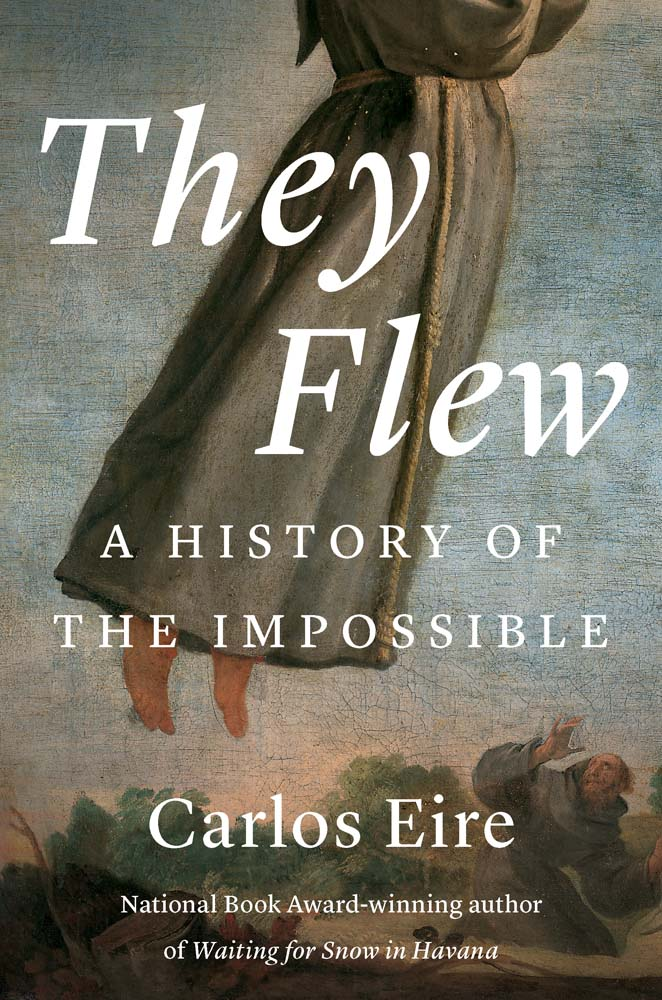
‘They Flew’ by Carlos Eire – A Review Essay

I listened to this book a few weeks after reading Rod Dreher’s thought-provoking new book, Living in Wonder. Both books present some challenges to Protestant readers as they take aim at various aspects of modern metaphysical assumptions which, of the three major branches of Christianity, are most embedded within the children of the Reformation. Carlos Eire takes as his subject the levitation of medieval Catholic monks and nuns, prodigiously attested to by copious historical records. I was not aware of this phenomenon before. The book is a serious intellectual and historical treatment of a subject that would be treated as ridiculous by many.

The book traces the historical records of levitation from antiquity to the modern age. It shows up consistently throughout those many centuries in a number of different religious and pagan contexts, though it reaches its apogee in the medieval period within certain Catholic circles.

The book focuses in on three specific people for whom levitations and other similar miracles were common and widely attested: St. Teresa of Avila, St. Joseph of Cupertino, and the Venerable María de Ágreda. The overall picture that emerges is one where, despite budgeting for exaggeration and embellishment by hagiographers and admirers, it’s hard to deny that something truly remarkable happened with these people. The volume and variety of witnesses makes it very difficult to explain away.

The strangeness of the topic and the solidity of the evidence offers a direct challenge to our absorbed habits of skepticism and our confidence in the stable laws of nature. We come away with nagging questions. Just what happened, exactly? And how does it make sense within our understanding of reality? The book navigates this challenge carefully, letting the weight of the evidence land on the reader gradually, leaving the uncomfortable questions to nag at our modern minds.

The book includes a substantial and helpful treatment of medieval and early-modern views about the devil, witchcraft, and demons.

I was fascinated to learn that the topic of miraculous levitations became a proxy for the battle between the Roman Catholic church and the new fledgling but energetic Protestant churches, with both treating the phenomenon as real but Protestants largely attributing it to the power of the devil. Thus the rather fascinating phenomenon was reduced to one facet of a high-stakes battle between entrenched religious groups; a battle that not infrequently resulted in torture and death.

The fact that Protestant denunciations of Catholic miracles occurred in this fraught context gives me pause. I don’t think I agree with the esteemed Reformers in this matter, but I can understand how there was a strong impulse to circle the wagons. For their part, Catholic apologists argued forcefully that these miracles were nothing less than a divine seal of approval and approbation on the entire Roman Catholic institution; God’s ‘amen’ to their claim to be the One True Church. Thus there was a powerful partisan incentive, aside from the normal human proclivity, for Catholic chroniclers to exaggerate and inflate the accounts of the miraculous in their midst. This helps me understand why the debate about these kinds of preternatural or supernatural events played out the way they did in the wake of the Reformation.

With a bit of historical distance, and a warming of relations between good-faith members of Catholicism and Protestantism, it seems like a good time to revisit this issue. Here is a sketch of my own still-forming view of this. Levitations can be faked rather easily, especially if they occur indoors, but this cannot explain most of the historical record. The phenomenon is, at least part of the time, real. The physical body somehow is able to suspend the force of gravity, or to be unaffected by it, during a state of spiritual ecstasy. This porous barrier between the physical and the spiritual was the default worldview within medieval Catholicism, though it was considerably hardened within Protestantism, in part as a reaction against Catholic fixation on these and similar topics, and then fully cemented by the time of the enlightenment (which was really the enshrining of the new dogma of mechanistic, reductive materialism).

Within premodern cultures and in certain spiritualist and occult traditions even today, this separation does not exist in the same way, and testimonies of such “impossible” feats regularly trickle out, though hard evidence that would be amenable to scientific analysis is almost never produced. The fact that the real phenomenon was mostly located within certain Catholic institutions like monasteries and convents does not, for me, serve to underwrite the whole of Catholicism. Far from it. But neither do I dismiss it as merely a trick of the devil to deceive the masses. We should leave room for demonic trickery and preternatural manipulations, such as the testimony of one tortured soul in the book who eventually confessed to making a pact with two demons, resulting in her ability to manifest, among other things, inexplicable levitations—I don’t see why that wouldn’t be possible. But if it’s not all demonic, and if I don’t buy what the pro-Roman Catholic apologists were selling, then we need some other framework to fit this into.

And so for me the conclusion is that these weird things did and do happen. They happened for a variety of reasons, perhaps divine and angelic, or demonic and devilish, or maybe even some other source besides that remains mysterious to us. God, in his perpetual purpose to confound the proud and the worldly-wise, perhaps scattered such manifestations among the Catholics in such a way as to frustrate the excesses of the Protestants. The injunction to “test the spirits” (1 John 4:1) applies to individuals. For Catholics to dismiss Protestants because of their lack of miracles (something which is not true today, if it ever was) is just as misguided as Protestants lumping all Catholic miracles together and denouncing them as demonic. In both of these approaches I see an all-too-human pride in one’s institution, one’s group. “You are still worldly. For since there is jealousy and quarreling among you, are you not worldly? Are you not acting like mere humans?” (1 Cor. 3:3:).

If I have taken anything away from my reading of church history, it’s that God does not play favourites with his children. There is enough shameful wreckage in each and every human grouping of Christians to keep us humble, and enough goodness and grace to rightly celebrate. We do well to keep this in mind even as we hold our Biblical, theological, and historical convictions firmly.

Carlos Eire has produced a book that feels very much suited to our moment of metaphysical re-evaluation. Although I struggled and skimmed through some parts of it—the accounts of levitations all blur together after a while—I enjoyed this book and the way it made me wrestle through this fascinating historical thread running from the medieval world well into our modern age.

The central question—they flew?—rests uneasily on the modern mind. Can we really believe they flew without losing all the goods modernity has bequeathed on us? Can we believe it without reverting to a medieval worldview that, if enchanted, also tended to be marked by ignorance and superstition? Can we really believe they flew and still remain well equipped to live and lead in the twenty-first century? My answer to all these questions is yes.

We must let go of reductive materialism and the hold it has on our minds. By this I mean broadening our view of reality in order for it to accord with the way the world really is. In fact, I’ve become convinced that letting go of reductive materialism is going to be a necessary step if we are to hold on to the goods of the modern age; if we are to avoid the ditch of scientism and the ditch of superstition; if we are to have the perceptual tools and the wisdom to navigate the challenges of the twenty-first century—an age when, if my intuition is right, we will see the return of the old gods and every strange being and phenomenon we so eagerly ignored during the age of reason.

In other words, we may well need categories for things even stranger than floating nuns and flying friars.

My Review of Rod Dreher’s ‘Living in Wonder’

I am happy to share with you that my review of Rod Dreher’s newest book, Living in Wonder, was released this week over at Mere Orthodoxy. I hope you’ll check it out. I really enjoyed Dreher’s book but also concluded that it presented some stumbling blocks to widespread appreciation by Protestant evangelicals. I tried to get both of those elements across in my review. I was a bit surprised to see that TGC’s review of it was so thoroughly critical, without recognizing that there are imbalances and weaknesses within Reformed evangelicalism that Dreher’s book actually helps us to address.

That was the direction I wanted to take my review. After noting my criticisms, I focused in what evangelicals can take away from the ideas in the book. This dovetails with my larger project in recent years to think through the nature of evangelicalism and Protestantism, the state of the culture with regard to spiritual matters (re-enchantment and the demise of modernity), and gleaning the best insights from the sharpest minds wherever I can find them.

While I’m a thorough-going Protestant, or rather because I am settled in my rejection of key, fundamental historical claims made by both Eastern Orthodox and Roman Catholic authorities, I feel free to read and engage with them without fear of being drawn in. I do not feel threatened by them, and I think it inevitable that each branch of Christendom, especially to the degree that they are shaped by sharp polemics aimed against other branches, will be imbalanced and in need of continual course correction. This is necessarily an endless process of discernement, reformation, and renewal. The end goal is always spiritual renewal, walking with the Spirit, and having the mind of Christ.

I also believe deeply in true small-c catholicity, the Biblical principle of affirming wherever possible, without dishonesty or sentimentality, the true spiritual unity we share with genuine believers which are scattered in many different institutions. It was a bit of a dodge when Billy Graham resolutely refused to pronounce who was in and who was out when it came to salvation, but there is something good about being slow and hesitant to pronounce on such matters when we take into account the incredible human capacity for inconsistency, and the mystery of genuine Spirit-wrought faith. I also recognize that for many people with busy lives and a simple faith, it’s not possible to navigate, assess, and discern all these things and they need trustworthy authority figures in their lives who can do a lot of that work for them.

These things shape my vocation as a writer and thinker for the church. I want to hold my convictions firmly and deeply, and yet be able to converse fruitfully with people from a wide range of perspectives. I want to offer helpful insights into culture, literature, and arts, and yet always make sure to remain in touch and appreciative of simple, hard-working, hands-on people. I want to continually hone my ability to write clearly and creatively, saying what I have to say with a dash of style that makes it enjoyable to read. I have a long way to go in each of these respects, but that is the direction I am aiming towards.

I have been mulling over once again the idea of moving this sleepy little blog of mine over to Substack, the it-place for writers. If I do, I would keep it free and try to move my previous articles and my subscribers over.

In coming days I should have a piece coming out at TGC Canada that I have been working on for quite a few months called Why We Need Beautiful Churches. It’s an attempt to piece together a whole bunch of reading and thinking on aesthetics, beauty, architecture, and the evangelical church. As always, I’m grateful for readers who take time out of their busy lives to consider my words. I don’t take that lightly, and I hope it’s a blessing and benefit to you. And if you do enjoy my writing or glean some benefit from it, I hope you’ll pass it on to others, share widely, and maybe even let me know.

The Pornographers and Those who make them Rich

It is a fact universally acknowledged that great evils persist because the good men and women who could stop them do nothing. Laila Mickelwait is not one of those who do nothing, not one to stand by while evil has its way. Instead, armed with her conscience, her compassion for victims, her moral certitude, and an indefatigable fighting spirit, Mickelwait has singlehandedly brought a multi-billion dollar business to its knees under the growing weight of lawsuits, criminal investigations, and the righteous anger of an outraged public.

This is the story told in her new book, Takedown. It is an unflinching (and at times disturbing) tale of the author’s crusade against the execrable PornHub. It reads like a hybrid memoir and crime thriller. The writing is competent for the task at hand, which is telling a story dramatically from the first person perspective. Potential readers should know that Mickelwait doesn’t hold back from describing the criminal videos she discovers in her efforts to hold PornHub accountable, and for this reason the book is harrowing to read (or listen to); it’s not for the faint of heart.

A Distinction

The book, like the law, makes a distinction between ‘regular’ pornography on the one hand and criminal pornography—content involving children or non-consensual acts—on the other. This is an important moral and legal distinction, but it was striking to see just how much and how often the author took pains to assure the reader that she was not against ‘legal’ pornography. What the typical reader might not realize however is that the legality of pornography itself has always been in question, with numerous courts adjudicating the tension between free expression and obscene materials in the US and Canada in recent decades.

This insistence on the part of the author is a strong signal as to what kind of moral compass a mass-market book can assume in its audience. It is taken as a matter of fact that pornography featuring consenting adults is perfectly fine, while the non-consensual variety is a heinous evil that should be tirelessly opposed. I agree of course with the second part of the previous sentence, but what I want to point out is how much moral significance is invested into the rather thin category of consent. Can consent really serve as the north star for our morality? And do we realize just how recently, as a society, we swapped out older and deeper moral foundations for the proverbial duct tape of consent?

My own view of pornography is that it is a poison for all involved, and that this can be established without necessarily drawing on Scripture. For example, consider the words of Roger Scruton from his book, Beauty:

The old morality, which told us that selling the body is incompatible with giving the self, touched on a truth. Sexual feeling is not a sensation that can be turned on and off at will: it is a tribute from one self to another and—at its height—an incandescent revelation of what you are. To treat it as a commodity, that can be bought and sold like any other, is to damage both present self and future other. The condemnation of prostitution was not just puritan bigotry; it was a recognition of a profound truth, which is that you and your body are not two things but one, and by selling the body you harden the soul. And that which is true of prostitution is true of pornography too. It is not a tribute to human beauty but a desecration of it.

Not only is this kind of moral clarity foreign to much of our society, there is even an inversion at work such that people who hold views like mine (and yours?) are discredited from having something worthwhile to say in the public square. Don’t believe me? Consider that the main strategy of PornHub’s apologists to discredit Laila Mickelwait was the claim that she was “one of those anti-pornography crusaders.” And this accusation was countered strategically by Mickelwait listing her pro-porn bona fides.

That is really something, if you stop and think about it.

A Criminal Enterprise

The book makes it abundantly, disturbingly clear that PornHub—and one has to assume there are many websites like it—has been involved in facilitating, profiting from, and committing crimes. For years the site has employed top-shelf PR firms and marketing companies to burnish their image and present themselves in a way not unlike Playboy did in decades past; as sophisticated and a little naughty. A knowing smile and a wink, “Hey, everyone does it, right?

The dirty little secret was that the site was a rats’ nest of criminal child pornography and video evidence of serious sexual crimes—and that PornHub not only knew this but embraced it as a lucrative aspect of their business. Laila Mickelwait led the charge to uncover this reality, thus taking on one of the biggest and most profitable websites in the world. Unsurprisingly, the men who were comfortable getting rich off the life-destroying trauma of victims had no problem hacking, harassing, doxing, and threatening physical injury to Mickelwait and her family. The reality is that the owners of PornHub, just like its content, were more than just ‘a little naughty’—they were criminal and evil.

The fact that it has taken such a Herculean effort to get the authorities to treat PornHub like a criminal organization is a sad reflection on our culture’s moral confusion. And yet the book focuses in on those people who decided to do something rather than looking away, and that is a heroic act. I wholeheartedly applaud them for that, and hope that many others rise up to join them. People are clearly hungry for moral clarity and a worthy cause to fight for—here is one where even at this point in our divided culture we can still find a general consensus.

The Enablers

But what is also clear from the book is that we cannot expect corporations to do the right thing, no matter how black and white the case looks. Consider the example of the credit card giants, VISA and Mastercard. It was not enough for the VPs of these companies to be given direct evidence that PornHub was hosting illegal content, that the site was knowingly doing this, and that they were prioritizing making money off the illegal content—the traumatic sexual abuse of minors, lest we forget—over the frantic requests of those very same victims to have the videos taken down. No, all of that was not nearly enough, because large corporations tend to function like sociopaths. If there is a good chance they might get away with something immoral, even illegal, they will tend to do it, guided by the profit motive.

Don’t underestimate the almost limitless ability of people in these corporations to rationalize their behaviour away. In order for them to do the right thing, only one thing must be clearly demonstrated: that they will lose far more money or face criminal prosecution if they continue than if they stop. In VISA and Mastercard’s case, they had to be pressured intensely and relentlessly not only by customers through petitions but also by power brokers: billionaire hedge fund managers like Bill Ackman, Pulitzer-prize-winning New York Times columnists like Nicholas Kristoff, and elite lawyers armed with track records of billion-dollar settlements like Michael Bowe. These companies do not deserve any credit for “doing the right thing.”


A Failure of Education

The experience of reading this book got me thinking about what kind of people become pornographers, profiting on the exploitation of vulnerable women and boys. This question is especially poignant because of my geographical proximity to many of the people working at and leading PornHub. I grew up in the English community in the greater Montreal area, and many of my friends (and some family) have studied at Concordia, where two of the founders of PornHub first met and got their start. This reflection has connected in my mind with the larger theme of education and moral formation, which I’ve written about recently. Here is what I mean.

It’s become clear to me that as a society we have lost the ability to educate young people in a way that would have been recognizable to the great thinkers of the past: Plato, Aristotle, Augustine, Boethius, Aquinas, etc. Modern education is focused on pragmatics, utilitarianism, and increasingly aligned with the radically nominalist ideology of the LGBT movement. The goal of the modern educational approach has been: helping students get a good job and succeed in the world. That’s the pragmatic utilitarian side. Increasingly even this has been jettisoned for progressive activism in the classroom. But in contrast to both of these modern approaches, the older approach to education was about the cultivation of the virtues, forming not just the mind but the chest (to borrow from C.S. Lewis); not just right thinking, but right feeling.

Today we have almost totally lost the idea that one’s emotions and affections need to be trained, but this is something the best of our forebears knew. We tell students to look within themselves to discover what great wonderful uniqueness is just waiting to come out. A properly educated person in centuries past was trained to know and to love the good, the true, and the beautiful. We utterly abandoned this approach to education in the late 19th and early 20th century, and I would argue that this goes a long way to explain the moral decrepitude of the obviously intelligent and well-educated (in computer programming or whatever discipline) men and women working at PornHub. But in the deepest sense, these people are not educated, they are not properly formed. There is a corruption deep in the soul that is at odds with the moral fibre of the universe.

I went to school with these guys, and I recognize the type. Cut adrift from a clear moral foundation to build upon, and with all that modern life and the internet makes available within easy reach, it’s not surprising to me that so many today think nothing of consuming violent pornography or working for a company that exists to peddle and get rich off such filth—even if some of it isn’t technically illegal. It’s a toxic cocktail of nihilism, cynicism, and ennui.

While children are not morally pure, they have a beautiful innocence that can mature into a love for what is good and a hatred for evil. But the appetites are malleable, and our hearts can be drawn away towards evil in all kinds of directions, not only from outside influences, but by the evil that grows naturally in every fallen human heart. And let’s not forget the Biblical testimony about the spiritual beings who prey on the sinful human heart and lead it to ever darker domains of depravity; indeed the depth of evil and cruelty one encounters in this realm is difficult to explain without reference to the demonic.

The Troubled Conscience

One interesting theme in the book is the role of the whistleblowers and insiders, former and current PornHub employees who reach out to Mickelwait to help her. When some of the early stories about PornHub came out a few years ago, I went to a popular employer-rating website and looked up what employees were saying about PornHub. I was fascinated by the people who would admit to working there. I remember reading many complaints about the management, but the most fascinating were those who were complaining about the soul-crushing nature of the work, especially content moderation (which involves watching the worst flagged videos for 8 hours a day).

One has to wonder what kind of person agrees to this work in the first place, and then what kind of reflection takes place—some flowering sense of morality, guilt, and shame—such that they turn against their employer and partner with Mickelwait in her efforts to take it down. This offers us a lens into the human conscience. Even after it has been seared and suppressed for years, it can be awakened by the suffering of innocent people and by the proper human response: righteous moral outrage. We might even say such people are taking their first steps in their true education.

Something Dark was Let Loose

As encouraging as it is to see these criminals get their comeuppance as the lawsuits and investigations pile up, I confess this book has left me with gloomy thoughts. Why? Because by all available evidence the problems of child sexual abuse and the prevalence of pornography, especially of a violent nature, are getting worse, not better. The reason we’re talking about this is because there is an endless and insatiable market for this material, a black teeming mass of abusing and abused souls, perpetrators and victims—the pornographers and those who make them rich.

The sexual revolution promised to set free the repressed love and desire that was making unfulfilled people miserable, but considered from this vantage point, it delivered instead a spirit of unbridled desire that commodified and objectified the human person, a spirit which too often revealed itself as desiring not just the bodies of others but the suffering of others. And once set free, it has proven impossible to bind that spirit of lust and destruction. PornHub’s empire was but one large and visible manifestation of what is a far more pervasive and profound moral rot.

When the only forbidden thing is to forbid, it is the weakest, the women and children, who inevitably suffer the most. One can be forgiven for wondering if the sexual revolution was such a good idea after all, whether consent can really be the guide for our morality, and whether that older morality was not altogether better than what we’ve got now.

As an Amazon Affiliate I earn a small commission from qualifying purchases of books purchased through links on my website, while customers do not pay anything extra.

East of Eden by John Steinbeck- Outside the Garden, Far from the Cross

In the Salinas Valley of California, a novel was born. John Steinbeck wove together strands from his own life, the character of the land, and the first few chapters of Genesis to form a story that is epic, loaded with meaning. The book is both broad and narrow in scope; broad in its tracing of multiple generations of the two main families, the Hamiltons and the Trasks, and narrow in the way it focuses its gaze into the lives of its main characters.

The book was criticized by some as being too heavy-handed in its message. It’s true that the author does not try too hard to hide what he really believes about human nature, good and evil, and the purpose of life. And yet, Steinbeck is an excellent prose writer, and aside from a few bits of dialogue that I felt were clunky, the book holds together, flows easily, and stands as a massive achievement. I found the clarity of the message to be a positive, not a negative, and the clear allusions to Scripture gave it added depth for me.

While some might complain that the self-conscious patterning of the narrative after the Cain and Abel story betrays a lack of imagination or creativity, this objection is a characteristically modern stupidity. In previous eras, it was expected that great art would be patterned after earlier works. Authors were less originators of novel ideas and more stewards of literary traditions. As they retold the same stories, they modified and added to the tradition, making it their own to some extent, leaving their imprint upon it. Although I love creativity and originality, I think there is a particular kind of literary genius in the older kind of storytelling. And what we think of as original work is often drawing on traditions and stories we simply don’t know, so it feels fresh and new to us even though it isn’t. In fact, there is a special joy in discovering the sources that one’s favourite authors have drawn from: “Oh, that’s where she got that from.”

Steinbeck considered East of Eden to be his magnum opus. It has that kind of feel, both in its length (300,000+ words, 600 pages) and in its gravitas. There is not much levity in the book. It takes hold of the heaviest themes that trouble humanity and wrestles with them page after page. It took eleven years of gestation and one year of uninterrupted writing to complete it. Steinbeck said of it, “It has everything in it I have been able to learn about my craft or profession in all these years.” And also: “I think everything else I have written has been, in a sense, practice for this.”

One of the ways this shows up is in the little bits of wisdom Steinbeck seems to have wanted to include in the book. They adorn the narrative but are not in any way necessary to it. For example: “You can boast about anything if it’s all you have have. Maybe the less you have, the more you are required to boast.” Or, describing how some years were rich and others were lean in the Salinas Valley, “it never failed that during the dry years the people forgot about the rich years, and during the wet years they lost all memory of the dry years. It was always that way.”

The Salinas Valley in California

The book certainly deals with adult themes—prostitution and murder—but not in a prurient way. I much prefer this handling of such themes to what I encountered in Ken Follet’s Pillars of the Earth, or what sounds like a similar pornographic quality to the Game of Thrones books by George R. R. Martin. Art should be able to depict sin without tempting the reader to it; great art depicts sin in utterly realistic ways and yet manages to encourage virtue in the reader. The divorcing of art from virtue is one of modernity’s great achievements, to our profound detriment. The modern novel is often a kind of literary nihilism, depicting with indifference the beauty and filth and goodness and evil of the world, as if they were all interchangeable and, after all, who can really tell the difference?

In my reading of 20th-century literature, this amorality has often been a prominent feature. Steinbeck himself was known for it. And yet East of Eden concerns itself with good and evil as real categories, and in that sense it feels different from something like Waiting for Godot by Samuel Beckett, Slaughterhouse-Five by Kurt Vonnegut, or The Stranger by Camus. Steinbeck, who grew up Episcopalian (Anglican) but called himself an agnostic, held on to solid moral categories even as he lost the surest foundation for them. It is said that his last novel, The Winter of Our Discontent, explores the moral decline of Americans. It was not especially well received, which makes me think I might like it.


Back to East of Eden. I really enjoyed seeing how Steinbeck shaped his story to mirror the Cain and Abel narrative. But more than that, he included in the novel itself an extended reflection on the Cain and Abel story by some of the main characters, including a detailed discussion of the Hebrew translation into English of Genesis 4:7, “If thou doest well, shalt thou not be accepted? and if thou doest not well, sin lieth at the door. And unto thee shall be his desire, and thou shalt rule over him” (KJV). The crux of the matter is the last phrase. The KJV renders is “thou shalt rule over him [sin].” Now I happen to have studied this verse in some detail in Bible College during my ‘Exegetical Methods’ class, with a focus on the word translated desire. But here the focus is the verb shalt rule, transliterated as “timshal” (תִּמְשָׁל). In contrast to the KJV, the ASV rendered it do thou rule over it. In the novel, the wisest and best character, the servant Lee, rejects both of these translations because the KJV seems to promise that Cain will rule over sin, while the ASV seems to merely command it. Lee concludes that it should be rendered thou mayest rule over it. The key, for Steinbeck’s purposes, is that it is conditional, that it comes down to Cain’s choice. The consensus among all the main modern translations is that the verb should be translated as you must. I see why Steinbeck did what he did, making clear the conditional aspect that I think is nevertheless present in all the translations.

This central challenge to overcome sin and evil is what animates the drama of the book. Will the Cain-like characters give into the malicious impulses that course through their veins, or will they choose to master sin? In the novel, this struggle is personified in Cal, who learns that his mother is a sociopath, a deeply wicked and malicious person. He finds in himself a mix of malice and goodness, and this discovery tempts him to believe that he is in some way fated towards evil, or helpless in the face of it. Lee, who raised him and knows him best, discerns this and speaks directly to it:

Cal drifted toward the door, slowly, softly. He shoved his fists deep in his pockets. “It’s like you said about knowing people. I hate her because I know why she went away. I know—because I’ve got her in me.” His head was down and his voice was heartbroken.

Lee jumped up. “You stop that!” he said sharply. “You hear me? Don’t let me catch you doing that. Of course you may have that in you. Everybody has. But you’ve got the other too. Here—look up! Look at me!”

Cal raised his head and said wearily, “What do you want?”

“You’ve got the other too. Listen to me! You wouldn’t even be wondering if you didn’t have it. Don’t you dare take the lazy way. It’s too easy to excuse yourself because of your ancestry. Don’t let me catch you doing it! Now—look close at me so you will remember. Whatever you do, it will be you who do it—not your mother.”

The novel intends to leave us with the same challenge.


But for all of its moral force and Biblical pathos, the novel is Christless and devoid of redemption. (This is an observation, not necessarily a criticism.) It manages to capture the essence of life East of Eden, that is, life outside of the garden, life among the thorns. Steinbeck captures as much beauty and goodness as can be found in the created world, and I would argue he borrows heavily from the accumulated capital of Christianity in that effort, but ultimately we are left confronted with a moral law, the imperative to choose between good and evil, and the haunting sense that we have not the power to choose rightly, so powerful is the pull of sin.

Here is where a writer like Tolstoy or Dickens would, after a few hundred pages of wallowing in the deepest human misery, bring in the transformative power of love and of grace to serve as an illustration of the gospel. Steinbeck therefore reflects the exhausted and lifeless character of so much mainline Protestant Christianity in the 20th century. It reminds me of what Alan Jacobs described so movingly in his book, Original Sin, where he traced the views of human sinfulness throughout various times and cultures. He showed how many people have tried to deny the depth and severity of human sin, recasting it or ignoring it. This can be a pleasant sort of delusion. Others accepted the true nature of our depravity but then entered into the joy of salvation in Christ, who alone can solve the problem at its root by generating a new heart, new birth, and new creation within the human person. But the bleakest prospect, and the darkest literature, is produced by those who fully accept the depth of human depravity while, for whatever reason, remaining outside of Christ. These people see and feel the problem rightly but not the solution. East of Eden is firmly in this category.

What we don’t find in East of Eden is any mention of the seed of the woman, the promised one who would crush the head of serpent with bruised heel. But this shadowy figure stands above the entire Genesis narrative and alone gives it cohesion. Why was it important that Abel should live? To produce the promised snake-crusher. And contra Steinbeck’s claim in the novel, we are not the descendants of Cain, but of Seth (see Gen. 5). Yes, we have a little bit of Cain in each of us, but it’s Seth, who Eve says God has given her “in the place of Abel,” who produces both Noah and eventually the Messiah himself, Jesus.

Ultimately, it isn’t our ability to choose good over evil, to resist the sin crouching at our door, which makes the decisive difference. That choice, which we make every day to some extent, is a reflection of what is happening more deeply in our hearts, and what is happening on the vertical, spiritual plane which is all but absent in the novel.

The world-historical event that serves as the great hinge of history occurred on a hill not too terribly far from the land of Cain and Abel, on which a man who was also the Lord bled and died like Abel, murdered by his brothers. Hebrews 12:24 says that Christ’s blood “speaks a better word than the blood of Abel.” Jon Bloom explains: “For though Abel’s innocent blood cried out for justice against sin, Jesus’s innocent blood cried out for mercy for sinners. Abel’s blood exposed Cain in his wretchedness. Jesus’s blood covers our wretchedness and cleanses us from all sin.”

This may not have been Steinbeck’s understanding, but as I ponder the meaning of the magnificent work of fiction he wrote, I cannot help thanking God that he did not leave us to our own devices in the arid lands East of Eden. Rather, he made a way, through the blood of the cross, to a place even better than the Salinas Valley in the spring.

As an Amazon Affiliate I earn a small commission from qualifying purchases of books purchased through links on my website, while customers do not pay anything extra.
The Stranger by Albert Camus – The Distilled Nectar of Meaninglessness

Here is one of the quintessential 20th-century novels. Often assigned to college students as an introduction to Existentialism, it is the story (quoting from the back of the book now) “an ordinary man who unwittingly gets drawn into a senseless murder on a sun-drenched Algerian beach.” It is an exploration of, in Camus’ own words, “the nakedness of man faced with the absurd.”

It is well written, draws you in, and certainly has an unusual and distinctive feel. Perhaps more than any other novel I have read, it captured the bleakest essence of the absence of morality and meaning that characterized the post-war era, ending more or less around the passing of Queen Elizabeth II. I was struck by many things as I read it.

The protagonist, Meursault, exists in a moral vacuum. He is utterly passive in almost every situation he finds himself in, even in the face of evil. The 20th-century taught us that passivity in the face of evil is evil. Camus knew this better than you and me—he was a brave man who joined the French resistance under Nazi occupation during WW2, risking his life countless times. But rather than make any moral judgments about anything, Meursault merely finds things ‘interesting’ or not. When a moral pronouncement is made in his presence, he abdicates completely and says, “Who’s to say?” As the narrative picks up momentum, we find him saying “it doesn’t matter” (or variations of it) to all kinds of events that obviously matter very much.

Therefore everything is reduced to the absurd, the amoral meaninglessness of existence in an accidental universe. Death, abuse, lies, oppression, and murder are all meaningless. The only time we see Meursault caring about anything is when it involves his imprisonment and possible execution.

Camus once said that there was only one serious philosophical problem, and that is suicide. The fundamental question for him then was whether life is worth living or not.

I have read a number of books by these kinds of thinkers now and they all seem very brave and bold, willing to face the cold dark winds of an uncaring universe while the rest of us simpletons huddle stupidly around the warm fires of our comforting delusions. And I get that—there is certainly something seemingly absurd about life. The wise have recognized that for some thousands of years, such as the teacher in Ecclesiastes who said that everything under the sun was meaningless. But ultimately the conclusion of Ecclesiastes is quite different than anything offered by existentialist literature.

The scene where the Christian accosts Meursault is painful to read. The Christian says, “all men believe in God, even those who turn their backs on him.” I hear echoes of Romans 1. Meursault comments: “That was his belief, and if he were ever to doubt it, his life would become meaningless.” The Christian then shouts “Do you want my life to become meaningless?” It is a good scene, a good rebuke and warning. Faith can have many pathologies, such as the cringing insecurity Camus exposes in this scene. It is right for me to read that and ponder whether my faith is so fragile that it cannot abide the indifference of a Meursault.

But Camus ought to have turned the tables on himself a little. The more I read these folks, the more I am struck by the fleeting vapidity of their lives. Which of them has actually produced anything? Have they raised flourishing families of whole and happy children and grandchildren—legacies of truth flowering into maturity? Have they built lasting institutions of learning that have these great insights as foundation-stones for a growing body of wisdom and knowledge that can guide future generations? Have they taught us how to live in such a way that a society or culture based on these teachings would grow and flourish into a great civilization?

And these comforting delusions they have so confidently thrown aside, are they really without any merit? Is there no baby in that bathwater? Has enlightenment thinking really dealt a death-blow to belief in God? Or has it merely managed to create that illusion with smoke and mirrors and the bleating insistence of our cultural elites for the last two hundred years? Haven’t we witnessed a group of very brilliant people enamored with the idea and possibilities of a godless existence and the resulting emancipation from moral imperatives?

Well, you know what I think.

Camus and others tried to stave off nihilism with existentialism. Life is worth living, despite the pointlessness of everything, because it is nice to eat ice cream on a hot day, and the grass on your feet is nice, and many things are interesting. But this is like treating a 6 inch cannon-ball wound through the chest with a dab of Polysporin and grape-flavored Children’s Advil. It will not hold, and it does not hold, and we today are everywhere seeing and feeling just how badly it has not held. There is no buttress against vice, no strength to deny the self and build strong families, no roots to draw from, no meaning to guide you, and ultimately nothing to satisfy what Augustine rightly described as the restlessness of the soul. If anything, Camus shows us what it looks like to try and make your bed in that restlessness, like that dog who says “this is fine.”

 “On Fire” by KC Green

These 80 years later, with the youth of the West mired in ‘The Meaning Crisis,’ and suicide sharply on the rise, and all sorts of troubling trends on the rise, it seems clear that the bed is not very comfortable, or safe. More foreboding still is the sense that the vacuum is quickly collapsing. The nihilists and existentialists are mostly forgotten. The energy now is with a rising tide of what R. R. Reno calls the Strong Gods, which range from faceless ideologies that colonize young minds to a panoply of paganisms, including human sacrifice and contact with spiritual entities. But as I have tried to argue elsewhere, there is a heartening stream of conversions to Christianity among the currents flowing in to fill the yawning void.

I enjoyed the book, but I am so glad I am not a disciple of Camus.

The State of the Blog (What I’ve Been Up To)

Things have been quiet here at the blog, you might have noticed. Life has its way of crowding in and getting busy, doesn’t it? Work has been a couple notches busier than normal, and then I also recently was voted in to serve as an elder in my local church (again). By the way, I just signed up for the Amazon affiliates program, so that if you are so convinced by my writing to make a purchase on Amazon through a link on my site, I will become an internet millionaire through Bitcoin. I’m pretty sure that’s how it works. Anyways, moving on.

I’ve been keeping up my reading, though. I read Church Elders by Jeramie Rinne – simple and good on the topic. I finally got around to reading Rod Dreher’s Benedict Option, which I found myself resonating with. It’s a bleak perspective on the state of the West, to be sure, but I largely agree with his assessment. I also found that the loudest critiques of the book I’d heard were pretty obviously mis-readings of Dreher’s actual argument. I’ve got an idea to combine a review of it with a review of Aaron Renn’s Life in the Negative World (which is sitting on my shelf), putting the books in conversation with each other.

I also read a Canadian book called Divorcing Marriage, a collection of essays from social conservatives and lawyers from the era a generation ago in 2004 when homosexual marriage was just being pushed through the courts. It was astonishing just how much things have changed in the last twenty years. At the time, I was not politically or socially conscious. I was easily convinced by simple appeals to fairness and empathy that gay marriage regulated by the secular state was fine – it had no bearing on Christians and I could not imagine any reason why society as a whole might wish to retain a traditional view of marriage. Well, this book really helped crystalize my thinking, which I now realize was about as solid as my 100-year old barn that is half fallen over and whose beams are rotted. I hope to write something more extensive on this, we’ll see.

After finishing that I felt I was due for some classics, so I’ve read Sir Gawain and the Green Knight and the story of Percival, and I’m now reading Roger Lancelyn Green’s classic King Arthur and His Knights of the Round Table, which retells those two stories as well as many others. My son, who just turned 13, read it this year in his schooling so we’ve been able to connect over it. Lastly, I started Charles Dickens’ Great Expectations and am enjoying that as well.

Oh, I forgot, I’m also reading Thomas Watson’s The Lord’s Supper as recommended by Gavin Ortlund during his video on the topic. It’s excellent. It argues for what is known as the ‘Spiritual Presence’ view of the Lord’s supper, as a middle way between the excesses of transubstantiation and memorialism. I’ve become very interested in this topic as I’ve been thinking through re-enchantment and the church (more on which in a moment).

Did you know that both the Westminster Confession and the London Baptist Confession of 1689 took this view? Somewhere along the way the default evangelical view seems to have gotten filtered through enlightenment materialism and the supernatural was stripped out, leaving only the human-level interaction with memory and Scripture. This mere memorialism is the view explicitly laid out in the Southern Baptist document, the Baptist Faith and Message, as well as my own denomination’s Affirmation of Faith. But I haven’t been able to find out why. On the strength of which argument was the more classic reformed view replaced? I am eagerly looking forward to reading Dr. Michael Haykin’s book Amidst Us Our Belovèd Stands: Recovering Sacrament in the Baptist Tradition, which argues this point. Here is the short blurb summarizing the book:

When it comes to baptism and the Lord’s Supper, many Baptists reject the language of sacrament. As a people of the book, the logic goes, Baptists must not let tradition supersede the Bible. So Baptists tend to view baptism and Communion as ordinances and symbols, not sacraments.

But the history of Baptists and the sacraments is complicated. In Amidst Us Our Beloved Stands, Michael A. G. Haykin argues that earlier Baptists, such as Charles Spurgeon, stood closer to Reformed sacramental thought than most Baptists today do. More than mere memorials, baptism and Communion have spiritual implications that were celebrated by Baptists of the past. Haykin calls for a renewal of sacramental life in churches today—Baptists can and should be sacramental.

That’s exactly what I have been leaning towards. It marries my interest in historical retrieval & ressourcement and my desire to exhort evangelical churches to steward well the cultural movement towards re-enchantment.

I translated that desire into an article, my latest over at TGC Canada: Leaning into Evangelical Re-enchantment. If you haven’t, I hope you’ll read it. I was pleased to see Aaron Renn & Rod Dreher both linked to it at their Substacks – it’s a real blessing to a small-beans writer to get amplified and shared to much wider audiences.

I really don’t know much of anything about internet traffic, but I have to say I have been surprised at the sustained level of reading on this here, my little blog. I have been averaging about 150 visitors and 200 views a week since early this year. This may not interest anyone, but I find it interesting. Here are my most popular posts of 2024. The #1 article, about Adult AI, was boosted by a link from Tim Challies, which also led to an interview with Moody Radio’s Kurt & Kate in the Mornings, which you can listen to if you so wish. Challies is a singular blogging phenomenon.

The #2 post, an extended quote from C.S. Lewis, has been quietly accumulating views week by week as people from all over the world find it, mostly through Google searches and perhaps links on forums. After that it seems that my reviews of popular books are of enduring interest. I would also like to add to my website here a page with links to all my published pieces elsewhere – a kind of central hub where those can be easily found.

Aside from that piece at TGCC, I have one submitted to another outlet (which I haven’t been published at before) and I am waiting to hear back from the editors. It’s another piece about psychedelics. Speaking of psychedelics, I was pleased to be interviewed by none other than Justin Brierley for his excellent documentary podcast series, The Surprising Rebirth of Belief in God. The episode on psychedelics hasn’t been released yet, but I’ll link to it when it comes out. I think I will wind down my writing on psychedelics, however – I’ve said what I had to say, and I think there are others who are better placed to continue writing for the church on this topic.

That about does it for me at this point. I’ve got some articles at various points of completion: on the Pride Rainbow compared to Vaclav Havel’s greengrocer illustration; on cathedral beauty and gospel beauty; and an article on the Haitian Christian community in Montreal which has been commissioned by Faith Today.

As always, thanks for reading.

As an Amazon Affiliate I earn a small commission from qualifying purchases of books purchased through links on my website, while customers do not pay anything extra.

Digging for Roots: Theological Retrieval

Amid the tumult of our times, a lot of people have been looking for answers. Among Christians, one of the ways that has manifested itself is a search for rootedness, or solid foundations. And because evangelical Protestants are often ignorant of the roots of their tradition, or have been taught to be suspicious of any appeals to tradition and history, they are primed for the idea that all of this – their upbringing – has been wrong and that what they really need is the oldest church with the strongest claim to have preserved the unbroken practice of the early church. I’m sympathetic to that impulse.

Photo by Eilis Garvey on Unsplash

Another related challenge is the transition to adulthood. This is true for believers of all stripes and traditions, since integrating one’s life into the structures and institutions of this world does not encourage faith but undermines it. I think it’s worth thinking about why that is.

It’s only natural that we adopt the beliefs of our parents as we grow. This state of affairs typically enjoys a phase of equilibrium until adolescence or early adulthood. Growing minds and widening spheres of life experience cause us to rub shoulders with all kinds of people who hold all kinds of different beliefs. This experience can be destabilizing; we encounter people who believe that what we believe is utter nonsense. And who’s to say they’re not right and we’re not wrong?

It’s worth mentioning that this is largely a modern phenomenon. In premodern times there was usually a consensus of beliefs within one’s village or town, with perhaps a few exceptions – eccentrics, weirdos, outcasts. But nothing like the cosmopolitan culture of today where every religion and every shocking variation of no religion can be seen walking the streets of any mid-size town.

Sociologist Peter Berger speaks of plausibility structures as a way to understand how one’s social environment contributes to certain beliefs, not by argument, but by making them look reasonable and respectable. In a homogeneous society, the structures of belief are extremely strong and rigid – all the people in one’s life basically share the same worldview. In such contexts it takes courage, imagination, and a fiercely independent spirit to dissent from the rigid consensus. Dissenters are then met with a wide variety of social pressures aimed at discouraging such non-conformity. Examples of this would be pre-reformation medieval towns or current-day middle-eastern Muslim societies.

Families and church communities have their own sets of plausibility structures, but when nested within a larger secular culture, that framework of shared beliefs and relationships is far less robust. Going to public high school, university, or getting one’s first job plunges a person into a pot pourri of different beliefs, philosophies, and lifestyles. For many growing up in the church, the experience of this plunge is bewildering. They are simply not equipped to process it. They hear compelling arguments from authority figures like competent teachers or successful bosses that undermine Christianity’s claims. 

But more subversive than the arguments themselves are the subtle workings of other dynamics: the social pressures that play on our desires to be liked, included, and accepted. To be thought clever, right-thinking, and on the correct side of important issues.

Under these kinds of pressures, it is quite easy for a faith that isn’t deeply rooted to wither away. My own experience has taught me that theological and historical retrieval can serve as a kind of inoculation to these forces. That brings me to the work of Gavin Ortlund, and specifically his book Theological Retrieval for Evangelicals as well as his thoughtful and substantive video content on his YouTube channel, Truth Unites.

Gavin’s strengths are his academic rigor, his irenic demeanour, and the depth of his familiarity with the primary sources of church history, including Roman Catholicism and Orthodoxy. And for bonus points, he regularly interacts with the work of C.S. Lewis.

Speaking of Lewis, I often think of this memorable passage from Screwtape Letters when pondering this issue:

One of our great allies at present is the Church itself. Do not misunderstand me. I do not mean the Church as we see her spread out through all time and space and rooted in eternity, terrible as an army with banners. That, I confess, is a spectacle which makes our boldest tempters uneasy. But fortunately it is quite invisible to these humans. All your patient sees is the half-finished, sham Gothic erection on the new building estate.

When he goes inside, he sees the local grocer with rather an oily expression on his face bustling up to offer him one shiny little book containing a liturgy which neither of them understands, and one shabby little book containing corrupt texts of a number of religious lyrics, mostly bad, and in very small print. When he gets to his pew and looks round him he sees just that selection of his neighbours whom he has hitherto avoided.

You want to lean pretty heavily on those neighbours. Make his mind flit to and fro between an expression like “the body of Christ” and the actual faces in the next pew. It matters very little, of course, what kind of people that next pew really contains. You may know one of them to be a great warrior on the Enemy’s side. No matter. Your patient, thanks to Our Father below, is a fool. Provided that any of those neighbours sing out of tune, or have boots that squeak, or double chins, or odd clothes, the patient will quite easily believe that their religion must therefore be somehow ridiculous.

Screwtape Letters, chapter 2.

Notice the inadvertent revelation that the Church is glorious and rooted in eternity. Every true church is in some way connected to that vital reality. But the enemy works hard to set up plausibility structures such that the humdrum and all-too-human quality of any one local church can seem “somehow ridiculous.” Surely this cannot be the Church, the vehicle of God’s plan for the world. But here is a beautiful thing we should be reminding our congregations of regularly: that this little local church is in spiritual continuity and communion with the great stream of Christianity flowing directly from the apostolic headwaters all those centuries ago. 

So if you find yourself among the growing number of evangelicals troubled by the lack of historical rootedness in your tradition, dissatisfied by the shallowness of the faith that was passed on to you through your upbringing in Sunday school and youth groups, and hungering for a faith that has a tangible connection to that unbroken string of believers joining us to the first disciples, then I commend to you the work of Gavin Ortlund.

He has shown himself to be a worthy guide for introducing evangelicals and Protestants to the ways in which the Christian past can inform and deepen our faith. He has also done excellent work engaging with the claims of those branches of the Christian tree which most often attract disaffected evangelicals: Roman Catholicism and Eastern Orthodoxy. This engagement has been mostly on his YouTube channel, but it connects to the book on a number of levels.

The book itself is written at a fairly high academic level, with copious footnotes and robust engagement with academic journal articles and books. The book also ranges from extremely readable to quite challenging at points, using rarified theological language without bothering to explain and define terms. I’ve taken theological courses at a college level and am generally quite conversant with that world but I admit I had to google at least one term for which I was drawing a blank: perichoresis. Beyond the sometimes technical language, it can be mentally taxing to wrap one’s mind around the way that medieval or patristic Christians thought. Gavin does a good job guiding the modern reader across that conceptual gap but it is demanding nonetheless. The flip side of that effort as a reader is the reward of really grasping a foreign way of thinking. For example, I really enjoyed it when I finally started to grasp how the medievals understood God as being outside of time. Maybe understood is too strong a term, but I grasped something that had previously escaped me.

The most useful parts of the book for me were the introduction, the chapter on atonement, and the engagement with Gregory’s work on pastoral practice. The atonement discussion, for me at least, alone was worth the price of the book. Very helpful and edifying. Gavin’s YouTube content is more approachable and less academic than the book. He speaks to a popular audience but still makes regular use of primary sources when making his points. I don’t always agree with him, but he works hard to engage opponents in ways that I think demonstrate a good faith approach.

In conclusion, I think the book – Theological Retrieval for Evangelicals – as well as his increasingly popular YouTube channel, are both profoundly helpful to the evangelical Protestant church. There are large swaths of evangelicals who are not struggling with the kinds of questions this book seeks to address. But for those who are, I believe it could be paradigm-shifting. And if my reading of the cultural moment is correct, the number of people asking these kinds of questions will only be increasing for years to come.

As an Amazon Affiliate I earn a small commission from qualifying purchases of books purchased through links on my website, while customers do not pay anything extra.

The Work in My Hand

Enough for today, the demands of the moment
The thing on my mind is the work in my hand
Wood for the woodstove and water for coffee
Somethin’ I can still understand
.

James Taylor, Montana.

The theme of manual work is something I’ve returned to again and again, and I think that is because I reliably come away with a glowing conviction that the particular blindness our society has to the demands and merits of manual work is integrally connected to so many of the things that ail us. There is a thread, so to speak, that connects the philosophical analysis of Western civilization’s malaise and the realities of the proverbial shop floor.

We need amphibians to make sense of this and get the message out, people who can exist in both worlds. For whatever reason, I am such a person. I’ve always had these two parallel interests in my life: the world of things and the world of words, of matter and of books. My earliest work experiences were manual – working for a neighbour who had a small business doing maintenance for grocery stores. We built out of wood, tiled floors, poured cement. For a few weeks I was sent to a rural lumbermill to build wooden crates out of rough planks that would be sold to grocery stores to use as displays for produce. There I had my first introduction to some basics of woodworking: planing planks to a certain thickness (there is no noise quite like it), cutting them to length, using a router and jig to cut out the handles, and a pneumatic nailgun to assemble it all.

What an education. I learned to respect that spinning router bit, seeing how effortlessly it ate through the wood. I learned to handle the wood with a firm hand, for the softer wood sometimes pulled the tool almost out of my grip, while the hard knots and denser sections smoked and resisted and needed to be pushed. I learned not to put my fingers anywhere near the reach of the nails coming out the nailgun, for they had a way of careening off wildly at various angles as they encountered knots and different densities in the wood. My ideas about how to go about the work of building had to be constantly adjusted and reconsidered in light of the immovable realities I kept bumping up against.

And then there was the lunchroom, where I rubbed shoulders with men whose lives were quite different from my own. One of them was a wiry little guy named Mo (perhaps short for Maurice?), all sinew and muscle, with a few missing teeth and an accent so rural and thick I just couldn’t understand a word he said despite my best efforts. I smiled and nodded a lot. Simple, rough, hard-working men, with plenty of common sense and not much time for book learning. But they understood their craft, the materials they handled, and the giant machines they operated. They knew well that one mistake could be the end of limb or life.

Later I completed a diploma in automobile mechanics, worked briefly in a Volvo dealership garage, and later still found myself doing electro-mechanical maintenance in an industrial setting: bolting, wiring, greasing, and troubleshooting large, complex machinery. All through this time I read and read, books of all kinds. I went off to Bible College and dove into philosophy, theology, Biblical studies, cultural studies, and history. I read everything I could get my hands on by Lewis. New worlds opened up to me, and I started to make sense of politics and the history of ideas. I worked part-time for a cabinet maker as I finished my degree in Theology, loading up my iPod with hours and hours of sermons and lectures to stimulate my mind as I sanded, painted, varnished, cut, and edge-banded stacks of wood.

I had no appreciation at the time for the particular contribution these experiences with manual work would make to my view of the world, but it has been dawning on me now for a few years. I realize now that these profound experiences working with the material world fostered a skepticism towards all forms of utopianism and ideology, since I know the world is not as simple as any of those systems make it. One of the writers who has helped me realize this is Matthew B. Crawford, and what follows is some interaction with his book Shop Class as Soulcraft.

Crawford seems to be one of those amphibian types as well. He kept up his interest in motorcycle mechanics even as he completed advanced university studies and took a coveted job at a DC think tank. But a few months later, he left that position and opened up a repair shop specializing in rare and vintage motorcycles. He found the complex troubleshooting of temperamental machinery more intellectually stimulating than the academic work:

“What is required then is the kind of judgment that arises only from experience; hunches rather than rules. I quickly realized there was more thinking going on in the bike shop than in my previous job at the think tank.”

He goes on to describe how this kind of work fosters the virtue of attentiveness. In order to “diagnose and fix things that are variable, complex, and not of our own making, and therefore not fully knowable,” one must have “a certain disposition toward the thing you are trying to fix. This disposition is at once cognitive and moral. Getting it right demands that you be attentive in the way of a conversation rather than assertive in the way of a demonstration. I believe the mechanical arts have a special significance in our time because they cultivate not creativity, but the less glamorous virtue of attentiveness.” This is the attentiveness of the natural philosophers, the attentiveness that gives birth to a posture of humility towards the “authority” of things-as-they-are.

“Any discipline that deals with an authoritative, independent reality requires honesty and humility. I believe this is especially so of the stochastic arts [repairing the work of another] that fix things, such as doctoring and wrenching, in which we are not the makers of the things we tend. […] If we fail to respond appropriately to these authoritative realities, we remain idiots. If we succeed, we experience the pleasure that comes with progressively more acute vision, and the growing sense that our actions are fitting or just, as we bring them into conformity with that vision.”

This insight alone illuminates a core difference between the conservative instinct and the progressive one. The conservative sees the world as already having a given shape that we must discern and adapt to. The progressive sees the world as so much raw material, like play-doh, endlessly malleable to fit his or her dreams and visions of how the world should be. As N.S. Lyons has recently argued, quite convincingly, this Conservative-Progressive spectrum is actually quite different from the Right-Left political spectrum, which he boils down to the difference between an egalitarian vision vs a hierarchical one.

Turning to the topic of education, Crawford notes, “When the point of education becomes the production of credentials rather than the cultivation of knowledge, it forfeits the motive recognized by Aristotle: ‘All human beings by nature desire to know.’ Students become intellectually disengaged.”

He fell into this trap of credentialism as he earned his Master’s Degree and began work in a corporate office. He quickly became disillusioned with this new life among the educated class when he compared the pay and rewarding nature of his previous work as an electrician.

“How was it that I, once a proudly self-employed electrician, had ended up among these walking wounded, a ‘knowledge worker’ at a salary of $23,000? I hadn’t gone to graduate school for the sake of a career (rather, I wanted guidance reading some difficult books), but once I had the master’s degree I felt like I belonged to a certain order of society, and was entitled to its forms. Despite the beautiful ties I wore, it turned out to be a more proletarian existence then I had known as a manual worker.” 

Crawford writes with an eloquence and ease that frankly makes me a little envious. He uses language to describe realities that resonate with me intuitively but which I would not have known how to express. This is the mark of a good writer and clear thinker. Aside from this book, I also really enjoyed his Why We Drive. If these kinds of subjects are of interest to you, you won’t be disappointed.

On Facts & Meaning; Nihilism & Salvation

I recently re-read that great collection of essays & talks by C.S. Lewis, The Weight of Glory. Any regular readers here know I cannot go long without referring to Lewis’s thought in some way. I’m afraid that is just the way it’s going to be. I find reading Lewis to be like spreading a large bag of super-fertilizer all over the garden of my mind – it stimulates growth and activity of all kinds.

One of the essays in that book is called ‘Transposition’. It is on the more philosophical end of things, discussing how things on one level of reality look to the level below it, such as how 3-dimensional shapes can be represented on 2-dimensional paper but only in a flattened and reductionist way. You can find it online (usually bundled with other essays) but here is an audio version of it: https://www.youtube.com/watch?v=PXwJk8WtpUY.

He uses this analogy to make sense of how the reality of the spiritual so often looks and feels prosaic and explainable in material terms. He argues that this is exactly what we should expect, but that when one assumes there cannot be a higher realm then he will always find some such explanation:

And the sceptic’s conclusion that the so-called spiritual is really derived from the natural, that it is a mirage or projection or imaginary extension of the natural, is also exactly what we should expect; for, as we have seen, this is the mistake which an observer who knew only the lower medium would be bound to make in every case of Transposition. The brutal man never can by analysis find anything but lust in love; the Flatlander never can find anything but flat shapes in a picture; physiology never can find anything in thought except twitchings of the grey matter. It is no good browbeating the critic who approaches a Transposition from below. On the evidence available to him his conclusion is the only one possible.

This line of reasoning found its apogee in the New Atheists, who never grew tired of pointing out that such and such transcendent experience was really “just” this or that. You can see this little trick being pulled by Dawkins, Bill Nye, Neil DeGrasse Tyson, and so on. Here is a little clip of Jonathan Pageau making the very same point as Lewis:

It’s surely no accident that Pageau looks at the world hierarchically and symbolically, seeing it as laid out across different levels of being or reality. This is the same basic structure as what Lewis lays out in his essay. Near the end of the essay, Lewis makes his point even more explicitly, and I quite enjoyed it. Allow me to quote it at length:

I have tried to stress throughout the inevitableness of the error made about every transposition by one who approaches it from the lower medium only. The strength of such a critic lies in the words “merely” or “nothing but”. He sees all the facts but not the meaning. Quite truly, therefore, he claims to have seen all the facts. There is nothing else there; except the meaning. He is therefore, as regards the matter in hand, in the position of an animal.

You will have noticed that most dogs cannot understand pointing. You point to a bit of food on the floor: the dog, instead of looking at the floor, sniffs at your finger. A finger is a finger to him, and that is all. His world is all fact and no meaning. And in a period when factual realism is dominant we shall find people deliberately inducing upon themselves this doglike mind. A man who has experienced love from within will deliberately go about to inspect it analytically from outside and regard the results of this analysis as truer than his experience.

The extreme limit of this self-blinding is seen in those who, like the rest of us, have consciousness, yet go about to study the human organism as if they did not know it was conscious. As long as this deliberate refusal to understand things from above, even where such understanding is possible, continues, it is idle to talk of any final victory over materialism. The critique of every experience from below, the voluntary ignoring of meaning and concentration on fact, will always have the same plausibility. There will always be evidence, and every month fresh evidence, to show that religion is only psychological, justice only self-protection, politics only economics, love only lust, and thought itself only cerebral biochemistry.

His line about the one who has experienced love from within analyzing it and finding “the results of this analysis as truer than his experience” reminds me of the Preface to J. Budziszewski’s book “The Revenge of Conscience.” I read this fifteen years ago but I have never forgotten those opening pages. In them the Budziszewski tells the story of his conversion from materialistic naturalism (or nihilism as he refers to it) to Christianity. This is how he describes his love for his wife and family during that time:

I resisted the temptation to believe in good with as much energy as some saints resist the temptation to neglect good. For instance, I loved my wife and children, but I was determined to regard this love as merely a subjective preference with no real and objective value. Think what this did to very capacity to love them. After all, love is a commitment of the will to the true good of another person, and how can one’s will be committed to the true good of another person if he denies the reality of good, denies the reality of persons, and denies that his commitments are in his control?

In another place, he writes this memorable quote:

Though it always comes as a surprise to intellectuals, there are some forms of stupidity that one must be highly intelligent and educated to commit. God keeps them in his arsenal to pull down mulish pride, and I discovered them all.

It was ultimately his existential dread at the kind of person he was becoming that convinced him that if there was horror there must be its opposite as well: “I knew that if there existed a horrible, there had to exist a wonderful of which the horrible was the absence. So my walls of self-deception collapsed all at once.”

As the dominance of New Atheism fades and crumbles, there remain a huge number of people whose operative worldview was shaped and cemented by their arguments. Yes, there may be a “Surprising Rebirth of Belief in God” dawning among leading thinkers but these things take time to filter down to the masses. The fact is that there are still countless millions of people walking around with basically the same form of nihilism as Budziszewski describes above.

May their “walls of self-deception” collapse as well, unto light and life and salvation.