
On Facts & Meaning; Nihilism & Salvation

I recently re-read that great collection of essays & talks by C.S. Lewis, The Weight of Glory. Any regular readers here know I cannot go long without referring to Lewis’s thought in some way. I’m afraid that is just the way it’s going to be. I find reading Lewis to be like spreading a large bag of super-fertilizer all over the garden of my mind – it stimulates growth and activity of all kinds.

One of the essays in that book is called ‘Transposition’. It is on the more philosophical end of things, discussing how things on one level of reality look to the level below it, such as how 3-dimensional shapes can be represented on 2-dimensional paper but only in a flattened and reductionist way. You can find it online (usually bundled with other essays) but here is an audio version of it: https://www.youtube.com/watch?v=PXwJk8WtpUY.

He uses this analogy to make sense of how the reality of the spiritual so often looks and feels prosaic and explainable in material terms. He argues that this is exactly what we should expect, but that when one assumes there cannot be a higher realm then he will always find some such explanation:

And the sceptic’s conclusion that the so-called spiritual is really derived from the natural, that it is a mirage or projection or imaginary extension of the natural, is also exactly what we should expect; for, as we have seen, this is the mistake which an observer who knew only the lower medium would be bound to make in every case of Transposition. The brutal man never can by analysis find anything but lust in love; the Flatlander never can find anything but flat shapes in a picture; physiology never can find anything in thought except twitchings of the grey matter. It is no good browbeating the critic who approaches a Transposition from below. On the evidence available to him his conclusion is the only one possible.

This line of reasoning found its apogee in the New Atheists, who never grew tired of pointing out that such and such transcendent experience was really “just” this or that. You can see this little trick being pulled by Dawkins, Bill Nye, Neil DeGrasse Tyson, and so on. Here is a little clip of Jonathan Pageau making the very same point as Lewis:

It’s surely no accident that Pageau looks at the world hierarchically and symbolically, seeing it as laid out across different levels of being or reality. This is the same basic structure as what Lewis lays out in his essay. Near the end of the essay, Lewis makes his point even more explicitly, and I quite enjoyed it. Allow me to quote it at length:

I have tried to stress throughout the inevitableness of the error made about every transposition by one who approaches it from the lower medium only. The strength of such a critic lies in the words “merely” or “nothing but”. He sees all the facts but not the meaning. Quite truly, therefore, he claims to have seen all the facts. There is nothing else there; except the meaning. He is therefore, as regards the matter in hand, in the position of an animal.

You will have noticed that most dogs cannot understand pointing. You point to a bit of food on the floor: the dog, instead of looking at the floor, sniffs at your finger. A finger is a finger to him, and that is all. His world is all fact and no meaning. And in a period when factual realism is dominant we shall find people deliberately inducing upon themselves this doglike mind. A man who has experienced love from within will deliberately go about to inspect it analytically from outside and regard the results of this analysis as truer than his experience.

The extreme limit of this self-blinding is seen in those who, like the rest of us, have consciousness, yet go about to study the human organism as if they did not know it was conscious. As long as this deliberate refusal to understand things from above, even where such understanding is possible, continues, it is idle to talk of any final victory over materialism. The critique of every experience from below, the voluntary ignoring of meaning and concentration on fact, will always have the same plausibility. There will always be evidence, and every month fresh evidence, to show that religion is only psychological, justice only self-protection, politics only economics, love only lust, and thought itself only cerebral biochemistry.

His line about the one who has experienced love from within analyzing it and finding “the results of this analysis as truer than his experience” reminds me of the Preface to J. Budziszewski’s book “The Revenge of Conscience.” I read this fifteen years ago but I have never forgotten those opening pages. In them the Budziszewski tells the story of his conversion from materialistic naturalism (or nihilism as he refers to it) to Christianity. This is how he describes his love for his wife and family during that time:

I resisted the temptation to believe in good with as much energy as some saints resist the temptation to neglect good. For instance, I loved my wife and children, but I was determined to regard this love as merely a subjective preference with no real and objective value. Think what this did to very capacity to love them. After all, love is a commitment of the will to the true good of another person, and how can one’s will be committed to the true good of another person if he denies the reality of good, denies the reality of persons, and denies that his commitments are in his control?

In another place, he writes this memorable quote:

Though it always comes as a surprise to intellectuals, there are some forms of stupidity that one must be highly intelligent and educated to commit. God keeps them in his arsenal to pull down mulish pride, and I discovered them all.

It was ultimately his existential dread at the kind of person he was becoming that convinced him that if there was horror there must be its opposite as well: “I knew that if there existed a horrible, there had to exist a wonderful of which the horrible was the absence. So my walls of self-deception collapsed all at once.”

As the dominance of New Atheism fades and crumbles, there remain a huge number of people whose operative worldview was shaped and cemented by their arguments. Yes, there may be a “Surprising Rebirth of Belief in God” dawning among leading thinkers but these things take time to filter down to the masses. The fact is that there are still countless millions of people walking around with basically the same form of nihilism as Budziszewski describes above.

May their “walls of self-deception” collapse as well, unto light and life and salvation.
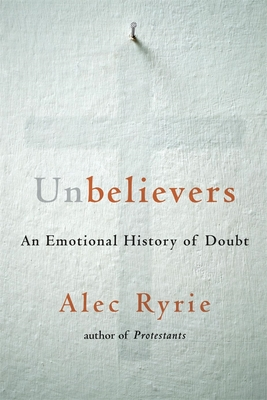
The Reasons for Unbelief

Unbelievers: An Emotional History of Doubt by Alec Ryrie (audiobook)

“The heart has its reasons which reason knows not.” (You’ll see variations on this memorable quote by Blaise Pascal because it was originally written in French: “Le coeur a ses raisons que la raison ne connaît point.”)

This book is in some ways an in-depth historical exploration of that statement and the truth it contains. The author, historian Alec Ryrie, states explicitly that he seeks to counter the prevalent narrative that atheism and secular humanism arose from changes in philosophical reasoning and intellectual beliefs. Rather, he argues that two powerful emotional currents – anger and fear – animated unbelief for centuries before it ever emerged as a coherent set of beliefs. In order to make his point, Ryrie garners evidence from across multiple centuries and the whole of Europe (with a special emphasis on England).

The historical work seems sound to this layman. Ryrie has unearthed dozens of fascinating first-hand accounts. Whatever issues one might take with how Ryrie summarizes the meaning of all the material, I think it’s undeniable that he’s onto something really worthwhile here. There really does seem to be a powerful emotional current at work in so much unbelief both in the past and today.

I found myself wishing he would apply these insights more thoroughly to our own day. But this was not his stated goal so I cannot fault him for anything except failing to write precisely the book I would have preferred. He does however make some interesting comments in the concluding chapter which are worth repeating and reflecting on.

Ryrie argues that, since WW2, Adolf Hitler now functions as the universally agreed fixed moral point. It is now unthinkable to praise Hitler just like it used to be unthinkable to criticize Jesus in centuries past. This manifests itself in another interesting way also. In the 17th Century, the argument-ending slander was to call someone an “atheist,” and Ryrie made clear in previous chapters just how endlessly that insult was hurled from one group to another. Today the argument-ending tactic is to call someone a “Nazi.” Lastly, in terms of imagery, the most potent moral symbol in past centuries was the cross. Today it is the swastika.

I might wish it was different, but this argument strikes me as correct. Modernity and subjective moral reasoning have chipped away at all the shared moral points of reference and really there are not very many left, of which Hitler and Nazism seems to be the one that has the most purchase across the breadth of our society.

These reflections are especially timely for us Canadians as the Freedom Trucker Convoy in the first couple months of 2022 led to some significant political and cultural turmoil, including endless talk about swastikas and accusations of Nazi-sympathy. It is interesting to step back and see that, in a time of massive moral transformation (one might even say revolution), this is indeed the one fixed moral point. Whatever else we believe is right or wrong, everyone agrees that THAT is wrong. And all ends of the political spectrum seem unable to resist the temptation to weaponize that moral certainty to score political points in our troubled age.

A Very Boring-Sounding Title: The Foundation of True Discourse

Image

“That’s the dumbest thing I’ve ever heard.”

“I can’t understand how anyone could believe that.”

“Anyone who thinks that is a complete idiot and understands nothing.”

We’ve all heard people say things like this, and most of us have said some of them ourselves. But the more I observe people interacting in person and online, the more I see how destructive such attitudes are towards the goals of honest conversation and true discourse.

It is the most natural inclination of any group with shared beliefs to reinforce those beliefs by developing arguments against the beliefs of others. This in and of itself is fine and good. This is why Christians study and discuss the wrong beliefs of Muslims, Mormons, and atheists, and why Camaro enthusiasts talk trash about Mustangs. The last thing we want is to say that one belief is as valid as another, or else we end up with plain old relativism and that is about as helpful as a set of black and white traffic lights or pharmacists who only administer placebo pills. 

And yet something critical is lost when the Camaro Club members come to believe that the Mustang is a useless piece of junk and quite literally the worst car ever made, or when a Christian says that Muslims or Mormons or atheists are completely deceived and know nothing about God or the world. What is lost is simply the truth. In the effort of preserving and reinforcing one’s own beliefs, it is all too easy to leave the realm of truth and reality. Constructing crude caricatures of opposing views is so rampant in religious and political discourse that its easy to lose sight of how harmful and destructive it is. And it isn’t just harmful for the one being caricatured. No – it is even more harmful for the one doing the caricaturing, because even if that person holds the view that is really true, he has left the realm of truth in his attack on the other, and is now frankly unable to convince anyone else of the truth.

Why is this? It’s because of a very simple and understandable reaction that always occurs when someone hears their own beliefs misrepresented. It’s essentially impossible to be convinced by an argument that is not addressing your position. And if I can narrow the focus a little bit to an especially guilty party of which I am a guilty member, we Christians are constantly doing this. The other partners in this fumbling waltz of misfired arguments are the atheists, who I daresay are just as bad. 

ImageImage

I don’t know how many times I’ve heard Christians quote Psalm 14:1, “The fool says in his heart, “There is no God”” and then proceed to argue that atheists are all fools and if they had any working brain cells they would see that God exists. Now, the scripture is true, and in the last analysis, when all things are revealed and our profound blindnesses are cured, it will be obvious that it is a foolish thing to say there is no God, sort of like it is a foolish thing to say there is no such thing as speech. But that doesn’t mean it isn’t perfectly understandable why someone would be a committed atheist. In fact, I am quite sure I would be a committed atheist if I had been born to atheist parents and if God had not so clearly intervened in my life; there but for the grace of God go I and you too.

The truth is, if the deepest pre-supposition you held was that there is no such thing as the supernatural, God, or anything beyond the physical world, then it makes sense to look at all the data available and conclude, like so many do, that the universe somehow came into existence through a big kablamo and that by endless chance life came into being and through countless eons evolved into what we see today. A lot of very intelligent, sensible people believe this. Likewise, atheists should be able to imagine how an intelligent and thoughtful person could come to believe that God created all things and that Jesus is the son of God.

We need a kind of intellectual empathy that says “I can see how you could believe that.” 

This is the foundation for any conversation which might actually bear the fruit of mutual understanding, growth, and maybe even epiphany. 

Defending the truth is a vital and worthy objective. But often in the interest of defending the truth we build walls instead of bridges, creating insular intellectual communities instead of winsome truth-telling communities, based in fear instead of love.

Someone I know came back from a conference a few years ago and told me “Post-modernism is so stupid!” I don’t disagree with the fact but the sentiment is not likely to convince many post-modernists. Forgive the analogy but if you want the dog to come inside you’re going to have to do something other than throw sticks at it. 

Republicans routinely demonize and draw caricatures of the Democrats, who then turn around and return the favour with interest. Christians get together and make fun of those stupid know-nothing atheists, who also get together and chuckle at the poor misguided fools who believe in an imaginary omnipotent being. And then there was the guy in my class who had decided that any and all Japanese cars were ugly and stupid and that only Fords and Chevys were worthy of appreciation, a position so untenable that it was hard not to laugh. 

Building walls of mutual incomprehension will do a good job of preserving the status quo but it will also prevent any actual conversation and – most shockingly of all – any realization of our own errors and wrong beliefs. Ultimately it is the path to ignorance, blindness, and even hate and violence, for there is a sense in which the kinds of mental attitudes I’ve described contain the seeds of the dehumanization necessary for violence.