I have not read much Warfield, so I welcomed the chance to dip into his writing with this handsome little volume put out by Crossway. I found it to be delightful.
Warfield writes with a crisp, clean prose that flows comfortably into lengthy sentences. He is judicious and careful in his choice of words, poking at an idea with different descriptors until he finds just the right one. I love this kind of writing. It is careful, clear, and yet often includes powerful phrases and images. The exploration of the emotional life of Christ is thorough and insightful. Warfield reveals a deep understanding not only of the Bible, including the original language, but also of human beings and emotions.
Here we find not that caricature of the theologian as the emotionally stunted egghead who cannot seem to understand or enter into normal human experiences, but rather the opposite; an emotionally intelligent, discerning person.
Warfield helps the reader appreciate all the ways in which the humanity of Christ is displayed in the gospels, sparse as the treatment of Christ’s emotions is, and yet he draws the reader’s mind and heart up to a posture of adoration for the way in which this reveals his glory and is a part of his redemptive work.
I conclude with two quotes from the work which illustrate its virtues.
“Joy he had: but it was not the shallow joy of mere pagan delight in living, nor the delusive joy of a hope destined to failure, but the deep exaltation of a conqueror setting captives free. This joy underlay all his sufferings and shed its light along the whole thorn-beset path that was trodden by his torn feet.”
“As we survey the emotional life of our Lord as depicted by the Evangelists, therefore, let us not permit it to slip out of sight that we are not only observing to proofs of the truth of his humanity, and not merely regarding the most perfect example of a human life that is afforded by history, but are contemplating the atoning work of the Savior and its fundamental elements. The cup that he drank to its bitter dregs was not his cup but our cup, and he needed to drink it only because he was set upon our salvation.”
This short work is enjoyable, illuminating, and edifying. I highly recommend it.
I came across this paperback copy of the late Anne Rice’s novel in a thrift store. I had heard about it some years ago and knew she was a popular author, though I had never read anything by her. I’m not really into the whole vampire genre, which she was best known for. It seems that this novel, and the subsequent books in the series, were a departure for her. Rice was a boomerang Catholic, raised in a strict Irish Catholic community until college, at which point she left it all behind and drew on the deposit of Christian ideas and images only to adorn her novels. But then she says she lost faith in her atheism. Her old skeptical certainties started to crumble, leading eventually to a full-hearted return to Catholicism and to belief in Christ. Rice says that she then devoted her subsequent writing efforts to portraying the life of Christ, and this book was the first fruit of that endeavour.
So what about this book, then? Well, it’s a bit difficult to rate. Like most readers, I come to the book with some preconceived notions about the person and life of Christ. But this is not like a book about Caesar, who I also have some notions about. Christ is a singular figure, and for Christians like myself, he steps out of history and into the depths of my inner being. I say this to underline the fact that it’s not possible to sit down and read this book like I might read any other piece of historical fiction. So perhaps I’m not really the ideal audience for this book, seeing as I already have strong convictions about Jesus; perhaps the book is better suited to moderns who think they know who Jesus was, swayed by modern liberal scholarship that claims to have scientifically determined the truth about the Jesus myth. More on that liberal scholarship in a bit.
The book opens in Egypt, with a seven year old Jesus living with his family in Alexandria. The plot follows the family’s migration out of Egypt and back to Israel, featuring brushes with both Israelite zealots and ruthless Roman soldiers. The central intrigue surrounds the unanswered questions that young Jesus has about his early childhood. He knows there was something special about his birth, and he knows that something happened in Bethlehem. The plot then develops as he puts together the pieces and grows in his self-understanding.
The prose is, if I’m honest, a bit clunky and bare. It’s not a book that draws you in by it’s beautiful descriptions or its eloquence. Was this an intentional choice, trying to capture the inner voice of this special 7-year old child? I don’t know, but aside from a couple of moments in the book where Jesus was interacting with some of the Rabbis and teachers, the character didn’t really sound or feel like the Jesus of the Scriptures. But then again… how could he? This is an impossible task, and in this regard the book could never succeed. The person of Jesus, as captured by the gospel writers, is the single most compelling literary character ever put to paper. Obviously I believe that he is far more than a literary character, but he is not less than that.
There were a few ways in which Rice wove future characters from the gospels into the family’s network of relationships such that the reader with knowledge of the New Testament would recognize that a deeper connection was being forged such that when the critical interaction occurred later, this extra freight of history would deepen the meaning of the event. For example, Rice has the family meeting the future high priest Caiaphas as a young man. He would, of course, later be involved in the trial and execution of Christ.
This is a plot device that is used a lot by the popular show, The Chosen, whereby familiar events in the gospels are retold with imagined backstories that make the stories feel deeply layered with extra significance. It’s effective on an emotional level, and when done well it doesn’t do violence to the text by changing anything. It simply adds details that the gospel writers left out, details which are no doubt wrong in their specifics but perhaps correct in a broader sense. What I mean is that each person encountered by Jesus in the gospels really had a full and complex life story like we all do. And no doubt some of those stories and specifics made their encounters with Jesus so powerful that they were never the same. I think that a reverential and imaginative exploration of what some of those backstories might have been is well within the bounds of legitimate Christian art, as long as it’s clear that the fictional additions are not Scriptural or authoritative.
But this brings me to Rice’s use of apocryphal material, such as the legends of Jesus discovering his own miraculous abilities as a child: turning clay birds into living ones, causing the weather to change, healing people, and even, as in the opening pages of the book, supernaturally taking the life of a neighbourhood bully (before miraculously resuscitating him). This was an inauspicious start, immediately signaling to me as a reader that the book was comfortable departing sharply from the Bible. Given the fact that this theme faded as the book progressed, I feel like it was used as a way to hook readers more than anything else. Ultimately, however, it cheapened the book, reminding me far more of a superhero origin story, where a character discovers their super powers and unique destiny, than of an episode from Holy Writ. This underscored an important principle that Christian artists must remember: when it comes to the Scriptures, to add to them in this way is automatically a deterioration; by trying to change things we only end up taking away from their own mysterious power.
It’s true the Bible’s style is to leave out many details and to leave many questions unanswered. The hidden things belong to the Lord. What inevitably happens when some well-meaning writer or artist deems to fill in some of the details is that the work takes on a ham-fisted, all-too-human quality. It takes true genius and a measure of restraint to avoid this result. Perhaps we can say that Milton achieved it in Paradise Lost and Samson Agonistes, and many others through the years. Anne Rice’s Christ the Lord: Out of Egypt is a mixed result, with some elements succeeding well and others falling short.
The real surprising delight of this book however came after the narrative was done. In a lengthy Author’s Note, Rice goes into great detail about her own testimony and the journey of her extensive research into the New Testament era. There are some real gems in this text, which I will quote at some length. The great value to me was Rice’s recounting of her encounters with both liberal New Testament scholars and the more conservative ones. I came away impressed at the breadth of her research and reading, and also at the sensitivity with which she read and interpreted these works. She writes:
I had taken in a lot of fashionable notions about Jesus – that he’d been oversold, that the gospels were “late” documents, that we really didn’t know anything about him, that violence and quarreling marked the movement of Christianity from its start. …
New Testament scholarship included books of every conceivable kind, from skeptical books that sought to disprove Jesus had any real value to theology or an enduring church, to books that conscientiously met every objection of the skeptics with footnotes halfway up the page.
Bibliographies were endless. Disputes sometimes produced rancor.
And the primary source material for the first century was a matter of continuous controversy in which the Gospels were called secondary sources by some, and primary sources by others, and the history of Josephus and the works of Philo were subject to exhaustive examination and contentions as to their relevance or validity or whether they had any truth. …
Having started with this skeptical critics, those who take their cue from the earliest skeptical New Testament scholars of the Enlightenment, I expected to discover that their arguments would be frighteningly strong, and that Christianity was, at heart, a kind of fraud. I’d have to end up compartmentalizing my mind with faith in one part of it, and truth in another. …
These skeptical scholars seemed so very sure of themselves. They built their books on certain assertions without even examining these assertions. How could they be wrong?
What gradually came clear to me was that many of the skeptical arguments – arguments that insisted most of the Gospels were suspect, for instance, or written too late to be eyewitness accounts – lacked coherence. They were not elegant. Arguments about Jesus himself were full of conjecture. Some books were no more than assumptions piled upon assumptions. Absurd conclusions were reached on the basis of little or no data at all.
In some, the whole case for the non-divine Jesus who stumbled into Jerusalem and somehow got crucified by nobody and had nothing to do with the founding of Christianity and would be horrified by it if he knew about it – that whole picture which had floated in the liberal circles I frequented as an atheist for 30 years – that case was not made. Not only was it not made, I discovered in this field some of the worst and most biased scholarship I’d ever read.
I saw almost no skeptical scholarship that was convincing, and the gospels, shredded by critics, lost all intensity when reconstructed by various theorists. They were in no way compelling when treated as composites and records of later “communities.”
I was unconvinced by the wild postulations of those who claim to be the children of the Enlightenment. And I had also sensed something else. Many of these scholars, scholars who apparently devoted their life to New Testament scholarship, disliked Jesus Christ. Some pitied him as a hopeless failure. Others sneered at him, and some felt an outright contempt. This came between the lines of the books. This emerged in the personality of the texts.
I’d never come across this kind of emotion in any other field of research, at least not to this extent. It was puzzling.
Rice describes then encountering a different kind of scholarship, written by believing, conservative, orthodox, and even Evangelical scholars. She heaps praise upon many familiar names, from Larry Hurtado and Craig Blomberg to Craig Keener and D.A. Carson; singling out N.T. Wright as preeminently helpful. The author’s note made me very sympathetic to what she was trying to accomplish in this book. Her experience of reading the voluminous (endless) scholarship is instructive and helpful, for she was a kind of curious neutral observer of the space, something which is rare. But she discerned this consistent undercurrent of both shoddy work and personal animus against Christ in the books by people who had dedicated their careers and lives to this topic.
The fact is that Christ, because of his all-encompassing claims to Lordship over every one of us, leaves very few people on the fence about him. The stakes are too high. Anne Rice’s note makes that clear in a surprising and very helpful way. I am sure that many readers found themselves following her towards a proper reexamination of the Scriptures without the jaundiced eye of the skeptics. That alone is reason enough to be thankful for the book, despite its flaws.
This was a fascinating biography of Jack Parsons, a pioneer of rocket science and a committed occultist. He helped found the famous Jet Propulsion Laboratory (JPL) and was instrumental in some of the earliest American advances in rocket technology, including the first time a rocket was attached to an airplane, with the JATO (Jet-Assisted Take-Off) program designed to help get heavy bombers airborne on short runways.
Parsons is interesting because he seems like a contradiction. The modern mind finds his two great interests to be at odds: science and magic. But Parsons, who was perhaps the closest thing to a successor that Aleister Crowley ever found, saw them as equivalent pursuits in different domains: namely, the exertion of the human will over created reality. On the one hand, control over the material world; on the other, over the non-material/spiritual/psychic world.
Parsons brought together what the enlightenment pulled apart.
Crowley’s life rule was to “do what thou wilt,” as clear a centering of the human will as can be imagined. What most people do not know is that Parsons was at one time very close to L. Ron Hubbard, whose bogus science of “dianetics” repackaged some of these ideas and thus was born Scientology.
A little digging reveals that many of the early pioneers of the scientific revolution were also deeply interested in spiritual, occult, and theosophical topics. See, for example, Francis Bacon, John Dee, and Isaac Newton, among others. It is Parsons, more so than the modern materialist scientist, who can be said to be their rightful heir. The drive to conquer more and more of nature has continued, with both positive and negative consequences.
Today a new front is opening up, one that strikes at the heart of what it means to be a human being: biological control. The idea is not new. It reared its head in the eugenics movement of the early 20th century. But the eugenicist dream became a Nazi nightmare, so it needed a bit of time out of the limelight and a new marketing strategy. Today the very same ideas have been repackaged as the transhumanist dream (of which transgenderism is a component), though this time with the awful power to engineer our own genetic code. The quest is still the same: exerting the will over created reality, whether with hydraulics, genetics, the surgeon’s knife, or whatever other technology we can devise. This hubristic project against nature cannot end well.
Returning to the book, I appreciated the open-handed way the author dealt with the paranormal aspects of the story. Not every author can resist the temptation to be embarrassed by the beliefs and testimonies of his or her subjects. One striking example is the experience of Parson’s lifelong friend and colleague, Edward Forman. Forman partook of Parson’s occult ceremonies countless times, that is, until the night he saw and heard what the author describes as terrifying screaming apparitions just outside the hallway window. Those in a previous era called them the screaming banshees. Forman was scared witless in that moment, and the fear never quite left him. Decades later, long after Parson’s death, Forman’s family recounts that he would sometimes ask his wife if she could hear people screaming.
Here we are at the end of another summer. It’s been a busy one for me, which will serve as my excuse for not having written here in some time. Aside from the normal demands and joys of work and family life – with the bulk of the demands coming from the work and the bulk of the joys coming from my family – I’ve been working against some deadlines for a pretty major project.
The project is a second edition of a little-known book about the history of the Fellowship of Evangelical Baptist Churches in Canada (FEBCC), or just The Fellowship for short. The book has had little readership due to its narrow focus on the subject of this denomination, a rather small one in the grand scheme of things. But when I was asked to consider taking on the project, there was a personal reason why I was drawn to say yes. When the first edition was published in 2003, it was for the 50th anniversary of this family of churches, and my mother was one of the people who worked on it. She co-wrote the chapter on Quebec and was involved with editing the whole to some degree. At the time, I was a high schooler with zero interest in church history or the projects my mom was working on, but thankfully I’ve grown up a little since then.
My mother passed away from cancer in 2012. Writing and editing is what she loved to do, and it is also what I love. This is a really meaningful connection for me, but it isn’t one we got much opportunity to share while she was alive. So when Dr. Haykin asked me in 2022 if I’d be willing to work with him on a second edition for the 70th anniversary of the Fellowship, I said yes. That was the easy part.
This summer saw the deadline for this project arrive, so naturally it meant I had to get done all the work I had procrastinated on in previous months. This meant dozens of emails back and forth with various contributors and lots of research and writing, culminating in a frenzy of productivity in the last weeks. But it’s quite amazing what you can get done when the need arises and when unbroken hours can be set aside for a focused purpose. So this project is coming to its fruition and the finished product will be presented in early November at the denominational convention, where I am expected to speak for five minutes or less about the book, or the experience of writing it, or what I learned, or something like that.
Another project came about unexpectedly in the summer: the chance to edit the text to Jonathan Pageau’s forthcoming adaptation of Snow White and the Widow Queen. I worked hard on it and am pleased that it was well received by the team at Symbolic World Press, who then asked me to continue editing the texts of the subsequent fairy tale books they are planning to publish. We’ll see where that goes, but I’m really enjoying the challenge of crafting English prose that feels ancient, mythological, and yet fully accessible to modern readers.
These projects have delayed the writing of a couple articles that I’ve had in the works for a while. But I recently finished a pretty major piece on psychedelics that I submitted to a new online outlet to see if they are interested in running it. If that goes anywhere, I’ll make sure to link to it. And then there is the second article I have been planning to write on the subject of pornography, as a follow-up to my earlier piece arguing that Pornography Poisons Everything. This second piece is meant to be a practical guide to fighting the scourge of pornography and lust in one’s personal life, and I am hoping to finish that this week or next.
Beyond that, I do need to write a book review for Glen Scrivener’s The Air We Breathe, which I am currently reading and enjoying very much. I think I will incorporate Andrew Wilson’s Remaking the World and Carl Trueman’s Strange New World into the review because together these three books cover a lot of the same ground, drawing on history to make sense of the present and give Christians tools for understanding and responding to the challenges of our age. I also would like to write a review & reflection on Christian Poetry in America Since 1940, of which I received a complimentary digital copy. I’ve been slowly reading it and trying to think of how I can say something useful about it despite not understanding much of the poetry within it.
So that’s what I’ve been up to instead of writing on this blog, but I hope to get back to more regular reflections in this space now that the big project is pretty much done. As always, thanks for reading!
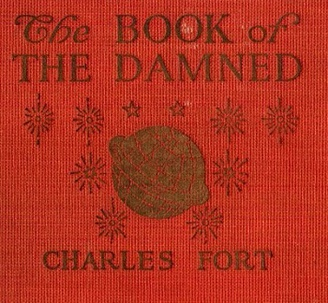
This is a strange book, about strange events, written in a strange prose style. First published in 1919, it is now over a hundred years old. And while it was not exactly an enjoyable read, I found it interesting and worthwhile, and at times the heavy sarcastic wit did draw a smile from my lips. I picked it up after hearing it recommended by a Christian who has been active in discussing and examining the paranormal, Ray Boeche.
The book consists of a lengthy collection anomalous events that have been reported by local newspapers and more specialized publications, starting with things falling out of the sky during storms: black rain, red rain, clumps of goo, blood, frogs, fishes, stones, and giant chunks of ice. From this and other observations, Fort speculates about various possible explanations, such as a floating body of matter somewhere above the surface of the earth but beyond our view. I suppose such ideas were more reasonable in 1919; in 2023 they come off as quaint and silly. And yet, for all our knowledge, many things both historical and contemporary remain anomalous and unexplained. While Fort’s speculations have not held up, his critique of how scientific authorities dismiss anomalous events out of hand feels as fresh and relevant today as ever.
Aside from being valuable as a compendium of baffling historical anecdotes, in my view the book’s real contribution lies in two related aspects.
First, the book shines a light on the all-too-human aspects of the scientific establishment. Namely, the inability of authoritative bodies on a given subject to take seriously data which challenges the fundamental assumptions which their authority and prestige is based on. This has been plain to see numerous times throughout history: Copernicus and Galileo, the theory of tectonic plates, and others. A prevailing explanatory model is established with institutional power. It cannot explain all the data, and alternative models are developed which sometimes do a better job explaining the data. But the orthodoxy of the established model is cemented and what ensues is usually silence, ignoring the upstarts, then defamation and slander, and finally a kind of revolution. It is a suppression and denial of data which would threaten not knowledge but status within a given sphere. And humans are rather attached to their status, usually more so than to truth which threatens that status.
Fort’s work is a jab in the eye to the hubristic claim that the scientific establishment is a purely truth-seeking entity.
The second strength is its common sense data-driven undermining of philosophical materialism. With a studied reticence to make any sweeping metaphysical claims, Fort nonetheless pokes holes into the veneer which materialism has enjoyed among the bien-pensants since the Enlightenment. He presents a carnival of inconvenient and vexing observations from all across the world. While many of these might have prosaic explanations, the cumulative effect of them all, page after page, from such a dizzying array of sources, is difficult to dismiss out of hand. Not that that has ever stopped anyone from doing it.
These ideas may be summarized pithily in Fort’s own words: “Science is a turtle that says that its own shell encloses all things.” Here we are, a hundred years hence, and this blindered certainty continues to characterize many skeptics and atheists. Their cultural authority is waning, however, as the West recedes from peak secularism. The new atheists had their day in the sun, but they have now shuffled off the stage.
The tide is now moving towards re-enchantment. The world is growing thin, and the non-material realities that were studiously ignored are making themselves felt once again.
I wonder what Charles Fort would have said about that.
Or how biblical Christians and evolutionary biologists ended up sharing foxholes in the culture war.
One of the strange alignments of recent years has been the agreement between biblical Christians with a strong sense of God’s designing hand in human nature and evolutionary biologists who have their own strong belief in the way that human evolution has given us a whole set of hardwired propensities.
We find ourselves allied against a sweeping advance by those who see nothing permanent or fixed in human nature, and perhaps in all of nature. They advocate for a liquid selfhood, a plastic sexuality, a human nature which is endlessly malleable as long as we have the right social engineering and technology.
Biblical Christians oppose this because they believe that God designed men and women to have specific natures, and that these things are a given. Yes, they are given as in a gift, to be received with gratitude and thanks. Men should be glad to be men, rejoicing in those aspects of their design which are well suited to their roles, and rejoicing in the delightful, intriguing, mysterious, and never-quite-comprehensible femininity of the opposite sex. Likewise the women in their femininity, which can and does take a variety of shapes. This dance has provided the raw material for countless poems, stories, plays, movies, and comedy routines.
Those who believe in evolutionary biology are likewise convinced that human nature is not so easily changed, and that millions of years of reinforced neurological and instinctual development is not so easily overthrown.
And so we find these two groups – groups which a decade ago were squabbling over the age of the Earth and the obvious validity of evolution as well as the obvious absurdity of it – both under fire from a new front. We huddle in the foxhole together and endure public shaming for daring to oppose the great revolution in human nature, the complete remaking and reshaping of humanity.
No time to fight each other now with these bullets flying at us.
The transhumanist dream is to have autonomous control over our bodies and minds. It is the enthronement of the authentic inner self over and against any physical or social reality outside of it. Transgenderism follows the same essential logic. Therefore physical bodies must be surgically changed to conform to one’s inner sense of selfhood and society as a whole must be made to affirm and celebrate every such case as a triumph of one’s authentic inner identity over the constraints of nature.
Of those who mount rational arguments against this new regime, most will fall into one of the two camps described above. Either one grounds human nature in the will of a Creator, or one grounds it in the genetic and neurological hardwiring of our long evolutionary past. It seems obvious to me that the former provides a far more stable and enduring foundation than the latter, since evolution is by definition always in a state of change, but nevertheless quite a few courageous evolutionists have stood up for something like a stable human nature in the midst of our current cultural upheaval.
We should not mistake such a shaky alliance for more than it is. The differences of conviction between Christians and materialist evolutionists go very deep. But I for one am happy to consider them co-belligerents against what threatens to sweep so much good away.
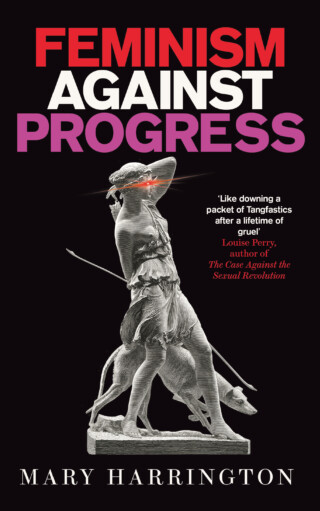
I just finished reading Mary Harrington’s new book, ‘Feminism Against Progress’. I forget exactly when I first came across her writing but it was immediately clear to me that she was not just another cultural commentator. She was willing to say things that were at odds with prevailing orthodoxies and she was clearly well-read. Plus she had a snappy style about her prose that I really liked. Having learned a little bit more about her in subsequent years, I see now why she had these qualities. She was educated at Oxford, went deep into queer theory in abstract and personal ways throughout her 20’s, and was then radically re-oriented by her experience of motherhood in her 30’s. She is one of those modern writers who has been through the swamp of post-modern ideology and emerged the other side sounding a little bit like a conservative. Well, that’s the slur typically deployed against such people; the once-faithful adherents who have abandoned the progressive enclave.
One of the most memorable phrases Harrington uses in her writing is that of meat lego gnosticism. Now that’s a phrase that needs a bit of unpacking the first time you hear it, sort of like moralistictherapeutic deism. “Say what now?” Harrington argues that the logic of the current iteration of feminism is leading our society into a tech-enabled dystopia of meat lego Gnosticism: ‘meat lego’ because we are talking about human bodies that are “liberated” from the biological constraints of gender and sexed differences, and fundamentally reduced to collections of exchangeable parts. And ‘Gnosticism’ because that ancient (and ever-present) heresy rejected the created goodness of embodied existence and made the internal (or spiritual) self the ultimate authority. So whatever I feel myself to be internally is the north star by which all other considerations are guided.
The myth of progress sold to us centers around the idea that ever greater freedom equals ever greater progress. We have equated those two concepts: freedom & progress. Therefore autonomy is prized over responsibility, and constraints are by definition to be resisted. But having achieved historically unprecedented levels of freedom and opportunity already, the modern woman is faced with the uncomfortable reality that women are not really any happier for all their gains. This is one of the book’s strengths: cataloguing all the ways in which a deep malaise haunts men and women who are beholden to this view of freedom-as-progress. So that leaves many in our culture facing the following choice. Either the fundamental promise of liberation was wrong or we just haven’t broken through enough constraints and inequalities to usher in the golden age. Folks on “the right side of history” (as they see it) are convinced it’s the latter, while Mary Harrington makes the case – rather persuasively to my mind – that it’s the former.
There are many other things to commend about this book and Harrington’s other writing in general (typically at the website UnHerd, where she is a regular contributor). She is not a conservative Christian like me, but it is precisely due to this difference of theological and cultural location that her particular insights shine brightly. She sees things differently, comes at them from different angles, and has read entirely different kinds of books. Yet I recognize in her that glimmer of common sense, of seeing the world rightly, of following the evidence when it collides with cherished beliefs, and pursuing truth at the expense of cultural capital among the bien pensants.
This book is precisely the thing to give that person in your life who has bought into all the mottos and slogans of modern feminism. This is not a conservative diatribe against feminism. Those books have their place, though usually not in convincing feminists to rethink their ideas. But this book, written from inside the feminist framework, can accomplish exactly that. And as our world hurtles ever on towards the dystopia of tech-enabled bio-libertarian meat lego gnosticism, Mary Harrington will be a thinker who will help us all to think carefully about the choices we face.
As she points out in this book, the greatest thing we may have to fight for in the coming decades is the right to remain fully and truly human.
I like the image of the bright green snake picked out by the editor, but the title I proposed fell a bit flat. I’m no expert in marketing or anything, but it seems there should be a little twist of intrigue in the title of a piece that piques the interest of the prospective reader. In my case, I just bluntly stated the thesis of my piece in three words and left it at that. No mystery. Upon further reflection, even adding a single word would have helped: How Pornography Poisons Everything. Ah, that’s better. Well, lesson learned.
Despite the title I’ve been very pleased with the engagement the piece has received, as it was linked to by the main TGC website and Twitter account as well as Tim Challies – major boosters of traffic! Such was their reach that I’ve now got a little radio interview scheduled to discuss the topic further with the fine folks at Moody Radio Florida. I expect this will consist of me trying hard not to say anything spectacularly stupid and my wife trying to keep the kids quiet while I talk into my computer.
I have been reflecting on the themes in the article for a number of years, so I am grateful that people seem to find it helpful, or at least confirming of some intuitions they held. What I tried to make clear is some of the subtle ways pornography influences individuals, families, churches, communities, and societies. I found it helpful to use a combination of Scripture and Natural Law reasoning (also known as common sense) to make this case.
I noted in the piece a shifting tide of opinion in some quarters on the question of pornography. The libertarian laissez-faire approach of “do whatever you want as long as it doesn’t hurt me” has proven disastrously inadequate for helping our society, and especially impressionable youth, deal with the wave of pornography that has multiplied proportionally with the spread of Wi-Fi and high-speed data-enabled cellphones with HD screens. And this all the more given the fact that foolish parents anxious to be liked by their teens are pushovers and give them these devices with absolutely no guardrails. Disaster.
So thoughtful people are waking up to the fact that this is noxious and dangerous stuff which is harming a whole generation recently come of age, and that wise leaders will no more allow this to go unrestricted and unregulated as they would let drug dealers open up booths in our community high schools and at local parks. Why? Because young people do not have the moral or even biological resources to muster up a strong defense against the open availability of such powerful stimulants. It’s been interesting to see secular people coming around to this realization and starting to make moral cases against not only open access to pornography for minors but the industry itself.
Another fascinating angle is the growing activism and legal challenge to the frankly criminal behavior of PornHub, the world’s biggest porn site. The lawsuits are huge, and well, money talks. It’s no exaggeration to say that there is a large amount of content on that site which not only depicts heinous crimes but is criminal itself; freely available images and videos that may someday soon be entered as incriminating evidence in a trial. Outrage over that fact should be widespread and non-political, and I have hope that awareness is growing. While we’re on the subject, perhaps you want to sign the online petition over at Traffickinghub.com.
I hope to write more about this in the future, but in the meantime I need to write the promised Part 2 where I try to offer some help for those still ensnared and enslaved to porn. Stay tuned for that in coming weeks.
This brings me to a related topic: anthropology. I know, I know – another big word which we’ve all heard before but aren’t really sure what it means.
And for my most faithful readers, this will feel like a re-run of a previous post, but I’m firmly convinced that it is a necessary word to understand the nature of the rapid transformations taking place in our time. One of the most helpful thinkers in this regard is Carl Trueman, who has made the transition from church historian to cultural critic with great success. And boy can he write. Consider for example this article just published today over at First Things, where he responds to the same controversy I alluded to in my piece, namely the statement made by Dennis Prager that pornography use and lust are not necessarily morally wrong.
Prager’s statement reveals that he lacks a real grasp of what is causing the social and political problems that he claims to abhor: We live in a time of anthropological chaos, where the very notion of what it means to be human is no longer a matter of broad social and political consensus.
Pornography is a great example of this. Behind the problems that should have been obvious to Prager—the objectification of other people, the human trafficking, the transformation of sex into something that is self- rather than other-directed, the reduction of the participants to instruments of pleasure for the spectators—lies a basic philosophy of life that sees me, my desires, and my fulfillment at the core of what it means to be human. Pornography is thus part of an anthropological shift that manifests itself most obviously in sexual mores but is far more comprehensive in its significance.
Later, he adds:
Now, sex and pornography are the most dramatic examples of where this plays out, but they do not exist in isolation from broader considerations of what it means to be a human person. Therefore those, like Prager, who see pornography as having a legitimate function are complicit in this shift. And this change underlies no-fault divorce, gay marriage, and (in its subordination of the body and its functions to the individual’s sense of well-being) even transgenderism. It is foundational to the progressive cause. To concede here is to concede everywhere.
I do encourage you to read the whole thing. This analysis goes much deeper than the moral outrage of an offended conscience and gets at the roots of what is driving a multitude of bewildering cultural phenomena. We do not need the momentary heat of Twitter-depth indignation which tempts us to feel morally self-righteous. That is cheap. But we do need the light of historically-informed thinking that sees through the chaos and confusion of the day and makes clear the deep tectonic shifts happening in our culture. That is “men of Issachar” type stuff.
I hope, in some small way, to continue making contributions to that good work. As always, thanks for reading.
This is the reason you shall do it. For it brings you a pleasure which is unalloyed, an unmitigated good. I don’t know what it might be for you, this thing. I can think of a handful of things for me: writing, driving (not commuting), reading a good book, going for a walk with my wife, playing with my kids until the giggles and shrieks mingle, building or fixing something with my son, and so on.
By dint of our individual natures and life experiences we will each have some set of activities which tap into some simple and primal creaturely mirth. My exhortation is: do that. It’s good. Obviously some caveats are in order, such as, don’t sin, since sin by definition does not satisfy nor is it aligned with who we were made to be. But aside from that, there is broad freedom here.
For some, there are kinds of manual work which fall into this category. Probably not shoveling – though who knows? I’m thinking of something a little bit more skilled which passes the time and brings pleasure. The pleasure should not be dependent on the accomplishment of some task or goal. The thing I have in mind is not done for the sake of productivity or efficiency; it is anti-utilitarian. It’s the kind of thing that fills in the open spaces on the hourly planner, which doesn’t really cross any items off any list, but which never feels like wasted time.
In short, it is good to do some things for the sheer joy of it, and not for any other purpose. There is something here which we share with other creatures. While animals are guided largely by instincts, they each have their own personalities and they also engage in playfulness which has no strict Darwinian logic to it, not that I am a Darwinian. Sometimes a dog just wants to run around the yard in big loops as fast as it can. There’s a pleasure inherent to the sensation of motion, balance, and even the aesthetics of a finely executed jump or swoop. See for example how the birds seem to enjoy playing in the wind, for the same reason children and child-hearted adults enjoy holding their hand out the car window on the highway, playing on the flowing air like the aileron of a jet.
If your life is so full of lists and efficiency and every-moment-scheduled activity such that there is no room for these kinds of things, or if the thought of it induces a mix of anxiety and guilt because you’re captive to an inflexible productivity mindset, I shake my finger at you, though in a friendly way.
My friend, we are human beings, not machines. We are mind, body, soul, and spirit, not algorithm, subroutine, and hydraulics. A human life, at a human pace, is one of those universal aspirations of all people everywhere (with varied manifestations of course). The French term, joie de vivre captures something of this essential joy in being. To lose this thing I’m trying to describe in any measure is to slide towards the mechanistic, robotic, slave-like inhumanity. Chesterton makes a related point in his chapter called The Maniac in the book Orthodoxy. Allow me to quote the relevant section:
The last thing that can be said of a lunatic is that his actions are causeless. If any human acts may loosely be called causeless, they are the minor acts of a healthy man; whistling as he walks; slashing the grass with a stick; kicking his heels or rubbing his hands. It is the happy man who does the useless things; the sick man is not strong enough to be idle. It is exactly such careless and causeless actions that the madman could never understand; for the madman (like the determinist) generally sees too much cause in everything. The madman would read a conspiratorial significance into those empty activities. He would think that the lopping of the grass was an attack on private property. He would think that the kicking of the heels was a signal to an accomplice. If the madman could for an instant become careless, he would become sane. Every one who has had the misfortune to talk with people in the heart or on the edge of mental disorder, knows that their most sinister quality is a horrible clarity of detail; a connecting of one thing with another in a map more elaborate than a maze. If you argue with a madman, it is extremely probable that you will get the worst of it; for in many ways his mind moves all the quicker for not being delayed by the things that go with good judgment. He is not hampered by a sense of humour or by charity, or by the dumb certainties of experience. He is the more logical for losing certain sane affections. Indeed, the common phrase for insanity is in this respect a misleading one. The madman is not the man who has lost his reason. The madman is the man who has lost everything except his reason.
I rarely read Chesterton without a smile on. His writing is so colourful, even playful. His mind jumps around between ideas and is always running here and there on the page, the reader at times struggling to keep up. And then at the end of a few paragraphs he puts the finishing touches on some zany idea and it comes into focus for the reader with a shock, like having been led into the Sistine chapel in darkness and then having someone suddenly flip on the lights. (Does the Sistine chapel have artificial lights? My metaphor depends on it.) I remember when I first read this paragraph above, how delighted I was. I had never thought of reason and madness that way before, and it gave me a new and permanent enjoyment of little ’causeless’ and ‘useless’ actions. Children are, of course, the ultimate example of this. They are playfulness incarnate, and have much to teach us in this regard.
G. K. Chesterton, the so-called prince of paradox.
Another fine example comes from the movie Chariots of Fire, where a conflict arises between the gifted runner Eric Liddell and his ministry-focused sister. She thinks he should quit running since it accomplishes nothing for the kingdom, but he sees something in the running that she cannot – some worth that is in and of itself, not dependent on some other measurable accomplishment. “When I run, I feel God’s pleasure.” But lest this attitude be taken as a being fundamentally at odds with a life lived fully for God’s glory, I want to point out that after his epic performance in the 1924 Olympics, during which his conviction to keep the Sabbath engendered no small amount of publicity, he became a missionary to China where he eventually died at the age of 43, a prisoner in a Japanese internment camp during World War 2. His love, concern, and self-sacrificing generosity towards his fellow inmates left an indelible mark on those who survived.
Eric Liddell
There is an application here for those in demanding and important vocations, perhaps especially ministry, since it concerns eternal things. There is an understandable way of thinking that says something like I can’t possibly read a novel or take up a hobby or learn a new instrument when there are people suffering and I can do something about it. This can work for a while, but I see at least three problems with it.First, this mentality is at odds with the natural rhythms of work and rest that God has designed us for. This attitude leads towards burnout. Second, there is a messiah complex, or the seeds of it, in that approach. Third, a life crammed to the ceiling with work is not a good model for others to emulate. Those in ministry especially are to be ‘an example’ to regular folks. But a life with no margin, no niches carved out for the simple pleasures described above, is not balanced or healthy. This is not to say we should not work hard, put in long hours, or have certain seasons of especially intense exertion. One can do all those things and yet preserve the kind of childlikeness, freedom to rest, and simple pleasures I’ve been trying to describe.
So to return to my opening exhortation: go ahead and do that thing for the sheer joy of it. Who knows? You may even find yourself feeling God’s pleasure in it.
Our family was recently in the US for a week and a half of vacation. I love America: I have equal parts fascination and affection for that inimitable nation, and I follow its happenings more closely than is probably healthy. I feel much like Os Guinness, the English social critic and apologist who describes himself as an interested outsider peering in, inspired and at times horrified by what transpires in the world’s premier superpower. I agree with him that as the leading nation, it has outsized influence upon the West (and indeed the entire globe). Therefore anyone concerned with the present and future state of the world will pay close attention to the trends at work in the US of A.
Photo by author.
But my purpose in writing today is not to tease out any of those world-shaping trends or big ideas. Rather, I just want to make some whimsical observations about the quirks and idiosyncrasies of America, something only an outsider can do. What follows is a series of scattered observations by a Canadian travelling through America.
Our trip to and from South Carolina included stops in Harrisburg (Pennsylvania) and Washington DC, including many hours on the I-81 and I-95. After so many hours on the interstate system, the whole thing blurs together into a kind of American highway casserole. The McDonalds, Cracker Barrels, and Sheetz gas stations; the rest stops and truck stops; the vehicles abandoned on the side of the road with a shirt fluttering out of the window; and most of all: the billboards. Compared to Canada, America has really turned billboards into its own art form. One might say that first America managed to transform every message it values into billboards, and then the billboard reshaped American culture into its own image.
Where else can you see billboards fighting for the very souls of motorists? Where else are ultimate matters routinely addressed on giant wooden placards as one races down the road towards the dentist, groceries, or vacation? In Canada, motorists are mostly left to decide ultimate matters for themselves, and are instead presented with products to buy or, at times, public announcements. Here are a few examples of the messages presented to motorists in America. “Jesus is the Answer. John 3:16.” “After you die, You will meet God.” And then there are some that are even a little more blunt, if that is possible. One of them features bold red block letters on a plain yellowy-beige background and says, “FORGIVE MY SINS, JESUS, SAVE MY SOUL.”
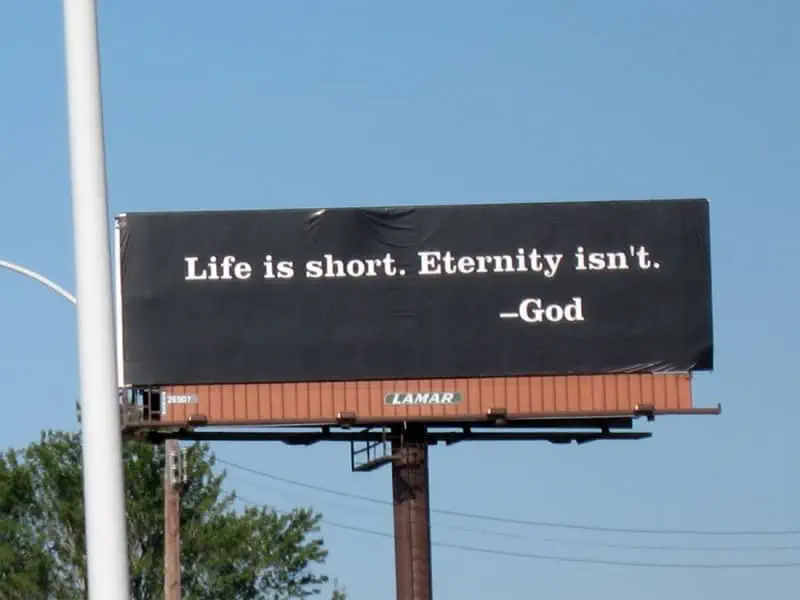
And then come the counter-billboards, here to set people free from the benighted ignorance of these silly fundamentalists. “Don’t believe in God? Join the club.” “Just skip church. It’s all FAKE NEWS!” Along similar lines are the billboards appealing to our vices. “Adult Fantasy Store, Exit 100!” And when we finally arrived to Exit 100, where the billboards had promised fulfilled fantasies and illicit pleasures, someone had put up a big billboard: “Life is short. Eternity isn’t. – God.”
Only in America.
The billboards waging spiritual war capture something about America: the reign of marketing. Of course we have marketing in Canada too, but in America it feels like everything is marketed. The essence of marketing is the marriage of image and slogan, logo and tagline, meme and hashtag. To market something means to commodify it, to sell it. And some things, sacred things, ought not be treated this way. Am I saying I wish there weren’t billboards calling on people to consider the truths of the Scriptures and trust in Christ? Not quite. I’m not sure how I feel about it. But something about it does make me uneasy. To boil down the message of Christianity to 6 or 8 words on a billboard is to do something to that message, even if I’m not sure how to express the nature of that something. McLuhan’s insight was that the medium is the message. So part of my uneasiness about the Christian billboards is the implication that Christ for your soul is the same kind of thing as Chick-Fil-A for your stomach or the University of Pennsylvania for your education. But one of these things is not like the others, and to treat them more or less the same seems to me a uniquely American phenomenon.
Speaking of billboards, what is the deal with lawyers and billboards? Do the billboard salespeople give lawyers a 50% discount? Are all these lawyers really getting lucrative lawsuits from these kinds of billboards? “Motorcycle Accident? Call FRED!” “Injured in a CAR WRECK? 1-800-GET-PAID.” I even saw one that said “BIRTH DEFECT? AGE 0-21. CALL ME!” This whole idea is foreign to me. I’ve been in a couple of car accidents, one of which was my fault; the other which was not. But never once did it cross my mind that there was anyone to sue. I’m left with myriad questions: Just who is being sued here? The other driver? The car-marker? The transport authority? I haven’t the foggiest. And what kind of accident would warrant a lawsuit? Do people rub their hands together with glee when they get rear-ended in traffic? Maybe if you were driving down the road and the steering wheel suddenly popped off in your hands you could sue your carmaker. Or what if I was driving down the road and was distracted by all the lawyer billboards and went into the ditch, could I sue the lawyers? Is there a lawyer somewhere specializing in suing other lawyers who put up distracting billboards?
On a slightly more serious note, this idea that I might be able to blame someone for an event and then receive significant financial recompense seems subtly insidious. It encourages the weaponization of victimhood. When bad things happen, as a general principle it is not good to fixate on the past and embrace the role of the innocent injured party who is crusading for justice. Of course in egregious cases this is precisely the thing to do, but I’m speaking of your typical accident. It seems to me that the promise of financial reward for being a victim creates incentives to twist the truth, leave out inconvenient facts, and generally misrepresent the case – probably in ways that may not even be obvious to the person doing it. That’s how incentives often work, on a subconscious level.
Speaking of the subconscious, it seems to me that Americans really do love everything to be bigger, especially vehicles. I have been a careful observer of what vehicles are on the road since I was a young teenager obsessed with cars. I worked to memorize every make and model, and thus I have a good sense of what is driving around. My son seems to have caught this bug, and he happily spent much of the drive looking to spot one of the hundred vehicles I put on a list for him (we found all but seven). Car companies typically offer a range of vehicles from most affordable and smallest to most expensive and large. So we have the Toyota Yaris or Corolla at one end and the Avalon or fully loaded Camry at the other; the Hyundai Accent and the Genesis G90; the GMC Terrain and the Yukon. In Canada the ratio is typically something like 15 or 20 most affordable vehicles for every most expensive one. In America, the ratio is more like 5 to 1 – a massive difference. Everyone seems to want the biggest thing available, whatever is on the last page of the brochure. “Fully loaded, top of the line.” “Super size it.” And inevitably the vast majority of the largest SUVs – the Escalades, Range Rovers, Suburbans – are driven by petite women with large sunglasses.
Herein lies another facet of that mysterious American temperament.
One of the most enjoyable aspects of our vacation was visiting the epic architecture of both the Pennsylvania State Capitol as well as DC landmarks, specifically the Capitol building, Library of Congress, and the Supreme Court. My appreciation for architecture has been growing exponentially over the last few years as I’ve come to a deeper appreciation of how our architecture is vitally connected to our ultimate beliefs. So it was with a kind of awestruck stupor that I gazed up at the majestic scope and ornate designs of these buildings. They are beautiful. And more striking still, they explicitly connect their own grandeur and beauty to the loftiness of the ideals which inspired them. Inscribed in marble and written in tiled mosaics were Bible verses and quotes from past luminaries who spoke of the essential natures of justice, liberty, goodness, and truth. Enduring truths etched into stone.
Inside the Pennsylvania State Legislature. Photo by author.
I know that America has never lived up to its ideals, but it must be said that America, more than any other nation I know of, has most clearly and elegantly elucidated its ideals in its founding documents and core institutions. As my gaze moved from the permanent truths which were encoded into the very beams of those buildings to the politicized bumper stickers adorning some of the congressional offices, and as I thought of the raw partisanship and frothing polemics used by both American political parties, the hypocrisy and moral bankruptcy on display among the ranks of each, and the general small-mindedness and incoherence of their political visions, I was left feeling that we are not worthy of this inheritance.
At the back of the Supreme Court building is written, “Justice the Guardian of Liberty.” The front of the building proclaims “Equal Justice Under Law.”
The Supreme Court building on a clear March day. Photo by author.
These buildings, these institutions and ideals, they aspired to something truly noble. Like I said, they never achieved it in full measure, but just like hypocrisy is the tribute vice pays to virtue, so our failure to live up to the ideals we embrace as a culture are a tribute to the fact that we have set our sights on something lofty. Increasingly it seems like we aren’t sure we have ideals, or if we should even have any. Instead of choosing something to define us, we avoid choosing by choosing to be defined by a hollow diversity. The West has by and large decided that the way to deal with its failure to live up to its ideals is to reject those ideals as well as the Christianity from which those ideals grew.
I love America, that land of searing contrasts, that paragon of both freedom and folly, liberty and license, virtue and vice.














 Phil's Scribblings