
Things have been quiet here at the blog, you might have noticed. Life has its way of crowding in and getting busy, doesn’t it? Work has been a couple notches busier than normal, and then I also recently was voted in to serve as an elder in my local church (again). By the way, I just signed up for the Amazon affiliates program, so that if you are so convinced by my writing to make a purchase on Amazon through a link on my site, I will become an internet millionaire through Bitcoin. I’m pretty sure that’s how it works. Anyways, moving on.
I’ve been keeping up my reading, though. I read Church Elders by Jeramie Rinne – simple and good on the topic. I finally got around to reading Rod Dreher’s Benedict Option, which I found myself resonating with. It’s a bleak perspective on the state of the West, to be sure, but I largely agree with his assessment. I also found that the loudest critiques of the book I’d heard were pretty obviously mis-readings of Dreher’s actual argument. I’ve got an idea to combine a review of it with a review of Aaron Renn’s Life in the Negative World (which is sitting on my shelf), putting the books in conversation with each other.
I also read a Canadian book called Divorcing Marriage, a collection of essays from social conservatives and lawyers from the era a generation ago in 2004 when homosexual marriage was just being pushed through the courts. It was astonishing just how much things have changed in the last twenty years. At the time, I was not politically or socially conscious. I was easily convinced by simple appeals to fairness and empathy that gay marriage regulated by the secular state was fine – it had no bearing on Christians and I could not imagine any reason why society as a whole might wish to retain a traditional view of marriage. Well, this book really helped crystalize my thinking, which I now realize was about as solid as my 100-year old barn that is half fallen over and whose beams are rotted. I hope to write something more extensive on this, we’ll see.
After finishing that I felt I was due for some classics, so I’ve read Sir Gawain and the Green Knight and the story of Percival, and I’m now reading Roger Lancelyn Green’s classic King Arthur and His Knights of the Round Table, which retells those two stories as well as many others. My son, who just turned 13, read it this year in his schooling so we’ve been able to connect over it. Lastly, I started Charles Dickens’ Great Expectations and am enjoying that as well.
Oh, I forgot, I’m also reading Thomas Watson’s The Lord’s Supper as recommended by Gavin Ortlund during his video on the topic. It’s excellent. It argues for what is known as the ‘Spiritual Presence’ view of the Lord’s supper, as a middle way between the excesses of transubstantiation and memorialism. I’ve become very interested in this topic as I’ve been thinking through re-enchantment and the church (more on which in a moment).
Did you know that both the Westminster Confession and the London Baptist Confession of 1689 took this view? Somewhere along the way the default evangelical view seems to have gotten filtered through enlightenment materialism and the supernatural was stripped out, leaving only the human-level interaction with memory and Scripture. This mere memorialism is the view explicitly laid out in the Southern Baptist document, the Baptist Faith and Message, as well as my own denomination’s Affirmation of Faith. But I haven’t been able to find out why. On the strength of which argument was the more classic reformed view replaced? I am eagerly looking forward to reading Dr. Michael Haykin’s book Amidst Us Our Belovèd Stands: Recovering Sacrament in the Baptist Tradition, which argues this point. Here is the short blurb summarizing the book:
When it comes to baptism and the Lord’s Supper, many Baptists reject the language of sacrament. As a people of the book, the logic goes, Baptists must not let tradition supersede the Bible. So Baptists tend to view baptism and Communion as ordinances and symbols, not sacraments.
But the history of Baptists and the sacraments is complicated. In Amidst Us Our Beloved Stands, Michael A. G. Haykin argues that earlier Baptists, such as Charles Spurgeon, stood closer to Reformed sacramental thought than most Baptists today do. More than mere memorials, baptism and Communion have spiritual implications that were celebrated by Baptists of the past. Haykin calls for a renewal of sacramental life in churches today—Baptists can and should be sacramental.
That’s exactly what I have been leaning towards. It marries my interest in historical retrieval & ressourcement and my desire to exhort evangelical churches to steward well the cultural movement towards re-enchantment.
I translated that desire into an article, my latest over at TGC Canada: Leaning into Evangelical Re-enchantment. If you haven’t, I hope you’ll read it. I was pleased to see Aaron Renn & Rod Dreher both linked to it at their Substacks – it’s a real blessing to a small-beans writer to get amplified and shared to much wider audiences.
I really don’t know much of anything about internet traffic, but I have to say I have been surprised at the sustained level of reading on this here, my little blog. I have been averaging about 150 visitors and 200 views a week since early this year. This may not interest anyone, but I find it interesting. Here are my most popular posts of 2024. The #1 article, about Adult AI, was boosted by a link from Tim Challies, which also led to an interview with Moody Radio’s Kurt & Kate in the Mornings, which you can listen to if you so wish. Challies is a singular blogging phenomenon.
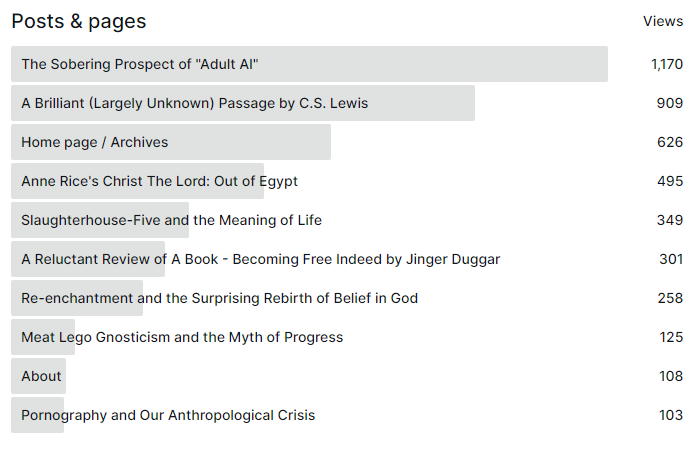
The #2 post, an extended quote from C.S. Lewis, has been quietly accumulating views week by week as people from all over the world find it, mostly through Google searches and perhaps links on forums. After that it seems that my reviews of popular books are of enduring interest. I would also like to add to my website here a page with links to all my published pieces elsewhere – a kind of central hub where those can be easily found.
Aside from that piece at TGCC, I have one submitted to another outlet (which I haven’t been published at before) and I am waiting to hear back from the editors. It’s another piece about psychedelics. Speaking of psychedelics, I was pleased to be interviewed by none other than Justin Brierley for his excellent documentary podcast series, The Surprising Rebirth of Belief in God. The episode on psychedelics hasn’t been released yet, but I’ll link to it when it comes out. I think I will wind down my writing on psychedelics, however – I’ve said what I had to say, and I think there are others who are better placed to continue writing for the church on this topic.
That about does it for me at this point. I’ve got some articles at various points of completion: on the Pride Rainbow compared to Vaclav Havel’s greengrocer illustration; on cathedral beauty and gospel beauty; and an article on the Haitian Christian community in Montreal which has been commissioned by Faith Today.
As always, thanks for reading.
As an Amazon Affiliate I earn a small commission from qualifying purchases of books purchased through links on my website, while customers do not pay anything extra.
 Phil's Scribblings