A Gem Among the Wreckage (of YA Fiction)

What books can we give our teenagers that will help them grow in virtue? So much of the Teen Fiction genre today seems to find its raison d’être in being transgressive and celebrating vice. The result is often a reading experience that drives a wedge between the young person and their moral and spiritual heritage. But there are always a few bright spots, a few gems among the wreckage.

Enter Black Bottle Man, a novel that recently came to my attention. It is a fine example of an exciting story that, while not a explicitly Christian, is nicely compatible with a Christian view of the world. It is the debut novel of Craig Russell, a Canadian from Manitoba.

The story begins in the 1920’s, with an extended family living on three connected farms. Three couples, but only one child: young Rembrandt. The two childless women reach a point of dark desperation and resort to black magic to bring about the children they so desire.  

The magic works, but there’s a very nasty catch, and only a hastily struck deal with the nefarious Black Bottle Man gives the troubled family a glimmer of hope. There are souls at stake and the men of the family, including Rembrandt, must find a champion who will be able to defeat the Black Bottle Man. From this strange beginning we follow the trio as they learn to survive out on the road and as Rembrandt matures into a young man.

The narrative spans the entire life of the protagonist, with chapters jumping back and forth across time so that we see snapshots of the characters’ lives at various stages as the story unfolds. These separate pieces gradually come together for the climatic end, which is framed as a battle between good and evil, the champion against the Black Bottle Man.

The world in which the story takes place is anchored by Christian reference points. The book contains its fair share of the supernatural, but rather than relegate it to the world of fantasy, it is presented in a straightforward manner. The moral compass is calibrated correctly – virtue is good, vice is bad – which is all too rare in teen fiction. And so Black Bottle Man is the kind of book that has something of value to offer the human spirit as it deals with the themes of family, tragedy, loneliness, romance, and grace.

The writing is consistently good. In one memorable scene, Rembrandt finds himself in a small town church where the preacher uses Scripture to cajole and manipulate rather than edify. “Right then and there Rembrandt knew that he’d study that Book like Pa had, until he knew all the funny little corners where the mean, small-minded people like to hide” (p36). That’s insightful.

Scattered throughout the book are clever and thoughtful descriptions. At one point, Rembrandt is eased into the back of a police car: “The back seat is vinyl, patched and repaired from a life spent accepting displaced anger. The car smells of human beings in all their wondrous variety, locked in a perpetual battle with cheap disinfectant” (p91). One chapter opens up like so: “All music contains within itself a kind of divine madness. Few will read a book or watch the same film more than once, but everyone returns to their favourite songs. Of all the arts, music is the king of repeated experience” (p120). These fine touches help lift the book from a prosaic adventure book to something in touch with the imaginative.

Not everything about the book is a complete success. At times the back-and-forth motion from past to present is jarring and hinders the momentum of the story. Also, some aspects of the book are a bit harder for me to believe or understand. But these hiccups do not detract significantly from the overall appeal of the book. Craig Russell has managed to craft a compelling story with a clear moral vision, bring it to life with vivid and memorable descriptions, and fire up the reader’s imagination; all within a world that is infused with spiritual realities. That’s quite an accomplishment.

If every Young Adult book had these ingredients in the mix, we would have much less reason to be concerned about what our teens are reading. 

I received a complimentary copy of this book from the author for the purposes of writing a review.

He Descended to the Dead

As we approach Easter week, the Christian’s thoughts turn to those epic events of Christ’s passion week: his triumphal entry, his betrayal, his unjust trial, his crucifixion, his burial, and his resurrection. Now what is missing from that list? Did I forget any major events? At least one evangelical theologian says yes, and he argues that most of us skip over the events of what has historically been referred to as Holy Saturday: that full day where Jesus laid in the tomb between his death and resurrection.

And what were those events? Just what exactly happened on Saturday? The Apostles’ Creed summarizes the Easter weekend with these unforgettable words:

     He suffered under Pontius Pilate,
      was crucified, died, and was buried;
      he descended to hell.
      The third day he rose again from the dead.

All Christians have heard or repeated those words: “He descended to the dead” or, “He descended into hell.” But what the Sheol does that really mean? Sounds like some spooky hocus pocus stuff, right? Well, not quite. Enter Matthew Y. Emerson’s helpful book:

Dr. Emerson has written this book in order to metaphorically hold the hands of confused evangelicals and introduce them to this classic doctrine of the ‘descent.’ No, not the classic PC video game by the same name – though many a happy hour did I there spend.

Not this. But if you were into video games in the 90’s, you probably remember this.

Back to our topic. So what is the argument of the book, in a nutshell? From page 103:
“… the confession that Christ ‘descended to the dead’ can be summarized like this:

Christ, in remaining dead for three days, experienced death as all humans do: his body remained in the grave, and his soul remained in the place of the righteous dead. He did not suffer there, but, remaining the incarnate Son, proclaimed the victory procured by his penal substitutionary death to all those in the place of the dead – fallen angels, the unrighteous dead, and the OT saints. Christ’s descent is thus primarily the beginning of his exaltation, not a continuation of his humiliation.”

Elsewhere, he expands on this a bit and claims that:
“Christ ‘releases’ the OT saints, by which we mean simply that, rather than dwelling in Abraham’s bosom (or paradise) awaiting the Messiah, they now dwell in the presence of the risen Christ.”

One of the interesting aspects of this doctrine is the metaphysical discomfort it brings. It’s one thing to believe in a far-away heavenly realm. But it smacks of an embarrassing medieval credulity to say that Jesus descended through the earth to the realm of the dead, wherever that is. This embarrassment is in part due to the stranglehold that modernity has had on even faithful evangelical theology for the last hundred years or more. Such is the incredible power of the dominant materialistic assumptions that underpin our age. This is what I meant by metaphysical discomfort. This doctrine means agreeing more with the ancient Greeks and Israelites about the existence of Hades or Sheol than with the respectable materialist metaphysics of modernity.

But this so-called respectability is really a house of cards, a mirage, like the ethos of ‘cool’ that hung around certain people in high school. It’s not worth fighting for because it is built on a foundation of weaponized doubt and unbelief.

By and large I found this book compelling, fascinating, and edifying. This was especially true for the first three or four chapters, which form the heart of his biblical and historical work. I wish I could delve into these details more substantially, but I’ll leave you with this link where you can hear a 25-minute interview where the heart of the book’s teaching is really laid out.

In later chapters I sometimes found it a bit tedious, and I confess I even skipped a few footnotes. The author takes to time to interact with many academic journal articles and historical arguments related to this and it had a tendency to get a bit overly technical for a non-scholar such as myself. The book is clearly aimed at pastors and Bible college or seminary students. But the author won me back by always keeping an eye on the practical implications both personal and corporate of the truths he was dealing with.

The author states his hope at the very start of the book: “My goal… is simple: to recover the doctrine of the descent for evangelicals today.” I think he is successful in that regard. In most cases, evangelicals have no real argument against the doctrine except for the intuitive metaphysical discomfort that it brings. It’s not like there is some other firmly held belief that Jesus spent Holy Saturday playing Uno with Abraham. There is simply nothing there at all. We don’t have a theology of the descent; and we don’t know what to do with it. We usually just avoid it.

The book therefore serves to cure our ignorance historically, Biblically, and theologically. There are riches and truths to gain and grow from here that we ought not miss out on any longer. And as for that temptation to feel even a little bit embarrassed about believing such a thing? Let it go. I was embarrassed of my parents in High School, but it was I who was wrong. I had breathed that nauseous atmosphere too deeply and it had distorted my view of reality. Likewise, we’ve been living with a truncated and distorted materialistic worldview for far too long already.

The Reasons for Unbelief

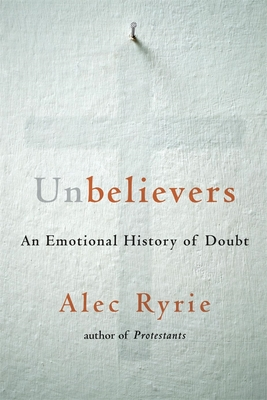
Unbelievers: An Emotional History of Doubt by Alec Ryrie (audiobook)

“The heart has its reasons which reason knows not.” (You’ll see variations on this memorable quote by Blaise Pascal because it was originally written in French: “Le coeur a ses raisons que la raison ne connaît point.”)

This book is in some ways an in-depth historical exploration of that statement and the truth it contains. The author, historian Alec Ryrie, states explicitly that he seeks to counter the prevalent narrative that atheism and secular humanism arose from changes in philosophical reasoning and intellectual beliefs. Rather, he argues that two powerful emotional currents – anger and fear – animated unbelief for centuries before it ever emerged as a coherent set of beliefs. In order to make his point, Ryrie garners evidence from across multiple centuries and the whole of Europe (with a special emphasis on England).

The historical work seems sound to this layman. Ryrie has unearthed dozens of fascinating first-hand accounts. Whatever issues one might take with how Ryrie summarizes the meaning of all the material, I think it’s undeniable that he’s onto something really worthwhile here. There really does seem to be a powerful emotional current at work in so much unbelief both in the past and today.

I found myself wishing he would apply these insights more thoroughly to our own day. But this was not his stated goal so I cannot fault him for anything except failing to write precisely the book I would have preferred. He does however make some interesting comments in the concluding chapter which are worth repeating and reflecting on.

Ryrie argues that, since WW2, Adolf Hitler now functions as the universally agreed fixed moral point. It is now unthinkable to praise Hitler just like it used to be unthinkable to criticize Jesus in centuries past. This manifests itself in another interesting way also. In the 17th Century, the argument-ending slander was to call someone an “atheist,” and Ryrie made clear in previous chapters just how endlessly that insult was hurled from one group to another. Today the argument-ending tactic is to call someone a “Nazi.” Lastly, in terms of imagery, the most potent moral symbol in past centuries was the cross. Today it is the swastika.

I might wish it was different, but this argument strikes me as correct. Modernity and subjective moral reasoning have chipped away at all the shared moral points of reference and really there are not very many left, of which Hitler and Nazism seems to be the one that has the most purchase across the breadth of our society.

These reflections are especially timely for us Canadians as the Freedom Trucker Convoy in the first couple months of 2022 led to some significant political and cultural turmoil, including endless talk about swastikas and accusations of Nazi-sympathy. It is interesting to step back and see that, in a time of massive moral transformation (one might even say revolution), this is indeed the one fixed moral point. Whatever else we believe is right or wrong, everyone agrees that THAT is wrong. And all ends of the political spectrum seem unable to resist the temptation to weaponize that moral certainty to score political points in our troubled age.

Why Hollywood Can’t Pull Off Goodness (According to C.S. Lewis)

I’m no movie critic – not even close. I don’t seem to have whatever artistic antennae are required to appreciate the subtleties of the cinematic medium. Nevertheless, like most people, I do have eyes in my head and do enjoy a good movie. And it happens to be a fact that every movie works from a script – a story with characters and dialogue. So the basis for every movie is the written word, while it cannot be said that every book is based on a movie. (Woe to the book that is based on a movie: Thou art a fraud.) My point is that the same dynamics of moral imagination are at play in a movie as in a novel or any other creative work of fiction. And this is where the following quote by C.S. Lewis collided in my mind with a simple observation I’ve made about many of the movies and TV shows made in recent decades, which I’ll get to in a moment.

It remains, of course, true that Satan is the best drawn of Milton’s characters. The reason is not hard to find. Of the major characters whom Milton attempted he is incomparably the easiest to draw. Set a hundred poets to tell the same story and in ninety of the resulting poems Satan will be the best character. In all but a few writers the ‘good’ characters are the least successful, and every one who has ever tried to make even the humblest story ought to know why. To make a character worse than oneself it is only necessary to release imaginatively from control some of the bad passions which, in real life, are always straining at the leash; the Satan, the Iago [the scheming antagonist from Shakespeare’s play Othello], the Becky Sharp [the morally vile protagonist from Thackeray’s novel Vanity Fair], within each of us, is always there and only too ready, the moment the leash is slipped, to come out and have in our books that holiday we try to deny them in our lives. But if you try to draw a character better than yourself, all you can do is to take the best moments you have had and to imagine them prolonged and more consistently embodied in action. But the real high virtues which we do not possess at all, we cannot depict except in a purely external fashion. We do not really know what it feels like to be a man much better than ourselves. His whole inner landscape is one we have never seen, and when we guess it we blunder. It is in their ‘good’ characters that novelists make, unawares, the most shocking self-revelations. … To project ourselves into a wicked character, we have only to stop doing something, and something that we are already tired of doing; to project ourselves into a good one we have to do what we cannot and become what we are not.

C.S. Lewis, A Preface to Paradise Lost, Chapter 13. Emphasis mine.

Now since I’ve already dipped into the mode of the woe-throwing Old Testament prophet, I’ll allow myself one more: Woe to the one who looks to Hollywood for moral clarity. And all the people said Amen. But even without looking to movies for moral clarity, it remains a fact that so much of what is compelling about a movie is the moral fabric of the main characters, both good and evil. I am limiting myself here to those movies which are a essentially a contest between moral opposites: crime dramas, thrillers, action movies, or the never-ending series of original or rebooted or off-shoot superhero movies. The simple observation I am making about such movies and shows is that the good characters are becoming more troubled and morally compromised. It is so very rare to see a compelling protagonist that is good. The anti-hero is the hero for our age; the anti-hero is the only kind of hero we can believe in.

The above quote by Lewis is commenting on the scholarly consensus that Milton’s Satan (in Paradise Lost) is more compelling as a character than any other in the story. Lewis then lays out a morally insightful explanation for why that is necessarily the case in fallen humanity’s literature. Another example of this principle is found in the fact that Dante’s Inferno is by far and away more popular and compelling to the typical reader than either Purgatorio or Paradisio.

I used to think that an author’s characters had no vital connection to them – that an imagination could dream up moral monsters and virtuous heroes without it being a reflection of itself. But this is not true. As Lewis says, “It is in their ‘good’ characters that novelists [and screenwriters] make, unawares, the most shocking self-revelations.” Indeed, we are infected with moral cynicism. We look back on the virtuous heroes of past literature and we groan at the naivety of such caricatures. But this reaction reveals far more about our modern moral weakness than it does about anything else. And our modern writers cannot conceive of a truly virtuous person because our culture has jettisoned objective morality and the priority of character formation.

Adam and Eve and the obedient angels may not have been Milton’s best characters, but I dare say he was able to make them far more compelling than our typical cadre of authors and screenwriters could today. Even when they attempt to treat subjects of similar greatness, it seems they cannot avoid falling into caricatures either of rigid moralists and unhappily repressed religious people on the one hand, or vile hypocrites who are only pretending to be good on the other.

Small wonder then that the heroes we see onscreen, whatever technical mastery and skill they may have, are hardly ever compelling examples of deep moral goodness: Iron Man and the whole Marvel cast, John Wick, Deadpool, and so on. There are of course blessed exceptions to this rule, such as Aragorn in Peter Jackson’s LotR Trilogy and Franz & Fani from Terrence Malick’s recent movie A Hidden Life. It takes real effort to pull off these characters well and avoid portraying a plastic pseudo-goodness that comes across more as naivety than virtue. One common element between them is suffering. Perhaps goodness untested by suffering and evil is never very compelling. But I am straying from my main point, which is that we do learn all too much about the storytellers of our time by the manifestations of goodness that they are able to imagine and conjure for us.

Simply put, we do not have deep and compelling moral goodness manifested in our entertainment because a writer’s imagination is constrained by his or her own moral character and by and large we have forgotten (or rejected) the possibility and priority of conforming ourselves to an objective standard of virtue.

I mean, have you ever seen Caillou? That kid’s a brat.

“Weak point, sir. I’m from Canada, not Hollywood.”

As an Amazon Affiliate I earn a small commission from qualifying purchases of books purchased through links on my website, while customers do not pay anything extra.

Turning Up the Heat

The spirit of censorship is ascendant.

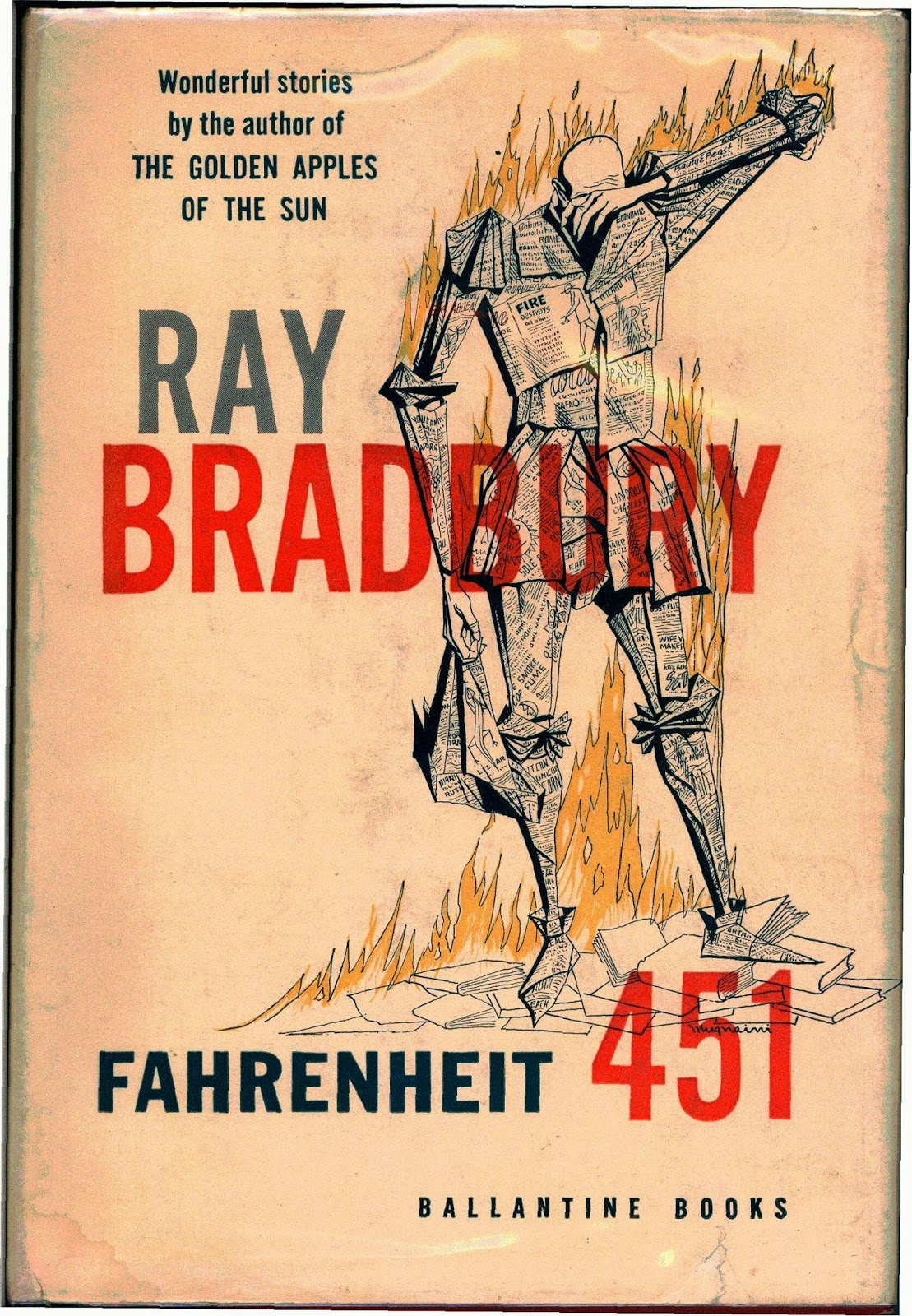
So it seems like a good time to revisit Fahrenheit 451.

I didn’t realize the first time I read it (in 2014) how much of a role the Bible plays in the story. In a book about burning books, the Book plays a prominent role. Of course, this being a 20th-century novel, the Bible is not treated as inerrant or infallible, but as something like a deep well of nourishment for our civilization and the human spirit, as a cornerstone, as something precious. This is true.

There is a loss of memory and the erasing of history. (This is one of the most recurring themes in all dystopian literature – shall we listen?). How interesting that the vast majority of the people in that society seem to be distracted by the constant presence and noise of technology and entertainment in the form of AI-powered screens that know their names and, I kid you not, wireless earbuds that have never-ending audio content. Here is an illustration of the fact that some time has to pass before one can truly say if a work is prescient. And in this regard at least, F-451 is spot on.

The effect of this technology is that people do not notice or appreciate the natural world. This is a curious fact and I’m not sure I understand the connection. Why would that kind of ubiquitous technology necessarily result in the inability or lack of interest in the material world? It is the protagonist’s new neighbour who awakens him to the beauty of nature, such as tasting the rain.

In one of the book’s most striking scenes, a house full of books is discovered and the firemen (including Montag, the protagonist) arrive and spray kerosene all over it as they prepare to burn it down. The woman in the house refuses to leave, and even strikes the match which sets the whole thing ablaze. And then in the silence of the ride back to the firehouse, this conversation takes place:

“Master Ridley,” said Montag, at last.

“What?” said Beatty.

“She said, ‘Master Ridley.’ She said some crazy thing when we came in the door. ‘Play the man,’ she said, ‘Master Ridley.’ Something, something, something.”

“‘We shall this day light such a candle, by God’s grace, in England, as I trust shall never be put out,'” said Beatty. Stoneman glanced over at the Captain [Beatty], as did Montag, startled. Beatty rubbed his chin.

“A man named Latimer said that to a man named Nicholas Ridley, as they were being burnt alive at Oxford, for heresy, on October 16, 1555.”

Fahrenheit 451, page 40.

Why would the author include this historical anecdote from the English reformation? Perhaps he saw something analogous to the spirit that animated those who murdered Latimer and Ridley starting to percolate in our own society. And perhaps he saw that the courage of Latimer would be needed before the end. Fear is contagious, but so is courage.

I happen to be writing this as the invasion of Ukraine by Russia has just started one day ago. Soldiers and civilians are dying. Fathers are putting their families on buses or taking them to the border and then returning to fight. We have already heard the story of a young soldier sacrificing himself to detonate a bridge and hinder the advance of invading troops. Courage is on display in a way that it has not been for a long time. Moral clarity seems to be returning.

All this is whirling about in my mind along with words I heard from Archbishop Charles Chaput during an interview: If there is nothing in your life that you are willing to die for, then are you really living a good life?

At the same time, tectonic shifts are taking place in our societies that many of us are struggling to grapple with. Will things continue on as they have? Or are we at the turning of an age? It feels like history has started up again, and we are waking from a dream.

So we better know our principles and our convictions. And we better be willing to stand up for them come what may. Yes, we better be willing to die for them.

A Brilliant (Largely Unknown) Passage by C.S. Lewis

When someone asks me, as a friend did not long ago, who my favorite authors are, C.S. Lewis ranks near the very top. I know that really makes me stand out from the crowd. (I didn’t plan to be so boringly typical, okay?). Aside from his best-known works, I have really enjoyed reading the collections of essays, articles, and public addresses that one can find in various formats here and there.

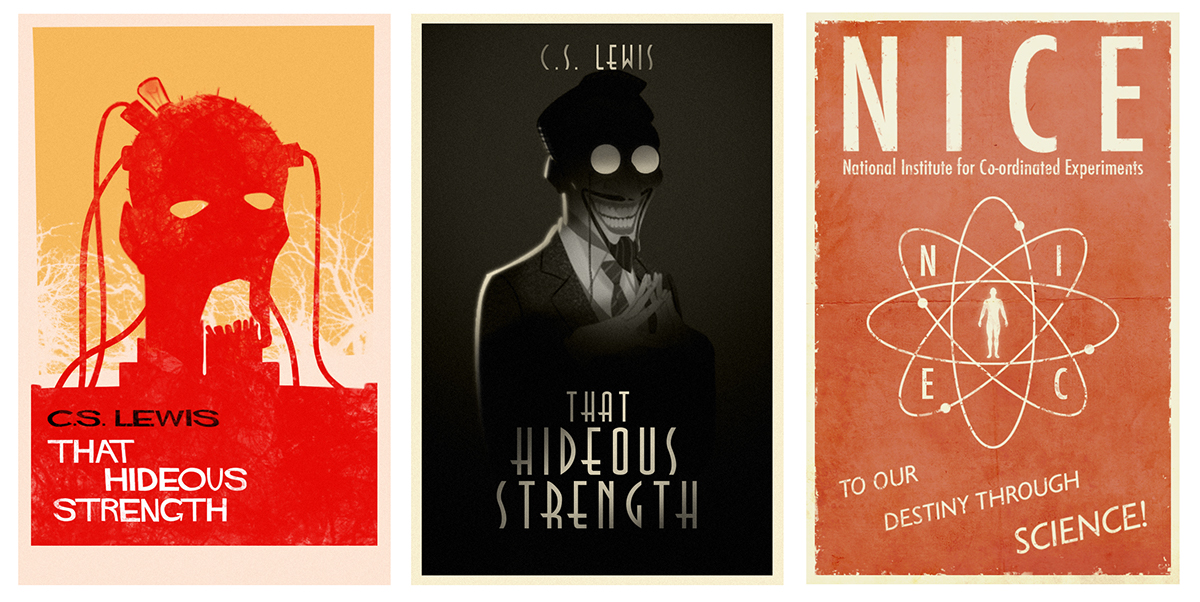
Two of the most profound and prescient of Lewis’ books are The Abolition of Man and That Hideous Strength. It has often been pointed out that what Lewis argues in the former he demonstrates with fiction in the latter. But I am a little thick, and I have often wished that Lewis had fleshed out his argument a little more in The Abolition of Man.

The Abolition of Man by C. S. Lewis

How happy I was then when I stumbled across the chapter in a little-known collection of Lewis essays called ‘Of Other Worlds,’ from which the following selection is taken, for in it Lewis explores those very themes in very clear terms, and in a way that seems to me very applicable for our own day. The selection is part of an unpublished reply to a certain Professor J. B. S. Haldane who had written a criticism of That Hideous Strength. Haldane is described by Walter Hooper in the preface as “a theoretical biologist,” a “disillusioned Marxist,” and “violently anti-Christian.” Sounds like a great guy! I tracked down his criticism of Lewis on the interwebs, and for those interested, the ‘online Yoda of Lewis’ Brenton Dickieson (A Pilgrim in Narnia) has a helpful post on it as well.

Here is the nub of Haldane’s critique:

As a scientist I am particularly interested in his attitude to my profession. There is one decent scientist in the three books, a physicist who is murdered by the devil-worshippers before we have got to know him. The others have an ideology which ranges from a Kiplingesque contempt for “natives” to pure “national socialism,” with the devil substituted for the God whose purposes Hitler claimed to carry out. As a matter of fact, very few scientists of any note outside Germany and Italy have become Fascists. In France only one, the engineer Claude, did so, though the Catholic biologist Carrel came back from the U.S.A. to support the Vichy government. A very much larger fraction of the clerical, legal, and literary professions bowed the knee to Baal.

Weston is recognisable as a scientist; Frost and Wither, the devil-worshippers, are not. They talk like some of the less efficient of the Public Relations Officers who defend Big Business, and even Mr. Lewis did not dare to assign them to any particular branch of science. At a guess I should put them as psychologists who had early deserted the scientific aspect of psychology for its mythological developments.

Mr. Lewis’s idea is clear enough. The application of science to human affairs can only lead to hell. This world is largely run by the Devil. “The shadow of the dark wing is over all Tellus,” and the best we can do is to work out our own salvation in fear and trembling. Revealed religion tells us how to do this. Any human attempts at a planned world are merely playing into the hands of the Devil.

So with that in mind, here is the passage by Lewis.

But if you must reduce the romance to a proposition, the proposition would be almost the converse of that which the Professor supposes: not ‘scientific planning will certainly lead to Hell’, but ‘Under modern conditions any effective invitation to Hell will certainly appear in the guise of scientific planning’ – as Hitler’s regime in fact did. Every tyrant must begin by claiming to have what his victims respect and to give what they want. The majority in most modern countries respect science and want to be planned. And, therefore, almost by definition, if any man or group wishes to enslave us it will of course describe itself as ‘scientific planned democracy’. It may be true that any real salvation must equally, though by hypothesis truthfully, describe itself as ‘scientific planned democracy’. All the more reason to look very carefully at anything which bears that label.

My fears of such a tyranny will seem to the Professor either insincere or pusillanimous. For him the danger is all in the opposite direction, in the chaotic selfishness of individualism. I must try to explain why I fear more the disciplined cruelty of some ideological oligarchy. The Professor has his own explanation of this; he thinks I am unconsciously motivated by the fact that I ‘stand to lose by social change’. And indeed it would be hard for me to welcome a change which might well consign me to a concentration camp. I might add that it would be likewise easy for the Professor to welcome a change which might place him in the highest rank of an omnicompetent oligarchy. That is why the motive game is so uninteresting. Each side can go on playing ad nauseam, but when all the mud has been flung every man’s views still remain to be considered on their merits. I decline the motive game and resume the discussion. I do not hope to make Professor Haldane agree with me. But I should like him at least understand why I think devil worship a real possibility.

[…]

I am a democrat because I believe that no man or group of men is good enough to be trusted with uncontrolled power over others. And the higher the pretensions of such power, the more dangerous I think it both to the rulers and to the subjects. Hence Theocracy is the worst of all governments. If we must have a tyrant a robber baron is far better than an inquisitor. The baron’s cruelty may sometimes sleep, his cupidity at some point be sated; and since he dimly knows he is doing wrong he may possibly repent. But the inquisitor who mistakes his own cruelty and lust of power and fear for the voice of Heaven will torment us infinitely because he torments us with the approval of his own conscience and his better impulses appear to him as temptations. And since Theocracy is the worst, the nearer any government approaches to Theocracy the worse it will be. A metaphysic, held by the rulers with the force of a religion, is a bad sign. It forbids them, like the inquisitor, to admit any grain of truth or good in their opponents, it abrogates the ordinary rules of morality, and it gives a seemingly high, super-personal sanction to all the very ordinary human passions by which, like other men, the rulers will frequently be actuated. In a word, it forbids wholesome doubt. A political programme can never in reality be more than probably right. We never know all the facts about the present and we can only guess the future. To attach to any party program – whose highest real claim is to reasonable prudence – the sort of assent which we should reserve for demonstrable theorems, is a kind of intoxication.

[…]

Being a democrat, I am opposed to all very drastic and sudden changes of society (in whatever direction) because they never in fact take place except by a particular technique. That technique involves the seizure of power by a small, highly disciplined group of people; the terror and the secret police follow, it would seem, automatically. I do not think any group good enough to have such power. They are men of like passions with ourselves. The secrecy and discipline of their organization will have already inflamed in them that passion for the inner ring which I think at least as corrupting as avarice; and their ideological pretensions will have lent all their passions the dangerous prestige of the Cause. Hence, in whatever direction the change is made, it is for me down by its modus operandi. The worst of all public dangers is the committee of public safety. The character in That Hideous Strength whom the Professor never mentions is Miss Hardcastle, the chief of the secret police. She is the common factor in all revolutions; and, as she says, you won’t get anyone to do her job well unless they get some kick out of it.

I must, of course, admit that the actual state of affairs may sometimes be so bad that a man is tempted to risk change even by revolutionary methods; to say that desperate diseases require desperate remedies and that necessity knows no law. But to yield to this temptation is, I think, fatal. It is under that pretext that every abomination enters. Hitler, the Machiavellian Prince, the Inquisition, the Witch Doctor, all claimed to be necessary. 

From this point of view is it possible that the professor could come to understand what I mean by devil worship, as a symbol? For me it is not merely a symbol. Its relation to the reality is more complicated, and it would not interest Professor Haldane. But it is at least partly symbolical and I will try to give the Professor such an account of my meaning as can be grasped without introducing the supernatural. I have to begin by correcting a rather curious misunderstanding. When we accuse people of devil worship we do not usually mean that they knowingly worship the devil. That, I agree, is a rare perversion. When a rationalist accuses certain Christians, say, the seventeenth-century Calvinists, of devil worship, he does not mean that they worshipped a being whom they regarded as the devil; he means that they worshipped as God a being whose character the rationalist thinks diabolical. It is clearly in that sense, and that sense only, that my Frost worship devils. He adores the ‘macrobes’ because they are beings stronger, and therefore to him ‘higher’, than men: worships them, in fact, on the same grounds on which my communist friend would have me favour the revolution. No man at present is (probably) doing what I represent Frost as doing: but he is the ideal point at which certain lines of tendency already observable will meet if produced.

The first of these tendencies is the growing exaltation of the collective and the growing indifference to persons. The philosophical sources are probably in Rousseau and Hegel, but the general character of modern life with its huge impersonal organisations may be more potent than any philosophy. 

[…]

Secondly, we have the emergence of ‘the Party’ in the modern sense – the Fascists, Nazis, or Communists. What distinguishes this from the political parties of the nineteenth century is the belief of its members that they are not merely trying to carry out a programme, but are obeying an impersonal force: that Nature, or Evolution, or the Dialectic, or the Race, is carrying them on. This tends to be accompanied by two beliefs which cannot, so far as I can see, be reconciled in logic but which blend very easily on the emotional level: the belief that the process which the Party embodies is inevitable, and the belief that the forwarding of this process is the supreme duty and abrogates all ordinary moral laws. In this state of mind men can become devil-worshippers in the sense that they can now honour, as well as obey, their own vices. All men at times obey their vices: but it is when cruelty, envy, and lust of power appear as commands of a great super-personal force that they can be exercised with self-approval. The first symptom is in language. When to ‘kill’ becomes to ‘liquidate’ the process has begun. The pseudo-scientific word disinfects the thing of blood and tears, or pity and shame, and mercy itself can be regarded as a sort of untidiness.

[Here the essay goes on for a sentence or two and then is missing at least a page.]

C.S. Lewis, “A Reply to Professor Haldane,” Of This and Other Worlds (London: William Collins & Sons, 1982), 104-109.

There’s a lot in those few paragraphs, but I will let you, the reader, take from it what you will.

The most striking quotes to me, here at the end (it’s the end, right?) of our Covid moment, are these:

The majority in most modern countries respect science and want to be planned.

The worst of all public dangers is the committee of public safety.

I would not have agreed with that first quote until this my experience of this pandemic. Regarding the second quote, notice that he does not say such a committee is illegitimate or has no reason to exist. Rather he is pointing out the possibility that public safety can be used as a vehicle for illegitimate goals. To deny that is to be stupendously naïve.

Whether and to what degree that has been the case with all this, I think time will tell.

As an Amazon Affiliate I earn a small commission from qualifying purchases of books purchased through links on my website, while customers do not pay anything extra.

A Book Fit for Any Time

Some works translate well across time, while others don’t. It’s interesting to me that intellectual and polemical works tend to be more temporally bound than spiritual literature. For example, in Augustine’s Confessions, the portions that deal with the workings of the human heart can be read profitably by any Christian, while the portions dealing with the Manichean heresies are less accessible.

Some works are simply ageless; perennially helpful. I consider this book, Backslider, by Andrew Fuller, to be such a work. This short book is wholesome spiritual food for any Christian in any age.

I believe that the editing and reprinting of classic spiritual works from centuries past is one of the most beneficial things modern publishers can do. Ressourcement is one of the great needs of the church; to feed upon nutritious truth that has stood the test of time. This short handsome volume put out by H&E Publishing (Hesed & Emet) is a great example of that. The formatting and editing helps the book to look and feel comfortably accessible for modern readers.

Oh that it and works like it would be plastered on the front page of the ChristianBook.com catalogs that I receive rather than the thin modern drivel that is usually there.

But enough slightly self-righteous moaning about the shortcomings of modern evangelical publishing and on to the content of the book. Backslider is a short book, or lengthy tract, written to counsel believers who have backslidden to some degree in their walk with God. And this means it is applicable to every believer at least once in a while. Fuller’s pastoral sensitivity is on display as he nimbly diagnoses the various causes and sources of backsliding, warns the wanderer not to presume upon any later opportunity for repentance, and sets forth the ever-merciful heart of God which welcomes any and all who repent and turn to Him by faith in Christ.

Fuller identifies five categories of backsliding: 1. Relinquishing Evangelical Doctrine (abandoning orthodox beliefs); 2. Falling into Gross Immorality (moral failure); 3. The Love of the World; 4. Conformity to the World; and 5. Political Disputes.

I’ll admit I didn’t expect #5 (Political Disputes), but it contained many a timely word for us today. Listen to this insightful comment on how revolutionary movements lead Christians astray:

The flattering objects held out by revolutionists were so congenial with the wishes of humanity, and their pretenses to disinterested philanthropy so fair, that many religious people for a time, forgot their own principles. While gazing on the splendid spectacle, it did not occur to them that the wicked, whatever name they assumed, would do wickedly.

Backslider, page 19.

He concludes in this way concerning inordinate interest in politics: “It is not only contrary to the whole tenor of the New Testament, but tends in its own nature to eat up true religion.” That is a very good and timely word for us today.

To highlight just one example of Fuller’s characteristic careful thinking and balance, consider this comment, still on the topic of politics: “Nor does the danger belong exclusively to one side. We may sin by an adherence to the measures of a government, as well as by an opposition to them.”

I promise I am trying to get to the rest of the book, but, perhaps because of the particularly tumultuous politics of the last few years, or because I stand in need of it, this last paragraph on the danger of politics seems too good to pass by:

By standing aloof from all parties and approving themselves the friends of government and good order, by whom so ever administered, Christians would acquire a dignity of character worthy of their profession. They would be respected by all, and possess greater opportunities for doing good. By a contrary conduct, they render one part of the community their enemies and the other, I fear, would derive but little spiritual advantage from being their friends.

Backslider, page 25.

Fuller goes on to examine the various symptoms that accompany backsliding, such as a departure from our first love, and a self-justifying spirit. The next chapter explores the effects of such a state. How the ‘symptoms’ differ precisely from the ‘effects’, I am not entirely sure, but folks in those days sure did love to draw tiny distinctions and make lists, so we must not be too bothered by it. On page 48 I came across a gem of a quote which captures pithily what has been a pillar in my understanding of human sin since early in my Christian life: “There is no sin committed by the most ungodly man of which the godliest is not in danger.”

That is worth reading again.

There is no sin committed by the most ungodly man of which the godliest is not in danger.

The last chapter discusses the ‘Means of Recovery’. I conclude this review with a quote from that chapter which jumped out at me for its resonance with the singular theme of John Piper’s ministry, and more importantly, with the teaching of Scripture.

Sin is not to be opposed so much directly as indirectly; not by mere resistance, but by opposing other principles to it which shall overcome it. It is not by contending with the fire, especially with combustible materials about us, that we should be able to quench it, but by dealing plentifully with the opposite element. The pleasures of sense will not be effectually subdued by foregoing all enjoyment but by drinking deeply of other pleasures, the relish of which will deaden the heart to what is opposite.

Backslider, page 80.

In other words, fight the pleasures of sin with the pleasures of God. By delighting in God, our hearts lose their taste for the small paltry pleasures that sin promises but never delivers.

I trust that by now you can see this book is worthy of reading and re-reading. I hope it finds its way into many more hands and blesses, challenges, and encourages many more hearts like it did mine.

Ivan Ilych is Alive

One of the purposes of this blog is to help people access the world of literature. (You can pronounce it the boring way, or you can do it properly, the way Michael Caine would – “litshratshurr“). I do this through book reviews and short reflections on things that I’m reading. Not only does this help me process what I’m reading, it also hopefully gives others a taste of the benefit from engaging with this material, which often feels too distant and intimidating. One of the things that compelled me to make the effort to read “the classics” was hearing how they had such an impact on others, and observing others appreciate them.

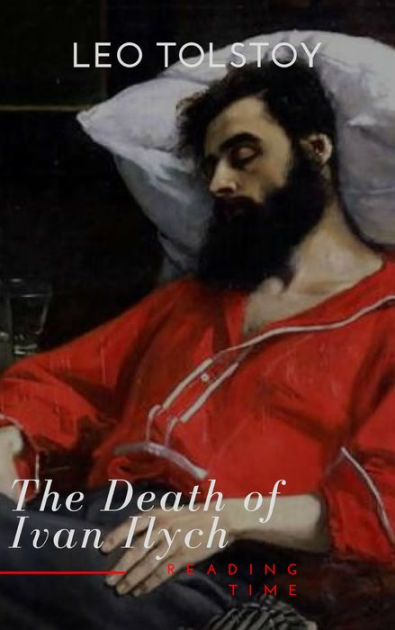
Recently I was listening to Karen Swallor Prior in discussion with Matthew Barrett on the Credo Podcast. One of the things that came up was Tolstoy’s The Death of Ivan Ilych, and that discussion prompted me to re-read it. One of the nice things about this story is that it is so short. Everyone has heard of Tolstoy, but most people do not have the courage to take on some of his better-known novels such as War and Peace (1400 pages) or Anna Karenina (950 pages).

If you would like to read it, you can download it here (I’m not sure about the quality of the translation – but hey! it’s free). Note that the following reflection contains spoilers if you haven’t read the story yet.

I am struck by the power of words, ideas, and story. In only 50 pages or so, Tolstoy harnesses that power and delivers to the reader a profound encounter with truth. One of the first things that strikes me in the story is the brutal honesty of the internal dialogue. Tolstoy gets inside the mind and around the various self-deceptions we employ and reveals what is truly there in all of its ugliness. It is done in a matter-of-fact way:

Each one thought or felt, “Well, he’s dead but I’m alive!” But the more intimate of Ivan Ilych’s acquaintances, his so-called friends, could not help thinking also that they would now have to fulfill the very tiresome demands of propriety by attending the funeral service and paying a visit of condolence to the widow.

The story reveals how hard it is to come to believe something that you really don’t want to believe, something that has profound and far-reaching implications for the verdict of how you lived your life. We oppose these kinds of paradigm-shifts in many areas of our lives because re-evaluation is costly. We are invested in our way of seeing things. Within the story this is seen in everybody’s stubborn denial of their own mortality (save for the peasant Gerasim), and especially in Ivan’s wrestling with whether he has lived a good life. There were many layers to peel away before he could get to the honest core of this question. It is only at the end of a long struggle that he breaks through his own defenses to the truth:

… the question suddenly occurred to him: “What if my whole life has been wrong?” It occurred to him that what had appeared perfectly impossible before, namely that he had not spent his life as he should have done, might after all be true. It occurred to him that his scarcely perceptible attempts to struggle against what was considered good by the most highly placed people, those scarcely noticeable impulses which he had immediately suppressed, might have been the real thing, and all the rest false. And his professional duties and the whole arrangement of his life and of his family, and all his social and official interests, might all have been false. He tried to defend all those things to himself and suddenly felt the weakness of what he was defending. There was nothing to defend.

… he saw himself—all that for which he had lived—and saw clearly that it was not real at all, but a terrible and huge deception which had hidden both life and death.

There is another dimension to this. Just like Ivan has been living in a cocoon of self-deception, the same is true for his colleagues and his family in their own ways. As mentioned above, they are all in denial about their own inevitable death. But without the harsh and inescapable pain to shock them into a sober honesty, we do not see these characters make any progress towards escaping that deception.

At the very end, in the last two or three hours of Ivan’s life, he experiences a conversion and rebirth. He breaks through into light. Tolstoy does not name Christ, but rather describes the change of heart and makes an oblique reference to God:

At that very moment Ivan Ilych fell through and caught sight of the light, and it was revealed to him that though his life had not been what it should have been, this could still be rectified. He asked himself, “What is the right thing?” and grew still, listening. Then he felt that someone was kissing his hand. He opened his eyes, looked at his son, and felt sorry for him. His wife came up to him and he glanced at her. She was gazing at him open-mouthed, with undried tears on her nose and cheek and a despairing look on her face. He felt sorry for her too.

…He tried to add, “Forgive me,” but said “Forego” and waved his hand, knowing that He whose understanding mattered would understand.

… He sought his former accustomed fear of death and did not find it. “Where is it? What death?” There was no fear because there was no death.


In place of death there was light.


“So that’s what it is!” he suddenly exclaimed aloud. “What joy!”

Modern secular readers are probably tempted to view this as a moral reformation or a kind of epiphany, but Tolstoy clearly has something deeper in mind. It is quite common in literature for the conversion of characters to be described in ways that hint at Christ but do not explicitly name him. I’m not entirely sure of the reason for this. C.S. Lewis discusses it somewhere, commenting on the habit of medieval Christians to ‘hide’ Christ in pagan themes and deities in their fiction, something he does in his writing as well.

Nevertheless, the Christian reader can recognize many (though not all) of the elements of true conversion: conviction of sin, repentance for sin, and a changed heart with new desires. Is this fictional portrayal sufficient to point others towards faith in Christ for their salvation? No. But what good fiction (and good art generally) does is faithfully represent some part of reality, it serves as a signpost on the good road. In doing so it adds one more voice to that choir made up of countless voices, singing not the same note but a great and variegated harmony.

A Voice from the Wilderness

I have been enjoying reading some of the writings of Paul Kingsnorth recently. He is a British author of some repute and has a very interesting background. Now a Christian in the Orthodox church, he was not so long ago a radical environmentalist and practicing Wiccan. I first encountered him in an interview he did with Jonathan Pageau, who is another interesting character. Kingsnorth has written for First Things here, where he details his conversion and gives the reader a taste of his style and substance. He is a gifted writer.

Paul Kingsnorth

I have a weakness for good writing, even when I find myself disagreeing with some or much of what is written. Thus I find myself reading and returning to a broad range of writers – but this I think ends up being a good thing. I am not so rootless in my own tradition that I end up being tossed to and fro, but I love to get inside the minds of those who think differently than me, or who see the world from another vantage point. Good writers are those who can express these thoughts, ideas, and insights with the most clarity and beauty. I am the better for this exposure, and the best of those insights can always be incorporated into my own thinking.

On his Substack, The Abbey of Misrule, Kingsnorth has been exploring the role of technology in modern society in a series of reflections titled Divining the Machine. It is worth reading. I’d like to draw a link between something he explores in Part Five of the series and a theme one finds throughout the writings of C.S. Lewis and J.R.R. Tolkien: the relationship between magic and science.

First, Lewis, from his (increasingly?) prescient and relevant The Abolition of Man:

There is something which unites magic and applied science while separating both from the ‘wisdom’ of earlier ages. For the wise men of old the cardinal problem had been how to conform the soul to reality, and the solution had been knowledge, self-discipline, and virtue. For magic and applied science alike the problem is how to subdue reality to the wishes of men: the solution is a technique; and both, in the practice of this technique, are ready to do things hitherto regarded as disgusting and impious—such as digging up and mutilating the dead. If we compare the chief trumpeter of the new era (Bacon) with Marlowe’s Faustus, the similarity is striking.

First Edition of The Abolition of Man

We see a fictional representation of this dynamic in Tolkiens’ The Two Towers, where the wizard Saruman constructs an industrial hellhole – or should we say a dark Satanic Mill – in and around Isengard. The key line is placed in the mouth of Treebeard, who says of Saruman:

“He is plotting to become a Power. He has a mind of metal and wheels; and he does not care for growing things, except as far as they serve him for the moment.”

That a corrupted wizard would be the one to lead in mechanization is telling. By itself it may mean nothing, but in context of Tolkien’s other writings on the subject, and those of his friend Lewis, we see that he is making a profound point. Tolkien explains this in a letter to a friend in 1951, where he describes the almost-finished Lord of the Rings as having to do, amongst other things, with The Machine:

By the [Machine] I intend all use of external plans or devices (apparatus) instead of development of the inherent inner powers or talents — or even the use of these talents with the corrupted motive of dominating: bulldozing the real world, or coercing other wills. The Machine is our more obvious modern form though more closely related to Magic than is usually recognised. . . . The Enemy in successive forms is always ‘naturally’ concerned with sheer Domination, and so the Lord of magic and machines.

I found this quote in an article by Alan Jacobs in The Atlantic

Fascinating. We do Lewis and Tolkien a great injustice when we make it seem that they were simply good writers of compelling fiction. The more one digs into their thought, the more one finds a depth of learning and reflection that informs a stunningly broad range of topics. I will now quote a somewhat lengthy section of Paul Kingsnorth’s piece (but if Rod Dreher is allowed to do it, then so am I).

The scientific worldview is leading us rapidly towards the total remaking of both humanity and non-human nature in the image of the (post) modern self. Science built the Machine. Now the Machine will rebuild the world, and us with it. As Sherrard has it:

There is a price to be paid for fabricating around us a society which is as artificial and mechanised as our own, and this is that we can exist in it only on condition that we adapt ourselves to it. This is our punishment.

Sherrard presents science as a modern enterprise built on a Christian rootstock that grew out of shape. He is not the only one to make this case, but as I was reading his book, another thought occurred to me; a thought that took me back to the time, not so long ago, when I used to practice magic.

When I say ‘magic’ I don’t mean fairground tricks; I mean the workings of what is sometimes called the Western Mystery Tradition, or, if we want to be spookier about it, the occult. The meaning of the word ‘occult’ is actually less sinister than it has been made to sound: occulted simply means hidden. A few years back, before I became, to my own surprise, an Orthodox Christian, I was a practicioner of Wicca, a nature religion founded by the eccentric Englishman Gerald Gardner back in the 1950s. Wicca is a form of modern ‘witchcraft’, though everyone involved will have a different explanation of what that word means. Being a modern path, Wicca is mostly undefined and eclectic. At its (usually American) extreme, you can basically make it up as you go along, which is why it has proved so appealing to millennial teenagers.

The Wicca I practiced was the more traditional variety: I was a member of a coven, whose workings and details were secret and into which you had to be initiated. The people in the coven were not dastardly devil-worshippers; they were basically good-hearted, interesting people looking for meaning in a society which offered none outside the marketplace. Wiccan covens do all sorts of things, but at the heart of the enterprise is the practice of magic: which, if you’re feeling mysterious or pretentious, you can spell magick.

There are all kinds of magick available to the practicing mage. There’s sympathetic magic, Hermetic magic, herbal magic, elemental magic, High (or ceremonial) magic, folk magic (or ‘cunning craft’), natural magic, Enochian magic (fun with secret Angelic languages) and – for the ultimate rush – Goetic magic, which involves the summoning of spirits to do your will. Faust, who did his famous deal with the devil, was practicing Goetia. At the heart of the practice is the notion that the spirits of the otherworld are ours to command. If we are knowledgeable, smart and well-trained enough, we can summon up the very forces of nature itself, and ‘bind’ them to our will.

Perhaps you can see where I’m going here. The history of magic in the West is a long one, but one thing it teaches is that what we call ‘magic’ and what we call ‘science’ are intertwined. Many of the pioneers of science we know today were also magicians of one sort or another. Bacon was said to be a Freemason and an alchemist. Isaac Newton wrote far more about alchemy than he did about physics, and many of the august founders of England’s Royal Society, still one of its foremost scientific institutions, were alchemists or mages. In the early modern period, today’s distinction between ‘science’ (real, good, objective) and ‘magic’ (fantastical, bad, superstitious) did not really exist. Both were branches of the same effort: to understand the mysterious forces of the universe, and ultimately to control them.

Here is Francis Bacon’s definition of science:

“The knowledge of causes and secret motions of things; and the enlarging of human empire, to the effecting of all things possible.”

And here is the occultist Aleister Crowley’s definition of magic:

The science and art of causing change to occur in conformity with the will.”

These could be swapped around without anybody really noticing. The thread that links them together is control. Both the scientific enterprise, and the magical quest which it was part of, spring from the same desire: to know the world, and to bend it to our will. Will, in both cases, is the key word. When Aleister Crowley, pioneering occultist, rampant self-publicist and self-described ‘Great Beast’, created his own occult religion, Thelema, in the early 20th century, he gave it its own famous commandment: do what thou wilt shall be the whole of the law. Thelema wilted on the vine, but we could say that Crowley’s dictum lived on as the foundational basis of what our culture has become.

At this point, any scientists reading will be protesting. No, no! they might cry; that’s not what we do at all! We’re driven only by curiosity, by wonder, by a desire to understand the world! Maybe. But science, always and everywhere, is handmaiden to technology, and technology is, in this time, never innocent. Einstein bombed Hiroshima just as surely as the pilots of the Enola Gay, and he knew it.

My point is not that all magical workings, or all scientific experiments, are bad, let alone the people who carry them out. A magician might want to perform a working aimed at bringing good luck to a friend. A scientist may be searching for a cure for cancer. But the wider project of both carries hidden within it a telos: a direction of travel. It is the direction of the Machine that now envelops us, and the new world it is building.

Read the whole thing.

Clearly there is a lot of overlap here and, I think, something profound we need to grasp. And given our – all of us – embeddedness in the Machine, something to grapple with personally. Are we giving ourselves over to the human desire for control? Is such control always bad? I wish that Kingsnorth dealt with the tension and distinction between the desire for control and the calling we have to exercise dominion over the natural world. I haven’t finished his series yet, so maybe I will find it addressed elsewhere.

One thing is for sure, the signals are coming increasingly loudly and clearly from every conceivable source that our relationship to technology is deeply unhealthy. We need thinkers and resources to help us navigate this with wisdom we do not yet possess. I commend to you the artful writing of Paul Kingsnorth, a voice in the wilderness, to stimulate your thinking in this important endeavor.

Chronological Snobbery – Part 2

In the first post on the topic of chronological snobbery we looked at what C.S. Lewis meant by the phrase and we considered two reasons for its particular prevalence in our own day. In this post I would like to explore related ideas from a thinker that has been helpful to me: René Girard.

Girard was a profound and original thinker whose work ranges over many disciplines. I am familiar with only a few small slices of that work, but some of those slices have been eye-opening. Consider his reflections on the words of Jesus in Matthew 23:29-30.

“Woe to you, scribes and Pharisees, hypocrites! For you build the tombs of the prophets and decorate the monuments of the righteous, saying, ‘If we had lived in the days of our fathers, we would not have taken part with them in shedding the blood of the prophets.’ 

Girard focuses in on the attitude of the scribes and Pharisees as they built tombs and monuments for prophets who were harassed, persecuted, and killed by their forefathers: “If we had lived in the days of our fathers, we would not have taken part with them in shedding the blood of the prophets.” He considers this as a kind of spirit, an attitude of the heart that any of us can adopt.

In the context of his broader theory of mimetic desire and the scapegoating mechanism, he describes this impulse as a mob of the living scapegoating the dead. For our purposes, we can simply say it is the attitude whereby one generation or group condemns those who came before them, exonerating themselves.

Girard points out one historical example of this in the phenomenon of Christian anti-Semitism, the kind that blames the Jews for killing Jesus. It says “if we, who are the spiritual children of Abraham, had been there when Jesus was crucified, we would not have joined the actual children of Abraham in condemning and killing Jesus. We are better than them. We alone would have resisted the mob. We would have stood by him when all had deserted him. We would have been willing to be killed with him rather than deny him.”

When one lays out what such an attitude really claims, as I did above, it starts to be seen for what it is. But usually the claim to superiority is not parsed and exposed for what it is. A claim like that is really more about the person making it than about the people he or she is supposedly superior to. At bottom, such statements are saying something like: “If everyone was as innocent as I am the world would be better. Therefore they must not be innocent like me, because someone has to be responsible for all this mess.”

Ask any high school class if they think they would have stood up against the Nazis if they had lived in Germany leading up to and during WW2. Most will say they would have resisted, which is to claim that if Germany had been populated with 21st-century North American teenagers instead of Weimar-era Germans, Hitler would not have done what he did. More pointedly, it is to claim that each of those students raising their hands, students who allow their wardrobes, attitudes, mannerisms, and vocabulary to be dictated by the passing fads and peer pressures of their social peers, yes these paragons of strict moral virtue, would have had the backbone to stand against what was an immense amount of social pressure and very real threats to their reputations, social standing, finances, and very lives.

In Romans 2:1, the apostle Paul writes “Therefore you have no excuse, O man, every one of you who judges. For in passing judgment on another you condemn yourself, because you, the judge, practice the very same things.” We live in a time when forces all around us seem to be working hard to whip up offense, outrage, and judgment towards the other. But not all judgment is the same. Some judgment is warranted and needed, but a lot of it is spiritually dangerous.

What do I mean by spiritually dangerous? Well, I mean that it is dependent on sin and it fosters sin. To judge others for what I am guilty of is to reinforce my own blindness to that sin, thereby distancing myself further from the truth about myself that might lead me to repentance and freedom. It is much harder to admit to a sin that I have clearly – and perhaps publicly – judged another for. I am less able to see it in myself when I get a kick out of pointing it out in others.

So this leaves the one judging further from the grace of humility, further from the grace of gospel sanity, further from the grace of honesty about my sin. These are graces that flow from Christ and to Christ.

When one takes this principle and applies it, what happens? It becomes very difficult to stand in judgment over our historical predecessors, because we now see that to do so is to fall into a very dangerous spiritual trap. It is the trap of saying that we are better and we would not have done what they did.

But does this rule out any and all criticism of the past? Quite the opposite: It allows for the kind of criticism that is good for us, rather than a danger. When I recognize that in the garden of my own soul grows the same root that in others bore such heinous fruit, it motivates me to weed it out. When I recognize that there is more than a little family resemblance between their sin and my own – if not in the fruit, then in the root – this encourages humility.

Indeed the effect is precisely the opposite of what self-righteous criticism produces, namely a deepening blindness with regard to my own expressions of whatever fault I am pointing out in others married to a swelling pride at being found so much superior.

The best writers of history intuitively (or perhaps intentionally) treat their subjects with this kind of moral sensitivity. They do not fall into moral relativism, which may be an enjoyable intellectual hobby for rich and comfortable Westerners, but is insufferable in the face of actual evil. Neither do they unleash a full one-dimensional moral tirade against historical villains, painting them as uniformly evil characters. Rather they preserve the humanity of both heroes and villains, allowing for nuance and being honest about the shortcomings of the heroes as well as the positive qualities of the villains, all while writing with a sense of moral clarity. This kind of history proves informative and beneficial to the reader. It is humbling, sobering, inspiring.

Moving from history to the contemporary, we can apply this idea to so many current cultural issues. For example, I see a lot of folks these days eager to tear down statues of people who, terribly flawed and implicated in evil as they may have been, are nevertheless in many ways their betters. Leaving aside the specific arguments for or against any particular monument, or even for the taking down of statues in general, I just want to point out that this kind of fury, this kind of one-dimensional judgment of those in the past, is spiritually dangerous for all the reasons described above.

To take an example from the opposite side of the culture wars, we have the phenomenon of so many conservative religious leaders who were so thundering in their denouncing of sexual immorality being revealed to be sexually immoral themselves. Zacharias, Falwell, Hybels, and the list goes on and on. We all know such failures do not happen overnight. So we have someone publicly denouncing a sin in others that they are not just struggling against but positively nurturing in their own hearts.

This can happen on the political left as much as on the right, both inside and outside the church. But from my perspective, which is admittedly conservative, it does seem to be a particularly fashionable attitude among progressives on the left these days. If you think I’m wrong about that, let me know why in the comments.