This was a fascinating biography of Jack Parsons, a pioneer of rocket science and a committed occultist. He helped found the famous Jet Propulsion Laboratory (JPL) and was instrumental in some of the earliest American advances in rocket technology, including the first time a rocket was attached to an airplane, with the JATO (Jet-Assisted Take-Off) program designed to help get heavy bombers airborne on short runways.
Parsons is interesting because he seems like a contradiction. The modern mind finds his two great interests to be at odds: science and magic. But Parsons, who was perhaps the closest thing to a successor that Aleister Crowley ever found, saw them as equivalent pursuits in different domains: namely, the exertion of the human will over created reality. On the one hand, control over the material world; on the other, over the non-material/spiritual/psychic world.
Parsons brought together what the enlightenment pulled apart.
Crowley’s life rule was to “do what thou wilt,” as clear a centering of the human will as can be imagined. What most people do not know is that Parsons was at one time very close to L. Ron Hubbard, whose bogus science of “dianetics” repackaged some of these ideas and thus was born Scientology.
A little digging reveals that many of the early pioneers of the scientific revolution were also deeply interested in spiritual, occult, and theosophical topics. See, for example, Francis Bacon, John Dee, and Isaac Newton, among others. It is Parsons, more so than the modern materialist scientist, who can be said to be their rightful heir. The drive to conquer more and more of nature has continued, with both positive and negative consequences.
Today a new front is opening up, one that strikes at the heart of what it means to be a human being: biological control. The idea is not new. It reared its head in the eugenics movement of the early 20th century. But the eugenicist dream became a Nazi nightmare, so it needed a bit of time out of the limelight and a new marketing strategy. Today the very same ideas have been repackaged as the transhumanist dream (of which transgenderism is a component), though this time with the awful power to engineer our own genetic code. The quest is still the same: exerting the will over created reality, whether with hydraulics, genetics, the surgeon’s knife, or whatever other technology we can devise. This hubristic project against nature cannot end well.
Returning to the book, I appreciated the open-handed way the author dealt with the paranormal aspects of the story. Not every author can resist the temptation to be embarrassed by the beliefs and testimonies of his or her subjects. One striking example is the experience of Parson’s lifelong friend and colleague, Edward Forman. Forman partook of Parson’s occult ceremonies countless times, that is, until the night he saw and heard what the author describes as terrifying screaming apparitions just outside the hallway window. Those in a previous era called them the screaming banshees. Forman was scared witless in that moment, and the fear never quite left him. Decades later, long after Parson’s death, Forman’s family recounts that he would sometimes ask his wife if she could hear people screaming.
Here we are at the end of another summer. It’s been a busy one for me, which will serve as my excuse for not having written here in some time. Aside from the normal demands and joys of work and family life – with the bulk of the demands coming from the work and the bulk of the joys coming from my family – I’ve been working against some deadlines for a pretty major project.
The project is a second edition of a little-known book about the history of the Fellowship of Evangelical Baptist Churches in Canada (FEBCC), or just The Fellowship for short. The book has had little readership due to its narrow focus on the subject of this denomination, a rather small one in the grand scheme of things. But when I was asked to consider taking on the project, there was a personal reason why I was drawn to say yes. When the first edition was published in 2003, it was for the 50th anniversary of this family of churches, and my mother was one of the people who worked on it. She co-wrote the chapter on Quebec and was involved with editing the whole to some degree. At the time, I was a high schooler with zero interest in church history or the projects my mom was working on, but thankfully I’ve grown up a little since then.
My mother passed away from cancer in 2012. Writing and editing is what she loved to do, and it is also what I love. This is a really meaningful connection for me, but it isn’t one we got much opportunity to share while she was alive. So when Dr. Haykin asked me in 2022 if I’d be willing to work with him on a second edition for the 70th anniversary of the Fellowship, I said yes. That was the easy part.
This summer saw the deadline for this project arrive, so naturally it meant I had to get done all the work I had procrastinated on in previous months. This meant dozens of emails back and forth with various contributors and lots of research and writing, culminating in a frenzy of productivity in the last weeks. But it’s quite amazing what you can get done when the need arises and when unbroken hours can be set aside for a focused purpose. So this project is coming to its fruition and the finished product will be presented in early November at the denominational convention, where I am expected to speak for five minutes or less about the book, or the experience of writing it, or what I learned, or something like that.
Another project came about unexpectedly in the summer: the chance to edit the text to Jonathan Pageau’s forthcoming adaptation of Snow White and the Widow Queen. I worked hard on it and am pleased that it was well received by the team at Symbolic World Press, who then asked me to continue editing the texts of the subsequent fairy tale books they are planning to publish. We’ll see where that goes, but I’m really enjoying the challenge of crafting English prose that feels ancient, mythological, and yet fully accessible to modern readers.
These projects have delayed the writing of a couple articles that I’ve had in the works for a while. But I recently finished a pretty major piece on psychedelics that I submitted to a new online outlet to see if they are interested in running it. If that goes anywhere, I’ll make sure to link to it. And then there is the second article I have been planning to write on the subject of pornography, as a follow-up to my earlier piece arguing that Pornography Poisons Everything. This second piece is meant to be a practical guide to fighting the scourge of pornography and lust in one’s personal life, and I am hoping to finish that this week or next.
Beyond that, I do need to write a book review for Glen Scrivener’s The Air We Breathe, which I am currently reading and enjoying very much. I think I will incorporate Andrew Wilson’s Remaking the World and Carl Trueman’s Strange New World into the review because together these three books cover a lot of the same ground, drawing on history to make sense of the present and give Christians tools for understanding and responding to the challenges of our age. I also would like to write a review & reflection on Christian Poetry in America Since 1940, of which I received a complimentary digital copy. I’ve been slowly reading it and trying to think of how I can say something useful about it despite not understanding much of the poetry within it.
So that’s what I’ve been up to instead of writing on this blog, but I hope to get back to more regular reflections in this space now that the big project is pretty much done. As always, thanks for reading!
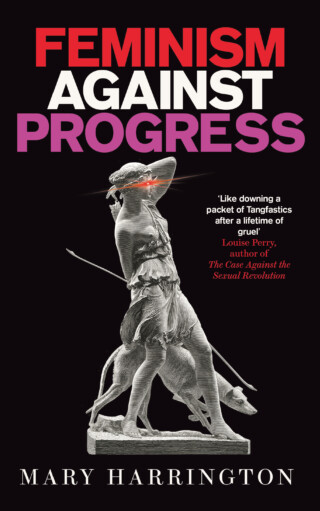
I just finished reading Mary Harrington’s new book, ‘Feminism Against Progress’. I forget exactly when I first came across her writing but it was immediately clear to me that she was not just another cultural commentator. She was willing to say things that were at odds with prevailing orthodoxies and she was clearly well-read. Plus she had a snappy style about her prose that I really liked. Having learned a little bit more about her in subsequent years, I see now why she had these qualities. She was educated at Oxford, went deep into queer theory in abstract and personal ways throughout her 20’s, and was then radically re-oriented by her experience of motherhood in her 30’s. She is one of those modern writers who has been through the swamp of post-modern ideology and emerged the other side sounding a little bit like a conservative. Well, that’s the slur typically deployed against such people; the once-faithful adherents who have abandoned the progressive enclave.
One of the most memorable phrases Harrington uses in her writing is that of meat lego gnosticism. Now that’s a phrase that needs a bit of unpacking the first time you hear it, sort of like moralistictherapeutic deism. “Say what now?” Harrington argues that the logic of the current iteration of feminism is leading our society into a tech-enabled dystopia of meat lego Gnosticism: ‘meat lego’ because we are talking about human bodies that are “liberated” from the biological constraints of gender and sexed differences, and fundamentally reduced to collections of exchangeable parts. And ‘Gnosticism’ because that ancient (and ever-present) heresy rejected the created goodness of embodied existence and made the internal (or spiritual) self the ultimate authority. So whatever I feel myself to be internally is the north star by which all other considerations are guided.
The myth of progress sold to us centers around the idea that ever greater freedom equals ever greater progress. We have equated those two concepts: freedom & progress. Therefore autonomy is prized over responsibility, and constraints are by definition to be resisted. But having achieved historically unprecedented levels of freedom and opportunity already, the modern woman is faced with the uncomfortable reality that women are not really any happier for all their gains. This is one of the book’s strengths: cataloguing all the ways in which a deep malaise haunts men and women who are beholden to this view of freedom-as-progress. So that leaves many in our culture facing the following choice. Either the fundamental promise of liberation was wrong or we just haven’t broken through enough constraints and inequalities to usher in the golden age. Folks on “the right side of history” (as they see it) are convinced it’s the latter, while Mary Harrington makes the case – rather persuasively to my mind – that it’s the former.
There are many other things to commend about this book and Harrington’s other writing in general (typically at the website UnHerd, where she is a regular contributor). She is not a conservative Christian like me, but it is precisely due to this difference of theological and cultural location that her particular insights shine brightly. She sees things differently, comes at them from different angles, and has read entirely different kinds of books. Yet I recognize in her that glimmer of common sense, of seeing the world rightly, of following the evidence when it collides with cherished beliefs, and pursuing truth at the expense of cultural capital among the bien pensants.
This book is precisely the thing to give that person in your life who has bought into all the mottos and slogans of modern feminism. This is not a conservative diatribe against feminism. Those books have their place, though usually not in convincing feminists to rethink their ideas. But this book, written from inside the feminist framework, can accomplish exactly that. And as our world hurtles ever on towards the dystopia of tech-enabled bio-libertarian meat lego gnosticism, Mary Harrington will be a thinker who will help us all to think carefully about the choices we face.
As she points out in this book, the greatest thing we may have to fight for in the coming decades is the right to remain fully and truly human.
I like the image of the bright green snake picked out by the editor, but the title I proposed fell a bit flat. I’m no expert in marketing or anything, but it seems there should be a little twist of intrigue in the title of a piece that piques the interest of the prospective reader. In my case, I just bluntly stated the thesis of my piece in three words and left it at that. No mystery. Upon further reflection, even adding a single word would have helped: How Pornography Poisons Everything. Ah, that’s better. Well, lesson learned.
Despite the title I’ve been very pleased with the engagement the piece has received, as it was linked to by the main TGC website and Twitter account as well as Tim Challies – major boosters of traffic! Such was their reach that I’ve now got a little radio interview scheduled to discuss the topic further with the fine folks at Moody Radio Florida. I expect this will consist of me trying hard not to say anything spectacularly stupid and my wife trying to keep the kids quiet while I talk into my computer.
I have been reflecting on the themes in the article for a number of years, so I am grateful that people seem to find it helpful, or at least confirming of some intuitions they held. What I tried to make clear is some of the subtle ways pornography influences individuals, families, churches, communities, and societies. I found it helpful to use a combination of Scripture and Natural Law reasoning (also known as common sense) to make this case.
I noted in the piece a shifting tide of opinion in some quarters on the question of pornography. The libertarian laissez-faire approach of “do whatever you want as long as it doesn’t hurt me” has proven disastrously inadequate for helping our society, and especially impressionable youth, deal with the wave of pornography that has multiplied proportionally with the spread of Wi-Fi and high-speed data-enabled cellphones with HD screens. And this all the more given the fact that foolish parents anxious to be liked by their teens are pushovers and give them these devices with absolutely no guardrails. Disaster.
So thoughtful people are waking up to the fact that this is noxious and dangerous stuff which is harming a whole generation recently come of age, and that wise leaders will no more allow this to go unrestricted and unregulated as they would let drug dealers open up booths in our community high schools and at local parks. Why? Because young people do not have the moral or even biological resources to muster up a strong defense against the open availability of such powerful stimulants. It’s been interesting to see secular people coming around to this realization and starting to make moral cases against not only open access to pornography for minors but the industry itself.
Another fascinating angle is the growing activism and legal challenge to the frankly criminal behavior of PornHub, the world’s biggest porn site. The lawsuits are huge, and well, money talks. It’s no exaggeration to say that there is a large amount of content on that site which not only depicts heinous crimes but is criminal itself; freely available images and videos that may someday soon be entered as incriminating evidence in a trial. Outrage over that fact should be widespread and non-political, and I have hope that awareness is growing. While we’re on the subject, perhaps you want to sign the online petition over at Traffickinghub.com.
I hope to write more about this in the future, but in the meantime I need to write the promised Part 2 where I try to offer some help for those still ensnared and enslaved to porn. Stay tuned for that in coming weeks.
This brings me to a related topic: anthropology. I know, I know – another big word which we’ve all heard before but aren’t really sure what it means.
And for my most faithful readers, this will feel like a re-run of a previous post, but I’m firmly convinced that it is a necessary word to understand the nature of the rapid transformations taking place in our time. One of the most helpful thinkers in this regard is Carl Trueman, who has made the transition from church historian to cultural critic with great success. And boy can he write. Consider for example this article just published today over at First Things, where he responds to the same controversy I alluded to in my piece, namely the statement made by Dennis Prager that pornography use and lust are not necessarily morally wrong.
Prager’s statement reveals that he lacks a real grasp of what is causing the social and political problems that he claims to abhor: We live in a time of anthropological chaos, where the very notion of what it means to be human is no longer a matter of broad social and political consensus.
Pornography is a great example of this. Behind the problems that should have been obvious to Prager—the objectification of other people, the human trafficking, the transformation of sex into something that is self- rather than other-directed, the reduction of the participants to instruments of pleasure for the spectators—lies a basic philosophy of life that sees me, my desires, and my fulfillment at the core of what it means to be human. Pornography is thus part of an anthropological shift that manifests itself most obviously in sexual mores but is far more comprehensive in its significance.
Later, he adds:
Now, sex and pornography are the most dramatic examples of where this plays out, but they do not exist in isolation from broader considerations of what it means to be a human person. Therefore those, like Prager, who see pornography as having a legitimate function are complicit in this shift. And this change underlies no-fault divorce, gay marriage, and (in its subordination of the body and its functions to the individual’s sense of well-being) even transgenderism. It is foundational to the progressive cause. To concede here is to concede everywhere.
I do encourage you to read the whole thing. This analysis goes much deeper than the moral outrage of an offended conscience and gets at the roots of what is driving a multitude of bewildering cultural phenomena. We do not need the momentary heat of Twitter-depth indignation which tempts us to feel morally self-righteous. That is cheap. But we do need the light of historically-informed thinking that sees through the chaos and confusion of the day and makes clear the deep tectonic shifts happening in our culture. That is “men of Issachar” type stuff.
I hope, in some small way, to continue making contributions to that good work. As always, thanks for reading.
I have been an avid reader and consumer of Tim Keller’s teaching since not long after my conversion to Christ in 2004. I found in him something of a kindred spirit, a person whose temperament and disposition was in many ways similar to my own, and therefore someone whom I could look at and say, “I’d like to learn how to be more like that.” I can say that Keller’s influence on me has been profound and positive. And in the interest of honesty and disclosure, I must admit that Keller and I are very close, by which I mean that I once said a brief hello to him during a large lunch gathering at a conference while he ate macaroni salad. I’m sure he has never forgotten it.
Tim Keller, probably thinking about that macaroni salad.
I therefore approached this book with a warm disposition. Despite the presentation of the book as not quite a biography, it is. Only it’s one that rightly makes no attempt to analyze Keller’s legacy. The book deepened my appreciation for his influences, many of which I was already familiar with: R.C. Sproul, Richard Lovelace, Jack Miller, Harvey Conn, Edmund Clowney, John Owen, and Jonathan Edwards.
The narrative spanned Keller’s entire life and ministry and it filled in many details that I was not familiar with, including some that weren’t so flattering, such as the persistent struggles he had leading the staff of Redeemer church before the arrival of a good executive pastor. The only part I cringed at a little bit was the mention of Francis Collins as the supposed paragon of the ‘faithful presence’ approach to cultural influence. Whatever respect I had for Collins died from the multiple gunshot wounds of this, that, and the other bullets of journalism and public facts. His role in the early days of the pandemic slandering the framers of the Great Barrington Declaration hasn’t helped either. But let’s move on from that unpleasant subject.
Like all of us, Keller’s weaknesses are the inversions of his gifts. His ability to see things from all sides, analyze them, and arrive at a mediatory solution can sometimes slip into the pitfall of false equivalency. His self-confessed disposition towards peacemaking has at times been at the cost of moral clarity. In short, he is not all that the church needs. He is not Luther, and at times we need Luthers. Much of the criticism of Keller in recent years has amounted to just that: the sense among some that the church now needs more of a blunt, Luther-like voice, and that Keller is not the man for that job. I sympathize with that sentiment, but it does not lessen for one moment my gratitude for Keller’s influence on me personally and on the church as a whole.
The church needs men and women with Keller’s uncanny ability to synthesize insights from wide-ranging sources. Rarely have I heard or read Tim Keller and not been stimulated to think more deeply and wisely, as well as to feel (or wish to feel) more affection for Christ. His greatest gift to the church has been the combination of his fertile mind and warm heart. Yet the church needs more than Tim Keller and those like him. This shouldn’t be controversial or surprising, should it? ‘The eye cannot say to the hand, “I don’t need you!” And the head cannot say to the feet, “I don’t need you!”’ (1 Cor 12:21). Likewise, the church which tries to grow into a balanced and healthy body using only one or two body parts will become anything but.
If nothing else, I hope this book encourages many readers to mine the spiritual and intellectual resources that so shaped and animated Keller’s thought. In years past I did it by scouring articles, podcasts, and footnotes, scribbling authors’ names and book titles down and looking them up later in libraries and on iTunes and Amazon. I still remember the thrill of stumbling upon all the audio lectures for Keller and Clowney’s D.Min preaching course from Reformed Theological Seminary, Preaching Christ in a Post-Modern World, on the now-defunct iTunes University platform. I then found the accompanying syllabus as a badly-scanned 188-page PDF somewhere online. For the next few weeks I soaked up the stimulating lectures while doing repetitive manual labour at my cabinet-making job. That experience alone led to permanent shifts in my understanding of sanctification, preaching, and the dynamics of sin in both the preacher’s and listener’s hearts. It was through Keller that I was introduced to Luther’s Shorter Catechism, Lovelace’s Dynamics of Spiritual Life, Edwards’ The Nature of True Virtue, Chalmers’ The Expulsive Power of a New Affection, and other gold mines.
It brings me joy to think of many others now being ushered into those rich deposits, for in them the believer discovers more of Christ and more of the Scriptures which testify to Him.
Okay, yes, I did read this glossy author-on-the-cover reality TV star’s co-written faith ‘memoir.’ Guilty as charged. As a general rule, I avoid any book with the author on the cover like a slug avoids the salt shaker. I know what I’m likely to find behind the cover: smarmy tone, bland prose, predictable writing – But! There were extenuating circumstances, your Honor. You see, my wife, whom I love, watched the Duggar show for a while (and possibly I sat beside her at various points while it was on – who can say?), and so she was interested in the book, and we were on a long road trip, and we had free access to it via Scribd, and it purported to be a kind of reverse-deconstruction of the author’s faith, a topic which has interested me for some time. So you see? Anyone would have read this book in such circumstances. Good, I’m glad we got that out of the way.
(Interested in my thoughts on Jill Duggar’s memoir, Counting the Cost? You can see a short reflection and review here.)
Frankly, I had quite low expectations, so I can say it was better than I expected. The story, in case you’re not up to speed, is that Jinger Duggar grew up in a uber-conservative subset of American evangelicalism that had many elements of your typical cult. Centered around the person and teaching of Bill Gothard, a one-time Wheaton grad and inner city youth minister, it focused heavily on external issues of morality such modest dress, courting instead of dating, having lots of children, shunning debt and mortgages, not drinking alcohol, not listening to secular music, etc. Her family had a long-running reality TV show because they had 19 kids and seemed like a strange artifact of American culture. The whole thing took a dark turn when the eldest Duggar son, Josh, was accused of molesting some sisters and eventually got caught with child pornography and was hauled off to jail where he remains. Gothard was also accused by scores of the young attractive women he staffed his headquarters with of sexual misconduct of various kinds.
Gothard’s ministry was called the Institute for Biblical Life Principles (IBLP) and the whole thing sounds to me like a giant collection of red flags literally on fire. But clearly quite a few thousand people were taken in hook, line, and sinker, so I’m sure it had a certain appeal. As with other legalistic and unbiblical religious groups, you can’t help but have a lot of compassion for the people raised in it. And it’s not surprising that a huge chunk of them leave Christianity behind completely, imagining it to be equated with what they knew growing up.
This book does a good job of drawing important distinctions between the legalism of IBLP (and ultra-conservative fundamentalism in general) and the gospel of Christ. The story, such as it is, is pretty interesting and is written in a simple, straightforward style. The narrative is interspersed with lengthy treatments of Gothard’s teaching and explanations of Jinger’s new understanding. There is a certain irony in the fact that Jinger recovers from the fundamentalism of IBLP by landing at Grace Church in California, a place which many within evangelicalism would equate with a kind of quasi-fundamentalism under the long and prominent ministry of John MacArthur. I wouldn’t totally agree with that characterization but there’s no denying that Grace is very conservative.
One thing I found particularly interesting was the author’s description of how her view of God changed as she ‘disentangled’ the beliefs she absorbed from Gothard from the truth of Scripture. I recently re-read Sinclair Ferguson’s superb ‘The Whole Christ,’ wherein he shows how legalism and antinomianism share a common rotten root, one which reaches all the way back to the garden, and that this root is a suspicion that the heart of God the Father is not one of love, mercy, and grace. So this God must be appeased with performance and religious duties lest he be angry and withhold the good things we want.
At one point, Jinger quotes Gothard as telling a woman whose life was a sinful mess that she needed to clean up her life before Christ could come into it. As Ferguson shows, this is more or less the same instinct as some in the Church of Scotland had during the Marrow Controversy and the debates over whether the gospel should be freely offered to all or only towards the truly repentent.
It is nothing less than an anti-gospel, and it enslaves rather than frees. It sees the Father as one who holds back the benefits of redemption through his Son until the person has made themselves worthy to receive them. But as Ferguson points out, this results in a grave error, the separation of Christ from His benefits, and it breeds spiritual sickness rather than health.
Rather, the Father has sent the Son because he loves us, and all who turn to Christ in repentance and faith receive Him and all the manifold gifts of redemption. The believer is united to Christ by the Holy Spirit, and Jesus is the greatest gift – for in Him are all the benefits, and through Him we are reconciled to the Father, and it is His Spirit by which we are sealed and with which we are filled.
It’s hard to overstate the distance between this rich and glorious gospel and the paltry saltine cracker ‘gospel’ of IBLP and Bill Gothard. This book made me thankful for the wonderful teaching I found and received early in my Christian life which helped me grasp not only the pulsing heart of the gospel but the grand sweep of Scripture’s united narrative, the history of redemption.
I have to say there’s a certain amount of righteous anger I feel towards the people who run these legalistic religious systems based on the Bible. I was stunned to hear that Jinger, despite having grown up in a supposedly very ‘Christian’ environment for her entire life, had never heard decent expository preaching (only proof-texting), nor an explanation of how the two Testaments fit together, nor how Christ fulfilled the law, nor had she ever heard a real God-centered emphasis on His glory and character, nor been given any sense of the historical placement of her community’s tiny slice of Christian belief within the grand scope of Christendom, nor had Romans 14 or the concept of liberty over disputable matters or the Christian conscience ever been explained to her, nor had she been shown how all of Scripture is ONE story which all culminates in Jesus. What!? Was it really all about how long skirts should be and avoiding rock music? These poor people.
I’m glad Jinger managed to disentangle that mess and find that Christ is far better. Given the size of the audience for their now-ended TV show and the toxic level of interest many Americans have towards the lives of celebrities, I’m sure it will be read by many. I think it could be helpful for some, especially those who grew up in IBLP or similar legalistic groups. If some are thereby guided towards a living faith in the real Christ through a richer understanding of the gospel, then all I have to say is: Thanks be to God.
As an Amazon Affiliate I earn a small commission from qualifying purchases of books purchased through links on my website, while customers do not pay anything extra.
The breakdown of political discourse and the crisis of legitimacy that traditional democratic institutions now face is therefore apocalyptic, in that it has unveiled this underlying, technologically fueled anthropological chaos. The “who are we?” question—always important, given that we are intentional, not merely instinctive creatures—has become the only question, no longer anchored in commitment to a notion of universal human nature, with limitations, a moral structure, and some common goal or range of common goals. Without such a foundation, without answering the “what are we” question, how can we answer the “who” question in any stable or meaningful way? How can we build any stable or coherent society?
Covid restrictions highlighted this in a painful way. Virtual Man, who works through his laptop and can thus work anywhere in general and nowhere in particular, found such restrictions to be far more reasonable than Real Man, who has to go to work in a particular time and particular place because he works with material, not virtual, reality. That is not simply a vocational divide. I would suggest it is an anthropological divide. Real Man experiences the world—and his own sense of self—in a fundamentally different way from Virtual Man. This is reflected in so many of the conflicts now straining western democracy, from the French Yellow Jackets to the rise of working-class nationalism to the Canadian truck protests. In each case, we see what Mary Harrington has dubbed the clash of the Virtuals versus the Reals. Underneath that divide lies a conflict of anthropologies between a technologically liberated view of human beings as disembodied wills who can transcend the limitations of the materiality of the world and a belief that embodiment and place are critical to survival.
For the Virtual elite, the most unforgiveable thing about the Physicals, and the physical world in general, is that they stubbornly refuse to yield to full, frictionless control. There is a reason the dominant informational class is today most comfortable in a purely virtual environment – it’s one where they can have direct, instantaneous control over (virtual) matter. Real matter is stubbornly resistant, a reminder that the self doesn’t control the universe. It’s dirty, polluting, a reminder of one’s vulnerability, even mortality. And the need to rely on other humans to deal with it is super awkward.
So expect the Virtuals of the ruling class to double down on trying to exert control, moving with all haste to develop new and innovative methods of information management and coercion to try to eliminate every human vulnerability from the machine. Self-driving truck startups are about to have an excellent next funding round.
So the farmer and the trucker get discipled into a kind of humility with regard to nature. Their relationship to the nature of the cosmos and of human behavior is such that they must adjust themselves, like a partner in a waltz, to the larger forces they reckon with and harness. The best farmers, or plumbers, or electricians, or woodworkers — all those hands-on trades — are those who best discern and adjust themselves to the raw material they handle, and the natural forces which act on that material. This willingness and ability to adjust to nature as we find it is a kind of humility which is absent from those who aim to remake the world.
Trueman’s piece is important and helpful because he focuses in on anthropology. Anthropology is the study of man – what is man? What is human nature? He traces the loss of broad agreement on the answer to those questions from the Reformation to today. He makes an important point that I am not at all convinced most Christians are clear on:
Christianity takes the material world very seriously and sees it as having an authoritative moral structure that limits how we should act. Most obviously, it sees human nature as a real, universal thing, inextricably connected to our embodiment. From identity and sex to family and community, from the private sphere to the public square, this is foundational to Christian thinking. And in a world that wishes to assert the opposite, this means that the emerging terms of membership in civil society are increasingly those that will deny Christianity and Christians the possibility of full membership.
When I was growing up, I saw the conflict between orthodox belief and the unbelieving culture in the issues of exclusivity (Jesus as the only way to salvation) and sexual morality. But then over the course of my 20’s and early 30’s it dawned on me that a more fundamental divide was emerging, that of anthropology. Trueman does a good job making that divide clear in his piece.
What first alerted me to the deep significance of one’s anthropology was the difference I observed between the ‘Christian counseling’ content I read in popular books and through some teachers at my Bible College and the ‘Biblical counseling’ content I was starting to come across from David Powlison, Paul Tripp and others at CCEF. Much of that difference boiled down to two very different ways of seeing the human person. The former approach adopted rather uncritically the concepts of secular psychology and tweaked the therapeutic advice to accord with Biblical statements. But the latter approach questioned the premises of secular psychology and sought to arrive at an understanding of human nature that was deeply informed by the Scriptures. This approach led to a deeper appreciation of the multifaceted effects of indwelling sin and of life lived in a broken world.
The writing and teaching of the folks at CCEF struck me as qualitatively different from what I had encountered in the popular Christian psychologists like Dr. Henry Cloud and Dr. Larry Crabb, though their work was still very helpful in some ways. Nevertheless, this experience settled a conviction for me that a thoroughly Biblical anthropology was crucial for building on. Simply put, it serves as the substructure for your view of sanctification and human flourishing. This experience also convinced me that this was one of the areas where regular church folks and ministry leaders had imbibed an awful lot of unbiblical assumptions from the world around them.
Fast forward to today and we find that many of the most pressing moral issues of our time are directly related to the question of human nature: transgender ideology, the dystopian dreams of the transhumanists, and the advances of AI.
Now, more than ever, the church needs to search the Scriptures diligently and gain a new level of clarity and conviction on what human nature is, what God’s intent for humanity is, and how this informs our response to the challenges that are coming at us with increasing complexity and velocity day by day.
While Trueman closes his piece with a glimmer of hope, his overall analysis is very sobering. I encourage you to read the whole thing. Here is how he wraps it up:
Yet here, perhaps, is a glimmer of hope. The reason for this is something we all intuitively know: we human beings are not simply whoever we wish to be; we are not simply disembodied wills; on the contrary, we do have a nature—a “whatness”—that cannot be indefinitely denied with impunity. We are embodied, and those bodies involve biological limits (we all die, even if we choose to self-identify as immortal) and a moral framework—we never exist in isolation but always within a network of dependence and obligation. If the time of Covid revealed anything, it revealed that most human beings still have some intuition that embodiment, and the communities of obligation and dependence that are intrinsic to our embodiment, are of critical importance to what it means to be human.
The challenge for the church, embedded as she is in this technological age, is to embody that reality in her life. The path forward is to take our coming marginalization seriously, as an opportunity, not merely a setback: an opportunity to embody in our own lives and congregations what it means to be truly human.
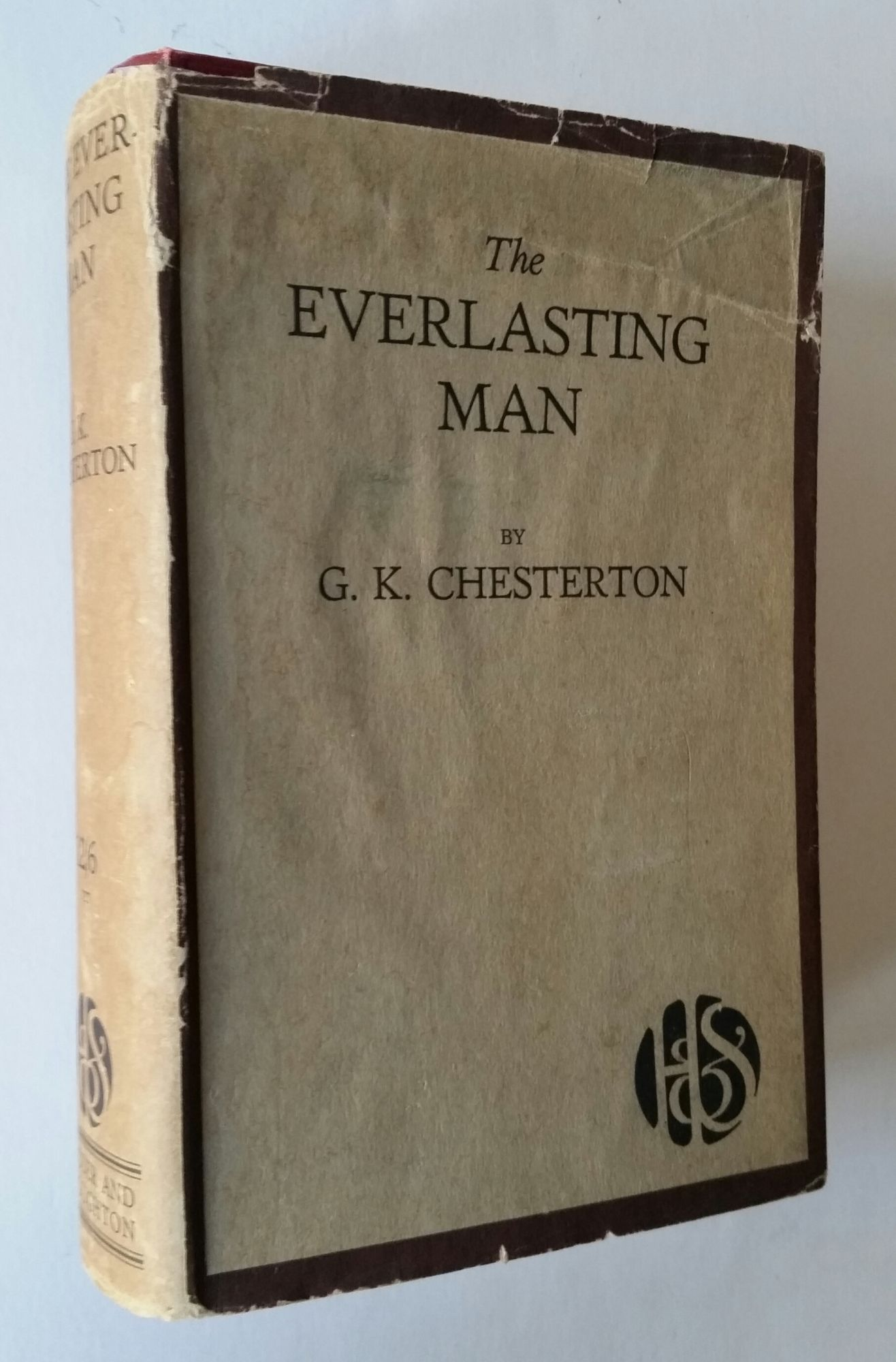
Since reading it over ten years ago, I’ve had lodged in my mind an affectionate fascination with Chesterton’s Everlasting Man. It is a kind of intellectual tour de force of the history of religious thought as only possible from Chesterton’s singular mind and from the vantage point of the early 20th century. If you have some interest in understanding how paganism relates to Christianity, or how Christianity fulfills the philosophy of the classical era, you will enjoy it.
An early edition.
But this is a Christmas post, and so I want to walk you through a few selections from the first chapter of the second half of the book. The chapter is called The God in the Cave, referring to the tradition that the stable was actually a rocky cave. In this chapter Chesterton reflects on the symbolism and meaning of Christmas, teasing out implications from it that do not naturally spring to my mind. And yet, once I read them, they have a certain logic and an undeniable power. My goal here is to deepen your appreciation for Christmas and your wonder at the incarnation.
We start with a some paragraphs about the paradox of Christmas — that of the very high and very big (God) united with the very small and very weak (a baby).
A mass of legend and literature, which increases and will never end, has repeated and rung the changes on that single paradox; that the hands that had made the sun and stars were too small to reach the huge heads of the cattle. Upon this paradox, we might almost say upon this jest, all the literature of our faith is founded. It is at least like a jest in this, that it is something which the scientific critic cannot see. He laboriously explains the difficulty which we have always defiantly and almost derisively exaggerated; and mildly condemns as improbable something that we have almost madly exalted as incredible; as something that would be much too good to be true, except that it is true. When that contrast between the cosmic creation and the little local infancy has been repeated, reiterated, underlined, emphasised, exulted in, sung, shouted, roared, not to say howled, in a hundred thousand hymns, carols, rhymes, rituals, pictures, poems, and popular sermons, it may be suggested that we hardly need a higher critic to draw our attention to something a little odd about it; especially one of the sort that seems to take a long time to see a joke, even his own joke.
… Any agnostic or atheist whose childhood has known a real Christmas has ever afterwards, whether he likes it or not, an association in his mind between two ideas that most of mankind must regard as remote from each other; the idea of a baby and the idea of unknown strength that sustains the stars. His instincts and imagination can still connect them, when his reason can no longer see the need of the connection; for him there will always be some savour of religion about the mere picture of a mother and a baby; some hint of mercy and softening about the mere mention of the dreadful name of God. …
In other words, this combination of ideas has emphatically, in the much disputed phrase, altered human nature. There is really a difference between the man who knows it and the man who does not. Omnipotence and impotence, or divinity and infancy, do definitely make a sort of epigram which a million repetitions cannot turn into a platitude. It is not unreasonable to call it unique. Bethlehem is emphatically a place where extremes meet.
It is true, isn’t it, that even after a hundred thousand hymns, that joining of divinity and infancy retains an inexhaustible power? We return to it again and again. Now we turn to a passage where Chesterton argues that Christmas turned the universe inside out, placed heaven under the earth, and in so doing set off a kind of revolution.
It might be suggested, in a somewhat violent image, that nothing had happened in that fold or crack in the great grey hills except that the whole universe had been turned inside out. I mean that all the eyes of wonder and worship which had been turned outwards to the largest thing were now turned inward to the smallest. […] But it is true in a sense that God who had been only a circumference was seen as a centre; and a centre is infinitely small. It is true that the spiritual spiral henceforward works inwards instead of outwards, and in that sense is centripetal and not centrifugal. The faith becomes, in more ways than one, a religion of little things.
…
Whether as a myth or a mystery, Christ was obviously conceived as born in a hole in the rocks primarily because it marked the position of one outcast and homeless. Nevertheless it is true, as I have said, that the cave has not been so commonly or so clearly used as a symbol as the other realities that surrounded the first Christmas. And the reason for this also refers to the very nature of that new world. It was in a sense the difficulty of a new dimension. Christ was not only born on the level of the world, but even lower than the world. The first act of the divine drama was enacted, not only on no stage set up above the sight-seer, but on a dark and curtained stage sunken out of sight; and that is an idea very difficult to express in most modes of artistic expression. It is the idea of simultaneous happenings on different levels of life. Something like it might have been attempted in the more archaic and decorative medieval art. But the more the artists learned of realism and perspective, the less they could depict at once the angels in the heavens and the shepherds on the hills, and the glory in the darkness that was under the hills. …But in the riddle of Bethlehem it was heaven that was under the earth.
There is in that alone the touch of a revolution, as of the world turned upside down. It would be vain to attempt to say anything adequate, or anything new, about the change which this conception of a deity born like an outcast or even an outlaw had upon the whole conception of law and its duties to the poor and outcast. It is profoundly true to say that after that moment there could be no slaves. There could be and were people bearing that legal title, until the Church was strong enough to weed them out, but there could be no more of the pagan repose in the mere advantage to the state of keeping it a servile state. Individuals became important, in a sense in which no instruments can be important. A man could not be a means to an end, at any rate to any other man’s end.
That last paragraph is quite something. Was the incarnation the beginning of the end for slavery? Perhaps the end was far too long in coming, but there is no question that it was a set of Christians acting on their Christian convictions who led the push to abolish slavery, not pagans or secularists. It was a Christian impulse to dignify the slave, and then to free him.
Later in the chapter he turns to mythology and philosophy, themes which he has developed in the first half of the book. So keep in mind that we are entering partway through a length discussion. Still, I think it is worth considering:
Mythology had many sins; but it had not been wrong in being as carnal as the Incarnation. But something of the ancient voice that was supposed to have rung through the graves, it could cry again, ‘We have seen, he hath seen us, a visible god.’ So the ancient shepherds might have danced, and their feet have been beautiful upon the mountains, rejoicing over the philosophers. But the philosophers had also heard.
It is still a strange story, though an old one, how they came out of orient lands, crowned with the majesty of kings and clothed with something of the mystery of magicians. That truth that is tradition has wisely remembered them almost as unknown quantities, as mysterious as their mysterious and melodious names; Melchior, Caspar, Balthazar. But there came with them all that world of wisdom that had watched the stars in Chaldea and the sun in Persia; and we shall not be wrong if we see in them the same curiosity that moves all the sages. They would stand for the same human ideal if their names had really been Confucius or Pythagoras or Plato. They were those who sought not tales but the truth of things, and since their thirst for truth was itself a thirst for God, they also have had their reward. But even in order to understand that reward, we must understand that for philosophy as much as mythology, that reward was the completion of the incomplete.
Such learned men would doubtless have come, as these learned men did come, to find themselves confirmed in much that was true in their own traditions and right in their own reasoning. Confucius would have found a new foundation for the family in the very reversal of the Holy Family; Buddha would have looked upon a new renunciation, of stars rather than jewels and divinity than royalty. These learned men would still have the right to say, or rather a new right to say, that there was truth in their old teaching. But after all these learned men would have come to learn. They would have come to complete their conceptions with something they had not yet conceived; even to balance their imperfect universe with something they might once have contradicted. Buddha would have come from his impersonal paradise to worship a person. Confucius would have come from his temples of ancestor-worship to worship a child.
You may, at this point, if you are a good evangelical Protestant like me, start to feel things are getting a bit slippery. Is he granting too much here? After all, aren’t these false religions (Confucianism, Buddhism, etc)? Yes — and whatever light and truth were or are in them cannot reconcile us to God. But I think a careful and generous reading of his argument dodges the heart of these concerns, which I share. In fact, one can see here the genesis of much of C.S. Lewis’ later apologetical approach, that of Christianity as a fulfillment of more than the Old Testament, but of everything that was good about every system of belief anywhere — rather than a repudiation of it all.
Chesterton at 17, before growing into his girth, and judging by his face, perhaps also his mirth.
Skipping down a bit, he returns to the Magi and the long history of mysticism and philosophy which they represented.
Here it is the important point that the Magi, who stand for mysticism and philosophy, are truly conceived as seeking something new and even as finding something unexpected. That tense sense of crisis which still tingles in the Christmas story and even in every Christmas celebration, accentuates the idea of a search and a discovery. The discovery is, in this case, truly a scientific discovery. For the other mystical figures in the miracle play; for the angel and the mother, the shepherds and the soldiers of Herod, there may be aspects both simpler and more supernatural, more elemental or more emotional. But the wise Men must be seeking wisdom, and for them there must be a light also in the intellect. …
The philosophy of the Church is universal. The philosophy of the philosophers was not universal. Had Plato and Pythagoras and Aristotle stood for an instant in the light that came out of that little cave, they would have known that their own light was not universal. It is far from certain, indeed, that they did not know it already. Philosophy also, like mythology, had very much the air of a search. It is the realisation of this truth that gives its traditional majesty and mystery to the figures of the Three Kings; the discovery that religion is broader than philosophy and that this is the broadest of religions, contained within this narrow space. The Magicians were gazing at the strange pentacle with the human triangle reversed; and they have never come to the end of their calculations about it. For it is the paradox of that group in the cave, that while our emotions about it are of childish simplicity, our thoughts about it can branch with a never-ending complexity. And we can never reach the end even of our own ideas about the child who was a father and the mother who was a child.
I love the description of that Christmas scene as one which is limitless in its profundity and simplicity — we shall never reach the end of it. That’s something worth pondering this Christmas as we sit by the fire after dinner. Well this has gone long enough, but I leave you with two last paragraphs near the end of this remarkable chapter. Here Chesterton puts his finger on something of the unique ethos and spirit of Christmas, and the way it takes a hold on our minds and memories like nothing else.
Christmas for us in Christendom has become one thing, and in one sense even a simple thing. But like all the truths of that tradition, it is in another sense a very complex thing. Its unique note is the simultaneous striking of many notes; of humility, of gaiety, of gratitude, of mystical fear, but also of vigilance and of drama. It is not only an occasion for the peacemakers any more than for the merry-makers; it is not only a Hindu peace conference any more than it is only a Scandinavian winter feast. There is something defiant in it also; something that makes the abrupt bells at midnight sound like the great guns of a battle that has just been won. All this indescribable thing that we call the Christmas atmosphere only hangs in the air as something like a lingering fragrance or fading vapour from the exultant explosion of that one hour in the Judean hills nearly two thousand years ago. But the savour is still unmistakable, and it is something too subtle or too solitary to be covered by our use of the word peace. …
The truth is that there is a quite peculiar and individual character about the hold of this story on human nature; it is not in its psychological substance at all like a mere legend or the life of a great man. It does not exactly in the ordinary sense turn our minds to greatness; to those extensions and exaggerations of humanity which are turned into gods and heroes, even by the healthiest sort of hero-worship. It does not exactly work outwards, adventurously, to the wonders to be found at the ends of the earth. It is rather something that surprises us from behind, from the hidden and personal part of our being; like that which can some times take us off our guard in the pathos of small objects or the blind pieties of the poor. It is rather as if a man had found an inner room in the very heart of his own house, which he had never suspected; and seen a light from within. It is as if he found something at the back of his own heart that betrayed him into good.
This book lays out ten great ways to destroy your child’s imagination. It’s like long-form satire, the opposite of the argument being the actual position of the author. Kind of like The Screwtape Letters, but less smooth in execution. Here are some of the main themes Esolen deals with: the power of truth (even just facts) for nurturing the imagination, the wonder of the outdoors, the importance of heroes and patriotism and virtue and fairy tales, the magic of romance and love, and the need for the transcendent.
Esolen is a gifted and provocative writer. He makes his points sharply and unapologetically. At times he overstates his case, but he is largely right and has much to offer anyone engaging in the bewildering activity known as parenting. And parents today are indeed bewildered. Let me give you 2 quick reasons off the top of my head.
First, we have the alienation between the generations driven by rapid cultural change. Now more than ever, every new set of adolescents feels further from their parents culturally. The common cultural touchpoints are fewer and fewer, and they increasingly live in separate worlds. This is slightly less the case in religious families but they are by no means exempt from this dynamic.
Second, the epidemic of broken families leaves new parents with no positive model to build upon. Children of divorce hesitate to get married for all kinds of reasons, but one of them is that they have no success narrative to emulate. And even more difficult to overcome are the patterns of learned attitudes and behaviors that they absorbed in dysfunctional and toxic relational environments. It’s hard to overstate how massive a challenge this is, and by contrast what an advantage a healthy two-parent still-married family history for those forming their own families. All this to say then that books on parenting are needed now more than ever.
Esolen has a firm grasp of the classics and is constantly making reference (or re-telling portions of) these foundational stories, as well as Biblical narratives and countless anecdotes from history. He throws in a bunch of C.S. Lewis for good measure. So as he’s making his points, the reader’s familiarity with these works stretches and grows. This is characteristic of all of Esolen’s writing and teaching – it is guaranteed to be a mini-seminar in the classics and liberal arts.
The highlights of the book for me were the dozens of passages where Esolen calmly dismantles the modern secular soulless approach to childhood by laying it side by side with a fully human joy-filled alternative. Reading these passages is at once inspiring and sobering, for it is impossible to miss how far we have fallen.
For anyone fully immersed in our modern world, putting these truths into practice is an exercise in swimming upstream. But it is an also an exercise in truly living. What a refreshing vision of life fully lived, with our faculties engaged and aware and amazed at the incredible world around us. As Chesterton said, “A dead thing can go with the stream, but only a living thing can go against it.”
Esolen helps every parent who wants to be fully awake to the paltry state of childhood and fully alive in pursuing something much better for oneself and for one’s children. Although the book was first published in 2010, the last few years of cultural upheaval in the West have perhaps primed a greater readership than ever for its bracing message. Parents seem to be waking up to the inadequacies of the education systems, as well as their increasing ideological bent. And with skyrocketing rates of anxiety, depression, and suicide among school-aged children, it’s hard to ignore that the kids are not alright.
It’s almost as if their imagination – and perhaps more – has been largely destroyed.
With something like 65 million copies sold worldwide, The Alchemist, by Paulo Coehlo, is a phenomenon. Whenever one finds a bestseller on this scale, there is something important to learn. The book may or may not be of much value – just think of 50 Shades or Twilight – but it always tells us something about our own culture and the spirit of the age. It’s my contention that the success of The Alchemist is a powerful indicator of the spiritual poverty of modern secularism and the pull towards re-enchantment that is at work. Ironically, this book was first recommended to me by a coworker who was a very staunch Dawkins-style atheist.
The 25th anniversary edition is very nice, with rough-cut pages, a nice font, and an embossed cover.
The book wraps its narrative around the big ideas it is trying to convey. In this sense it is overly didactic and not like the great novels which embed such lessons deep into the structure of the work. Here it is on the surface, the narrative serving as a platform on which to serve up the lessons the author wishes the reader to learn. But the story makes use of a number of archetypes that lend it narrative power.
The story follows the life of a young boy, a teenager named Santiago, who leaves his seminary studies to become a shepherd because he wants to explore the world. “But ever since he had been a child, he had wanted to know the world, and this was much more important to him than knowing God and learning about man’s sins.” (10-11). “I couldn’t have found God in the seminary, he thought, as he looked at the sunrise.”
The book freely borrows from the Bible. Melchizedek plays a prominent role, as do the Urim and Thummim stones from Israelite law. Characters refer to the story of Joseph and Jesus. Yet the Bible is seen as one religious tradition among others, all of them a kind of fractal of the Universal Language and the Soul of the World. These include Islam, alchemy, Gypsies reading omens, and fortune tellers interpreting twigs. Key phrases, like Personal Legends, are capitalized throughout to make sure we don’t miss their importance. The influence of Eastern philosophy bleeds through heavily in numerous ways, such as when we are told (more than once) that “All things are one.”
These concepts sacralize one’s life. There is undeniable power in their ability to transform one’s experience of everyday life. They are an antidote to the meaninglessness of modern secular thought: rather than the victims of random impersonal forces, we are each of us given a Personal Legend to fulfill, a purpose which was birthed deep in the Soul of the Universe, and the fulfillment of which “is a person’s only real obligation” in life (24). They are amorphous and ambiguous, which locates the authority firmly in each individual’s interpretation of their own Personal Legend – or life mission. Now here is a message custom-made for our age. Sensing the cold emptiness of rigid rationalism, we want the thrill of the supernatural. Allergic to the endless arguments over doctrine and dogma, we want a Oneness which can reconcile all differences. Terrified of any authority outside the autonomous self, we want a spiritual paradigm that evokes wonder without demanding surrender; an impersonal God-force that infuses our lives with transcendent meaning while leaving us firmly in charge.
One can see how comfortably this focus on an individualized life mission fits with the modern elevation of personal autonomy. Somehow I don’t see this teaching leading many to persevere through a difficult marriage or make sacrifices to care for an aging parent. After all, one’s only real obligation is to realize their Personal Legend. This is thin gruel indeed. Small wonder then that this book proved to be so popular with that segment of American life most famous for being ego-driven and selfish: celebrities.
Despite the Biblical language and references, at its heart the message of the book is deeply unbiblical. It borrows from the spiritual capital of the Bible’s more symbolic and flowery phrasing to construct a tower of Babel which leaves Christ very much behind. This is not uncommon in the New Age movement, where every religious tradition is mined for some compatible nuggets of spiritual wisdom. Such an approach pretends to embrace a generous openness by saying all religions see only a part of the whole picture, but really that means it alone has the objective view that incorporates all the rest. This is a claim of epistemological superiority based on sophistry. It claims to see what others are blind to, and it accomplishes it through nice-sounding but vague spiritual language about universal Oneness. This is all done with the stated intention of being very agreeable and inclusive, harmonizing all the different paths into some kind of universal spirituality, but it always does violence to the integrity of those religions to tear bits and pieces out of context and reinterpret them as needed.
We see this repeatedly in the Alchemist’s use of Biblical phrases and ideas. Three examples will suffice. At one point the protagonist is told, “Remember that wherever your heart is, there you will find your treasure.” In context, it is clear that his heart is to be followed, and that it will lead to a real or metaphorical treasure. But this advice is an inversion of the Biblical principle that it resembles: “For where your treasure is, there will your heart be also” (Matthew 6:21). Jesus’ point is that the heart of each person is revealed by what they treasure — by what they love — and that his followers ought to live in such a way that they store up treasures in heaven, not on earth. Not quite the same thing.
In another place, the shepherd boy is told, “Listen to your heart. It knows all things, because it came from the Soul of the World, and it will one day return there.” This is more self-trust than the Christian can ever allow, for we remember that bracing passage in Jeremiah: “The heart is deceitful above all things, and desperately wicked: who can know it?” (Jeremiah 17:9)
One last example, which comes at the culminating moment of the narrative: “The boy reached through to the Soul of the World, and saw that it was part of the Soul of God. And he saw that the Soul of God was his own soul. And that he, a boy, could perform miracles.” Well here we have the whole beating heart of this project laid bare, and it makes a very simple argument: that we can be as God. Or even better: in some way we are already God, if only we would realize it. What is essentially the same promise was made to Eve in the garden; “For God knows that when you eat from it your eyes will be opened, and you will be like God,” (Genesis 3:5). So here is a good reason to know one’s Bible. False teachers love to use the very words of Scripture, and even those of Jesus, to teach what is, at bottom, a satanic doctrine.
It’s not too difficult to render a critique of this spiritual-but-not-religious approach to life. But the question I asked myself as I read this book was whether this might be an improvement over strict materialism or not. I make no bones about the fact that I am Christian, and of the sort who believes what the Bible says: that salvation is found in Christ alone. But I also recognize that to view the world as The Alchemist does is closer to reality than the frigid cement bunker of atheism. It has echoes of that older and more human paganism which Lewis and Chesterton saw as pre-Christian. I wonder if a post-Christian paganism, this New Age view of universal Oneness, can lead back to Christ as readily as the old paganism eventually did. I have my hopes, but also my doubts.
The hope comes in because a non-materialist worldview makes room for a supernatural being and often seeks after some kind of spiritual connection. These are the spiritual-but-not-religious types, and I get the appeal of that approach. It leaves the door open, as it were. And yes, sometimes Christ comes through that door. But I also have my doubts because spiritual experiences can have the effect of thoroughly blinding one’s heart and pulling people deep into half-truths and deceptions. In its worst forms, it leads to the occult.
Whatever else we might say, the massive popularity of this book belies the fact that our secular age has a strong undertow of spiritual hunger. And yet the dish of choice, this amorphous New Age spirituality of universal Oneness, is one which leaves our preferred idol of the autonomous self-defined individual unchallenged.







 Phil's Scribblings