Dave Barry—Still a Clown after All these Years

Dave Barry, true to form, made fun of himself and almost everything else in his memoir. I’ve enjoyed Barry’s writing on and off over the years as I’ve come across it. This book, like many of his columns, had me bursting out with laughter. For that reason alone it was worth reading.

The more serious sections were handled with adequate solemnity, but Barry’s brand of irreverence, as funny as it is, seems inadequate to face up to the realities of the world. The ability to make everything into a joke cuts both ways, of course. It helps one get through tough times with humour and wit, but it also encourages a habit of mind and heart that ultimately undermines one’s ability to take seriously what in fact is serious.

C.S. Lewis is helpful here, lest I be accused of simply being a fun-hating curmudgeon. In the Screwtape Letters, he helpfully distinguishes between four types of laughter: joy, fun, the joke proper, and flippancy. The first two are good and harmless. Barry’s humour contains a fair amount of rejoicing in sheer fun, and this is all to the good. The joke proper relies “on [a] sudden perception of incongruity,” and this is Barry’s bread and butter. Much of the time, it is simply clever and a good deal of fun, but Lewis warns that this type of humour is especially apt to be used to destroy the healthy human instinct towards shame (Brené Brown will just have to deal with it; I’m going with Lewis on this one). Barry certainly deploys jokes in this way, though not nearly as much as so many of the most popular comedians.

The last type of laughter, flippancy, is described memorably in the following lines: “Only a clever
human can make a real Joke about virtue, or indeed about anything else; any of them can be trained to talk as if virtue were funny. Among flippant people the Joke is always assumed to have been made. No one actually makes it; but every serious subject is discussed in a manner which implies that they have already found a ridiculous side to it…. It is a thousand miles away from joy it deadens, instead of sharpening, the intellect; and it excites no affection between those who practice it.”

As much as I enjoyed the book, I did feel this kind of flippancy to be at work in Barry’s writing, and it is the part of it I enjoyed least. Perhaps it is an occupational hazard when one is in the business of comedy. The other thought that came to me was that Barry’s type of humour is particularly situated in the baby boomer generation’s experience of the world. This is not a criticism, only an observation. And it seems to me that it’s unlikely to appear again in any subsequent generation.

I grabbed the (audio)book because I wanted something light and enjoyable to listen to on my commutes that wasn’t a current events podcast riling me up about the latest unbelievable political outrage. It certainly met and exceeded my hopes for such a light and enjoyable read. If that’s what you’re looking for, Dave Barry’s memoir may be just the ticket.

Escaping the Malaise of Modernity

The opening chapter of Samuel Parkison’s ‘To Gaze Upon God’ — a work of theological retrieval for evangelicals on the beatific vision — makes a striking argument.

Parkison states that all Christians throughout history have agreed that the beatific vision — seeing God face to face — is what makes heaven heaven, it is our blessed hope. But evangelicals in the last couple centuries have largely abandoned the term, though thankfully, many have not abandoned the idea. For example, John Piper’s ministry has hammered home the idea that seeing and savouring Christ is the chief delight of the soul; C.S. Lewis’ vision of “further up and further in” forever in Aslan’s country is similar, and so on.

But then Parkison takes aim at what he calls the “fundamentalist-biblicist” approach to the Bible as fatally compromised by the spirit of the Enlightenment. “Tradition, according to the Enlightenment, is a straight jacket, confining the would-be liberated intellect to immaturity.” Sola Scriptura, he argues, was never meant to be a rejection of the “confessional, catechetical, and liturgical life” that is shaped by the wisdom of past generations.

“The contemporary antipathy for tradition that often accompanies fundamentalism and a biblicist approach to theology did not come from sola Scriptura; modernity and the Enlightenment are to blame for this aberration form historic Christianity.”

This is a bold statement. And we are only at page 6. He goes on to argue that we have been largely cut off from our historical inheritance as Christians by this Enlightenment turn, this promise of intellectual maturity that turned out to be more like the journey of the prodigal son. Seeking self-fulfillment and freedom, we’ve ended up as a culture and in much of the evangelical church at a dead end, wondering what went wrong.

In this context of modern confusion, the idea of the beatific vision “touches a nerve within the soul; a nerve for which the post-Enlightenment imagination does not even have a category.”

And here is the conclusion he drives home to conclude the section:

“The way we escape the malaise of modernity is not by embracing individualistic biblicism, for individualistic biblicism is stuck in that very same malaise. The way forward is first the way backward. We must correct our course, and theological retrieval is the way to do this.”

I find myself resonating with this line of argument, though Parkison puts a very sharp point on the matter. One of the challenges here is that not every Christian or lay leader or pastor can be (or *should* be) doing this work of retrieval. There are SO many other good things to give ourselves to.

But I am convinced we do need a broad movement within evangelical Protestantism that consciously works to retrieve the best of the small-c catholic tradition, the ‘Great Tradition’ that forms the central core of Christian belief (including philosophical substructures) in such a way that is accessible and digestible for 21st-century believers of all kinds. Thankfully, there is such a movement already underway.

I’m looking forward to what I’ll find in pages 8-214 of this book, and maybe I’ll have more to share. I expect this book will be intellectually stimulating and, more importantly, spiritually edifying.

The Long Way Home – A Review of Ashley Lande’s ‘The Thing That Would Make Everything Okay Forever’

Here is a book that tells a beautiful story in a beautiful way. And yet, there is a lot of darkness to get through before the dawn breaks. The raw honesty of Lande’s story, the power of her effervescent prose, and the drastic nature of her conversion are just some of the elements that make this book difficult to put down and impossible to forget.

For anyone interested in psychedelics, especially those drawn to spiritual illumination via that route, this book is for you. Lande speaks the language, has been down that road, done that, got the t-shirt. And she found something far, far better, in the very last place she thought to look. If I have any complaints about the book, it’s that the conversion comes late in the narrative and then the book ends a bit too abruptly, even if those last two chapters among the most moving things I’ve ever read. Before reaching the back cover, I wanted to learn a bit more about how Christ had transformed different aspects of her life and relationships that had been explored in previous chapters.

There is some debate both inside and outside the church regarding the use of psychedelics. One of the common complaints from psychedelic enthusiasts is that Christians forbid psychedelics out of some blind dogma. But rather than seeing it as a silly religious bias to avoid psychedelics, perhaps it would be better to see two different sources of very ancient spiritual wisdom. One, the Judeo-Christian heritage, teaches us that there is danger in such things, and that practices such as the ingesting of psychoactive substances put us in contact with a world of spirits that is not our assigned place. And yet Christianity fully validates that longing for a connection to the spiritual. The Scriptures make clear that this God-given hunger for the transcendent is meant to be satisfied by God himself, through Christ his Son, as mediated by the Holy Spirit.

The other ancient source of spiritual wisdom comes from those traditions who have for millennia partaken of psychoactive substances to connect with the spirit world and transcend one’s embodied consciousness. To some degree they can deliver on that promise. People can and do make contact with personal spiritual forces, and aside from the thrill of that experience, there is the added buzz that comes from knowing something that so much of society seems oblivious to. These practices make no personal moral demands. There are no ten commandments, no golden rule, no ultimate moral Judge. This makes it particularly compatible with the moral relativism of our age. Lastly, there is no creed or structure of authority like in a church, which resonates with our current cultural suspicion of authority and institutions.

We in the West are now firmly post-Christian. As we cast about for a solution to the spiritual malaise afflicting us, the last place we will tend to look is the place we think we have just been: Christianity. Haven’t we just decided we’re done with those old superstitions? So a journey to the island paradise of paganism, earth religion, eastern philosophy, or psychedelics seems to be just the thing we need for our starved souls in our disenchanted world. But we perhaps forget (or have never learned) that the best of paganism was fulfilled and transcended by Christianity, as G.K. Chesterton chronicled in his book ‘The Everlasting Man’.

For Ashley Lande, and perhaps for many others now journeying through the twists and turns of psychedelia and new age spirituality, the way home spiritually seems to include going round the whole world before arriving back and finding in Christ the Thing That Would Make Everything Okay Forever.

The Pornographers and Those who make them Rich

It is a fact universally acknowledged that great evils persist because the good men and women who could stop them do nothing. Laila Mickelwait is not one of those who do nothing, not one to stand by while evil has its way. Instead, armed with her conscience, her compassion for victims, her moral certitude, and an indefatigable fighting spirit, Mickelwait has singlehandedly brought a multi-billion dollar business to its knees under the growing weight of lawsuits, criminal investigations, and the righteous anger of an outraged public.

This is the story told in her new book, Takedown. It is an unflinching (and at times disturbing) tale of the author’s crusade against the execrable PornHub. It reads like a hybrid memoir and crime thriller. The writing is competent for the task at hand, which is telling a story dramatically from the first person perspective. Potential readers should know that Mickelwait doesn’t hold back from describing the criminal videos she discovers in her efforts to hold PornHub accountable, and for this reason the book is harrowing to read (or listen to); it’s not for the faint of heart.

A Distinction

The book, like the law, makes a distinction between ‘regular’ pornography on the one hand and criminal pornography—content involving children or non-consensual acts—on the other. This is an important moral and legal distinction, but it was striking to see just how much and how often the author took pains to assure the reader that she was not against ‘legal’ pornography. What the typical reader might not realize however is that the legality of pornography itself has always been in question, with numerous courts adjudicating the tension between free expression and obscene materials in the US and Canada in recent decades.

This insistence on the part of the author is a strong signal as to what kind of moral compass a mass-market book can assume in its audience. It is taken as a matter of fact that pornography featuring consenting adults is perfectly fine, while the non-consensual variety is a heinous evil that should be tirelessly opposed. I agree of course with the second part of the previous sentence, but what I want to point out is how much moral significance is invested into the rather thin category of consent. Can consent really serve as the north star for our morality? And do we realize just how recently, as a society, we swapped out older and deeper moral foundations for the proverbial duct tape of consent?

My own view of pornography is that it is a poison for all involved, and that this can be established without necessarily drawing on Scripture. For example, consider the words of Roger Scruton from his book, Beauty:

The old morality, which told us that selling the body is incompatible with giving the self, touched on a truth. Sexual feeling is not a sensation that can be turned on and off at will: it is a tribute from one self to another and—at its height—an incandescent revelation of what you are. To treat it as a commodity, that can be bought and sold like any other, is to damage both present self and future other. The condemnation of prostitution was not just puritan bigotry; it was a recognition of a profound truth, which is that you and your body are not two things but one, and by selling the body you harden the soul. And that which is true of prostitution is true of pornography too. It is not a tribute to human beauty but a desecration of it.

Not only is this kind of moral clarity foreign to much of our society, there is even an inversion at work such that people who hold views like mine (and yours?) are discredited from having something worthwhile to say in the public square. Don’t believe me? Consider that the main strategy of PornHub’s apologists to discredit Laila Mickelwait was the claim that she was “one of those anti-pornography crusaders.” And this accusation was countered strategically by Mickelwait listing her pro-porn bona fides.

That is really something, if you stop and think about it.

A Criminal Enterprise

The book makes it abundantly, disturbingly clear that PornHub—and one has to assume there are many websites like it—has been involved in facilitating, profiting from, and committing crimes. For years the site has employed top-shelf PR firms and marketing companies to burnish their image and present themselves in a way not unlike Playboy did in decades past; as sophisticated and a little naughty. A knowing smile and a wink, “Hey, everyone does it, right?

The dirty little secret was that the site was a rats’ nest of criminal child pornography and video evidence of serious sexual crimes—and that PornHub not only knew this but embraced it as a lucrative aspect of their business. Laila Mickelwait led the charge to uncover this reality, thus taking on one of the biggest and most profitable websites in the world. Unsurprisingly, the men who were comfortable getting rich off the life-destroying trauma of victims had no problem hacking, harassing, doxing, and threatening physical injury to Mickelwait and her family. The reality is that the owners of PornHub, just like its content, were more than just ‘a little naughty’—they were criminal and evil.

The fact that it has taken such a Herculean effort to get the authorities to treat PornHub like a criminal organization is a sad reflection on our culture’s moral confusion. And yet the book focuses in on those people who decided to do something rather than looking away, and that is a heroic act. I wholeheartedly applaud them for that, and hope that many others rise up to join them. People are clearly hungry for moral clarity and a worthy cause to fight for—here is one where even at this point in our divided culture we can still find a general consensus.

The Enablers

But what is also clear from the book is that we cannot expect corporations to do the right thing, no matter how black and white the case looks. Consider the example of the credit card giants, VISA and Mastercard. It was not enough for the VPs of these companies to be given direct evidence that PornHub was hosting illegal content, that the site was knowingly doing this, and that they were prioritizing making money off the illegal content—the traumatic sexual abuse of minors, lest we forget—over the frantic requests of those very same victims to have the videos taken down. No, all of that was not nearly enough, because large corporations tend to function like sociopaths. If there is a good chance they might get away with something immoral, even illegal, they will tend to do it, guided by the profit motive.

Don’t underestimate the almost limitless ability of people in these corporations to rationalize their behaviour away. In order for them to do the right thing, only one thing must be clearly demonstrated: that they will lose far more money or face criminal prosecution if they continue than if they stop. In VISA and Mastercard’s case, they had to be pressured intensely and relentlessly not only by customers through petitions but also by power brokers: billionaire hedge fund managers like Bill Ackman, Pulitzer-prize-winning New York Times columnists like Nicholas Kristoff, and elite lawyers armed with track records of billion-dollar settlements like Michael Bowe. These companies do not deserve any credit for “doing the right thing.”


A Failure of Education

The experience of reading this book got me thinking about what kind of people become pornographers, profiting on the exploitation of vulnerable women and boys. This question is especially poignant because of my geographical proximity to many of the people working at and leading PornHub. I grew up in the English community in the greater Montreal area, and many of my friends (and some family) have studied at Concordia, where two of the founders of PornHub first met and got their start. This reflection has connected in my mind with the larger theme of education and moral formation, which I’ve written about recently. Here is what I mean.

It’s become clear to me that as a society we have lost the ability to educate young people in a way that would have been recognizable to the great thinkers of the past: Plato, Aristotle, Augustine, Boethius, Aquinas, etc. Modern education is focused on pragmatics, utilitarianism, and increasingly aligned with the radically nominalist ideology of the LGBT movement. The goal of the modern educational approach has been: helping students get a good job and succeed in the world. That’s the pragmatic utilitarian side. Increasingly even this has been jettisoned for progressive activism in the classroom. But in contrast to both of these modern approaches, the older approach to education was about the cultivation of the virtues, forming not just the mind but the chest (to borrow from C.S. Lewis); not just right thinking, but right feeling.

Today we have almost totally lost the idea that one’s emotions and affections need to be trained, but this is something the best of our forebears knew. We tell students to look within themselves to discover what great wonderful uniqueness is just waiting to come out. A properly educated person in centuries past was trained to know and to love the good, the true, and the beautiful. We utterly abandoned this approach to education in the late 19th and early 20th century, and I would argue that this goes a long way to explain the moral decrepitude of the obviously intelligent and well-educated (in computer programming or whatever discipline) men and women working at PornHub. But in the deepest sense, these people are not educated, they are not properly formed. There is a corruption deep in the soul that is at odds with the moral fibre of the universe.

I went to school with these guys, and I recognize the type. Cut adrift from a clear moral foundation to build upon, and with all that modern life and the internet makes available within easy reach, it’s not surprising to me that so many today think nothing of consuming violent pornography or working for a company that exists to peddle and get rich off such filth—even if some of it isn’t technically illegal. It’s a toxic cocktail of nihilism, cynicism, and ennui.

While children are not morally pure, they have a beautiful innocence that can mature into a love for what is good and a hatred for evil. But the appetites are malleable, and our hearts can be drawn away towards evil in all kinds of directions, not only from outside influences, but by the evil that grows naturally in every fallen human heart. And let’s not forget the Biblical testimony about the spiritual beings who prey on the sinful human heart and lead it to ever darker domains of depravity; indeed the depth of evil and cruelty one encounters in this realm is difficult to explain without reference to the demonic.

The Troubled Conscience

One interesting theme in the book is the role of the whistleblowers and insiders, former and current PornHub employees who reach out to Mickelwait to help her. When some of the early stories about PornHub came out a few years ago, I went to a popular employer-rating website and looked up what employees were saying about PornHub. I was fascinated by the people who would admit to working there. I remember reading many complaints about the management, but the most fascinating were those who were complaining about the soul-crushing nature of the work, especially content moderation (which involves watching the worst flagged videos for 8 hours a day).

One has to wonder what kind of person agrees to this work in the first place, and then what kind of reflection takes place—some flowering sense of morality, guilt, and shame—such that they turn against their employer and partner with Mickelwait in her efforts to take it down. This offers us a lens into the human conscience. Even after it has been seared and suppressed for years, it can be awakened by the suffering of innocent people and by the proper human response: righteous moral outrage. We might even say such people are taking their first steps in their true education.

Something Dark was Let Loose

As encouraging as it is to see these criminals get their comeuppance as the lawsuits and investigations pile up, I confess this book has left me with gloomy thoughts. Why? Because by all available evidence the problems of child sexual abuse and the prevalence of pornography, especially of a violent nature, are getting worse, not better. The reason we’re talking about this is because there is an endless and insatiable market for this material, a black teeming mass of abusing and abused souls, perpetrators and victims—the pornographers and those who make them rich.

The sexual revolution promised to set free the repressed love and desire that was making unfulfilled people miserable, but considered from this vantage point, it delivered instead a spirit of unbridled desire that commodified and objectified the human person, a spirit which too often revealed itself as desiring not just the bodies of others but the suffering of others. And once set free, it has proven impossible to bind that spirit of lust and destruction. PornHub’s empire was but one large and visible manifestation of what is a far more pervasive and profound moral rot.

When the only forbidden thing is to forbid, it is the weakest, the women and children, who inevitably suffer the most. One can be forgiven for wondering if the sexual revolution was such a good idea after all, whether consent can really be the guide for our morality, and whether that older morality was not altogether better than what we’ve got now.

As an Amazon Affiliate I earn a small commission from qualifying purchases of books purchased through links on my website, while customers do not pay anything extra.

Imminent: Thoughts on Luis Elizondo’s Book and the UFO/UAP Topic

Among my many interests are a number of fringe topics, those weird subjects that exist on the edges of respectable discussion. One such topic is psychedelics, which I’ve written about quite a bit. Another one, which I have not written about much, is the whole topic of UFOs, now rebranded as UAPs (Unidentified Aerial/Anomalous Phenomenon). I’ve been quietly studying the subject for a number of years, pondering just what is going on with it, and seeing a real change in the public consciousness with regard to it. The topic has steadily been emerging from the shadows of ridiculous TV shows and late night talk radio to Senate hearings, highly decorated and credible whistleblowers from inside the military, and serious engagement by eminent scientific figures.

One of the people at the center of this shift has been Luis Elizondo, a former counter-intelligence officer who went public in December 2017 and helped release three now-infamous videos from the Pentagon that were featured in a controversial and viral New York Times front-page story. Now, seven years after that story was released and ushered in a new era of public conversation about this topic, Elizondo has just published his highly anticipated memoir called Imminent, which I listened to on audiobook. The book was standard memoir fare, competently written, and fast-paced. I won’t summarize the book’s narrative here, you’ll be able to find that elsewhere easily enough. What I’d like to do in this post is reflect on how this topic interfaces with other areas of interest, such as the metaphysical shift taking place in the West.

Imminent traces both Elizondo’s life and his efforts to bring the UFO and UAP topic to the public, out of the confines of Pentagon halls. Much of the material was familiar to me from following this topic, but there were a few surprises, such as Elizondo’s direct involvement and study of ‘Remote Viewing’—a phenomenon I have read about in David Morehouse’s book, ‘Psychic Warrior‘ and in other places. The connection between the UAP topic and Remote Viewing is the notion that reality is not reducible to material, as well as both containing within their orbits various phenomena and behaviors that is usually considered occult.

Elizondo holds the view that UAPs pose a potential threat to national security. I grant that from an intelligence and military point of view, this is the inescapable assessment. And yet Elizondo seems to dismiss out of hand those Christians within the upper levels of our intelligence and security agencies who think that there are some malevolent entities behind much of this. Those people can be ignored, in the view of Elizondo and many others, since they are only “closed-minded fundamentalists.” Maybe. Or maybe they are right—or partially right. The knee-jerk response of dismissing such convictions is interesting to me.

Christians have an intellectual inheritance, a deposit of knowledge handed down across generations that is based on the Bible, yes, but also on the collective wisdom and experience of many of the best thinkers in the past. (If your reaction to that statement is to regurgitate some New Atheist blather about superstition, dark ages, and anti-scientific religious dogma, I don’t know what to say except you haven’t done the reading and you’ve bought into a convenient narrative that ignores the actual history).

Jacques Vallée, one of the foremost experts on UFOs, understood early on that the number of parallels between UAP experiences in the modern age and demonological experiences in the medieval age—before our epistemology was artificially restrained by the enlightenment assumptions—was more than could be explained by mere coincidence. His groundbreaking book ‘Passport to Magonia‘ made this argument all the way back in 1969. He saw that there was some undeniable continuity between those strange and mystifying stories from before the scientific revolution (that the modern mind collectively relegated to the proverbial closet, out of sight) and the similarly strange, mystifying, and sometimes hellish experiences endured by members of the public and the military in the modern era.

One way of seeing the disclosure movement is as the inability of our modern culture, with its strictly materialist metaphysics, to explain or deny these paradigm-busting testimonies any longer. If you spend any time looking into this topic, you’ll find that everyone deeply steeped in it has some other worldview than reductive physicalism. It is usually some variation of Eastern mysticism, New Age, occult, panpsychism, or a ‘materialism’ that is so expansive as to be unrecognizable to someone like Dawkins.

From my perspective, the unwillingness of folks like Elizondo to take seriously the concerns of Christians who have this historically-informed perspective is a blind spot. Whether the Christians he encountered expressed their views intelligently and respectfully is impossible to know—though from his telling it doesn’t seem so. This highlights the reality that within the labyrinth of the US government are numerous factions, including at least one that has been directly involved in trying to study and weaponize occult abilities and the powers of non-human entities (the claim is that our adversaries are doing the same, which I suppose is likely true).

This may not be widely known but the evidence is frankly superabundant. The pragmatic utilitarian “if it works” argument is hard to refute within such circles where results are all that matter and where a “flexible moral framework” (read: willing to do evil that good may come) is a career asset. Another faction clearly has deep moral and spiritual misgivings about all such involvement, as can be seen in the work of Ray Boeche and Nick Redfern about the so-called ‘Collins Elite’. (You can find a lengthy critical interaction with that topic by the late Dr. Michael Heiser here.) What the public sees in the media are the faint contours of a mostly-hidden struggle between such factions, and perhaps others.

What do I think about all this? Well, it’s complex. My working thesis is that we are seeing at least two separate things. First, there are deep-black projects and technologies that are tested, witnessed, and interpreted as non-human but are just exotic and advanced. Second, there is a whole other side which is irreducibly spiritual / occult. And then there is some blurry crossover between the two that doesn’t fit neatly into either category.

One thing is for sure, this strange topic is not going away. Too much of the cat is already out of the bag, and our civilizational moment of tumult and crisis has many people re-examining their most basic assumptions about reality. That, combined with historically-low levels of trust in government and other institutions, means we are primed for momentous revelations and paradigm shifts. And perhaps, as Diana Pasulka has argued in her books ‘American Cosmic‘ and ‘Encounters‘, we are seeing the contours of an emerging religious belief system.

East of Eden by John Steinbeck- Outside the Garden, Far from the Cross

In the Salinas Valley of California, a novel was born. John Steinbeck wove together strands from his own life, the character of the land, and the first few chapters of Genesis to form a story that is epic, loaded with meaning. The book is both broad and narrow in scope; broad in its tracing of multiple generations of the two main families, the Hamiltons and the Trasks, and narrow in the way it focuses its gaze into the lives of its main characters.

The book was criticized by some as being too heavy-handed in its message. It’s true that the author does not try too hard to hide what he really believes about human nature, good and evil, and the purpose of life. And yet, Steinbeck is an excellent prose writer, and aside from a few bits of dialogue that I felt were clunky, the book holds together, flows easily, and stands as a massive achievement. I found the clarity of the message to be a positive, not a negative, and the clear allusions to Scripture gave it added depth for me.

While some might complain that the self-conscious patterning of the narrative after the Cain and Abel story betrays a lack of imagination or creativity, this objection is a characteristically modern stupidity. In previous eras, it was expected that great art would be patterned after earlier works. Authors were less originators of novel ideas and more stewards of literary traditions. As they retold the same stories, they modified and added to the tradition, making it their own to some extent, leaving their imprint upon it. Although I love creativity and originality, I think there is a particular kind of literary genius in the older kind of storytelling. And what we think of as original work is often drawing on traditions and stories we simply don’t know, so it feels fresh and new to us even though it isn’t. In fact, there is a special joy in discovering the sources that one’s favourite authors have drawn from: “Oh, that’s where she got that from.”

Steinbeck considered East of Eden to be his magnum opus. It has that kind of feel, both in its length (300,000+ words, 600 pages) and in its gravitas. There is not much levity in the book. It takes hold of the heaviest themes that trouble humanity and wrestles with them page after page. It took eleven years of gestation and one year of uninterrupted writing to complete it. Steinbeck said of it, “It has everything in it I have been able to learn about my craft or profession in all these years.” And also: “I think everything else I have written has been, in a sense, practice for this.”

One of the ways this shows up is in the little bits of wisdom Steinbeck seems to have wanted to include in the book. They adorn the narrative but are not in any way necessary to it. For example: “You can boast about anything if it’s all you have have. Maybe the less you have, the more you are required to boast.” Or, describing how some years were rich and others were lean in the Salinas Valley, “it never failed that during the dry years the people forgot about the rich years, and during the wet years they lost all memory of the dry years. It was always that way.”

The Salinas Valley in California

The book certainly deals with adult themes—prostitution and murder—but not in a prurient way. I much prefer this handling of such themes to what I encountered in Ken Follet’s Pillars of the Earth, or what sounds like a similar pornographic quality to the Game of Thrones books by George R. R. Martin. Art should be able to depict sin without tempting the reader to it; great art depicts sin in utterly realistic ways and yet manages to encourage virtue in the reader. The divorcing of art from virtue is one of modernity’s great achievements, to our profound detriment. The modern novel is often a kind of literary nihilism, depicting with indifference the beauty and filth and goodness and evil of the world, as if they were all interchangeable and, after all, who can really tell the difference?

In my reading of 20th-century literature, this amorality has often been a prominent feature. Steinbeck himself was known for it. And yet East of Eden concerns itself with good and evil as real categories, and in that sense it feels different from something like Waiting for Godot by Samuel Beckett, Slaughterhouse-Five by Kurt Vonnegut, or The Stranger by Camus. Steinbeck, who grew up Episcopalian (Anglican) but called himself an agnostic, held on to solid moral categories even as he lost the surest foundation for them. It is said that his last novel, The Winter of Our Discontent, explores the moral decline of Americans. It was not especially well received, which makes me think I might like it.


Back to East of Eden. I really enjoyed seeing how Steinbeck shaped his story to mirror the Cain and Abel narrative. But more than that, he included in the novel itself an extended reflection on the Cain and Abel story by some of the main characters, including a detailed discussion of the Hebrew translation into English of Genesis 4:7, “If thou doest well, shalt thou not be accepted? and if thou doest not well, sin lieth at the door. And unto thee shall be his desire, and thou shalt rule over him” (KJV). The crux of the matter is the last phrase. The KJV renders is “thou shalt rule over him [sin].” Now I happen to have studied this verse in some detail in Bible College during my ‘Exegetical Methods’ class, with a focus on the word translated desire. But here the focus is the verb shalt rule, transliterated as “timshal” (תִּמְשָׁל). In contrast to the KJV, the ASV rendered it do thou rule over it. In the novel, the wisest and best character, the servant Lee, rejects both of these translations because the KJV seems to promise that Cain will rule over sin, while the ASV seems to merely command it. Lee concludes that it should be rendered thou mayest rule over it. The key, for Steinbeck’s purposes, is that it is conditional, that it comes down to Cain’s choice. The consensus among all the main modern translations is that the verb should be translated as you must. I see why Steinbeck did what he did, making clear the conditional aspect that I think is nevertheless present in all the translations.

This central challenge to overcome sin and evil is what animates the drama of the book. Will the Cain-like characters give into the malicious impulses that course through their veins, or will they choose to master sin? In the novel, this struggle is personified in Cal, who learns that his mother is a sociopath, a deeply wicked and malicious person. He finds in himself a mix of malice and goodness, and this discovery tempts him to believe that he is in some way fated towards evil, or helpless in the face of it. Lee, who raised him and knows him best, discerns this and speaks directly to it:

Cal drifted toward the door, slowly, softly. He shoved his fists deep in his pockets. “It’s like you said about knowing people. I hate her because I know why she went away. I know—because I’ve got her in me.” His head was down and his voice was heartbroken.

Lee jumped up. “You stop that!” he said sharply. “You hear me? Don’t let me catch you doing that. Of course you may have that in you. Everybody has. But you’ve got the other too. Here—look up! Look at me!”

Cal raised his head and said wearily, “What do you want?”

“You’ve got the other too. Listen to me! You wouldn’t even be wondering if you didn’t have it. Don’t you dare take the lazy way. It’s too easy to excuse yourself because of your ancestry. Don’t let me catch you doing it! Now—look close at me so you will remember. Whatever you do, it will be you who do it—not your mother.”

The novel intends to leave us with the same challenge.


But for all of its moral force and Biblical pathos, the novel is Christless and devoid of redemption. (This is an observation, not necessarily a criticism.) It manages to capture the essence of life East of Eden, that is, life outside of the garden, life among the thorns. Steinbeck captures as much beauty and goodness as can be found in the created world, and I would argue he borrows heavily from the accumulated capital of Christianity in that effort, but ultimately we are left confronted with a moral law, the imperative to choose between good and evil, and the haunting sense that we have not the power to choose rightly, so powerful is the pull of sin.

Here is where a writer like Tolstoy or Dickens would, after a few hundred pages of wallowing in the deepest human misery, bring in the transformative power of love and of grace to serve as an illustration of the gospel. Steinbeck therefore reflects the exhausted and lifeless character of so much mainline Protestant Christianity in the 20th century. It reminds me of what Alan Jacobs described so movingly in his book, Original Sin, where he traced the views of human sinfulness throughout various times and cultures. He showed how many people have tried to deny the depth and severity of human sin, recasting it or ignoring it. This can be a pleasant sort of delusion. Others accepted the true nature of our depravity but then entered into the joy of salvation in Christ, who alone can solve the problem at its root by generating a new heart, new birth, and new creation within the human person. But the bleakest prospect, and the darkest literature, is produced by those who fully accept the depth of human depravity while, for whatever reason, remaining outside of Christ. These people see and feel the problem rightly but not the solution. East of Eden is firmly in this category.

What we don’t find in East of Eden is any mention of the seed of the woman, the promised one who would crush the head of serpent with bruised heel. But this shadowy figure stands above the entire Genesis narrative and alone gives it cohesion. Why was it important that Abel should live? To produce the promised snake-crusher. And contra Steinbeck’s claim in the novel, we are not the descendants of Cain, but of Seth (see Gen. 5). Yes, we have a little bit of Cain in each of us, but it’s Seth, who Eve says God has given her “in the place of Abel,” who produces both Noah and eventually the Messiah himself, Jesus.

Ultimately, it isn’t our ability to choose good over evil, to resist the sin crouching at our door, which makes the decisive difference. That choice, which we make every day to some extent, is a reflection of what is happening more deeply in our hearts, and what is happening on the vertical, spiritual plane which is all but absent in the novel.

The world-historical event that serves as the great hinge of history occurred on a hill not too terribly far from the land of Cain and Abel, on which a man who was also the Lord bled and died like Abel, murdered by his brothers. Hebrews 12:24 says that Christ’s blood “speaks a better word than the blood of Abel.” Jon Bloom explains: “For though Abel’s innocent blood cried out for justice against sin, Jesus’s innocent blood cried out for mercy for sinners. Abel’s blood exposed Cain in his wretchedness. Jesus’s blood covers our wretchedness and cleanses us from all sin.”

This may not have been Steinbeck’s understanding, but as I ponder the meaning of the magnificent work of fiction he wrote, I cannot help thanking God that he did not leave us to our own devices in the arid lands East of Eden. Rather, he made a way, through the blood of the cross, to a place even better than the Salinas Valley in the spring.

As an Amazon Affiliate I earn a small commission from qualifying purchases of books purchased through links on my website, while customers do not pay anything extra.

The Stranger by Albert Camus – The Distilled Nectar of Meaninglessness

Here is one of the quintessential 20th-century novels. Often assigned to college students as an introduction to Existentialism, it is the story (quoting from the back of the book now) “an ordinary man who unwittingly gets drawn into a senseless murder on a sun-drenched Algerian beach.” It is an exploration of, in Camus’ own words, “the nakedness of man faced with the absurd.”

It is well written, draws you in, and certainly has an unusual and distinctive feel. Perhaps more than any other novel I have read, it captured the bleakest essence of the absence of morality and meaning that characterized the post-war era, ending more or less around the passing of Queen Elizabeth II. I was struck by many things as I read it.

The protagonist, Meursault, exists in a moral vacuum. He is utterly passive in almost every situation he finds himself in, even in the face of evil. The 20th-century taught us that passivity in the face of evil is evil. Camus knew this better than you and me—he was a brave man who joined the French resistance under Nazi occupation during WW2, risking his life countless times. But rather than make any moral judgments about anything, Meursault merely finds things ‘interesting’ or not. When a moral pronouncement is made in his presence, he abdicates completely and says, “Who’s to say?” As the narrative picks up momentum, we find him saying “it doesn’t matter” (or variations of it) to all kinds of events that obviously matter very much.

Therefore everything is reduced to the absurd, the amoral meaninglessness of existence in an accidental universe. Death, abuse, lies, oppression, and murder are all meaningless. The only time we see Meursault caring about anything is when it involves his imprisonment and possible execution.

Camus once said that there was only one serious philosophical problem, and that is suicide. The fundamental question for him then was whether life is worth living or not.

I have read a number of books by these kinds of thinkers now and they all seem very brave and bold, willing to face the cold dark winds of an uncaring universe while the rest of us simpletons huddle stupidly around the warm fires of our comforting delusions. And I get that—there is certainly something seemingly absurd about life. The wise have recognized that for some thousands of years, such as the teacher in Ecclesiastes who said that everything under the sun was meaningless. But ultimately the conclusion of Ecclesiastes is quite different than anything offered by existentialist literature.

The scene where the Christian accosts Meursault is painful to read. The Christian says, “all men believe in God, even those who turn their backs on him.” I hear echoes of Romans 1. Meursault comments: “That was his belief, and if he were ever to doubt it, his life would become meaningless.” The Christian then shouts “Do you want my life to become meaningless?” It is a good scene, a good rebuke and warning. Faith can have many pathologies, such as the cringing insecurity Camus exposes in this scene. It is right for me to read that and ponder whether my faith is so fragile that it cannot abide the indifference of a Meursault.

But Camus ought to have turned the tables on himself a little. The more I read these folks, the more I am struck by the fleeting vapidity of their lives. Which of them has actually produced anything? Have they raised flourishing families of whole and happy children and grandchildren—legacies of truth flowering into maturity? Have they built lasting institutions of learning that have these great insights as foundation-stones for a growing body of wisdom and knowledge that can guide future generations? Have they taught us how to live in such a way that a society or culture based on these teachings would grow and flourish into a great civilization?

And these comforting delusions they have so confidently thrown aside, are they really without any merit? Is there no baby in that bathwater? Has enlightenment thinking really dealt a death-blow to belief in God? Or has it merely managed to create that illusion with smoke and mirrors and the bleating insistence of our cultural elites for the last two hundred years? Haven’t we witnessed a group of very brilliant people enamored with the idea and possibilities of a godless existence and the resulting emancipation from moral imperatives?

Well, you know what I think.

Camus and others tried to stave off nihilism with existentialism. Life is worth living, despite the pointlessness of everything, because it is nice to eat ice cream on a hot day, and the grass on your feet is nice, and many things are interesting. But this is like treating a 6 inch cannon-ball wound through the chest with a dab of Polysporin and grape-flavored Children’s Advil. It will not hold, and it does not hold, and we today are everywhere seeing and feeling just how badly it has not held. There is no buttress against vice, no strength to deny the self and build strong families, no roots to draw from, no meaning to guide you, and ultimately nothing to satisfy what Augustine rightly described as the restlessness of the soul. If anything, Camus shows us what it looks like to try and make your bed in that restlessness, like that dog who says “this is fine.”

 “On Fire” by KC Green

These 80 years later, with the youth of the West mired in ‘The Meaning Crisis,’ and suicide sharply on the rise, and all sorts of troubling trends on the rise, it seems clear that the bed is not very comfortable, or safe. More foreboding still is the sense that the vacuum is quickly collapsing. The nihilists and existentialists are mostly forgotten. The energy now is with a rising tide of what R. R. Reno calls the Strong Gods, which range from faceless ideologies that colonize young minds to a panoply of paganisms, including human sacrifice and contact with spiritual entities. But as I have tried to argue elsewhere, there is a heartening stream of conversions to Christianity among the currents flowing in to fill the yawning void.

I enjoyed the book, but I am so glad I am not a disciple of Camus.

The State of the Blog (What I’ve Been Up To)

Things have been quiet here at the blog, you might have noticed. Life has its way of crowding in and getting busy, doesn’t it? Work has been a couple notches busier than normal, and then I also recently was voted in to serve as an elder in my local church (again). By the way, I just signed up for the Amazon affiliates program, so that if you are so convinced by my writing to make a purchase on Amazon through a link on my site, I will become an internet millionaire through Bitcoin. I’m pretty sure that’s how it works. Anyways, moving on.

I’ve been keeping up my reading, though. I read Church Elders by Jeramie Rinne – simple and good on the topic. I finally got around to reading Rod Dreher’s Benedict Option, which I found myself resonating with. It’s a bleak perspective on the state of the West, to be sure, but I largely agree with his assessment. I also found that the loudest critiques of the book I’d heard were pretty obviously mis-readings of Dreher’s actual argument. I’ve got an idea to combine a review of it with a review of Aaron Renn’s Life in the Negative World (which is sitting on my shelf), putting the books in conversation with each other.

I also read a Canadian book called Divorcing Marriage, a collection of essays from social conservatives and lawyers from the era a generation ago in 2004 when homosexual marriage was just being pushed through the courts. It was astonishing just how much things have changed in the last twenty years. At the time, I was not politically or socially conscious. I was easily convinced by simple appeals to fairness and empathy that gay marriage regulated by the secular state was fine – it had no bearing on Christians and I could not imagine any reason why society as a whole might wish to retain a traditional view of marriage. Well, this book really helped crystalize my thinking, which I now realize was about as solid as my 100-year old barn that is half fallen over and whose beams are rotted. I hope to write something more extensive on this, we’ll see.

After finishing that I felt I was due for some classics, so I’ve read Sir Gawain and the Green Knight and the story of Percival, and I’m now reading Roger Lancelyn Green’s classic King Arthur and His Knights of the Round Table, which retells those two stories as well as many others. My son, who just turned 13, read it this year in his schooling so we’ve been able to connect over it. Lastly, I started Charles Dickens’ Great Expectations and am enjoying that as well.

Oh, I forgot, I’m also reading Thomas Watson’s The Lord’s Supper as recommended by Gavin Ortlund during his video on the topic. It’s excellent. It argues for what is known as the ‘Spiritual Presence’ view of the Lord’s supper, as a middle way between the excesses of transubstantiation and memorialism. I’ve become very interested in this topic as I’ve been thinking through re-enchantment and the church (more on which in a moment).

Did you know that both the Westminster Confession and the London Baptist Confession of 1689 took this view? Somewhere along the way the default evangelical view seems to have gotten filtered through enlightenment materialism and the supernatural was stripped out, leaving only the human-level interaction with memory and Scripture. This mere memorialism is the view explicitly laid out in the Southern Baptist document, the Baptist Faith and Message, as well as my own denomination’s Affirmation of Faith. But I haven’t been able to find out why. On the strength of which argument was the more classic reformed view replaced? I am eagerly looking forward to reading Dr. Michael Haykin’s book Amidst Us Our Belovèd Stands: Recovering Sacrament in the Baptist Tradition, which argues this point. Here is the short blurb summarizing the book:

When it comes to baptism and the Lord’s Supper, many Baptists reject the language of sacrament. As a people of the book, the logic goes, Baptists must not let tradition supersede the Bible. So Baptists tend to view baptism and Communion as ordinances and symbols, not sacraments.

But the history of Baptists and the sacraments is complicated. In Amidst Us Our Beloved Stands, Michael A. G. Haykin argues that earlier Baptists, such as Charles Spurgeon, stood closer to Reformed sacramental thought than most Baptists today do. More than mere memorials, baptism and Communion have spiritual implications that were celebrated by Baptists of the past. Haykin calls for a renewal of sacramental life in churches today—Baptists can and should be sacramental.

That’s exactly what I have been leaning towards. It marries my interest in historical retrieval & ressourcement and my desire to exhort evangelical churches to steward well the cultural movement towards re-enchantment.

I translated that desire into an article, my latest over at TGC Canada: Leaning into Evangelical Re-enchantment. If you haven’t, I hope you’ll read it. I was pleased to see Aaron Renn & Rod Dreher both linked to it at their Substacks – it’s a real blessing to a small-beans writer to get amplified and shared to much wider audiences.

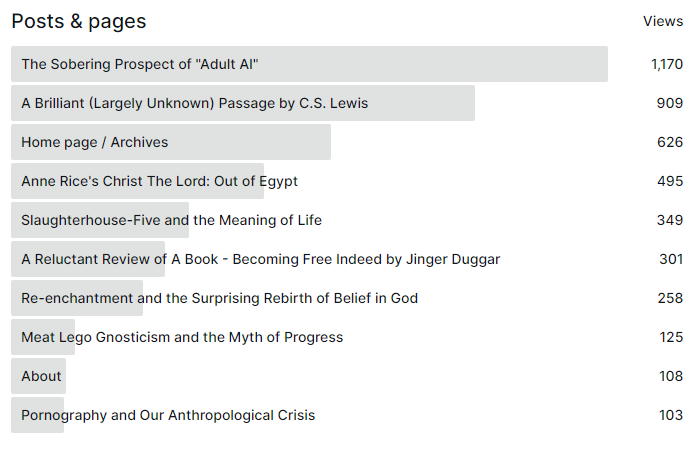
I really don’t know much of anything about internet traffic, but I have to say I have been surprised at the sustained level of reading on this here, my little blog. I have been averaging about 150 visitors and 200 views a week since early this year. This may not interest anyone, but I find it interesting. Here are my most popular posts of 2024. The #1 article, about Adult AI, was boosted by a link from Tim Challies, which also led to an interview with Moody Radio’s Kurt & Kate in the Mornings, which you can listen to if you so wish. Challies is a singular blogging phenomenon.

The #2 post, an extended quote from C.S. Lewis, has been quietly accumulating views week by week as people from all over the world find it, mostly through Google searches and perhaps links on forums. After that it seems that my reviews of popular books are of enduring interest. I would also like to add to my website here a page with links to all my published pieces elsewhere – a kind of central hub where those can be easily found.

Aside from that piece at TGCC, I have one submitted to another outlet (which I haven’t been published at before) and I am waiting to hear back from the editors. It’s another piece about psychedelics. Speaking of psychedelics, I was pleased to be interviewed by none other than Justin Brierley for his excellent documentary podcast series, The Surprising Rebirth of Belief in God. The episode on psychedelics hasn’t been released yet, but I’ll link to it when it comes out. I think I will wind down my writing on psychedelics, however – I’ve said what I had to say, and I think there are others who are better placed to continue writing for the church on this topic.

That about does it for me at this point. I’ve got some articles at various points of completion: on the Pride Rainbow compared to Vaclav Havel’s greengrocer illustration; on cathedral beauty and gospel beauty; and an article on the Haitian Christian community in Montreal which has been commissioned by Faith Today.

As always, thanks for reading.

As an Amazon Affiliate I earn a small commission from qualifying purchases of books purchased through links on my website, while customers do not pay anything extra.

Four Lessons from Writing History

“Of making many books there is no end” – Ecclesiastes 12:12

Last week I traveled to Toronto for the annual convention of my denomination, the Fellowship of Evangelical Baptist Churches in Canada – or The Fellowship for short. It was there that every delegate from around the country received a free copy of the book I’ve been working on for over a year, a revised and expanded second edition of A Glorious Fellowship of Churches, which tells the history of our little denomination. This was a collaborative effort with the esteemed historian Dr. Michael Haykin, our second such partnership. In this post I describe a bit of what that process was like and then reflect on what I took away from the experience.

These things are subjective but I think the new cover is quite nice.

As I’ve mentioned before, this was a special project for me to work on because the first edition, published in 2003, was worked on by my mother, Ginette Cotnoir, who served as the editor of the Fellowship’s magazine: then called The Evangelical Baptist and subsequently rebranded to Thrive. She worked with longtime missionary pastor Ernie Keefe on the chapter dealing with Quebec. For the second edition, updating that chapter to cover the time period from its publication in 2003 to current day (2023) was my main writing assignment. This meant interviews with several key leaders and research through annual reports, books, etc. The chapter was already quite long, so there was quite a bit of tightening up to do to make room for the new content. Then the whole thing needed a careful edit so that the narrative voice of the chapter was consistent and enjoyable to read. The main challenge there was to create a bit of distance between the narrator and the narrative. Mr. Keefe – a good and godly man – was a bit wordy and wrote in a style more reminiscent of a missionary update than a history book.

Beyond the writing, the project required a lot of communication, coordination, and editing. Each chapter needed to be expanded to cover the last twenty years, but aside from one chapter, none of the original authors were available to do the work. So this meant finding someone willing to take on the unenviable task of researching and writing a few thousand words of recent history and trying to meld it smoothly into an existing chapter written by someone else completely – with nothing but a “Thank You” and a free copy of the book to show for it. No wonder we had such a hard time finding willing souls for some of the chapters. But in the end we got contributors lined up and I gave them clear instructions as well as a deadline. All of this started well over a year ago, in August of 2022.

Once I received all the chapter updates, I simply blocked off chunks of time in the evenings and went through all the new text with a fine-toothed comb, and then the entire chapter as a whole. There was also one entirely new chapter, written by Steven Jones, the president of the Fellowship since 2011, which dealt with national ministries and how the head office has morphed and changed over the years. It was a needed addition as the first edition did not really deal with the big picture national issues at all.

The last few weeks were a blur of proofreading, sourcing pictures, and putting the finishing touches on the book. Then off to the printers it went, with no small worry in my mind that they might not actually be ready in time for the convention. I could just imagine showing up there and having to tell everyone it would be a week late. But then an email came in on the Friday, just three days before the opening day. The books had arrived! I slept well that night.

My first glimpse of the physical copies happened as I approached the registration tables to get my lanyard and nametag. Then my name wasn’t in their system, and I had to go to another table. After a few minutes, they printed one up for me, and handed me a tote bag with pamphlets and brochures for the conference, but no book. I pointed a bit sheepishly at the pile of books and asked if I could perhaps have a copy. “Sorry, the book is only for those registered as delegates.”

I was not a delegate that year, so I wasn’t sure what to say. I knew I’d be getting a free copy somehow, but I didn’t really want to plead my case at the busy registration table, so I was about to smile and walk away when my friend spoke up and told them that I had worked on it and pointed out my name on the front cover. How nice to have an advocate. So I got a copy of the book and held it in my hands, a very satisfying moment. It looks and feels great. It’s a bit thicker than we expected, but the font is quite large, with generous margins, and lots of colour pictures throughout. So while it feels a bit thick in the hand, it doesn’t feel dense, and therefore not overly intimidating.


So what did I take away from all this? Let me single out four things:

  1. The Importance of Roots

We all love a good tree analogy, do we not? Trees need strong roots. They cannot grow tall or broad without them. Christians and churches and denominations are similar. If there is a consistent weakness in evangelical Baptist groups, it is historical rootlessness. Many of us simply do not know where we came from. This was certainly the case for me growing up. And although this was probably exacerbated by the unusual context of my upbringing, being a part of a church filled with first-generation Christians coming out of a dead French-Canadian Catholicism, it is still a defining feature of evangelicals more broadly. This explains to some part the exodus from evangelicalism to Roman Catholicism, Eastern Orthodoxy, and Anglicanism – three branches of Christianity which emphasize their historical continuity far more than we do.

This was illustrated powerfully by a comment made by Dr. Haykin during a workshop session he gave at the conference. He described how, upon coming to Christ as a young man through the ministry of Stanley Park Baptist Church in Hamilton, he asked his leaders: “Where do Baptists come from?!” But he received no real compelling answer, aside from a suggestion that maybe the folks at Wycliffe College could help him, and that set him on the path to becoming one of the foremost Baptist church historians in the world.

This rootlessness has driven a lot of my own reading and intellectual curiosity over the last two decades. I’ve become convinced that within historic Protestantism, which is in continuity with the best of the ancient and medieval church, we have abundant resources for growing deep, healthy roots. So the problem is not a lack of nutrients but the prevailing alienation from those nutrients and, even worse, an attitude that assumes that the modern church has no need for all that old stuff.

Working on this book reminded me in a fresh way how stabilizing and encouraging it can be to discover one’s roots. The history of the churches that make up the Fellowship in some cases go back to the 18th and 19th centuries. The list of faithful men and women who built and sustained all those churches is long, and we shuffle onto the stage in their wake, holding their props, and seeking to carry on the faithful work they left us. Each new generation receives this legacy from the one before. And that, if it sinks down deep, helps us chart a path that is straight and true.

2. The Nearly-Forgotten Faithful

There are a few names in church history that everybody knows: Augustine, Aquinas, Luther, Whitefield, Spurgeon, Billy Graham. We continue to read and write books about them because of their compelling personalities and the momentous nature of their ministries. But for each of us, there is another, closer set of ancestors – locally, regionally, and nationally – who more directly shaped the church family in which we find ourselves. It is good and right for us to make the effort to remember these men and women. Unlike with Luther and Augustine, if we don’t remember them, no one will. As the spiritual descendants of these saints, it is our responsibility to remember them, to rehearse the works God did through them, and to honour their memory. This seems to me to flow naturally out of the repeated chorus we find throughout the Old Testament to remember the works of God in previous generations.

I’m so glad to have been a part of writing a history of The Fellowship, for I think it helps preserve the health and future of that movement of churches. It helps us remember who we are, and what we’re a part of. The narrower scope means that the book won’t sell thousands of copies, that’s true, but I think it has the potential to have a deeper impact on those who are part of The Fellowship as a result of that narrower focus.

3. The Forgotten Faithful

But here is the reality that we all must embrace: the vast majority of God’s people are, in a human sense, utterly forgotten within a short period of time after their death. This was a curious effect of my research and reading. As I came across name after name I had never heard of before, it impressed upon my mind the reality that there was simply no end to the names or the stories. I could never hear all of them, know all of them, or capture them rightly in words. And yet each of them played their parts through prayer and service and teaching and outreach and building and sowing and reaping, no less than anyone else.

Friends, this is going to be case with you and me, almost certainly. Few will make it into whatever history books are written, and that’s okay. As I heard it put many years ago, there will be only one name lifted high in the new heavens and new earth, and it won’t be yours or mine. The sooner we get on board with that, the better.

4. Don’t Live for the Next Achievement

If you had told me three years ago that I would have gotten multiple articles published and edited a couple of books with real publishers I would hardly have believed it was possible. I had wanted to explore the writing and publishing world for years, but never really saw how that could happen. So I find myself both deeply grateful for these opportunities and also sobered by the fact that the buzz I get from every new venture doesn’t last long.

Thankfully, I am not looking to my writing and editing to give my life meaning; it already has that. I get a joy from using my gifts and all the usual human sensations that come with trying your hand at something new and getting positive feedback. And on the flip side, when that new article is submitted to a new outlet or the new book manuscript sits almost finished but unsent to the publisher, there’s a typical insecurity wondering if it’s any good at all. This is par for the course for writers (and a recurring joke – Anne Lamott’s writing is pretty hilarious on this point). I hate to think how neurotic I would be if I was looking to these kinds of achievements to give my life meaning or secure my identity.

Let me close with an application of this truth. It may not be writing in your life, but maybe there’s some next thing that you’re aiming for and investing just a little too much security and joy into. Maybe it’s a new ministry position, a new relationship, a new church, a work promotion, or even a new car. Well, get ready to be disappointed. None of these things can fill our cup to overflowing.

But there is something which can: a living union with the risen Christ through the Holy Spirit; knowing and being known by God our exceeding joy.


(Update: The book is available to purchase via this link: https://www.fellowship.ca/GloriousFellowship70thAnniversaryEdition)

Anne Rice’s Christ The Lord: Out of Egypt

I came across this paperback copy of the late Anne Rice’s novel in a thrift store. I had heard about it some years ago and knew she was a popular author, though I had never read anything by her. I’m not really into the whole vampire genre, which she was best known for. It seems that this novel, and the subsequent books in the series, were a departure for her. Rice was a boomerang Catholic, raised in a strict Irish Catholic community until college, at which point she left it all behind and drew on the deposit of Christian ideas and images only to adorn her novels. But then she says she lost faith in her atheism. Her old skeptical certainties started to crumble, leading eventually to a full-hearted return to Catholicism and to belief in Christ. Rice says that she then devoted her subsequent writing efforts to portraying the life of Christ, and this book was the first fruit of that endeavour.

So what about this book, then? Well, it’s a bit difficult to rate. Like most readers, I come to the book with some preconceived notions about the person and life of Christ. But this is not like a book about Caesar, who I also have some notions about. Christ is a singular figure, and for Christians like myself, he steps out of history and into the depths of my inner being. I say this to underline the fact that it’s not possible to sit down and read this book like I might read any other piece of historical fiction. So perhaps I’m not really the ideal audience for this book, seeing as I already have strong convictions about Jesus; perhaps the book is better suited to moderns who think they know who Jesus was, swayed by modern liberal scholarship that claims to have scientifically determined the truth about the Jesus myth. More on that liberal scholarship in a bit.

The book opens in Egypt, with a seven year old Jesus living with his family in Alexandria. The plot follows the family’s migration out of Egypt and back to Israel, featuring brushes with both Israelite zealots and ruthless Roman soldiers. The central intrigue surrounds the unanswered questions that young Jesus has about his early childhood. He knows there was something special about his birth, and he knows that something happened in Bethlehem. The plot then develops as he puts together the pieces and grows in his self-understanding.

The prose is, if I’m honest, a bit clunky and bare. It’s not a book that draws you in by it’s beautiful descriptions or its eloquence. Was this an intentional choice, trying to capture the inner voice of this special 7-year old child? I don’t know, but aside from a couple of moments in the book where Jesus was interacting with some of the Rabbis and teachers, the character didn’t really sound or feel like the Jesus of the Scriptures. But then again… how could he? This is an impossible task, and in this regard the book could never succeed. The person of Jesus, as captured by the gospel writers, is the single most compelling literary character ever put to paper. Obviously I believe that he is far more than a literary character, but he is not less than that.

There were a few ways in which Rice wove future characters from the gospels into the family’s network of relationships such that the reader with knowledge of the New Testament would recognize that a deeper connection was being forged such that when the critical interaction occurred later, this extra freight of history would deepen the meaning of the event. For example, Rice has the family meeting the future high priest Caiaphas as a young man. He would, of course, later be involved in the trial and execution of Christ.

This is a plot device that is used a lot by the popular show, The Chosen, whereby familiar events in the gospels are retold with imagined backstories that make the stories feel deeply layered with extra significance. It’s effective on an emotional level, and when done well it doesn’t do violence to the text by changing anything. It simply adds details that the gospel writers left out, details which are no doubt wrong in their specifics but perhaps correct in a broader sense. What I mean is that each person encountered by Jesus in the gospels really had a full and complex life story like we all do. And no doubt some of those stories and specifics made their encounters with Jesus so powerful that they were never the same. I think that a reverential and imaginative exploration of what some of those backstories might have been is well within the bounds of legitimate Christian art, as long as it’s clear that the fictional additions are not Scriptural or authoritative.

But this brings me to Rice’s use of apocryphal material, such as the legends of Jesus discovering his own miraculous abilities as a child: turning clay birds into living ones, causing the weather to change, healing people, and even, as in the opening pages of the book, supernaturally taking the life of a neighbourhood bully (before miraculously resuscitating him). This was an inauspicious start, immediately signaling to me as a reader that the book was comfortable departing sharply from the Bible. Given the fact that this theme faded as the book progressed, I feel like it was used as a way to hook readers more than anything else. Ultimately, however, it cheapened the book, reminding me far more of a superhero origin story, where a character discovers their super powers and unique destiny, than of an episode from Holy Writ. This underscored an important principle that Christian artists must remember: when it comes to the Scriptures, to add to them in this way is automatically a deterioration; by trying to change things we only end up taking away from their own mysterious power.

It’s true the Bible’s style is to leave out many details and to leave many questions unanswered. The hidden things belong to the Lord. What inevitably happens when some well-meaning writer or artist deems to fill in some of the details is that the work takes on a ham-fisted, all-too-human quality. It takes true genius and a measure of restraint to avoid this result. Perhaps we can say that Milton achieved it in Paradise Lost and Samson Agonistes, and many others through the years. Anne Rice’s Christ the Lord: Out of Egypt is a mixed result, with some elements succeeding well and others falling short.

The real surprising delight of this book however came after the narrative was done. In a lengthy Author’s Note, Rice goes into great detail about her own testimony and the journey of her extensive research into the New Testament era. There are some real gems in this text, which I will quote at some length. The great value to me was Rice’s recounting of her encounters with both liberal New Testament scholars and the more conservative ones. I came away impressed at the breadth of her research and reading, and also at the sensitivity with which she read and interpreted these works. She writes:

I had taken in a lot of fashionable notions about Jesus – that he’d been oversold, that the gospels were “late” documents, that we really didn’t know anything about him, that violence and quarreling marked the movement of Christianity from its start. …

New Testament scholarship included books of every conceivable kind, from skeptical books that sought to disprove Jesus had any real value to theology or an enduring church, to books that conscientiously met every objection of the skeptics with footnotes halfway up the page.

Bibliographies were endless. Disputes sometimes produced rancor.

And the primary source material for the first century was a matter of continuous controversy in which the Gospels were called secondary sources by some, and primary sources by others, and the history of Josephus and the works of Philo were subject to exhaustive examination and contentions as to their relevance or validity or whether they had any truth. …

Having started with this skeptical critics, those who take their cue from the earliest skeptical New Testament scholars of the Enlightenment, I expected to discover that their arguments would be frighteningly strong, and that Christianity was, at heart, a kind of fraud. I’d have to end up compartmentalizing my mind with faith in one part of it, and truth in another. …

These skeptical scholars seemed so very sure of themselves. They built their books on certain assertions without even examining these assertions. How could they be wrong?

What gradually came clear to me was that many of the skeptical arguments – arguments that insisted most of the Gospels were suspect, for instance, or written too late to be eyewitness accounts – lacked coherence. They were not elegant. Arguments about Jesus himself were full of conjecture. Some books were no more than assumptions piled upon assumptions. Absurd conclusions were reached on the basis of little or no data at all.

In some, the whole case for the non-divine Jesus who stumbled into Jerusalem and somehow got crucified by nobody and had nothing to do with the founding of Christianity and would be horrified by it if he knew about it – that whole picture which had floated in the liberal circles I frequented as an atheist for 30 years – that case was not made. Not only was it not made, I discovered in this field some of the worst and most biased scholarship I’d ever read.

I saw almost no skeptical scholarship that was convincing, and the gospels, shredded by critics, lost all intensity when reconstructed by various theorists. They were in no way compelling when treated as composites and records of later “communities.”

I was unconvinced by the wild postulations of those who claim to be the children of the Enlightenment. And I had also sensed something else. Many of these scholars, scholars who apparently devoted their life to New Testament scholarship, disliked Jesus Christ. Some pitied him as a hopeless failure. Others sneered at him, and some felt an outright contempt. This came between the lines of the books. This emerged in the personality of the texts.

I’d never come across this kind of emotion in any other field of research, at least not to this extent. It was puzzling.

Rice describes then encountering a different kind of scholarship, written by believing, conservative, orthodox, and even Evangelical scholars. She heaps praise upon many familiar names, from Larry Hurtado and Craig Blomberg to Craig Keener and D.A. Carson; singling out N.T. Wright as preeminently helpful. The author’s note made me very sympathetic to what she was trying to accomplish in this book. Her experience of reading the voluminous (endless) scholarship is instructive and helpful, for she was a kind of curious neutral observer of the space, something which is rare. But she discerned this consistent undercurrent of both shoddy work and personal animus against Christ in the books by people who had dedicated their careers and lives to this topic.

The fact is that Christ, because of his all-encompassing claims to Lordship over every one of us, leaves very few people on the fence about him. The stakes are too high. Anne Rice’s note makes that clear in a surprising and very helpful way. I am sure that many readers found themselves following her towards a proper reexamination of the Scriptures without the jaundiced eye of the skeptics. That alone is reason enough to be thankful for the book, despite its flaws.