Healing the Gender War through Christian Marriage

“Marriage is a duel to the death which no man of honour should decline.” – G. K. Chesterton

Photo by Sandy Millar on Unsplash

There is something rotten in the state of the relation between the sexes. The statistics are consistently bleak. Young people are not getting married, or they are getting married much later; birth rates in the developed world are plummeting; a new political divergence between the sexes is emerging, with women predominantly leaning progressive and men increasingly drawn to the right; dating moved from the analog world to the internet, from the internet to dating apps, and now the conclusion seems to be that dating apps have made romance worst, not better.

Even the romantic comedy movie genre seems like an artifact from a previous, more innocent era. It feels like, as a society, we have quite forgotten how to fall in love. We have lost romance, and I almost feel nostalgic for the problems we had with the excess of romance. What killed romance? I don’t pretend to know the full answer to such a question, but clearly pornography has played a leading role. With young men (and women) typically being exposed to violent pornography in early adolescence, what chance does friendship really have to flower into attraction or romance?

Pornography takes the sacred consummation of covenantal love, the apogee of romance between two human persons, and desecrates it, reducing it to mere animal urges. By this defiling of the marriage bed the entire chain of romance is broken. If love is meant to grow organically and naturally between a young man and a young maiden, it’s difficult to come up with anything that could so deeply derail that enchanted procession as the mixture of dating apps and pornography that characterizes the modern mating market.

But there is good news, because I am convinced the church of Christ has an important role to play in preserving and modeling a healthy culture of romance and marriage for a watching world that has so completely lost its way. The culture is disillusioned and exhausted, tired of the cynicism and the failed promises of ever-more-freedom, one-more-hookup, the-transgression-of-one-more-sexual-taboo as the answer to all our problems. Into this dysfunction, the church has an opportunity to show a better way: marriages that reveal a complementarity in harmony with the created order and that manifest genuine friendship, romance, and selfless love.

It’s in Genesis that we find the original blueprint for the relations between the sexes as well as the defining characteristics of how sin has marred this blueprint ever since the fall. When I was a campus student leader at Bible College, I started to notice something troubling percolating among the student body. What I noticed was a spirit of division growing up between the young men and young women, fueled by a narrative of grievances between the two groups. It resembled the kinds of attitudes that are sadly all too common in the public square whenever discussion turns to the relations between the sexes. I also started noticing that the harmony that had existed between the men and women began to be frayed and strained as both sides were pressured to find solidarity primarily within their own gender grouping.

As a student leader this was very concerning to me because one of the most wholesome aspects to on-campus student life had been precisely the absence of these divisions. Indeed there was a healthy amount of brotherly and sisterly affection which was openly expressed between the hundred or so 18-25 year-olds who made up our little community.

It was to Genesis that we turned to find language to describe the problem we were facing. An honest reading of Genesis 3 made the nature of the perennial problem clear: men tended to be too passive or to dominate selfishly and women tended to usurp or undermine the men. Each side can always feel smug and satisfied by focusing on the sins and failures of the other group. And as long as this is what we do, we can be sure we’ll never get anywhere good. Part of the answer was just laying out this deep-rooted dynamic for all to see. These conversations were illuminating and convicting, and many humbled themselves in repentance when they identified how they had been contributing to the division.

The next step was giving them a vision of an alternative to the mutual suspicion and division that we see so much of. The New Testament provides the blueprint: that of the redeemed household, with brothers, sisters, aunts, and uncles. In a healthy family, siblings genuinely want the best for one another. I do think there are natural limits on what kinds of personal friendships can exist between men and women before the inevitable complications arise, but that’s a topic for another time. For now, we can simply assert that the brotherly love Christians are to have for one another includes everyone, male and female.

That addresses, if partially, the division and hostility between the sexes, but what about romance?

Here we find more to work with in the Old Testament than in the New. We have a number of narratives that seem to be more than merely descriptive, even if they are tainted by sin: Jacob and Leah, Ruth and Boaz, but especially the love poetry par excellence, the Song of Songs. Add to that this enigmatic Proverb:

“There are three things that are too amazing for me,

four that I do not understand:

the way of an eagle in the sky,

the way of a snake on a rock,

the way of a ship on the high seas,

and the way of a man with a young woman” (Prov 30:18-19).

Pondering these Scriptural depictions of romance will go a long way to correcting some of the worst confusions and distortions of our day. One of the things that becomes clear from these passages is that the experience of falling in love is a great good gift. Yes, it needs to be informed by wisdom and protected from the predations of sin, but it is good.


The relations between the sexes are fraught. In marriage, we find the reconciliation of the sexes that serves as a blueprint for peace. A happily married person, in view of their love and partnership with someone of the opposite sex, will necessarily be far slower to participate in broadsides against the other sex.

In Christian marriage, we find not only that, but a living picture of the gospel itself. Indeed, the Bible is clear that marriage, far from being an arbitrary arrangement that allows for the continuation of the species, is of cosmic significance, for it was designed from the very beginning to reveal something glorious about God: ”This is a profound mystery—but I am talking about Christ and the church” (Eph. 5:32).

In our day of relational carnage, a thriving marriage is a beacon of light, a promise that there is a better way than what the world offers. May the church be a place that welcomes the many wounded refugees from the gender war, a place where such people can learn God’s good design for men and women and even, perhaps, a place where they can do what men and women have always done: fall in love and get hitched.

(Happy 16th anniversary to my lovely wife, Kaitlyn, God’s great good gift to me).

Yes, Jesus was Crucified with Nails (and It’s Irresponsible to Suggest Otherwise)

A Response to Christianity Today’s recent article, which featured a subversive argument, a spirit of revisionist speculation, and evinced poor editorial stewardship.

Correction: In a previous version of this post I stated that Gordon College is associated with Gordon-Conwell Theological Seminary, but I was mistaken. Gordon-Conwell was formed in 1969 as a merger between Gordon College’s Divinity School and the Conwell School of Theology, so the two institutions (Gordon College and Gordon-Conwell Theological Seminary) have been separate entities since 1969. I apologize for this error and any confusion it engendered.

Introduction

I do not make a habit of speaking to the latest furor or controversy. It’s not healthy to be fixated on such things, at least for me. Polemics is not my wheelhouse. But I read an article on Good Friday that I found frankly shocking, called ‘Was Jesus Crucified with Nails?’ with the subtitle being ‘Why one evangelical scholar thinks the answer might be no’. It was featured at Christianity Today, under their Church Life section, as a kind of report on the thought of this scholar, Jeffrey P. Arroyo García, from Gordon College.

So I’m breaking from my usual habit and I want to share a few thoughts about this article and the three problems I see in it. The first problem is the argument, which I think is very weak and contrary to the clear teaching of Scripture. The second problem is the spirit of revisionist speculation that motivates the argument in the first place; and the third problem is the editorial decision by CT to publish this and push it during Easter week.

I have already seen a number of responses to this ill-begotten article. And so probably my voice is not needed to push back on it, but this is one of those pieces that I felt compelled to write, if for no other reason than to get it out of my system.

It’s never a good sign when a post has 25 times more comments than likes.

The Argument: Nails or Ropes?

Dr. García’s argument boils down to this: Since the crucifixion narratives themselves don’t explicitly mention nails, and since it is well established that crucifixion during Roman times was often done using ropes instead of nails, then it is quite possible that Jesus was not actually nailed to the cross but only hung with ropes. I think I have represented the argument fairly, but you can read the article for yourself and make of it what you will.

In one sense I am grateful for this article because it sent me, like the Bereans, examining the Scriptures “to see if these things were so.” And lo, I beheld they were not so. The article itself admits this problem about three quarters of the way through, where García deals with John 20:25, which he says is the “one place in the New Testament that mentions nails.” That’s not quite true, as we’ll see, but even if all we had was John 20, it’s a slam dunk that puts this argument to bed.

In John 20:25, Thomas says “Unless I see in his hands the mark of the nails, and place my finger into the mark of the nails, and place my hand into his side, I will never believe.” Then, in verse 27, Jesus makes clear that Thomas was not mistaken in assuming nail holes in his hands, when he responds: “Put your finger here, and see my hands.” It’s hard to imagine how the text could be clearer about the fact that Jesus was crucified with nails. The only way around the clear meaning of John 20 is to undermine the truthfulness of John’s gospel itself. Sadly, that’s exactly what García does:

But he isn’t completely convinced. Jesus doesn’t explicitly say “nails,” and the Bible does not say Thomas touches Christ’s hands or his feet. Many scholars think John was written later—perhaps after crucifixion with nails had become more common, García said.

Come again? I had to read that paragraph over a few times to believe what I was seeing. What does the dating of John’s gospel have to do with the argument? How is this not just refusing to believe what the text clearly says? What does it matter whether Jesus says the word “nails” when he does say “put your finger here.” García seems to be more riddled with doubt than poor Thomas was.

There are a lot of other passages in the Bible that point firmly towards the crucifixion being done with nails, including Colossians 2, Psalm 22, and Luke 24. For an excellent overview of these passages and more, see Benjamin Gladd’s article over at The Gospel Coalition.

To summarize, the Bible clearly teaches that Jesus was nailed to a Roman cross. This was the fulfillment of Old Testament prophecies and served as a powerful symbolic image for Paul to use in Col. 2:14, where he explained that God took “the record of debt that stood against us with its legal demands” and set it aside, “nailing it to the cross.”

It grieves me that this clear teaching was undermined in this subversive and speculative article that only serves to get Christians to question whether the text itself is trustworthy. But it raises the question of what exactly is driving this project? For lack of a better term, I’m calling it a spirit of revisionist speculation.

A Spirit of Revisionist Speculation

One of the few things I didn’t enjoy about my time living on a Bible College campus was the way in which some of the young men seemed to enjoy speculating about all kinds of biblical and theological matters. I hadn’t experienced that before and I wasn’t expecting it. My own formation had been towards seeing these things as weighty, consequential, eternal matters, so I was thrown off by the apparent enjoyment some guys took in questioning and speculating.

I was reminded of this experience as I read the article and came across the words “perhaps,” “unclear,” “maybe,” “not convinced,” and then language like this:

‘“We don’t really know,” García said. “We don’t really have a lot of evidence, and the evidence we do have, it involves interpretation.”’

This is the lexicon of speculation. I don’t mean to imply it’s wrong to ask questions and think through various sides of an issue. There is most certainly a place for that. But what I’m trying to put my finger on is this spirit of taking delight in calling into question things that normal Christians consider to be solid received truth. This is destabilizing for simple Christians, and it strikes me as a problem related to scholars who are divorced from the nitty-gritty sin and glory realities of church life among normal people.

Kevin Vanhoozer addresses this problem in his recent book, ‘Mere Christian Hermeneutics’, where he claims that this division between the academy and the church has led to a theological anemia in the church and an ecclesial anemia in the academy. That seems to apply here, for I cannot imagine how this line of speculation and subversive revisionism about the crucifixion could possibly be edifying for God’s people. As an intellectual exercise between historians and scholars, maybe, but not as a featured article for Easter week for a publication that claims to be the flagship magazine for evangelicals. And that brings me to the third problem.

Publishing as Editorial Stewardship

Christianity Today’s unfortunate trajectory of decline has been well documented. I subscribed to it a few years ago, while it was under the editorial leadership of Mark Galli. It was a mixed bag to be sure, but I found value in keeping abreast of the conversation in broad evangelicalism. But what became clear over time is that it was more reflective of an elite cadre of left-leaning evangelicals than actual normal evangelicals. Galli left his post and then converted to Catholicism, which is perhaps not the ideal trajectory we are looking for in the people who fill these very consequential editorial positions. He was replaced by Russell Moore, who has had his own troubling theological trajectory.

The magazine and website still publishes good straight news reporting on issues facing evangelicals around the world, and it also still publishes good, thoughtful writing, but it certainly does seem to suffer from what some have dubbed living under the progressive gaze. This latest article is sadly on brand for what CT has come to represent, though it is the most egregious I have seen because of its direct attack on the truthfulness of the Gospel of John.

Whether John’s gospel was written early or late makes no difference when we are talking about the canon of Holy Scripture. Consider the staggering hubris of the argument once again. Consider what John himself writes in verse 24 of chapter 21, “This is the disciple who is bearing witness about these things, and who has written these things, and we know that his testimony is true.” But here comes a scholar who, having studied extra-biblical sources, decides that they are a better guide to what really happened than the divinely inspired biblical author.

Should we also question wedding at Cana? The conversation with Nicodemus? The encounter with the woman at the well? The raising of Lazarus? After all, these stories only appear in the gospel of John, which “many scholars think was written later.” And if we shouldn’t question the truth of those stories, why not? On what basis are we deciding which parts of the gospel of John are trustworthy?

Whatever this is, it isn’t an evangelical view of the Bible.

Vanhoozer warns about the danger of allowing the world behind the text (historical context and research) to eclipse the text itself. I think that is what has happened here because it’s stated plainly in the article, here in the penultimate paragraph:

“The most important thing for me is that we read the text,” García said. “And then there is a world lying behind the text—but it takes some work for us as moderns to get to the point where we know something about that world, and for me, that deepens, that broadens and focuses how you read the text, how you understand it.” (emphasis mine).

Historical context is helpful, but it should not be used to contradict the plain meaning of the biblical text.

Any publishing outlet that puts content out has to decide what it will feature. These editorial decisions are what give each publication its own flavour and voice, and are therefore a stewardship of the trust and attention that readers grant. I think every publication has at times put out content that wasn’t so good in retrospect, but over time a publication does reveal what its agenda and priorities are—and readers will take note.

It strikes me as a staggeringly poor editorial choice to feature this article prominently on the week of Easter, and a poor stewardship of the trust and attention that regular churchgoers place in the masthead of Christianity Today.

I hope and pray that CT learns from this decision and recommits itself to building up the faith of its readers with robust, wholesome, edifying content. Especially during Easter, when the focus should be on the wonder and cosmic significance of the resurrection of the Son of God, as testified to by the trustworthy Scriptures.

Happy Easter, dear reader.


Update: The article’s author, Daniel Silliman, has since written an apology at the Christianity Today website, which is commendable and for which I am grateful. My critiques of the original article and of CT more generally remain the same, but good on them for course-correcting.

The Last Gasps of Liberalism – Reflections on Patrick Deneen’s ‘Why Liberalism Failed’

I’ve had this book on my radar for some years, but until now haven’t found the opportunity to read it. I was happy to find a copy in a library and pick it up. As a novice in the field of political theory, I feared the book would be confusing, boring, or some mix of the two, but it really wasn’t. In fact, it was very well written, with long flowing sentences that were easy to follow, sprinkled with some advanced vocabulary fitting for a distinguished professor at an elite University.

So what is this book? It is a diagnosis and critique. But not just any critique; Deneen offers a radical-to the roots-critique of liberalism as an ideology. For that is exactly what he claims it is. Born out of the myth of the autonomous individual freely choosing to form a state by way of the social contract, it was in fact a revolution in anthropology, he claims. The free market was devised to serve the telos of this new project: the emancipation of the human person, not from vice and passions, but from any unchosen external restraint or limit.

Deneen argues that what we today call conservatives and progressives are actually both united in their adherence to the liberal project. The difference between them is that conservatives restrain the liberalizing scope to freeing humanity from the constraints and limits of nature, while progressives expand the scope to include the limits of human nature and biology.

The author contrasts this modern revolutionary view of liberty with the classical vision of liberty. The earlier notion of liberty was of mastery over one’s passions, the freedom to choose the good. If enough people could be formed to exercise such self-control in a given social context like a town, then a self-governing group could emerge. This group could only govern well insofar as a critical mass of them were habituated in virtue and able to constrain their own passions for selfish gain. What stands out as the key element in this classical view is the role of the virtues. The new view of liberty, however, is fundamentally different: freedom from constraints, oppression, and limitations. And in practicality, this means freedom to indulge in the passions, as long as no one “picks my pocket nor breaks my leg,” to quote Jefferson.

Deneen argues then that liberalism, in one sense, has not failed at all. It delivered exactly what it was destined to deliver given its philosophical and anthropological foundations. But in another sense, it has failed to deliver the promises of ever-greater freedom and ever-growing economic prosperity that are central to it. This cycle of failed promises and the idea that more freedom will finally bring about the desired prosperity and liberty is where the book’s title comes from.


Any regular readers of my little blog will know I have had a keen interest in the topic of Biblical anthropology for some years. I was surprised and delighted to find that Deneen points to the turn away from a classical view of the human person to the one devised by the early liberal thinkers as a key to understanding the essential nature of liberalism — and why it will fail. Simply put, it gets humanity wrong. As Deneen describes it, liberalism is built on the notion that the individual is the starting point for everything else. It dreams up an Edenic scenario of unattached, autonomous individuals who come together freely to make a social contract about how they shall govern themselves. But in reality, humans always exist in families and tribes. There is no lone ranger, at least not for long.

This unsound foundation creates a tension, or even a contradiction, between liberalism’s ideals and the inescapable realities of human nature and society.


Deneen goes on to identify another contradiction. He argues that an ever-growing government is inherent in liberalism since it is needed to secure the expanding individual rights of the autonomous self. But here is a central contradiction: the expanding state apparatus itself must control more and more of its citizens lives in order to accomplish this. Such a diagnosis certainly has the ring of truth.

The book also touches upon the topic of culture in a way that I found helpful. Deneen argues that true culture is always local, organic, connected to history, and rooted in place. These are the hallmarks of local cultures all over the world and throughout history. Liberalism, by contrast, flattens, homogenizes, abstracts, and can only mimic such real cultures. It does not and cannot create real culture. This was an interesting point that I think has a lot of merit. Culture arises organically out of the shared life and practices of a group of people, and that culture cannot help but be made unique by the unique circumstances, geography, history, particularities of that group of people. And so almost by definition you cannot have a global culture.

What people call a global culture will necessarily leave almost everyone still connected to a local culture alienated from it.


The lens of Deneen’s analysis provides some interesting insights into more recent events. He claims that the death of self-governance (a classical virtue overthrown by liberalism) is the common thread between the widespread campus chaos of the 2010s and the 2008 mortgage crisis. The campus chaos arises from the fact that young adults are given the wafer-thin moral guidance of consent to guide them through the impossible moral maze of campus Life. And since these young people have not been taught to master their appetites, they wreak havoc in their relationships because their inner lives are a mess of conflicting desires.

Similarly, the investment bankers getting rich off dubious loans were shaped in a context where financial self-restraint was unheard of, where the profit motive was not moderated by other moral considerations. The inner desires for riches trumped everything else, and the result was a catastrophic global economic crisis that ruined the financial lives of millions. There are certainly other decisive factors at play in both these phenomena, but the connective tissue Deneen identifies is not imaginary. The loss of virtue that comes bundled with the ideology of liberalism certainly played a part.


Deneen offers an interesting perspective on the interplay between classical liberalism and progressivism. While classical liberalism created inequalities (intentionally), progressivism came in and argued for a new form of liberalism to deal with those inequalities. But it was not a deep rejection of liberalism’s core values.

“But this embrace of economic equality [by progressivism] was not intended to secure an opposite outcome to classical liberalism: rather, it sought to extend the weakening of social forms and cultural traditions already advanced by classical liberalism, with an end to increasing political consolidation. Under classical liberalism, this end could best be achieved by limiting government’s authority over individuals. For progressive liberalism, it was best achieved by empowering the State to equalize the fruits of an increasingly prosperous society while intervening more actively in the realms of church, family, and even human sexuality” (p. 142).

Melt down local connections, reforge strong partisan political ones. This is certainly what we have seen as progressives has advanced across Western democracies in the early 21st century. Deneen’s depth-charge criticism gets underneath the froth of contemporary partisan politics.


While I was ready for the critique of liberalism and progressivism, I had not come across a non-progressive critique of free market capitalism before this book. This is probably the aspect of the book that gave me the most food for thought. As someone with firmly conservative leanings, I’ve tended to buy into the idea that the free market is a de facto good which has lifted billions out of poverty. I still believe the free market is preferable to central control, or monopolies, or the corruptions of crony capitalism, but this book helped me see the very real local costs which were part of the package of global free markets, as well as the dehumanizing effects of reducing local economic production to dollar amounts and fungible units to be traded across the global market.

All in all, I really enjoyed the book and learned a lot from it. While published in 2018, so much has happened since then culturally that it was very interesting to read it in early 2025 as Trump started his second term. J.D. Vance is perhaps the clearest contemporary example of a post-liberal ‘conservative’ (we are all struggling with finding the right terms here), who is friendly with Deneen, and willing to entertain ideas and approaches to governing which go against some of the sacred cows of classical liberalism. As N.S. Lyons has argued recently, the second Trump term seems like the clearest end-point for the “long twentieth century.” And with it, perhaps, the end of liberalism as we have known it.

The question is: What comes next?

Philosophy for the People – A Review of Francis Schaeffer’s ‘He is There and He is Not Silent’

I haven’t read very much by Francis Schaeffer, so I was glad to come across this handsome reprint by Crossway, a publisher who continues to impress with the aesthetic and editorial quality of their books. And I came across it while browsing in a local library in Southwest Florida – something that I feel quite sure would never happen in Canada.

The book is short, moving along at a fine clip. And yet it is anything but simplistic. What it is is a readable popular-level work of Christian philosophy responding to the particular shape and blind spots of contemporary culture circa 1970. But despite the fifty-five years that have elapsed since its publishing, the insights are certainly still relevant.

I was impressed with Schaeffer’s use of simple language to cut through academic jargon and get at the nub of the issue. You can tell he cares little about academic respectability and a lot about the lives of regular people. He rightly identifies two areas of catastrophic error in the modern mind: metaphysics and epistemology. This comes back to the title of the book: He Is There (Metaphysics) and He Is Not Silent (Epistemology).

An alternative title might have been: “A Christian Response to Contemporary Metaphysical and Epistemological Thought.” And then we would never have heard of it because it would have been read by exactly seven people. So Schaeffer had a gift for boiling things down to their essentials. This comes across strongly in this brisk and fast-paced book, which leaves the reader with the impression that it might have been written in a week-end. The style of writing is conversational, and not especially eloquent. It’s a workmanlike prose that gets the job done.

The drawback of Schaeffer’s style is that he deals very briefly with those he disagrees with. He boils down their view to some essential points and then explains why he disagrees. This is actually quite helpful for the layman who is not and cannot be familiar with the finer points of, let’s say, logical positivism, but I am sure it would be objected to by a logical positivist, who might rightly point out that Schaeffer glossed over many important nuances. Be that as it may, for a work this brief, it manages to cover a lot of terrain in contemporary philosophy.

Schaeffer’s driving concern seems to be twofold: To speak to the seeker who is dismayed and confused by the spiritually devastating consequences of modern philosophical materialism; and to build up the believer in holding fast to a Biblical view of metaphysics and epistemology which is so out of step with the late 20th-century mind. When this is kept in mind, the pace and style of the book makes a lot of sense.

It is a work of evangelistic and pastoral philosophy. It’s central message is something like: “The world now says that ‘the material world is all there is and that the best we can say about God is that God-language is comforting to the mind’, but in reality, despite this modern hubris, there really is a God Who Is There. He is not just a projection of religious hopes, not just the composite picture of responses to religious experiences, but an eternal, self-existent, Triune Being who can and does reach down into the universe he made at His pleasure. And despite the claim that we can never truly know anything with certainty, the truth is that God Is Not Silent — He has chosen to reveal himself using human language. That revelation, it is true, cannot lead to exhaustive knowledge, but it is true revelation that does lead to true knowledge of God. Modern man is wrong. There *is* a God. He is There and He is Not Silent.”

While some of the references in Schaeffer’s book may be a bit dated, the central argument is fresh and relevant. It is a message that not only remains relevant, but may in fact receive a warmer response now than at any point since its original publication in 1972. I say this because of the massive shifts roiling the Western world in recent years. In God’s providence, people are open to reconsidering these most fundamental questions in a way they were not before. Call it the vibe-shift or the ‘Surprising Rebirth of Belief in God’ as Justin Brierley does, it is a real phenomenon.

I for one hope that this short and readable treatment finds its way into many more hands.

Review of ‘A priceless heritage’ – A History of Heritage College & Seminary

This book is a brief survey of the history of Heritage College & Seminary, with a chapter devoted to Central Baptist Seminary, another to London Baptist Bible College & Seminary, and then finally a chapter on the merged entity of Heritage College & Seminary (from 1993 to 2023 when the school celebrated its 30th anniversary and the book was published).

There is lots of very interesting and salient information to be gleaned in this book about the history of these three schools, even though it left me wishing it was longer. Despite being already somewhat familiar with the material, I learned lots from these essays. For example, I had not appreciated before just how central the topic of eschatology had been to the identity of the two schools (perhaps especially London) — which magnifies the accomplishment of finding a way to merge the schools together in 1993 to form Heritage. We too often hear about Christians splintering apart; it is good and right to celebrate when Christians find ways to come together without compromising on truth.

On a personal note, I was also surprised to hear about how truly dire the financial situation was even while I was living on campus and serving in student leadership from 2006-2009. Yet despite those challenges, the school was a buzzing hive of genuine spiritual transformation, regular deep immersion in the Scriptures, and warm Christian fellowship that has left a mark on me for life. As a student I had picked up on the fact that there were financial concerns, but it’s a credit to the leaders at the time that this did not put a damper on the spiritual and academic experience of students. I don’t deny that the school needed course correction and a way to achieve financial stability, but those were also great years of blessing under the leadership of Marvin Brubacher. If I have one minor criticism to make, it’s that this reality (admittedly based on my personal experience and bias) did not seem to come across in the way the story was told.

As a graduate of the college, a former staff member, and a continuing friend to the school and those who work there, I read the book with great personal interest. (And full disclosure: I also know and like the authors!) Despite whatever challenges it has faced and continues to face, Heritage remains a shining light of doctrinal fidelity and spiritual vitality among Bible Colleges and Seminaries in Canada. I pray that it grows and flourishes in the years to come.

I’m so very grateful for the work that went into researching and preparing this written history. I hope it spurs further writing on the history and leadership of what I consider to be the premier Bible College & Seminary option for broadly-reformed complementarian evangelicals in Canada.

C.S. Lewis’ Miracles – Another Prescient Masterpiece

Somehow I have never read ‘Miracles’ until now. I listened to it, narrated by a very good narrator, and really enjoyed it. Lewis’ prose is so striking and memorable – but why? It is a strange mixture of dense rational arguments, conversational tone, and colourful illustrations. There is a strong undercurrent of wit and humour spread throughout the whole thing. This kind of writing is a pleasure to take in, even when you don’t agree with it. Chesterton is the same way, though perhaps more effortlessly funny.

Lewis here is writing in the mid-20th century in an intellectual climate that is modernist and naturalistic. He is concerned about making a robust defense of miracles, but really miracles is just an entryway into a far more expansive discussion that centrally takes aim at the hubris of modernist metaphysics (naturalism) and, having disarmed it, makes a strong case for the reasonableness of the Christian faith which includes the central Christian miracles of the incarnation and resurrection.

It’s worth noting that he presents the incarnation as the central Christian miracle in a way that evangelical apologists have typically presented the resurrection. Lewis is in line with the early church here more than contemporary evangelical apologists, I believe, and my hunch is that this difference is not disconnected from the relative weakness of evangelical anthropology – our understanding of the human person and human nature. Which is not to take anything away from the importance of the bodily resurrection, of course.

This book is also a prime example of what makes Lewis so rewarding to read: his writing has aged so well. In fact, his analysis and prognosis of Western culture was so perceptive and ahead of its time that some of the books that were largely ignored in his lifetime have surged in popularity only in the last couple of decades, such as The Abolition of Man and That Hideous Strength. To a lesser degree, this is true of Miracles as well.

One of the most perceptive writers of recent years has been Dr. Iain McGilchrist, a psychologist and cultural critic who specializes in the way the brain hemispheres affect our modes of thinking. His work is fairly popular now, as one can see by the flowering of discussion about the left vs right brain kinds of thinking. He argues that the left hemisphere, which specializes in a narrow focus of attention for manipulating and controlling elements of our environment, has become dominant in the modern era. But the left hemisphere was always meant to be subservient to the broader-scoped, more intuitive and open right hemisphere. He argues that many of our modern psychological and social ills are related to this left-brain dominated mode of thinking.

Here again Lewis seems to have anticipated this state of affairs, this modern crisis. He was himself a man of unusual gifts in this exact regard, as John Piper helpfully explored in his conference and subsequent collaborative book called ‘The Romantic Rationalist’. In short, Lewis’s mind was a remarkable marriage between the left-brained hardnosed rationalism that he imbibed from his beloved tutor William Kirkpatrick, ‘the Great Knock’, and the right-brained imaginative intuition and romanticism. How many other authors have managed to write works of fiction (imaginative) and non-fiction (rational) that have endured so well?

These two passages here illustrate how prescient Lewis was in his diagnosis of the modern mental malady. The first passage traces the process of increasingly “truncated thought.”

“There is thus a tendency in the study of Nature to make us forget the most obvious fact of all. And since the Sixteenth Century, when Science was born, the minds of men have been increasingly turned outward, to know Nature and to master her. They have been increasingly engaged on those specialised inquiries for which truncated thought is the correct method. It is therefore not in the least astonishing that they should have forgotten the evidence for the Supernatural. The deeply ingrained habit of truncated thought—what we call the ‘scientific’ habit of mind—was indeed certain to lead to Naturalism, unless this tendency were continually corrected from some other source. But no other source was at hand, for during the same period men of science were coming to be metaphysically and theologically uneducated.” (Chapter 6).

In this second passage, Lewis argues that Christianity is uniquely equipped to bridge the “unbridgeable chasm” that has grown between the two different ways of thinking.

“There is thus in the history of human thought, as elsewhere, a pattern of death and re-birth. The old, richly imaginative thought which still survives in Plato has to submit to the deathlike, but indispensable, process of logical analysis: nature and spirit, matter and mind, fact and myth, the literal and the metaphorical, have to be more and more sharply separated, till at last a purely mathematical universe and a purely subjective mind confront one another across an unbridgeable chasm. But from this descent also, if thought itself is to survive, there must be re-ascent and the Christian conception provides for it. Those who attain the glorious resurrection will see the dry bones clothed again with flesh, the fact and the myth remarried, the literal and the metaphorical rushing together.” (Chapter 16).

As you can see, the book is brilliant and worthy of close scrutiny.

Another element that stood out to me was the way Lewis based his central argument against naturalism in the mystery of human consciousness and the mystery of human thought. I don’t know if consciousness studies were in vogue in the mid-20th century, but I know they have exploded in popularity in recent years. And somehow everything Lewis said about cognition and consciousness aligned with what I understand (as a layman) to be the best ‘theory of mind’ out there.

For a book that is nearly 80 years old, that is remarkable.

The Everlasting People: A Second Reading

Back in 2022, I read an interesting little book called The Everlasting People. I wrote up a brief review on Goodreads and then went on with my life. And then I got a reply from the author, gently pushing back on some of my comments. It was a strange experience, which I wrote about here.

I thought about what the author – Dr. Matthew Milliner – wrote back to me and I decided I needed to re-read the book. Fast forward to 2024, and it became time for me to keep my promise. So a few weeks ago I cracked it open again and gave it a second reading.

I tried to have a more open and positive posture towards the book this time around. It really is a remarkable project, trying to adopt the general approach and insights of the inimitable G.K. Chesterton, and applying them to the Native peoples of the Americas (or Turtle Island), especially their art and mythology. Having just re-read Chesterton’s great book, The Everlasting Man, I was all set.

The book, derived from a set of lectures that were delivered, is made up of three chapters, followed by three ‘responses’. The first thing to say is that I learned so much from the book (in both readings). I learned a ton about First Nations history, a lot about Chesterton himself, and much about the surprising degree to which those early indigenous people accepted Christianity. The fact that I – along with most North Americans – do not know this history well is a sad testament to our particular blindness when it comes to these matters.

So the first reaction is a genuine lament for the way in which human persons, indeed entire communities and peoples, were mistreated, cheated, and wiped out by bloodthirsty men who too often claimed the name of Christ. Milliner is to be commended for the evenhanded way he did not ignore the sins and atrocities of First Nations people (a common enough manipulation of the story in our day of cultural self-hatred). The third respondent came closest to this particular malady of the mind, but we can just leave that to the side since it was written in 2020; one can still catch the aroma of the peak wokeness and racial angst convulsing our educated classes at the time.

One concern I had in my initial review, the usage of terms like whiteness, is still worthy of comment. Having read the book more carefully, I don’t really see any compromise here. And yet the cultural turmoil of recent years is necessarily the context into which this book must be understood, and everyone knows that a term like ‘whiteness’ is strongly coded as leftwing-progressive. Here at the end of 2024, it feels like the winds have shifted and the reactionary populism of the normies has rejected the progressive left’s project of anti-Western critical theories. So while I am happy to gloss over the term in my reading of the book, it’s inescapable that it will signal certain political and cultural alignments whether the author intends it to or not.

The meat of the book, however, is far more interesting that culture wars. The Mishipeshu (underwater panther) and Thunderbird (Animiki), two mythical creatures found within indigenous mythology, are explored for their evocative imagery and the way in which these figures were adapted by Native Christians. It is powerful to consider the Native Christian, sorrowful after so much suffering, persevering in Christ and expressing that faith in ways that are genuine to the best aspects of their culture. That is good missiology, and a good example of the kind of thing Chesterton loved.

The last chapter, which reflects on Chesterton’s poem about the Virgin Mary (The Queen of Seven Swords) as well as the medieval Virgin of the Passion (a suffering Virgin Mary, later renamed Our Lady of Perpetual Help), and how devotion to her permeated through the region where the Lenape people had once lived, was the hardest for me to wrap my head around.

But that’s okay. Gotta leave something for the third reading, I guess.

Beautiful Churches at Christmas

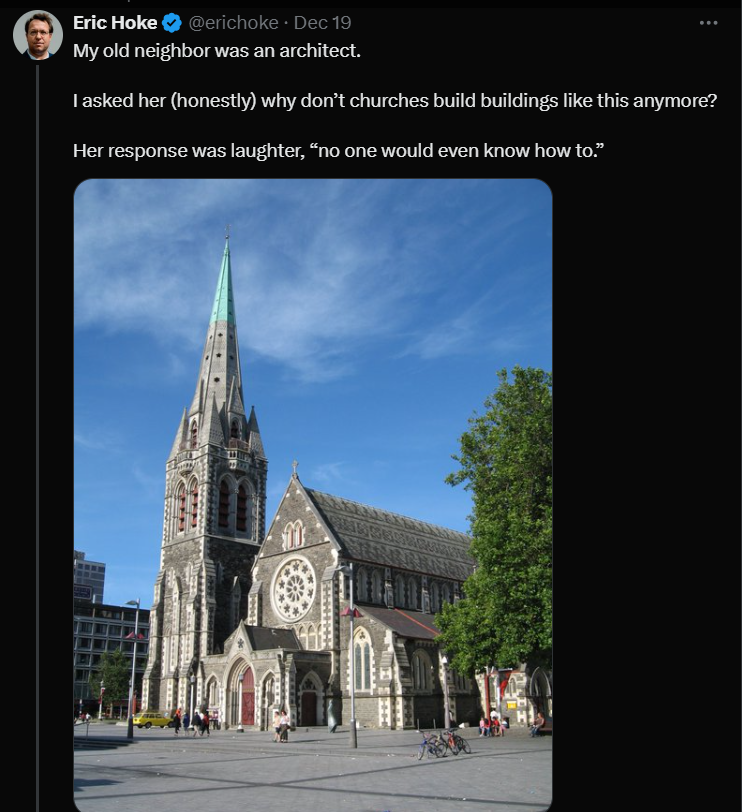
As we near the blessed Christmastide, those twelve (yes, twelve) days of festivity and feasting, I have a few tangentially connected thoughts that seem ripe for scribbling. First, I have a new piece over at TGC Canada: Why We Need Beautiful Churches. This comes out of a growing appreciation for architecture over the last number of years. The article is my attempt to synthesize a whole bunch of different thoughts into a cohesive argument for Christians today about the value and importance of beauty. It’s an exploration of geometry, mysticism, beauty, gothic architecture, and the 20th century aesthetic slippage among most evangelical Protestants that we can and should correct. “To willingly have ugly churches, then, is a kind of inconsistency, if not an untruth.” Extra points to whoever can pick up on the writer whose prose style I (unconsciously) imitated.

I was really gratified to see that Tim Challies picked up on it and shared it on his blog. This led to an appreciative email from a reader in another country that was deeply encouraging. As a writer, it doesn’t really get better than that.

It might be just a function of my own focused attention, but it really does seem like there is more interest and discussion about beautiful old architecture than I can remember. Here is just one example:

My reaction to this is to observe that we are all starved for enduring beauty and it shows. There is also a certain nostalgia at work – longing for a simpler time. These are symptoms of the inhuman pace and shape of so much of modern life. I, like so many others, feel them deeply also.

And yet there is a consistent glimmer of hope that keeps me from any kind of despair. What is that glimmer? It is the steady flowing stream of people who, having been starved for enduring beauty, are finding the Source of beauty in Christ. We all woke up to another example this morning – the brilliant and esteemed historian Niall Ferguson announcing his conversion to Christianity.

I find it fascinating that his conversion, like so many others in recent years, was not the result of reckoning with the compelling evidence for the historicity of the resurrection of Jesus. Rather, it was essentially a negative conclusion based on negative experiences:

In a sense, what we are seeing here is what happens when one finds the cut flowers really are dead and one starts to think deeply about soils, nutrients, and what makes flowers grow in the first place. These kinds of conversions have a distinctively post-Christian shape: thoughtful people who have glimpsed the contours of what it really looks like to leave all this Christian stuff behind and realized that what they really want is back up the road a fair way.

I’ve been thinking about this quite a bit, in conjunction with a passage from a little-known C.S. Lewis essay, and I have the outline of an article shaping up. The main observation is that we are living through a moment where many people are changing their minds, and it’s fascinating to me to watch it all take place. If nothing else, it represents a significant opportunity for the church to reach such people.

Much of my writing in the last while has been in some ways critical of my own tradition. I argued for Protestant re-enchantment, reviewed positively Rod Dreher’s book on the subject, and now this piece about architecture – all of which challenge my fellow Protestant evangelicals to shore up areas of characteristic weakness. But I am conscious of the danger that comes with focusing only criticism. It’s a bit ironic because in my local church involvement my ministry takes an almost entirely positive tone: leading worship, praying for and with the saints, caring for the precious souls both old and new who find their way into our church, and seeking to be an encouragement to the vocational pastors God has given us.

Allow me to try ending on a positive note. I joined my usual podcast buddies Wyatt Graham and Andrew Noble for an episode on The Mystery of the Incarnation that you can find here for your enjoyment and edification: https://www.youtube.com/watch?v=uPh-7ZiJO-Q

The incarnation, the Christmas miracle and mystery, is an inexhaustible wonder. Although the cares and sorrows of the world crowd in and besiege our minds and hearts, here at Christmas, with snow gently adorning the contours of our churches and homes, softening their edges, we get a glimpse of heaven. Grace and truth made flesh, God dwelling with us. May we not grow numb to this. Pray that the shock of it all would wash over you like the bracing chill of cold air into the lungs. Like the deep breath of that cold air that stings and washes over you, a wave of tingling clarity and attention.

Like the shepherds dumbstruck before angelic glory.

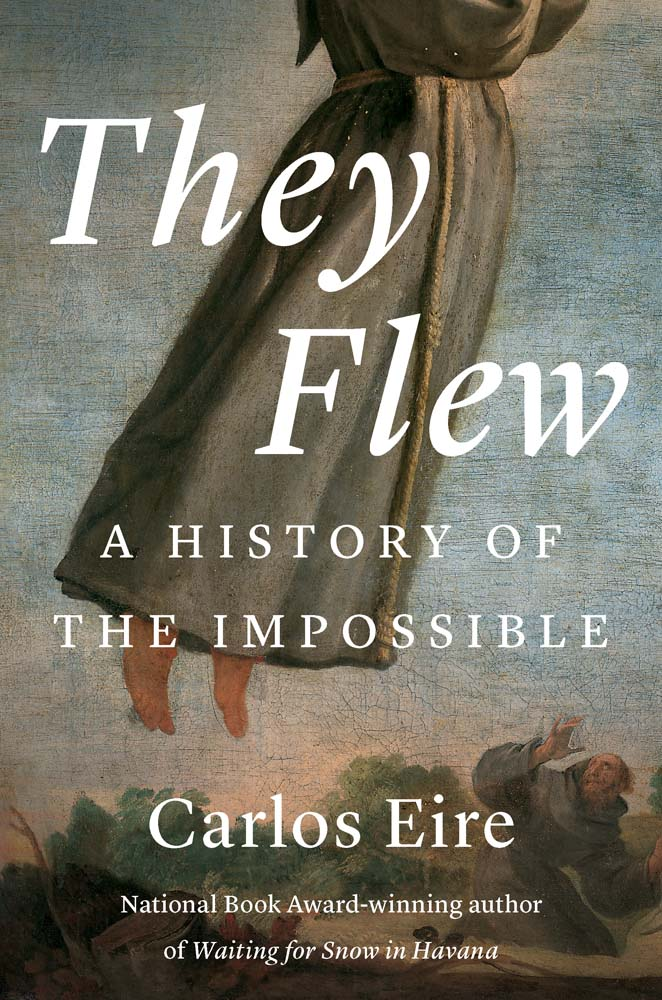
‘They Flew’ by Carlos Eire – A Review Essay

I listened to this book a few weeks after reading Rod Dreher’s thought-provoking new book, Living in Wonder. Both books present some challenges to Protestant readers as they take aim at various aspects of modern metaphysical assumptions which, of the three major branches of Christianity, are most embedded within the children of the Reformation. Carlos Eire takes as his subject the levitation of medieval Catholic monks and nuns, prodigiously attested to by copious historical records. I was not aware of this phenomenon before. The book is a serious intellectual and historical treatment of a subject that would be treated as ridiculous by many.

The book traces the historical records of levitation from antiquity to the modern age. It shows up consistently throughout those many centuries in a number of different religious and pagan contexts, though it reaches its apogee in the medieval period within certain Catholic circles.

The book focuses in on three specific people for whom levitations and other similar miracles were common and widely attested: St. Teresa of Avila, St. Joseph of Cupertino, and the Venerable María de Ágreda. The overall picture that emerges is one where, despite budgeting for exaggeration and embellishment by hagiographers and admirers, it’s hard to deny that something truly remarkable happened with these people. The volume and variety of witnesses makes it very difficult to explain away.

The strangeness of the topic and the solidity of the evidence offers a direct challenge to our absorbed habits of skepticism and our confidence in the stable laws of nature. We come away with nagging questions. Just what happened, exactly? And how does it make sense within our understanding of reality? The book navigates this challenge carefully, letting the weight of the evidence land on the reader gradually, leaving the uncomfortable questions to nag at our modern minds.

The book includes a substantial and helpful treatment of medieval and early-modern views about the devil, witchcraft, and demons.

I was fascinated to learn that the topic of miraculous levitations became a proxy for the battle between the Roman Catholic church and the new fledgling but energetic Protestant churches, with both treating the phenomenon as real but Protestants largely attributing it to the power of the devil. Thus the rather fascinating phenomenon was reduced to one facet of a high-stakes battle between entrenched religious groups; a battle that not infrequently resulted in torture and death.

The fact that Protestant denunciations of Catholic miracles occurred in this fraught context gives me pause. I don’t think I agree with the esteemed Reformers in this matter, but I can understand how there was a strong impulse to circle the wagons. For their part, Catholic apologists argued forcefully that these miracles were nothing less than a divine seal of approval and approbation on the entire Roman Catholic institution; God’s ‘amen’ to their claim to be the One True Church. Thus there was a powerful partisan incentive, aside from the normal human proclivity, for Catholic chroniclers to exaggerate and inflate the accounts of the miraculous in their midst. This helps me understand why the debate about these kinds of preternatural or supernatural events played out the way they did in the wake of the Reformation.

With a bit of historical distance, and a warming of relations between good-faith members of Catholicism and Protestantism, it seems like a good time to revisit this issue. Here is a sketch of my own still-forming view of this. Levitations can be faked rather easily, especially if they occur indoors, but this cannot explain most of the historical record. The phenomenon is, at least part of the time, real. The physical body somehow is able to suspend the force of gravity, or to be unaffected by it, during a state of spiritual ecstasy. This porous barrier between the physical and the spiritual was the default worldview within medieval Catholicism, though it was considerably hardened within Protestantism, in part as a reaction against Catholic fixation on these and similar topics, and then fully cemented by the time of the enlightenment (which was really the enshrining of the new dogma of mechanistic, reductive materialism).

Within premodern cultures and in certain spiritualist and occult traditions even today, this separation does not exist in the same way, and testimonies of such “impossible” feats regularly trickle out, though hard evidence that would be amenable to scientific analysis is almost never produced. The fact that the real phenomenon was mostly located within certain Catholic institutions like monasteries and convents does not, for me, serve to underwrite the whole of Catholicism. Far from it. But neither do I dismiss it as merely a trick of the devil to deceive the masses. We should leave room for demonic trickery and preternatural manipulations, such as the testimony of one tortured soul in the book who eventually confessed to making a pact with two demons, resulting in her ability to manifest, among other things, inexplicable levitations—I don’t see why that wouldn’t be possible. But if it’s not all demonic, and if I don’t buy what the pro-Roman Catholic apologists were selling, then we need some other framework to fit this into.

And so for me the conclusion is that these weird things did and do happen. They happened for a variety of reasons, perhaps divine and angelic, or demonic and devilish, or maybe even some other source besides that remains mysterious to us. God, in his perpetual purpose to confound the proud and the worldly-wise, perhaps scattered such manifestations among the Catholics in such a way as to frustrate the excesses of the Protestants. The injunction to “test the spirits” (1 John 4:1) applies to individuals. For Catholics to dismiss Protestants because of their lack of miracles (something which is not true today, if it ever was) is just as misguided as Protestants lumping all Catholic miracles together and denouncing them as demonic. In both of these approaches I see an all-too-human pride in one’s institution, one’s group. “You are still worldly. For since there is jealousy and quarreling among you, are you not worldly? Are you not acting like mere humans?” (1 Cor. 3:3:).

If I have taken anything away from my reading of church history, it’s that God does not play favourites with his children. There is enough shameful wreckage in each and every human grouping of Christians to keep us humble, and enough goodness and grace to rightly celebrate. We do well to keep this in mind even as we hold our Biblical, theological, and historical convictions firmly.

Carlos Eire has produced a book that feels very much suited to our moment of metaphysical re-evaluation. Although I struggled and skimmed through some parts of it—the accounts of levitations all blur together after a while—I enjoyed this book and the way it made me wrestle through this fascinating historical thread running from the medieval world well into our modern age.

The central question—they flew?—rests uneasily on the modern mind. Can we really believe they flew without losing all the goods modernity has bequeathed on us? Can we believe it without reverting to a medieval worldview that, if enchanted, also tended to be marked by ignorance and superstition? Can we really believe they flew and still remain well equipped to live and lead in the twenty-first century? My answer to all these questions is yes.

We must let go of reductive materialism and the hold it has on our minds. By this I mean broadening our view of reality in order for it to accord with the way the world really is. In fact, I’ve become convinced that letting go of reductive materialism is going to be a necessary step if we are to hold on to the goods of the modern age; if we are to avoid the ditch of scientism and the ditch of superstition; if we are to have the perceptual tools and the wisdom to navigate the challenges of the twenty-first century—an age when, if my intuition is right, we will see the return of the old gods and every strange being and phenomenon we so eagerly ignored during the age of reason.

In other words, we may well need categories for things even stranger than floating nuns and flying friars.

My Review of Rod Dreher’s ‘Living in Wonder’

I am happy to share with you that my review of Rod Dreher’s newest book, Living in Wonder, was released this week over at Mere Orthodoxy. I hope you’ll check it out. I really enjoyed Dreher’s book but also concluded that it presented some stumbling blocks to widespread appreciation by Protestant evangelicals. I tried to get both of those elements across in my review. I was a bit surprised to see that TGC’s review of it was so thoroughly critical, without recognizing that there are imbalances and weaknesses within Reformed evangelicalism that Dreher’s book actually helps us to address.

That was the direction I wanted to take my review. After noting my criticisms, I focused in what evangelicals can take away from the ideas in the book. This dovetails with my larger project in recent years to think through the nature of evangelicalism and Protestantism, the state of the culture with regard to spiritual matters (re-enchantment and the demise of modernity), and gleaning the best insights from the sharpest minds wherever I can find them.

While I’m a thorough-going Protestant, or rather because I am settled in my rejection of key, fundamental historical claims made by both Eastern Orthodox and Roman Catholic authorities, I feel free to read and engage with them without fear of being drawn in. I do not feel threatened by them, and I think it inevitable that each branch of Christendom, especially to the degree that they are shaped by sharp polemics aimed against other branches, will be imbalanced and in need of continual course correction. This is necessarily an endless process of discernement, reformation, and renewal. The end goal is always spiritual renewal, walking with the Spirit, and having the mind of Christ.

I also believe deeply in true small-c catholicity, the Biblical principle of affirming wherever possible, without dishonesty or sentimentality, the true spiritual unity we share with genuine believers which are scattered in many different institutions. It was a bit of a dodge when Billy Graham resolutely refused to pronounce who was in and who was out when it came to salvation, but there is something good about being slow and hesitant to pronounce on such matters when we take into account the incredible human capacity for inconsistency, and the mystery of genuine Spirit-wrought faith. I also recognize that for many people with busy lives and a simple faith, it’s not possible to navigate, assess, and discern all these things and they need trustworthy authority figures in their lives who can do a lot of that work for them.

These things shape my vocation as a writer and thinker for the church. I want to hold my convictions firmly and deeply, and yet be able to converse fruitfully with people from a wide range of perspectives. I want to offer helpful insights into culture, literature, and arts, and yet always make sure to remain in touch and appreciative of simple, hard-working, hands-on people. I want to continually hone my ability to write clearly and creatively, saying what I have to say with a dash of style that makes it enjoyable to read. I have a long way to go in each of these respects, but that is the direction I am aiming towards.

I have been mulling over once again the idea of moving this sleepy little blog of mine over to Substack, the it-place for writers. If I do, I would keep it free and try to move my previous articles and my subscribers over.

In coming days I should have a piece coming out at TGC Canada that I have been working on for quite a few months called Why We Need Beautiful Churches. It’s an attempt to piece together a whole bunch of reading and thinking on aesthetics, beauty, architecture, and the evangelical church. As always, I’m grateful for readers who take time out of their busy lives to consider my words. I don’t take that lightly, and I hope it’s a blessing and benefit to you. And if you do enjoy my writing or glean some benefit from it, I hope you’ll pass it on to others, share widely, and maybe even let me know.