
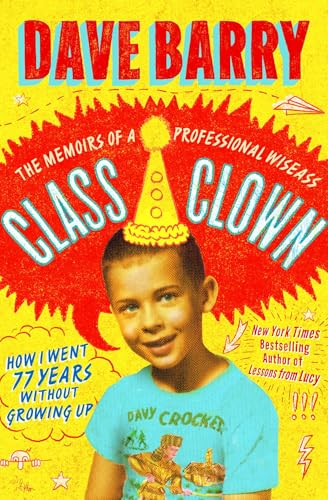
Dave Barry, true to form, made fun of himself and almost everything else in his memoir. I’ve enjoyed Barry’s writing on and off over the years as I’ve come across it. This book, like many of his columns, had me bursting out with laughter. For that reason alone it was worth reading.
The more serious sections were handled with adequate solemnity, but Barry’s brand of irreverence, as funny as it is, seems inadequate to face up to the realities of the world. The ability to make everything into a joke cuts both ways, of course. It helps one get through tough times with humour and wit, but it also encourages a habit of mind and heart that ultimately undermines one’s ability to take seriously what in fact is serious.
C.S. Lewis is helpful here, lest I be accused of simply being a fun-hating curmudgeon. In the Screwtape Letters, he helpfully distinguishes between four types of laughter: joy, fun, the joke proper, and flippancy. The first two are good and harmless. Barry’s humour contains a fair amount of rejoicing in sheer fun, and this is all to the good. The joke proper relies “on [a] sudden perception of incongruity,” and this is Barry’s bread and butter. Much of the time, it is simply clever and a good deal of fun, but Lewis warns that this type of humour is especially apt to be used to destroy the healthy human instinct towards shame (Brené Brown will just have to deal with it; I’m going with Lewis on this one). Barry certainly deploys jokes in this way, though not nearly as much as so many of the most popular comedians.
The last type of laughter, flippancy, is described memorably in the following lines: “Only a clever
human can make a real Joke about virtue, or indeed about anything else; any of them can be trained to talk as if virtue were funny. Among flippant people the Joke is always assumed to have been made. No one actually makes it; but every serious subject is discussed in a manner which implies that they have already found a ridiculous side to it…. It is a thousand miles away from joy it deadens, instead of sharpening, the intellect; and it excites no affection between those who practice it.”
As much as I enjoyed the book, I did feel this kind of flippancy to be at work in Barry’s writing, and it is the part of it I enjoyed least. Perhaps it is an occupational hazard when one is in the business of comedy. The other thought that came to me was that Barry’s type of humour is particularly situated in the baby boomer generation’s experience of the world. This is not a criticism, only an observation. And it seems to me that it’s unlikely to appear again in any subsequent generation.
I grabbed the (audio)book because I wanted something light and enjoyable to listen to on my commutes that wasn’t a current events podcast riling me up about the latest unbelievable political outrage. It certainly met and exceeded my hopes for such a light and enjoyable read. If that’s what you’re looking for, Dave Barry’s memoir may be just the ticket.
